








Wormhole Airdrop Rules Official Deep Dive: Everything You Need to Know from Eligibility Determination to Witch Detection
TechFlow Selected TechFlow Selected
Wormhole Airdrop Rules Official Deep Dive: Everything You Need to Know from Eligibility Determination to Witch Detection
An in-depth exploration of eligibility criteria for airdrops, Sybil detection techniques, and reward algorithms.
 Navigating Web3 tides with focused insights
Author: Wormhole
Translation: TechFlow
Wormhole's airdrop has been one of the most notable events in the recent crypto market.
However, after the release of the airdrop eligibility checker, some users expressed confusion about not receiving tokens or not understanding the qualification criteria.
In response, Wormhole officially released a detailed document on the 11th explaining eligibility rules, Sybil detection mechanisms, and other related policies, along with a comprehensive FAQ section.
TechFlow has translated this document below for your reference.
Airdrops are among the most exciting yet polarizing events in the crypto community. While some users walk away satisfied, others may lack clarity on how the underlying processes work.
With a commitment to transparency and aiming to set a new standard for how projects communicate about airdrops, the Wormhole contributors have provided the following detailed explanation of the airdrop logic.
Since its launch in 2020, Wormhole has spent over three years building and expanding. The Wormhole contributors aimed to design an equitable airdrop that maximizes rewards for legitimate users of the protocol. Focus was placed on two main groups:
-
First and foremost, on-chain users of multi-chain applications and bridges built on Wormhole
-
Key members of the multi-chain community
Over the past three years, on-chain users have leveraged multi-chain apps across 30 blockchains, sending over 1 billion messages via Wormhole’s messaging protocol from millions of wallets. These users will receive 81% of this airdrop—approximately 549 million W tokens.
Given the protocol’s reach, the Wormhole community has evolved into one of the most diverse multi-chain communities in crypto. It consists of builders, users, researchers, and public figures who care deeply about the ecosystem and tirelessly contribute to its growth. The Wormhole contributors also recognize that communities of projects built on Wormhole are part of the broader Wormhole community. The core hub for this community is the Wormhole Discord server—the central gathering place where ongoing dialogue and future initiatives will continue.
To evaluate these two groups, Wormhole contributors conducted a comprehensive analysis of on-chain data, reviewing the full transaction history within the multi-chain application ecosystem supported by Wormhole. This involved examining ownership clustering and behavioral patterns of wallets that interacted with the protocol and projects built on it. Each wallet was weighted based on cumulative transaction volume, duration of use, consistency of on-chain activity, and other key factors. The goal was to identify and reward users who have engaged authentically with Wormhole over time. To achieve this, Wormhole contributors partnered with external experts at Allium, applying advanced anti-Sybil clustering techniques, source-of-funds analysis, and various algorithms to ensure genuine users were appropriately rewarded.
This effort resulted in a fair, broad, and robust dataset covering over 400,000 wallets across more than 30 chains. Derived from over three years of data, this dataset primarily rewards on-chain users while also including active community members from projects within the Wormhole ecosystem. Below is an overview of the original data regarding W token recipients:
Airdrop Summary
Snapshotted Date: February 6, 2024, 23:59 UTC
Total Eligible Wallets: 400,000+
Total Airdrop Supply: 678,823,000 W (6.78% of total supply)
Allocation Breakdown:
-
On-chain users: ~81% of the airdrop supply (~549 million W)
-
Community participants: ~19% of the airdrop supply (~129 million W)
Below is a deeper look into eligibility criteria, Sybil detection techniques, and the reward algorithm.
Understanding Eligibility Criteria
On-Chain User Eligibility
On-chain users of projects in the Wormhole ecosystem are the largest beneficiaries of this airdrop, receiving 549 million W tokens—over 81% of the total allocation. To determine individual rewards, Wormhole contributors took a snapshot of on-chain activity as of 23:59 UTC on February 6, 2024. This snapshot includes millions of unique wallets that have interacted with Wormhole ecosystem applications over the past three years, offering a comprehensive view of user engagement.
Ownership Graph
Ownership clustering is central to the analysis. Multi-chain airdrops pose unique challenges because users often operate multiple wallets across different ecosystems. Wormhole connects diverse ecosystems including EVM, Solana, Move, Cosmos, Algorand, and NEAR. To maximize each user's chance of qualifying, Wormhole contributors constructed an ownership graph, assigning a unique user ID to sets of wallets belonging to the same individual. Any wallet that interacted with a Wormhole ecosystem app—such as Pike, Mayan, Allbridge, Portal—was included. The ownership graph aggregates all transactions a user made across different ecosystems under a single user ID. This ensures users are evaluated based on their complete transaction history rather than fragmented activity within any one ecosystem. This technique is also the first step in manually flagging contracts, protocol relayer hot wallets, and large Sybil clusters consisting of hundreds or even thousands of wallets.
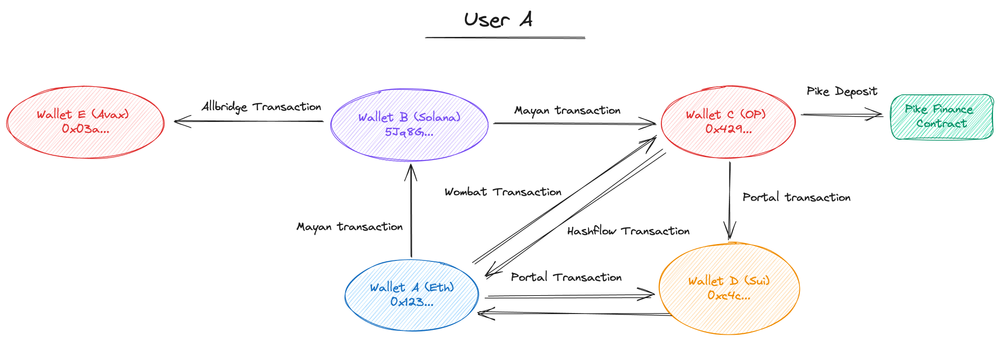
In the example above, interconnected wallets are grouped under a single user ID. This determines the reward for an individual user, even if certain wallets don’t directly interact. Notably, the total eligible reward is distributed across all wallets in the recognized ownership cluster. Therefore, it’s crucial to check every wallet that ever interacted with a Wormhole ecosystem application (both sending and receiving) to claim the full reward.
Source-of-Funds Analysis
Sybil activity within Wormhole ecosystem applications has significantly increased in recent months. To preserve rewards for genuine early adopters and new ecosystem participants, several Sybil detection methods were applied.
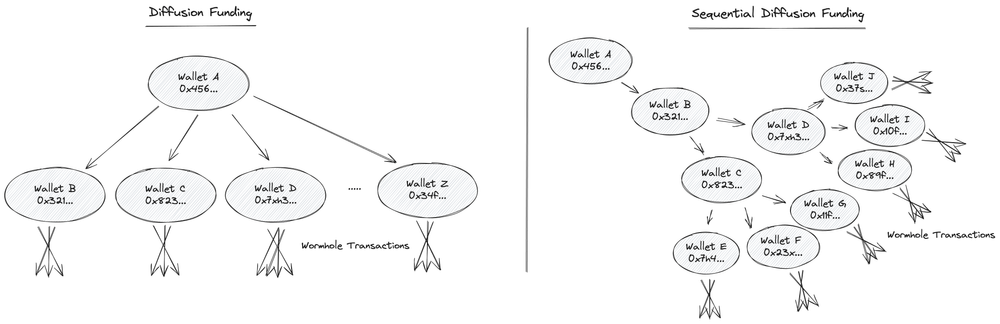
Sybils typically fund large clusters—or in several identified cases involving Wormhole, hundreds to thousands of wallets—from a single funding source. Each wallet then performs a series of transactions within the protocol. Wormhole contributors used historical data from archival nodes and widely labeled exchange wallets and contracts across connected chains to assess whether each wallet’s funding behavior exhibited clear Sybil characteristics.
The analysis revealed two types of funding-source attacks:
-
Spread funding: Wallet A funds wallets B, C, D … Z
-
Sequential spread funding: Wallet A funds Wallet B, which funds Wallet C, and so on
Behavioral Clustering Analysis
While source-of-funds detection is effective, Sybil strategies have evolved significantly. More sophisticated actors may fund many wallets directly from exchanges individually to bypass source-of-funds detection. However, executing such activity at scale requires automation, which usually leaves detectable behavioral patterns distinguishing them from legitimate users. By applying the Louvain community detection algorithm on a transaction similarity matrix across all ownership clusters, Wormhole contributors identified Sybils based on repeated operations executed over time and at similar intervals to other wallets. The image below provides a simplified example:
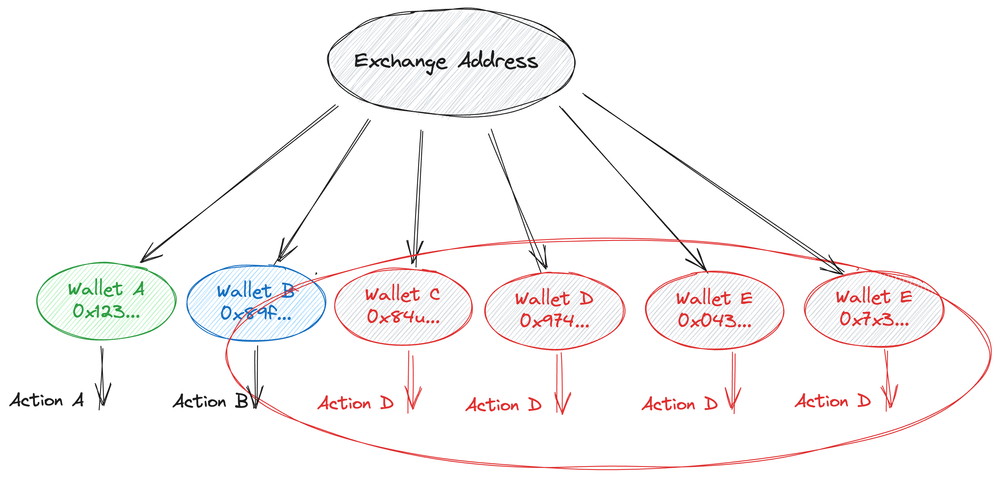
The algorithm maps transactions to unique IDs based on timing, rhythm, and actions to match identical or near-identical behaviors. This separates high-density, large-scale automated wallet behavior from low-density, authentic user activity. Wormhole contributors only used this identification strategy in combination with other Sybil detection mechanisms.
Spam Transaction Analysis
Another common mass operation involves rapid, consecutive transactions of identical token amounts, either between two chains or across multiple chains. During periods coinciding with surges in Sybil activity starting in December 2023, wallets exhibiting such abnormally frequent behavior were flagged as potential spam and subsequently removed from the eligibility dataset.
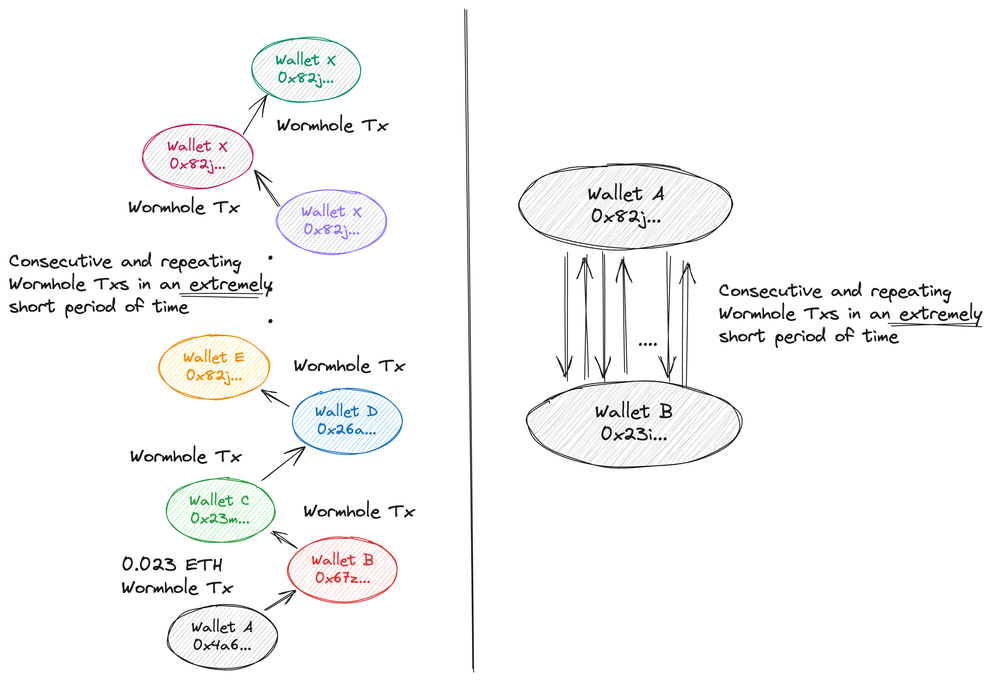
It should be noted that these Sybil detection techniques employ adjustable filtering parameters. Wormhole contributors acknowledge that inevitably, some legitimate users may be caught by any filter, especially during recent periods of heightened Sybil and spam activity. Contributors will carefully re-evaluate eligibility over the coming weeks. Today’s update has already expanded the eligibility pool to include new wallets. As stated in the announcement, reward allocations for eligible users may still change.
Reward Algorithm
Based on the ownership graph and filtered through anti-Sybil techniques, Wormhole contributors developed a reward algorithm to determine how many W tokens each user qualifies for. To clarify eligibility, key elements of the reward algorithm are disclosed below:
-
Time: Wormhole Mainnet launched three years ago as one of the earliest interoperability protocols. Since then, it has reliably enabled cross-chain communication through highs and lows of DeFi activity. Overall reward distribution strongly favors early adopters and ecosystem applications to reward long-term and early users of the protocol.
-
Cumulative Transfer Value: Users must meet a minimum threshold of cumulative value transferred across all linked wallets. Note that raw value is adjusted based on scoring weights tied to time, asset type, chain, and other features. The median threshold is approximately $1,500 post-adjustment. This threshold is lower for early and consistent ecosystem users, and higher for newer users.
-
Key Scoring and Bonus Multipliers
-
Users active for three consecutive months or longer receive a bonus multiplier.
-
User activity prior to December 1, 2023, receives a bonus multiplier.
-
User activity during the previous bear market (June 2022 – October 2023) receives a bonus multiplier.
-
-
User activity within the first year of mainnet launch receives a bonus multiplier.
-
Users with cumulative transaction value exceeding $10,000 receive a bonus multiplier.
-
Transactions involving popular chains (e.g., ETH) receive a bonus multiplier.
-
Transactions involving BTC, ETH, stablecoins, and other DeFi-centric assets receive a bonus multiplier.
-
Transactions involving assets with almost no liquidity on target chains receive a negative multiplier.
The Wormhole contributors collaborated closely with the excellent team at Allium throughout the entire analysis—from ownership clustering and Sybil detection to the development and execution of the reward algorithm. After the airdrop concludes, the Wormhole contributors and Allium team will publish a comprehensive technical report detailing the anti-Sybil strategies and clustering algorithms used. This document aims to provide full transparency to Wormhole users by offering accurate insights into the methods and technologies implemented. We also hope the broader crypto community benefits from this work, making future airdrops and reward programs fairer and more robust.
Community User Eligibility
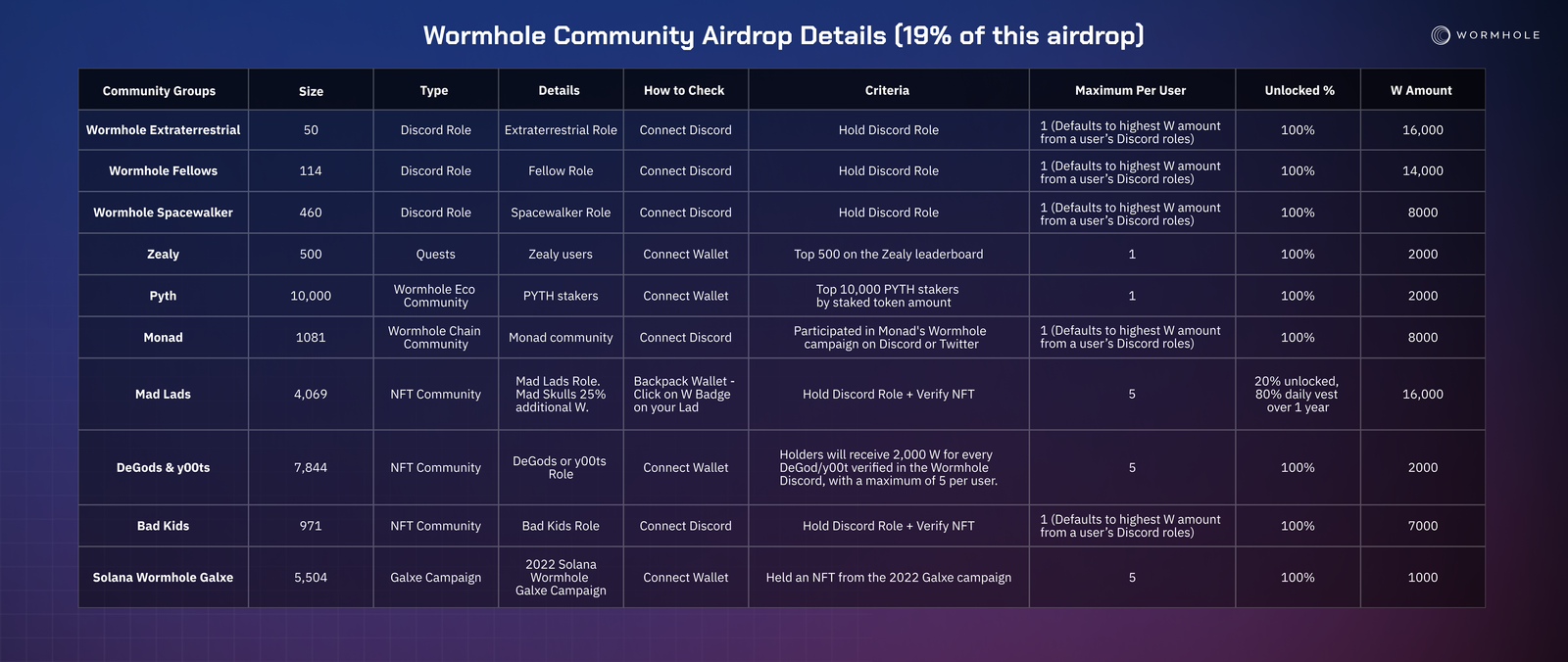
Detailed Eligibility Criteria for Specific Community Groups
This Wormhole airdrop (6.78% of W token supply) is allocated to on-chain users and developers (~81%) and various community groups (~19%). Below are the specific eligibility criteria for each community group:
Wormhole Discord Participation
Certain members of the Wormhole Discord community will be rewarded based on their active participation and contributions. Those who help foster a vibrant community experience, provide feedback on developer experience and product UX, and support both new and existing ecosystem applications play a vital role in the development and growth of the Wormhole protocol. Discord users who held any of the following roles before the snapshot are eligible: Spacewalker, Extraterrestrial, and Wormhole Fellows.
Zealy
Zealy users contributed to the Wormhole community by creating art and memes, answering quizzes, learning about Wormhole contributions, and participating in social campaigns focused on teams working closely with Wormhole. These creative, community-driven efforts help convey the mission of the Wormhole protocol, strengthen its brand, and educate others on how the protocol works. They are essential to the protocol’s growth and progress. Thus, the top 500 Zealy participants whose accounts are linked to their Zealy profile are eligible for the airdrop.
Pyth Stakers
The top 10,000 wallets ranked by amount of PYTH staked at the snapshot date are eligible. Pyth is one of the longest-standing multi-chain applications built on Wormhole and now serves many valuable crypto projects and ecosystems. The top 10,000 stakeholders are considered the most engaged individuals in the Pyth protocol, many of whom likely participate in governance. As such, they represent the largest community group to be rewarded.
DeGods/y00ts
DeGods and y00ts are NFT collections that strategically embraced multi-chain capabilities via Wormhole. Both teams used Wormhole to make their collections multi-chain and continue to collaborate closely with Wormhole contributors on multi-chain products. This airdrop rewards holders of these collections, who are part of the Wormhole Discord and have previously used Wormhole to transfer their NFTs across chains. Holders who joined Wormhole Discord and verified through Matrica before the snapshot are eligible. Rewards are attributed to the holder’s wallet address.
Bad Kids
Cosmos is one of the major crypto ecosystems and critical to Wormhole’s growth. Wormhole contributors have also made strategic investments in Cosmos infrastructure—Wormhole Guardians operate the Wormhole Gateway, a Cosmos SDK blockchain that enhances network security and acts as a router for message passing and token transfers into the Cosmos ecosystem. Wormhole currently connects to nine Cosmos app chains, with many teams building on Wormhole. Within Cosmos, Bad Kids is one of the largest and most active NFT communities. Therefore, holders who joined Wormhole Discord and self-assigned the Bad Kids role before the snapshot are eligible. Holders can verify eligibility via Discord connection on the website.
Mad Lads
The teams behind Backpack and the Mad Lads NFT series have worked closely with Wormhole contributors to build multi-chain products and grow the protocol. Backpack enables in-wallet cross-chain transfers via Wormhole, and Mad Lads holders form one of the most dynamic Solana NFT communities. The Mad Lads community has also actively contributed to the Wormhole Discord. Therefore, Mad Lads owners who joined Wormhole Discord and verified through Matrica before the snapshot are eligible. The allocation for this community will be 20% liquidity and 80% vested daily over one year. Liquidity rewards and vested amounts are tied to each NFT. Holders can check eligibility within the Backpack wallet.
Monad
Monad is a highly anticipated EVM-compatible Layer 1 blockchain that will leverage Wormhole for multi-chain functionality and cross-chain transfers upon launch. The Monad community is an active and engaged group of users and developers committed to building cutting-edge infrastructure to advance the industry. 1,081 Monad community members will be rewarded for their participation in the Wormhole Discord. Members can verify eligibility via Discord connection on the website.
Airdrop FAQ
General Questions
Q: Where can I read more details about the airdrop?
A: Detailed information about the airdrop can be found in this blog post.
Q: Where can I check my airdrop eligibility?
A: Please check all your wallets and/or Discord account on the airdrop checker at airdrop.wormhole.com.
Q: When can I claim?
A: Follow Wormhole’s Twitter or other social channels for updates.
Q: Will there be future airdrops?
A: Join Wormhole Discord and follow Wormhole’s Twitter and other social channels for announcements about future community activities.
Q: What happens to unclaimed tokens?
A: After the claim period ends, all unclaimed tokens will be returned to a multisig wallet and reserved for future community initiatives.
Q: I believe I should be eligible. How do I submit a reconsideration request?
A: We’ve done our best to ensure no one is overlooked. If you believe you qualify but aren’t listed, please submit your request here.
Q: What was updated in the latest airdrop checker (March 11)?
A: The latest airdrop checker and eligibility list includes additional user groups—such as Wormhole Fellows and DeGods/y00ts community members—as well as more on-chain users. The checker site also received several updates, including improved compatibility with Sui and Algorand wallets.
Q: What if I should be eligible after the update, but the checker shows nothing?
A: Users who checked eligibility before the latest update may still see no results unless they clear their cache. Please perform a hard refresh and check again.
Q: Why are rewards distributed across all my wallets?
A: Many users expressed concerns about the risk of losing access due to lost keys or compromised wallets. Therefore, rewards are distributed across all user wallets (sending and receiving) to maximize the chance of claiming the full allocation. Note that rewards for the same EVM wallet used across multiple chains are aggregated into a single “Ethereum” reward. As a result, users may see larger allocations at their EVM wallet addresses compared to non-EVM wallets.
Q: Why does a wallet with only a small transaction qualify for a partial airdrop?
A: Rewards are distributed to all wallets (sending and receiving) within an ownership cluster, regardless of the number of transactions associated with any single wallet. In the example below, Wallet E (0x696) has only one transaction. However, since the cumulative transfer value across all wallets exceeds the eligibility threshold, User A qualifies, and their reward is distributed across all wallets—including Wallet E (0x696). We understand this may cause confusion, as users may not realize the analysis could attribute ownership across interconnected wallets in different ecosystems.
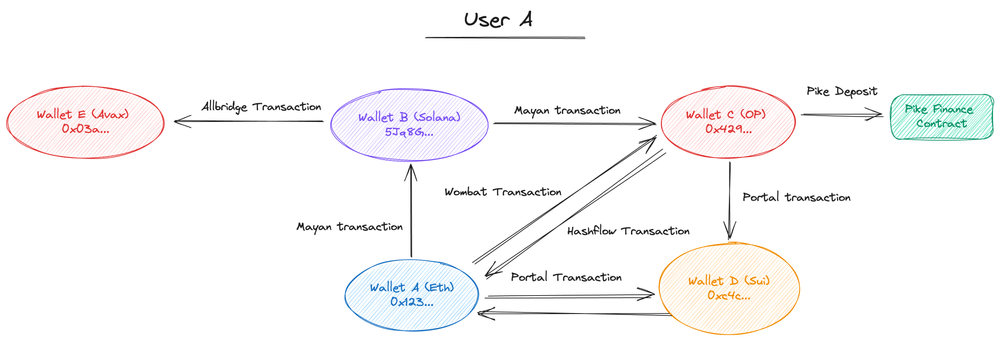
Note: Given the diversity and scale of the Wormhole ecosystem, Wormholescan and third-party APIs will not contain all information used in eligibility calculations.
Tokenomics
Q: What is the total supply of W?
A: The total supply of W is 10 billion tokens. For more details on W tokenomics, see the W tokenomics blog post.
Q: How is the initial circulating supply of W determined?
A: The initial circulating supply of W is 1.8 billion tokens. W is a multi-chain native token with ERC20 and SPL representations. This supply will initially be distributed across five chains: Ethereum, Solana, Arbitrum, Optimism, and Base.
Q: What is the vesting schedule for W, and how are tokens released?
A: The remaining portion of the W supply will be locked in protocol governance to encourage long-term holding and community governance. The team has decided to release these tokens over a period from 2022 to 2032. Specifically, 10% of the total supply will be released annually. Starting in 2023, this will decrease to 5% of the total supply per year.
Q: How much did private investors and early participants receive?
A: The Wormhole team completed two seed funding rounds, raising $30 million. Participants included prominent early supporters and investors such as Coinbase Ventures, Multicoin Capital, Paradigm, Delphi Digital, Pantera Capital, Dragonfly Capital, and Scalar Capital.
Q: How can I check my token balance?
A: You can check your token balance on Wormholescan.
Technical Questions
Q: Where can W tokens be traded?
A: W tokens can be traded on exchanges such as Uniswap, FTX, and Gate.io. For the latest market data on W tokens, check CoinMarketCap or CoinGecko.
Q: How does Wormhole achieve multi-chain interoperability?
A: Wormhole connects multiple chains by establishing a set of bidirectional Wormhole gates. These gates are open standards that allow different blockchain protocols to transfer information and value between them. Specifically, Wormhole uses a protocol called the Cross-Chain Communication Protocol (CCP), enabling users to transfer tokens and messages between Wormhole gateways.
Q: How is Wormhole secured?
A: Wormhole employs multiple security measures to protect user assets and data. First, Wormhole gateways use multi-signature (multi-sig) technology to ensure secure storage and transfer of assets. Second, Wormhole undergoes regular audits and testing to ensure protocol safety and reliability. Finally, the Wormhole team continuously updates and improves the protocol to address emerging threats and vulnerabilities.
Q: Who are Wormhole’s partners?
A: Wormhole has established partnerships with numerous crypto projects and ecosystems, including Solana, Ethereum, Arbitrum, and Optimism. These collaborations help drive Wormhole’s development and promote innovation and growth in the multi-chain ecosystem.
Q: What are Wormhole’s future directions?
A: Wormhole’s future goals include expanding the scale and scope of the multi-chain ecosystem, enhancing protocol performance and security, advancing DeFi and NFT ecosystems, and promoting innovation in cross-chain applications. The team will continue striving toward these objectives and regularly improve the protocol to meet evolving user and ecosystem needs.
Q: Does Wormhole plan to deploy on other blockchains?
A: The Wormhole team plans to deploy the protocol on additional blockchains to expand the multi-chain ecosystem. Specifically, Wormhole intends to launch on Polkadot, Avalanche, and Binance Smart Chain. These deployments will further enhance cross-chain interoperability and drive innovation across the broader crypto landscape.
Q: How does Wormhole handle user data and privacy?
A: Wormhole respects user privacy and is committed to protecting data security. Specifically, Wormhole implements encryption, secure transmission, and access controls to safeguard user data. Additionally, the Wormhole team does not collect or store personal user information and will not share it with third parties. Users can trust that their data and privacy are fully protected when using Wormhole.
Join TechFlow official community to stay tuned
Telegram:https://t.me/TechFlowDaily
X (Twitter):https://x.com/TechFlowPost
X (Twitter) EN:https://x.com/BlockFlow_News
 @wormholecrypto


