








Cancun Upgrade: Sparking the Next Revolution in Ethereum NFTs
TechFlow Selected TechFlow Selected
Cancun Upgrade: Sparking the Next Revolution in Ethereum NFTs
Ethereum's major upgrade introducing the new mechanism Blobspace will usher in a golden age for L2 scaling solutions.
 Navigating Web3 tides with focused insights
Author: WilliamM.Peaster, Bankless
Translation: Yvonne, Mars Finance
Major blockchain projects don't undergo significant evolutions every day.
That’s why all eyes are now on Ethereum, as this leading smart contract platform prepares for a major upgrade introducing an unprecedented mechanism: Blobspace.
The arrival of blobs on Ethereum will usher in the first golden age of Layer 2 (L2) scaling solutions, which in turn will spark a revolution in how builders and users handle NFTs.
In today’s article, let’s quickly review EIP-4844 and blobspace, along with key points to watch in the future.
Preparing for EIP-4844 and Blobspace NFTs
101: The Cancun-Deneb (also known as Dencun) hard fork upgrade, scheduled for deployment on Ethereum on March 13, 2024, marks the beginning of the Surge era—a phase aimed at doubling network scalability.
At the heart of Dencun is EIP-4844, which introduces native sharding through blobspace—a breakthrough innovation designed to help Ethereum's L2 ecosystem move toward 100,000 transactions per second (TPS).
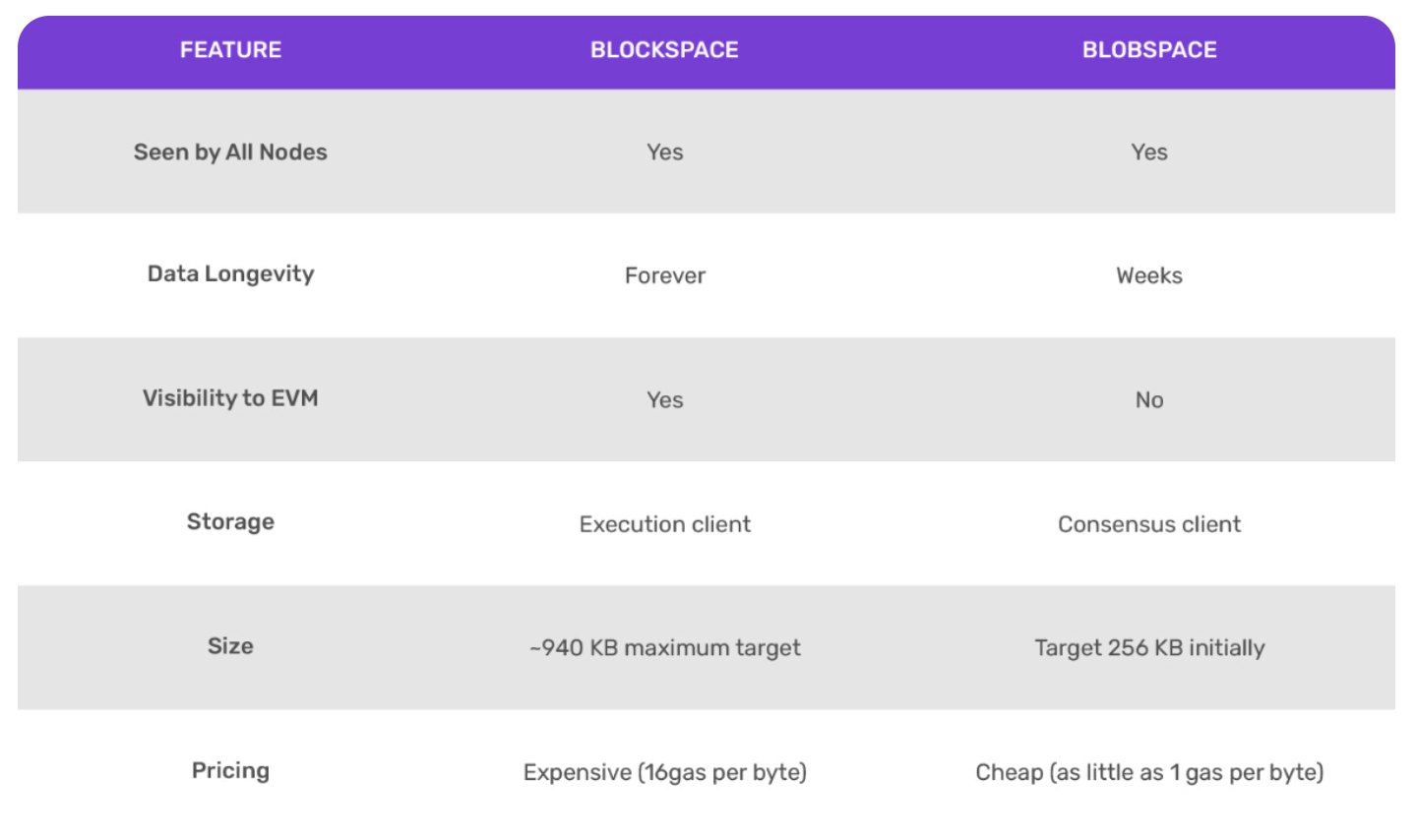
Why it matters: Blobspace is set to transform the Ethereum ecosystem by drastically reducing gas fees. This reduction is especially significant for Ethereum L2 solutions, where lower transaction costs will support growth and increase appeal to a broader user base.
How blobspace works: At its core, blobspace introduces a new way of handling transaction data via blobs—temporary blocks of transaction data efficiently stored on-chain.
This system differs from traditional block storage by using a pricing mechanism separate from Ethereum’s main gas market—called "blob gas."
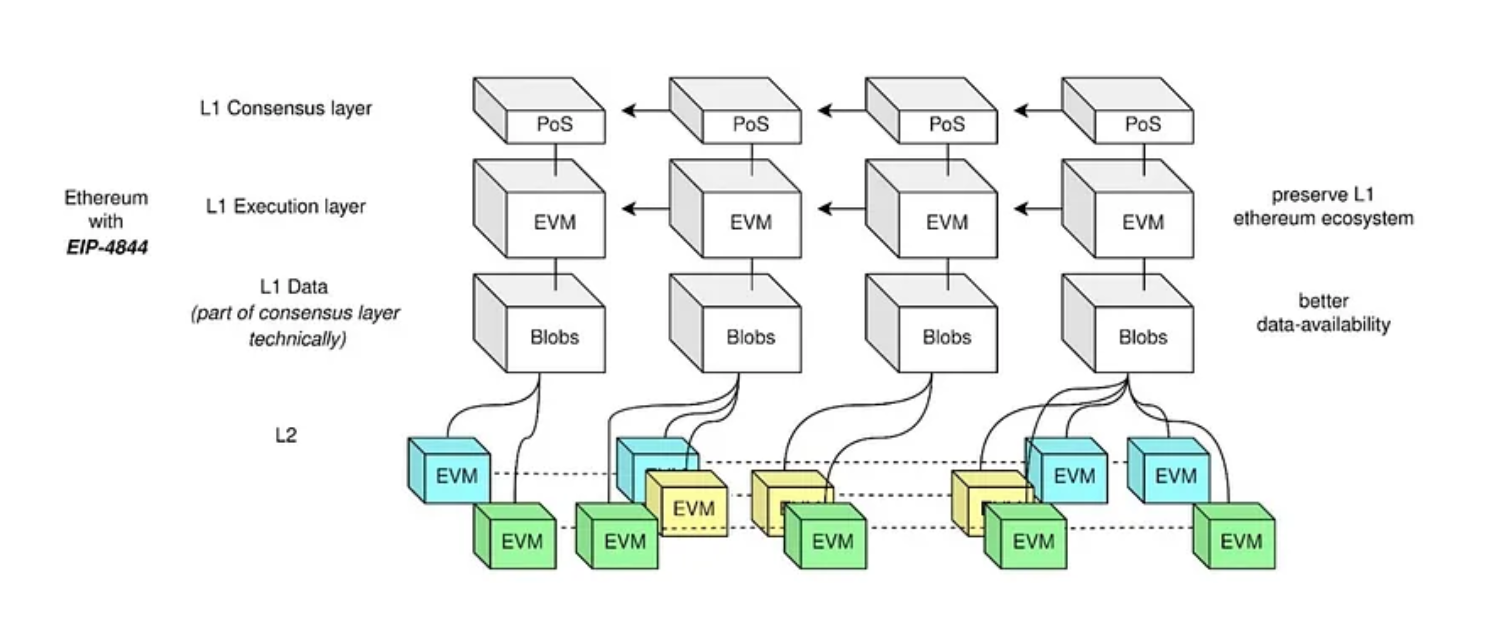
Blobs are created by splitting data into smaller chunks, then mathematically transforming these chunks into unique identifiers for storage and later retrieval. This process not only optimizes data storage on the blockchain but also ensures transactions are processed faster and more cost-effectively.
What happens next? With the implementation of the Dencun upgrade, Ethereum L2s will need to manually integrate this new technology to reap its benefits. For example, Optimism plans to launch its Ecotone upgrade immediately after Dencun deployment, implementing blobspace across its Superchain ecosystem (including Optimism, Base, Zora Network, etc.).
While full integration across different L2 platforms may take several months, the overall expectation is rapid adoption throughout the Ethereum ecosystem, ushering in a new era of efficiency and scalability for the leading smart contract network.
Estimated savings: The Optimism community has developed the "Superchain Savings Estimator," a tool designed to forecast how much gas costs might drop for Optimism Superchain L2s after adopting blobspace.
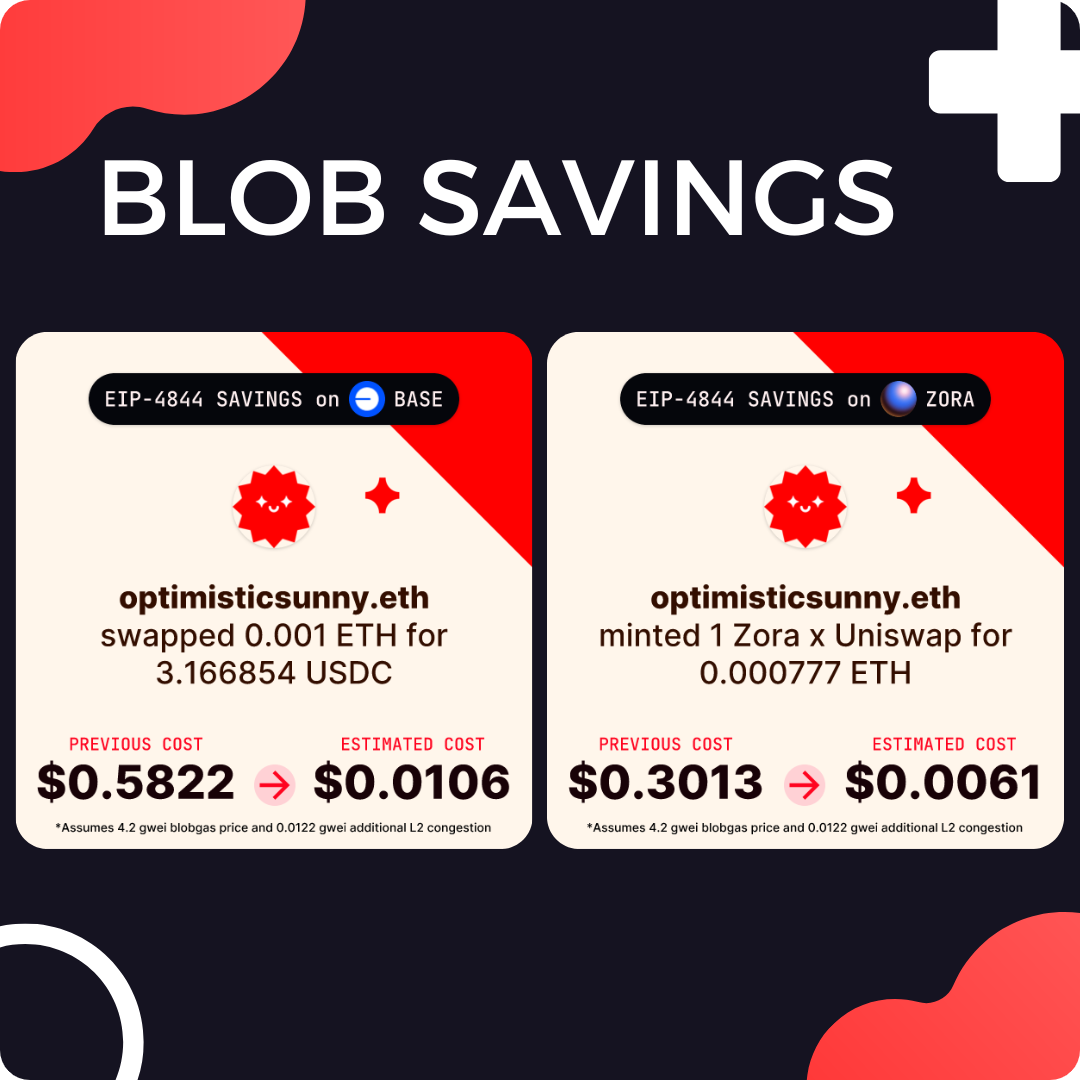
Using this tool, examples such as swapping on Uniswap on Base or minting a Zora NFT on Zora show dramatically reduced transaction fees—dropping by up to 98% in some cases. Based on recent average transaction assumptions across the Superchain, some clear examples include:
Uniswap swap on Base:
● Previous cost: $0.5822
● Estimated cost: $0.0106
● Reduction: 98.18%
Zora NFT mint on Zora Network:
● Previous cost: $0.3013
● Estimated cost: $0.0061
● Reduction: 97.98%
Mirror NFT mint on Optimism:
● Previous cost: $0.2032
● Estimated cost: $0.0128
● Reduction: 93.70%
Mint.fun NFT mint on Zora Network:
● Previous cost: $0.1476
● Estimated cost: $0.0037
● Reduction: 97.49%
Sending USDC on Base:
● Previous cost: $0.1758
● Estimated cost: $0.0037
● Reduction: 97.90%
NFT revolution: Blobspace will drastically reduce gas costs associated with NFT activities on L2s, thereby transforming the NFT ecosystem. This change paves the way for projects to cover all transaction costs for their users—similar to how Web2 platforms manage server costs.
Moreover, lower fees will encourage development of new applications and foster cross-pollination within the NFT domain—previously unfeasible due to cost constraints—leading over time to an explosion of new NFT innovations.
“Cheaper and faster transactions are absolutely critical to continuing innovation and unlocking new use cases like on-chain gaming and private limit order book exchanges,” noted the Base team. “They’ll also make it more practical to apply novel ideas emerging from rapidly advancing fields like cryptography and artificial intelligence, enabling entirely new categories of on-chain applications that haven’t even been imagined yet.”
Of course, beyond cost savings, blobspace will open up a new design space for NFTs—from storage use cases to fully “headless” NFT markets existing entirely within blobs. So, new models are just around the corner!
NFT tasks: If you're like me, once L2s begin integrating with the Dencun upgrade, you'll be eager to try out some apps in the ecosystem and see firsthand how much gas you can save. Some activities I plan to test include:
● Collecting a BasePaint daily open edition (Base)
● Buying and selling friend.tech keys (Base)
● Collecting or publishing NFTs on Mirror (Base, Linea, OP, Zora Network)
● Creating free mint airdrops on Zora (Arbitrum, Base, Blast, OP, Zora Network)
● Minting popular NFTs on mint.fun (OP, Base, Zora Network)
Join TechFlow official community to stay tuned
Telegram:https://t.me/TechFlowDaily
X (Twitter):https://x.com/TechFlowPost
X (Twitter) EN:https://x.com/BlockFlow_News
 Bankless









