








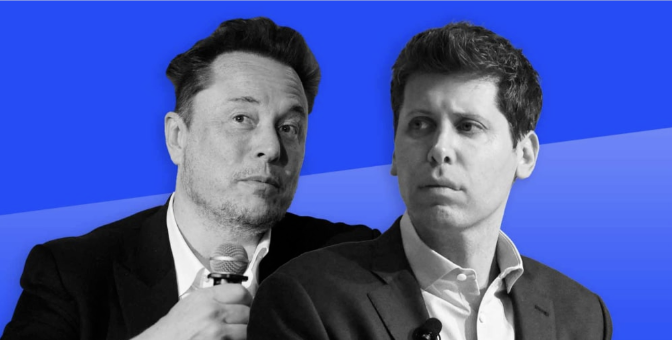
Elon Musk sues OpenAI: Is it really for the well-being of humanity?
TechFlow Selected TechFlow Selected
Elon Musk sues OpenAI: Is it really for the well-being of humanity?
Defendant directly exposes plaintiff's "ambition" by revealing emails.
 Navigating Web3 tides with focused insights
By Mu Mu
Elon Musk has criticized OpenAI more than once, but this time he's gone a step further—filing a lawsuit against the company at the Superior Court of San Francisco, California.
On March 1, news emerged that Musk is accusing OpenAI and its CEO Sam Altman of violating the original agreement made at the organization’s founding—to develop artificial intelligence for the benefit of humanity, not profit. His legal demand includes a request for a court injunction to prevent OpenAI and Microsoft from profiting off their artificial general intelligence (AGI) technologies.
Musk is once again invoking concerns about AI risks, placing the idea of "human well-being" squarely back into public discourse.
Would a leader of a commercial enterprise really act solely for the good of humanity? As public skepticism grows, OpenAI updated its blog stating, “We intend to take action to dismiss all of Elon’s allegations,” while releasing email exchanges between Musk and OpenAI’s founding members showing that Musk had previously sought to merge OpenAI with Tesla or gain controlling interest in it. This disagreement ultimately led to Elon Musk’s departure from OpenAI.
The “Iron Man” versus the AI giant has unearthed old secrets reminiscent of a corporate power struggle, with broader implications for the future of AI competition.
Musk Raises the Banner of “Human Well-Being” in Lawsuit Against OpenAI
“Microsoft” and “closed-source” are key terms in Musk’s complaint, serving as evidence for his claim that OpenAI has strayed from its founding mission of developing AI for the benefit of all humanity rather than for profit.
In the lawsuit, Musk argues that OpenAI’s growing ties with Microsoft have significantly deviated from its original goal of creating publicly accessible, open-source AGI. He claims OpenAI has effectively become a closed-source subsidiary of Microsoft, one of the world’s largest tech companies.
Musk also points out that GPT-4, released in March 2023, remains a closed-source model compared to earlier versions, with its closure driven by commercial interests rather than human welfare.
Whether GPT-4 has crossed the threshold into AGI will be pivotal in this case. Beyond GPT-4, Musk alleges in the complaint: “It is understood that OpenAI is currently developing a model called Q*, which is even more likely to represent AGI.”
“Q*” was first mentioned during the November incident when OpenAI CEO Sam Altman was temporarily ousted.
On November 23, Reuters cited sources saying that four days before Altman’s removal, several researchers sent a letter to the board warning of a powerful AI discovery within OpenAI that could threaten humanity. Later, insiders confirmed an internal project named Q*, with some believing it could be a breakthrough toward achieving AGI.
Since then, Q* has circulated in the industry as OpenAI’s “secret project,” widely perceived as the company’s AGI research effort.
Coincidentally, shortly after Musk filed the lawsuit, a 53-page PDF claiming OpenAI “will achieve AGI by 2027” went viral online. The document mentions the mysterious Q*, stating its next phase “was initially GPT-6 but has been renamed GPT-7,” and adds that it was “originally planned for release in 2026.”
However, netizens noticed this conveniently timed leak originated from an X account registered in July 2023. The poster @vancouver1717 has no known identity and has only posted two tweets. As such, supporters of OpenAI question the authenticity of the document.
Closed-source GPT-4, the enigmatic Q*, and Microsoft—the biggest financial beneficiary—form the core of Musk’s argument that OpenAI no longer prioritizes humanity’s well-being.
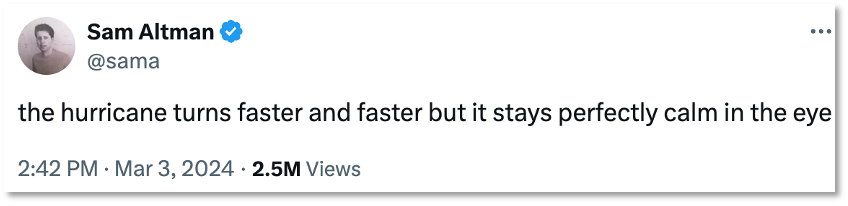
Altman’s tweet after Musk’s lawsuit
After Musk’s lawsuit, OpenAI CEO Sam Altman posted on X: “The hurricane spins faster and faster, but the eye remains perfectly calm,” seemingly reflecting his composed attitude toward the legal challenge.
Perhaps Altman and OpenAI are simply used to Musk’s criticisms by now.
Ever since ChatGPT ignited a global wave of large language models at the end of 2022, Musk, a former co-founder, has appeared increasingly agitated. He has repeatedly criticized OpenAI for not being open-source and calling ChatGPT “unsafe,” directing his ire not only at OpenAI but also at its primary investor, Microsoft.
In April last year, Musk accused Microsoft of illegally using Twitter data to train AI models, declaring, “Now is the time to sue.” After acquiring Twitter and rebranding it as X, Musk made significant changes to X’s API to prevent other AI companies from accessing its data. In response, Microsoft’s social media advertising service Smart Campaigns announced it would no longer support X.
The feud between Musk and OpenAI dates back to 2015, but erupted fully only after OpenAI gained widespread success. This latest lawsuit appears to revisit old grievances. However, this time, OpenAI seems unwilling to stay silent.
OpenAI Releases Emails Revealing Musk’s “Selfish Motives”
On March 5, OpenAI published a blog post titled “Our Relationship with Elon Musk,” reaffirming its mission to “ensure AGI benefits all of humanity,” and clearly stating: “We plan to take action to dismiss all of Elon’s allegations.”
More strikingly, while recounting the history of tensions between Musk and OpenAI, the blog released email exchanges revealing Musk’s past intentions—to either merge OpenAI with Tesla or gain full control over it.
According to the public narrative, Musk, as a founding figure, pledged $1 billion in 2015 to support OpenAI’s non-profit development of AI. After donating $100 million, ideological differences arose, leading to his departure. OpenAI later adopted a hybrid structure allowing partial profitability, paving the way for Microsoft’s investment.
But OpenAI’s March 5 blog post reveals new details that contradict this version.
The post discloses that during its non-profit phase, OpenAI actually raised less than $45 million from Musk, while securing over $90 million from other donors. Moreover, when Greg and Sam founded OpenAI at the end of 2015, they initially aimed to raise $100 million. Musk proposed instead: “We need a number much larger than $100 million… I suggest we say we’re starting with a $1 billion funding commitment… and I’ll cover whatever others don’t provide.”
In early 2017, as the team realized building AGI required massive computing power, OpenAI recognized it would need billions annually—far beyond what a non-profit could raise. This forced early founders, including Musk, to consider a for-profit structure.
During these discussions, “Elon wanted us to merge with Tesla, or else he wanted complete control over us,” OpenAI stated. In 2017, when deciding to create a for-profit entity, “Elon wanted majority ownership, initial control of the board, and to serve as CEO. During these talks, he withheld funding.” Ultimately, both sides failed to agree on profit-sharing terms because “we believed absolute control by any single individual contradicted our mission.”
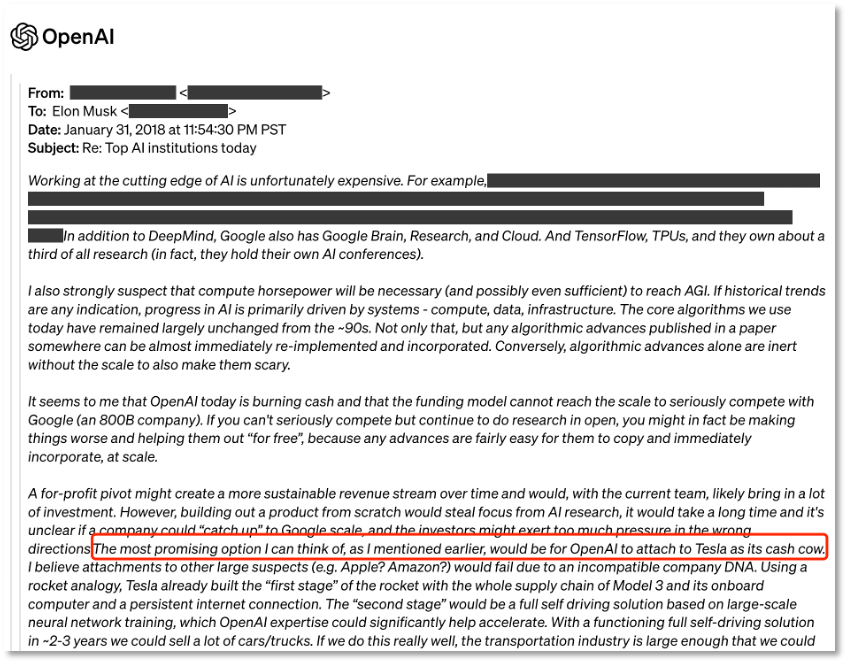
Musk once suggested OpenAI rely on Tesla for funding
Later, Musk proposed merging OpenAI into Tesla. “In early February 2018, Elon forwarded us an email suggesting OpenAI should ‘use Tesla as its money tree,’ commenting, ‘Absolutely right… Tesla is the only viable path to compete with Google.’ Even so, the odds were slim, but at least not zero.”
Eventually, Musk left OpenAI, believing its chances of success were zero. He planned to build an AGI competitor within Tesla and, by the end of February 2018, encouraged the team to seek their own path to raise billions. But by December 2018, Musk emailed again: “Even raising hundreds of millions won’t be enough. It needs tens of billions annually—or forget it.” The collaboration ended completely.
Regarding Musk’s accusation about “closed-source” practices, OpenAI countered that Musk himself acknowledged AGI shouldn’t be rushed into open-sourcing. The blog shared emails between OpenAI scientist Ilya and Musk: “As we get closer to building AI, it makes sense to become less open. Open AI means everyone benefits from AI’s outcomes, but not necessarily sharing the science… Elon replied: ‘Yes.’”
In closing, OpenAI expressed regret: “It’s unfortunate this comes from someone we deeply admire—someone who inspired us to aim higher, then told us we’d fail, created a competitor, and now sues us just as we make meaningful progress toward OpenAI’s mission without him.”
Musk Struggles to Gain Ground in Artificial Intelligence
OpenAI’s blog post, complete with email screenshots, exposes Musk’s past ambitions toward the company and undermines his accusations about “closed-source” practices.
This early “game of thrones” within OpenAI may be one reason Musk holds such resentment toward the AI giant. Now, in the era of explosive growth in natural language models, Musk—who aims to transform Tesla into an intelligent robotics company—must face fierce AI competition after missing out on OpenAI.
After signing the open letter last year calling for a pause in training more advanced GPT models, Musk announced plans to develop TruthGPT—a safe, human-beneficial generative dialogue product.
In November last year, Musk’s company xAI launched Grok, a chatbot directly competing with OpenAI’s ChatGPT. Despite Musk personally promoting Grok on social media, its popularity over the past year has been nowhere near that of ChatGPT.
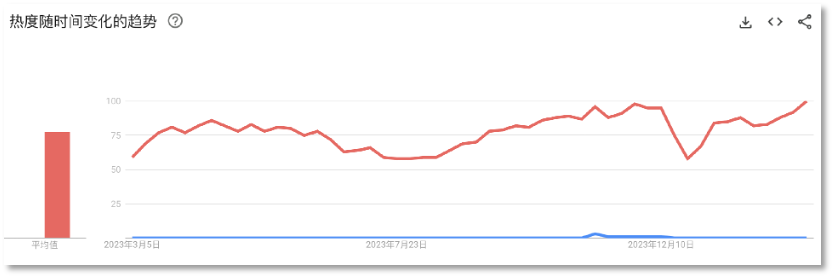
Google search interest comparison: Grok vs. ChatGPT
Today, the AI large model market isn’t just dominated by Google and OpenAI anymore—Anthropic, creator of Claude3, has also emerged, increasing competitive pressure on xAI.
Musk intends to integrate xAI with his existing businesses. On xAI’s official website, the company explicitly states it will closely collaborate with X and Tesla. Notably, however, xAI—though controlled by Musk—has no equity ties to X or Tesla.
Tesla shareholders, however, appear unprepared for the company’s shift toward intelligent robotics. Shareholders have stated that unless Musk retains at least 25% voting power in Tesla, he should not have the authority to steer the automaker into leadership in AI and robotics.
Musk’s journey in pursuing AI has not gone smoothly. The bullet of anxiety has ultimately been fired at his 2015 self.
According to CNBC, OpenAI Chief Strategy Officer Jason Kwon sent a memo to employees addressing Musk’s lawsuit: “We believe the motivation behind this lawsuit may stem from Elon’s regret at not continuing to participate in the company’s development. It is deeply disappointing to see Elon take such action against a company he helped found, especially given his close collaboration with many of you who continue striving for this mission.”
Nevertheless, Musk’s lawsuit might yield unintended consequences. Regarding whether GPT-4 and future versions should be open-sourced, or further disclosures about Q*, prominent AI blogger Rowan Cheung believes this lawsuit could help unravel these mysteries.
Join TechFlow official community to stay tuned
Telegram:https://t.me/TechFlowDaily
X (Twitter):https://x.com/TechFlowPost
X (Twitter) EN:https://x.com/BlockFlow_News










