









Revisiting Modularity: The Logic Behind Heavily Positioning in Bull Markets
TechFlow Selected TechFlow Selected
Revisiting Modularity: The Logic Behind Heavily Positioning in Bull Markets
From a profitability perspective, the market cap ceiling of a public blockchain is much higher than that of a Dapp.
 Navigating Web3 tides with focused insights
Author: Riyue Xiaochu
After conducting in-depth research on the sector, I have confirmed that modularization is a theme to heavily invest in during this bull market.
The core logic of this bull market revolves around mass adoption—whether it's the emergence of numerous Layer2 solutions, the Cancun upgrade, or the development of high-performance public blockchains like Sui and APT—all are aimed at welcoming a large influx of Web2 users.
Modularization serves as the foundational infrastructure for mass adoption and is an essential component. Back in 2021, Cosmos introduced the concept of Appchains—a vision that will now be realized through modularization. It drastically lowers the cost and complexity of launching a blockchain, enabling on-demand chain creation.
RaaS (Rollup-as-a-Service) providers can even launch and maintain a modular public chain with no-code tools for just $3,000 per month. They also offer comprehensive infrastructure support such as blockchain explorers, cross-chain bridges, and data APIs.
As outlined in "The Rise of Modularization," it's becoming a trend for individual dApps to launch their own chains—not only because they can tailor the chain to their needs but also to grow their ecosystem independently. From a value perspective, the market cap ceiling for a standalone public chain is far higher than that of a dApp.
1. Celestia (TIA)
Celestia is one of the most critical players in the modular architecture. It focuses exclusively on the Data Availability (DA) and consensus layers. Developers can offload DA responsibilities to Celestia while using Ethereum or another blockchain for consensus and settlement, handling execution themselves—or use Celestia for both DA and consensus, managing settlement and execution independently. Celestia Labs has launched Blobstream, which brings Celestia’s modular data availability layer to Ethereum. By relaying commitments of Celestia data roots via an on-chain light client, Ethereum developers can easily build high-throughput L2s just like deploying smart contracts.
Among the four layers—consensus, execution, settlement, and data availability—the DA layer has the highest demand. This explains why Ethereum undertook the complex Cancun upgrade to reduce DA costs. However, even after the upgrade, where blobs significantly lower L2 gas fees, it remains dozens of times more expensive than using Celestia.
From a practical standpoint, Celestia stands out as the most mature, well-known, and highest-market-cap DA solution. It has become the preferred choice for many Layer2 projects, some of which have airdropped tokens to Celestia stakers—creating a positive feedback loop for Celestia’s growth.
2. Dymension (DYM)
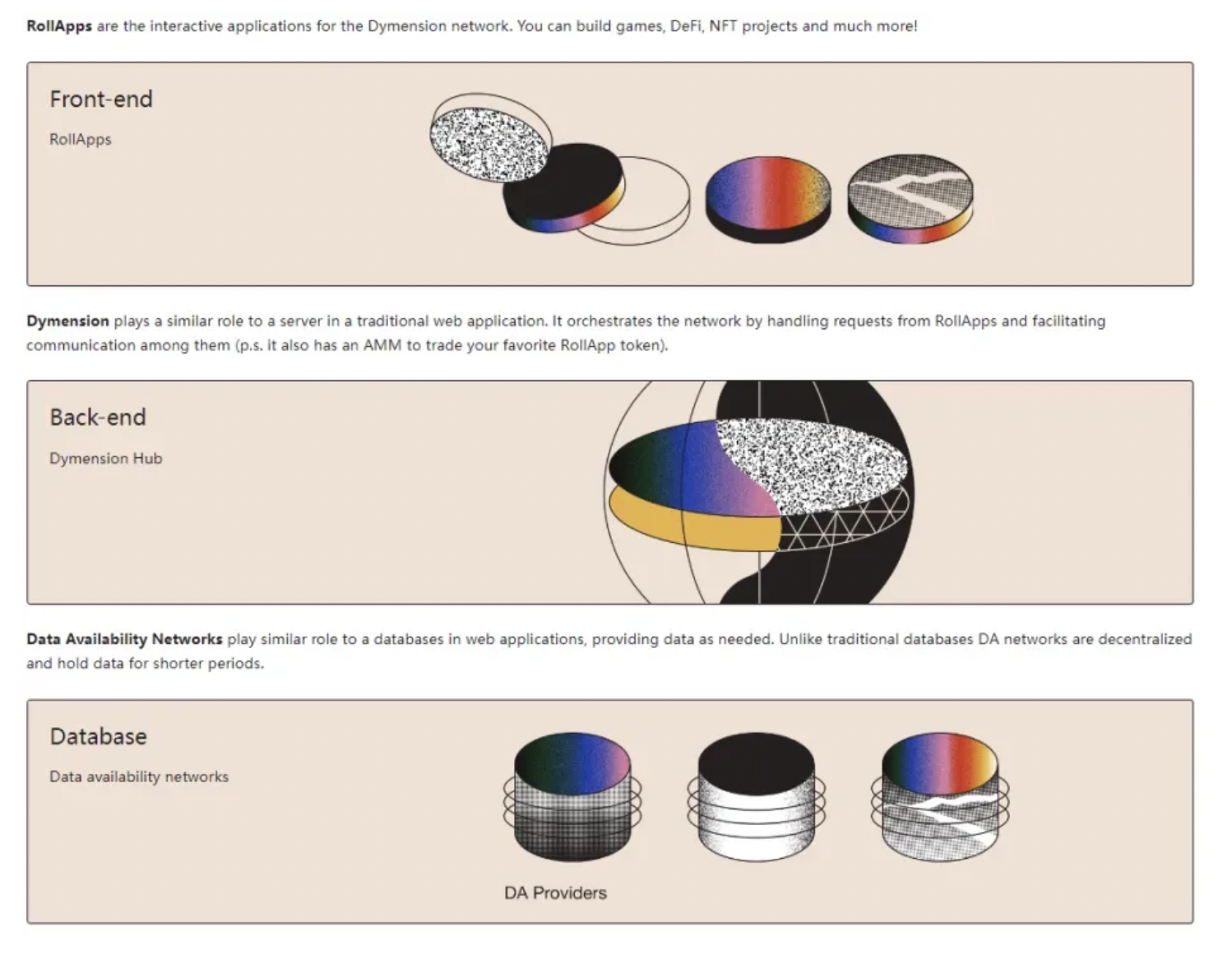
Dymension is generally regarded as a settlement-layer module, but it also functions as a RaaS provider. Using Dymension, anyone can launch a dedicated blockchain—specifically, what they call a RollApp chain.
Its core product, the Dymension RDK, is a customized version of the Cosmos SDK tailored for RollApps. The Cosmos SDK is a development framework preloaded with multiple modules that accelerate blockchain building. Dymension has further developed and deployed additional smart contract frameworks under various licensing models:
-
Ethermint: for EVM-compatible smart contracts
-
CosmWasm: a Wasm framework built by Confio and Cosmos contributors
Dymension features an embedded AMM that acts as a centralized liquidity layer for the RollApp ecosystem. This AMM supports cross-RollApp swaps, efficient token launches, and provides access to protocol incentives.
Compared to other modular solutions, Dymension has a steeper learning curve and doesn't hold a strong advantage over Ethereum-based L2s. However, it offers greater flexibility. In practice, although the official count shows over 1,000 RollApps deployed, our investigation reveals that top RollApps only have TVLs in the millions of dollars and single-digit daily active users. Thus, Dymension’s ecosystem still has significant room for growth.
3. Fuel
In the execution layer, Fuel plays a crucial role. Through its proprietary FuelVM, Fuel implements long-proposed improvements to the Ethereum Virtual Machine (EVM) without sacrificing backward compatibility—including parallel transaction execution and native support for multiple asset types. By adopting a strict state access list modeled after the UTXO system, Fuel enables parallel transaction processing. As a result, Fuel delivers higher computational capacity, state access efficiency, and transaction throughput compared to single-threaded alternatives.
4. Eclipse
Eclipse is another key player in execution-layer modularization. Its approach is to bring the Solana Virtual Machine (SVM) to Ethereum, giving Ethereum Solana-level performance. Its architecture is structured as follows:
Settlement Layer — Ethereum: Eclipse settles on Ethereum (via an embedded verification bridge), uses ETH for gas, and submits fraud proofs directly on Ethereum;
Execution Layer — Solana Virtual Machine (SVM): Eclipse runs a high-performance SVM as its execution environment—a fork of the Solana Labs client (v1.17);
Data Availability Layer — Celestia: Eclipse publishes data to Celestia to achieve scalable data availability (DA);
Proof Mechanism — RISC Zero: Eclipse uses RISC Zero for ZK fraud proofs (without requiring intermediate state serialization);
Communication Protocol — IBC: Interoperability with non-Eclipse chains is achieved via Cosmos’ Inter-Blockchain Communication (IBC) standard;
Cross-chain Protocol — Hyperlane: Eclipse collaborates with Hyperlane to bring Hyperlane’s permissionless interoperability solution to SVM-based blockchains.
5. Espresso
Espresso is a decentralized sequencer. Although not one of the four core modular layers, it plays a vital role. As we know, the core function of Layer2 is to bundle transactions and roll them up to Layer1. The ordering of these transactions is handled by a sequencer, which has the power to prioritize or exclude specific transactions. Currently, most sequencers are controlled by the Layer2 project teams themselves—clearly contradicting the principle of decentralization. In the future, decentralized sequencers will inevitably become the norm.
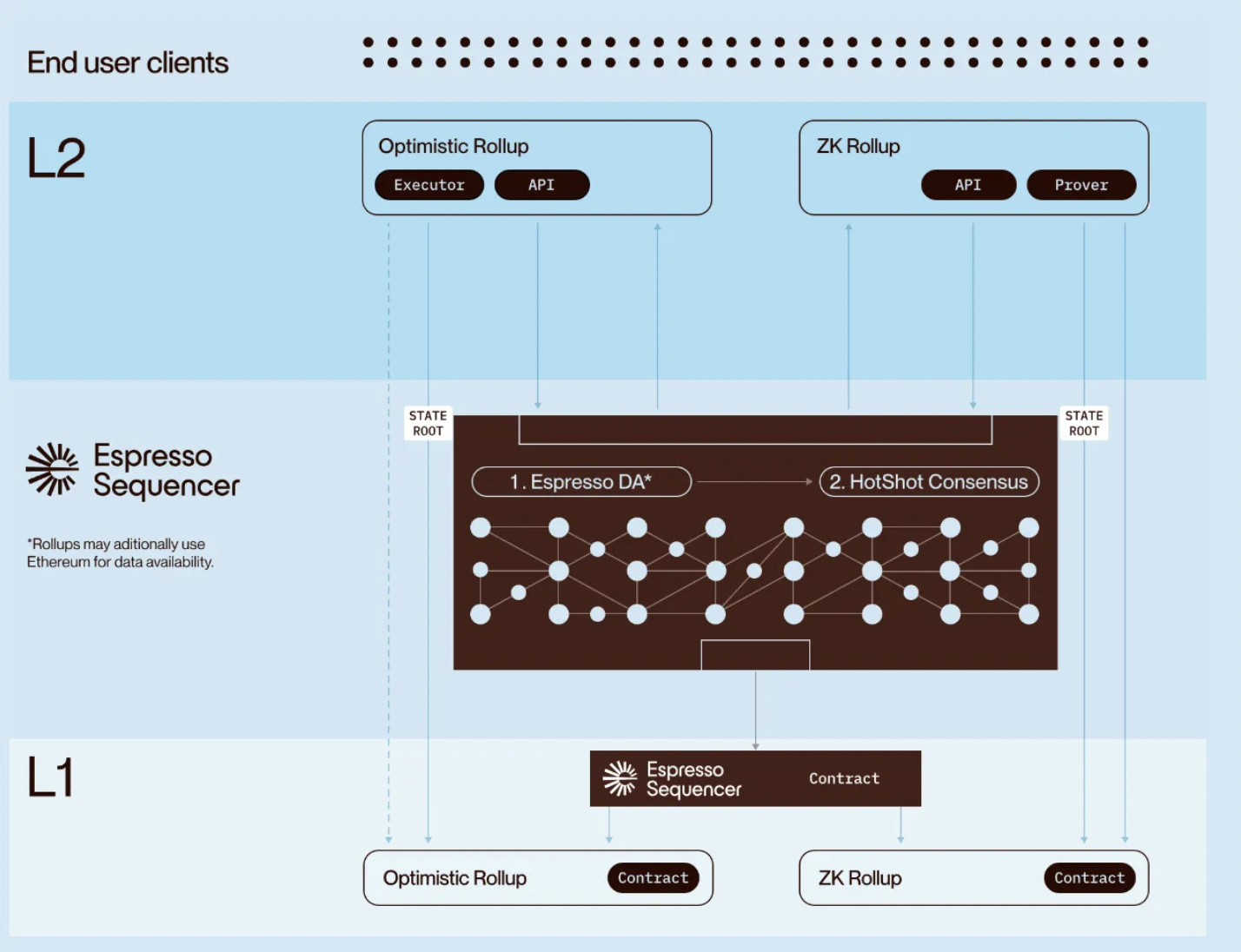
Espresso employs a decentralized sequencer powered by the HostShot consensus mechanism. This network may consist of thousands of heterogeneous nodes and includes its own DA layer for data storage. Espresso enables:
1) Fast response times and finality for Rollup transactions
2) The HostShot consensus mechanism used by Espresso can scale to tens of thousands of nodes, ensuring robust performance
3) Espresso-powered Layer2s achieve fast and low-cost cross-chain communication
6. RaaS Providers
RaaS providers integrate modular components into a unified platform, allowing users to launch custom chains on demand. They greatly simplify the process of launching modular chains and play a pivotal role in driving widespread adoption. Key players include Conduit, AltLayer, Caldera, Gelato, and Lumoz. Among them, AltLayer offers the highest integration, incorporating all four modular layers along with decentralized sequencers and interoperability protocols. Conduit and Caldera primarily focus on Layer2, supporting OP Stack and Arbitrum Orbit. Their main advantages are ease of use, simplicity, and competitive pricing. Several prominent modular public chains have already adopted these services—for example, ZORA, AEVO, and Lyra use Conduit, while Manta, Loot, and Injective have chosen Caldera.
Join TechFlow official community to stay tuned
Telegram:https://t.me/TechFlowDaily
X (Twitter):https://x.com/TechFlowPost
X (Twitter) EN:https://x.com/BlockFlow_News
 @riyuexiaochu









