









Web3 Legal Education | Buying and Selling USDT for Profit: Why Are Traders Convicted of Concealing Criminal Proceeds?
TechFlow Selected TechFlow Selected
Web3 Legal Education | Buying and Selling USDT for Profit: Why Are Traders Convicted of Concealing Criminal Proceeds?
If investigated by the police, can you claim your innocence?
 Navigating Web3 tides with focused insights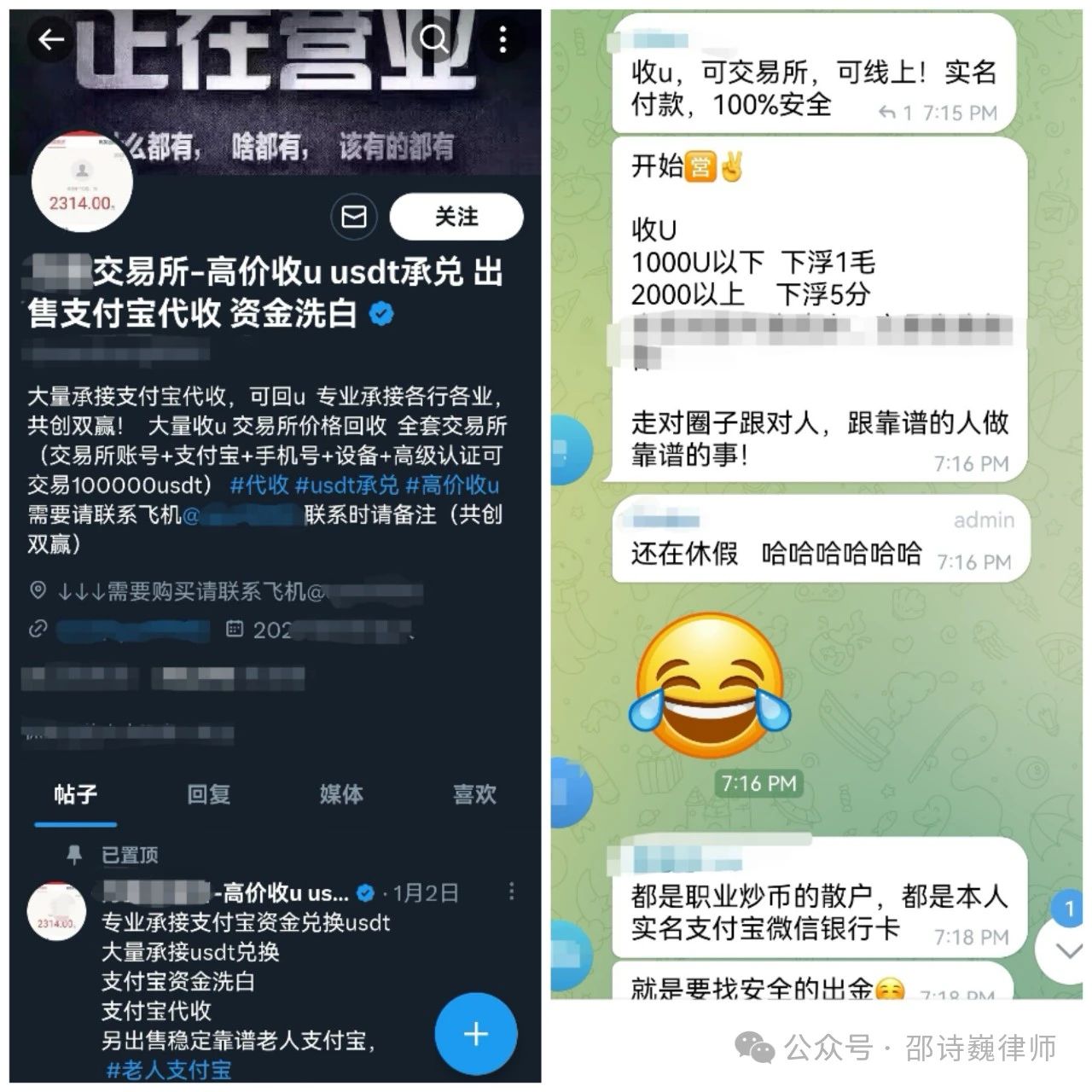
01 Nowadays, even pregnant women are doing U-money trading as a side job to profit from price differences
I don't know if it's because Attorney Shao has been handling cryptocurrency-related cases for a long time, but it seems to me that more and more people are becoming U-merchants?
Before the Lunar New Year, Attorney Shao’s team handled a case in which a U-merchant (let’s call her Xiao Mei) was suspected of aiding and abetting information network criminal activities ("helping crime"), and she has now been released on bail. When asked why she became a U-merchant, Xiao Mei said that she became pregnant last year and had nothing to do at home. She came across online information stating that buying and selling USDT could earn price arbitrage, so she started this side job hoping to supplement household income. Although all her transactions occurred on a major, legitimate cryptocurrency exchange, she still ended up receiving illicit funds.
Another sign indicating the growing number of U-merchants is the rise of businesses surrounding this trade—put simply, there are increasingly more schemes designed to fleece U-merchants.
You want to become a U-merchant? Well, there are certain barriers to entry. Do you know how to use a digital wallet? How can you maximize profits through arbitrage across different exchanges? How do you conduct KYC checks on clients? How do you avoid receiving tainted USDT ("black U")? What should you do if your bank card gets frozen and the police come knocking? You probably don’t know the answers to these questions. That’s where I come in—I offer training courses for U-merchants, priced at only xxxxx yuan. Interested? My course will perfectly resolve every obstacle you might encounter when buying and selling USDT. Isn’t that great value? Teaching others how to make money—now that’s one of the most profitable businesses around.
Don’t U-merchants always worry about being scammed? What if I send you the coins and you don’t pay me? Some entrepreneurs have spotted an opportunity here and launched U-merchant escrow services (similar to Alipay or Xianyu). Since neither party trusts each other, they can trust me instead. Both sides send their money and USDT to me. I charge a small fee from each side to cover my escrow service costs, then transfer the respective assets to both parties. This perfectly solves the trust issue. Double-sided profits, virtually risk-free—what a beautiful business model.
I’ve always said: being a U-merchant is incredibly tough. They earn cabbage-level profits while bearing cocaine-level stress, making razor-thin margins—sometimes less than 0.1%—all while constantly worrying about receiving dirty money, plus facing countless predators eager to exploit them. Getting a frozen bank card might be manageable—we’ve successfully resolved multiple card-unfreezing cases—but once criminal liability arises and personal freedom is lost, that’s when real trouble begins.
02 If investigated by police, can you claim innocence?
This reflects ordinary citizens’ intuitive sense of justice. Whether it’s the suspect or their family members, the first question they ask a lawyer upon being investigated by police is usually: “I was just buying and selling USDT for small profits—I truly didn’t know the money was dirty. Can I claim innocence?” As a criminal defense lawyer, I completely understand such inquiries. But does it really work that way? Can you simply tell the police: “I subjectively didn’t know the other party was committing a crime,” and everything will be fine? Of course not.
The core factor in determining criminal liability lies in assessing the degree of the suspect’s subjective knowledge.
Take, for example, a case prosecuted by the Changning District Procuratorate involving a U-merchant named Xiao, who was convicted of concealing criminal proceeds ("concealment offense"). This case illustrates how courts assess whether a defendant subjectively knew about the illegal nature of the counterparty’s actions.
The case can be briefly summarized as follows: Xiao bought USDT and sold it to others, receiving RMB payments that turned out to be proceeds from money laundering ("pig-butcher scam"赃款). Xiao was ultimately convicted of concealment offense.
Attorney Shao’s analysis:
Did Xiao clearly know the specific nature and origin of the upstream funds? I believe he likely did not—he was merely focused on selling USDT and doing his arbitrage.
But does the concealment offense require full awareness of the precise nature and source of the upstream funds? No—it only requires knowing that the funds were illicit.
Of course, no suspect would voluntarily admit during interrogation: “Yes, I knew the money was stolen! I helped transfer illicit funds!” Therefore, authorities must rely on circumstantial evidence to infer subjective knowledge. In this case:
1. Covert communication methods: The two parties avoided domestic platforms like WeChat or QQ, instead using Telegram (also known as "Paper Plane" or "Telegram"), a foreign messaging app with strong anti-detection features such as self-destructing messages.
2. Abnormal transaction patterns: Transactions were conducted offline rather than through exchanges, often arranged in toilets or cars—locations deliberately chosen to avoid surveillance. Additionally, the counterparties wore masks and hats to conceal their identities during meetings.
3. Presence of "card testing" and unusual profits: Each time, the upstream party requested Xiao to send 100 yuan worth of cryptocurrency to their wallet address at a price significantly higher than the day’s highest market rate—meaning the buyer was effectively losing money on the deal.
Taken together, these circumstances make it very difficult to argue that Xiao was unaware of the suspicious nature of the funds.
03 If acquittal isn't possible, how can one seek a lighter sentence?
Aiding crime carries a maximum sentence of three years; concealment offense, up to seven years. The choice between these charges greatly impacts the defendant. Legally speaking, concealment offense applies when someone knows the funds are proceeds of crime, whereas aiding crime only requires knowledge that someone is using information networks to commit crimes.
However, in judicial practice, the distinction between aiding crime and concealment offense remains blurry. As previously analyzed in my article "Can a conviction for concealment offense be reduced to aiding crime? Which carries a lighter penalty?," inconsistent rulings across similar cases remain common.
How can one seek leniency? First, one must accurately understand the definitions and distinctions between the two offenses. Refer to Attorney Shao’s article "A Comprehensive Overview: Potential Charges for Providing Accounts to Assist Transfers" for detailed analysis.
For individual cases, careful analysis based on the specific elements of each offense and the factual circumstances is essential to determine the correct charge.
In Conclusion
As Attorney Shao often tells those who come seeking advice: what U-merchants see in their transactions is merely the tip of the iceberg.
Join TechFlow official community to stay tuned
Telegram:https://t.me/TechFlowDaily
X (Twitter):https://x.com/TechFlowPost
X (Twitter) EN:https://x.com/BlockFlow_News










