









Analyze the pattern of changes in contract funding rates to guide future trading decisions
TechFlow Selected TechFlow Selected
Analyze the pattern of changes in contract funding rates to guide future trading decisions
The greater the rate decline, the higher the probability of a short-term rebound, but the pattern only holds when the decline exceeds a certain threshold.
 Navigating Web3 tides with focused insights
Author: Nanzhi, Odaily Planet Daily
After a short pullback following the approval of Bitcoin spot ETFs, BTC led the crypto market into a one-way rally. As the upward trend accelerated, the market entered an extremely euphoric phase, with funding rates for most tokens rising significantly—many reaching 0.2% to 0.3%. The average Bitcoin funding rate in March reached as high as 0.055%, indicating that the market has entered a high-level zone comparable to the 2021 bull run. At 23:00 yesterday, BTC briefly broke above 69,000 USDT, peaking at 69,080 USDT, surpassing its previous all-time high of 69,040.1 USDT set in November 2021. According to OKX data, BTC remained above this previous peak for less than one minute before dropping to 59,000 USDT by 03:55 the next day.
After the flash crash, most leveraged positions were liquidated and funding rates began to return relatively to rational levels. Binance's current BTC funding rate is 0.04%, down approximately 0.05% from the pre-crash high of 0.09%. Currently, only three tokens have funding rates exceeding 0.1%.
With leveraged positions cleared, can the market now rise unimpeded? Or will it continue to correct due to inertia? Based on 2021 bull market funding rate data and the price movements of BTC, ETH, and SOL, Odaily Planet Daily analyzes the relationship between funding rate declines and subsequent market performance.
Funding Rates and Price Trends
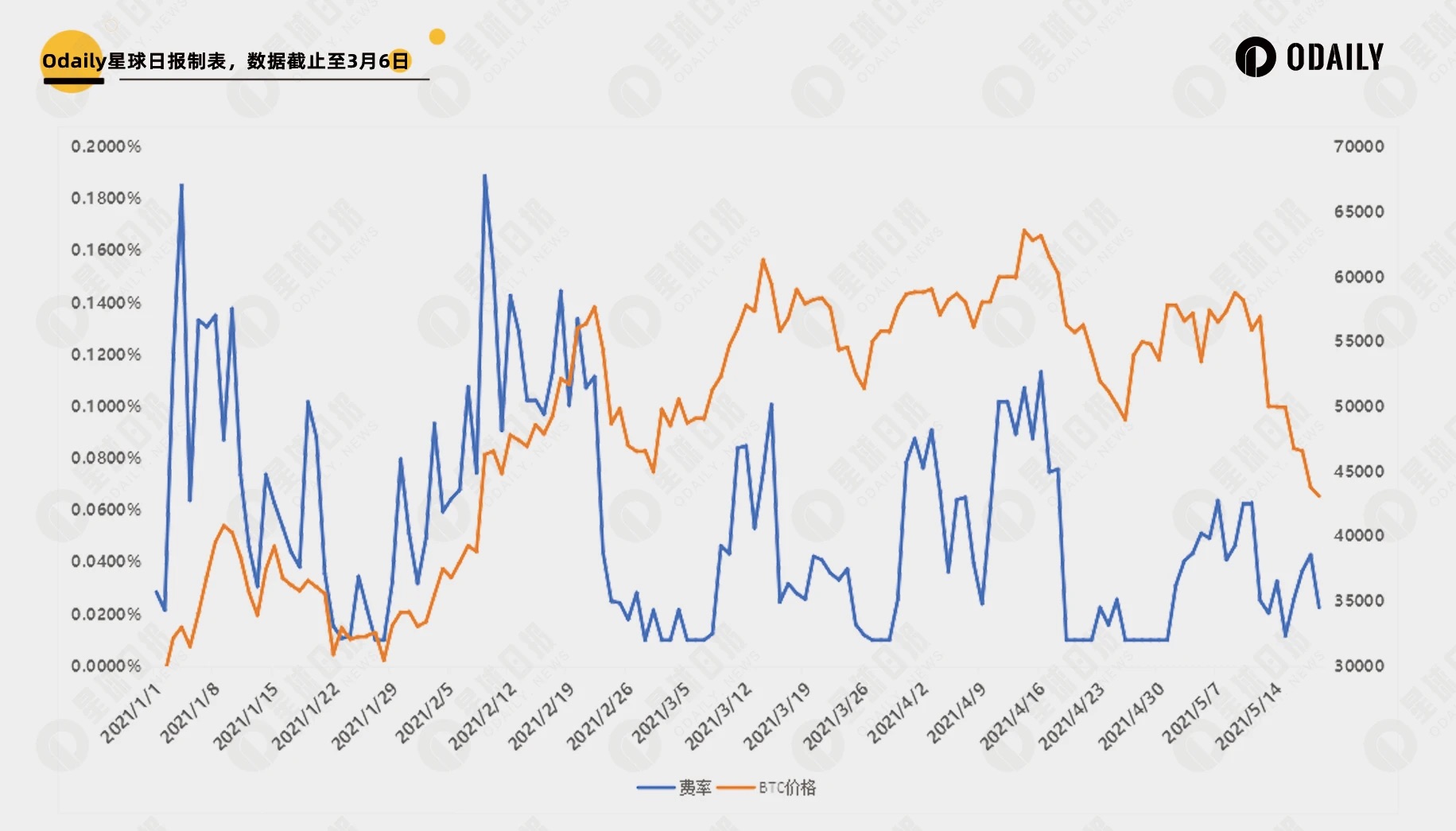
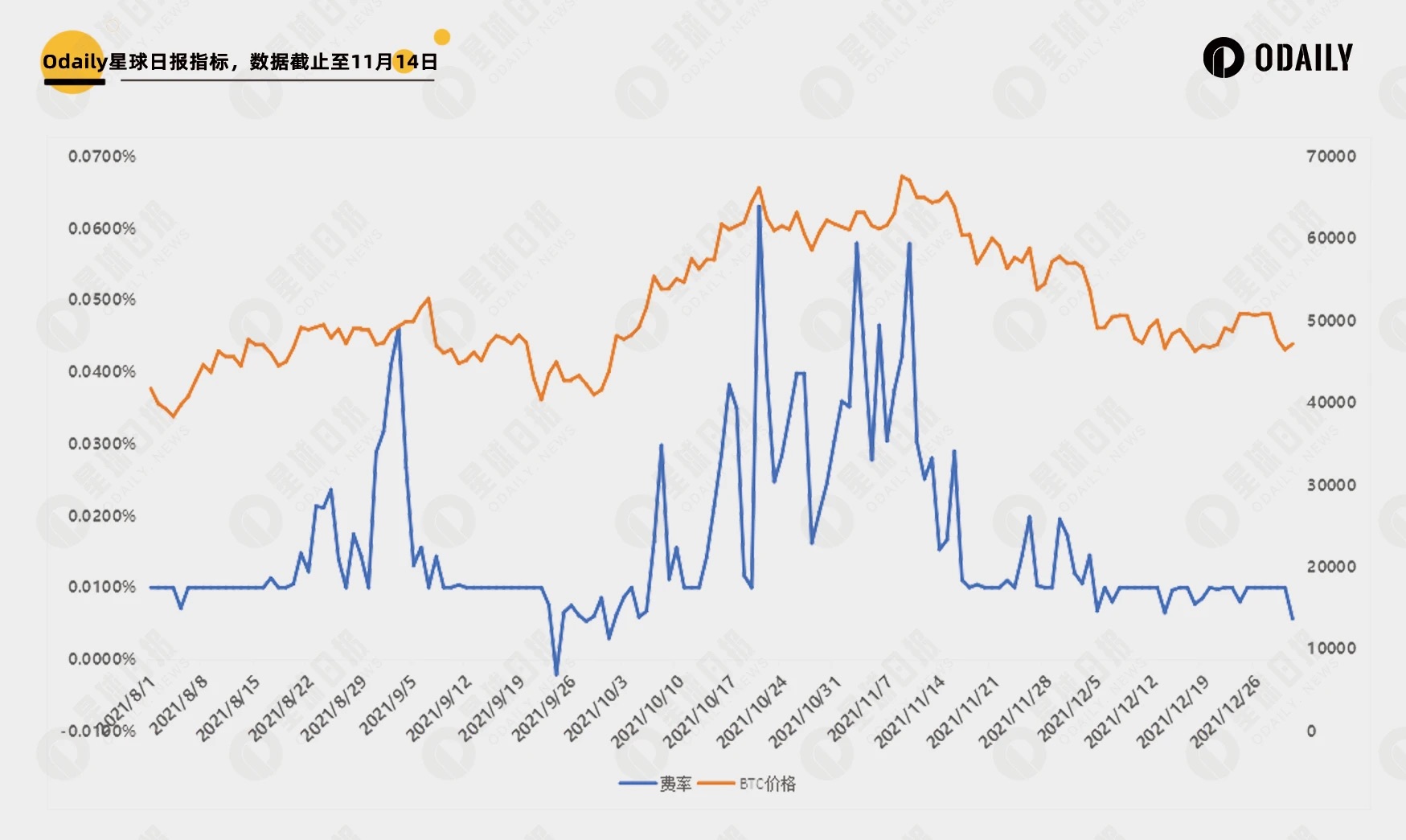
For clarity, the 2021 market is divided into two phases: January–May and August–December. The chart below shows these trends. From the chart, we can observe the following patterns:
-
Funding rates generally move in tandem with price trends—when prices rise overall, so do funding rates;
-
Funding rates tend to peak before prices and decline sharply after a flash crash;
-
However, falling prices are not a sufficient condition for declining funding rates;
After leveraged positions are wiped out due to falling funding rates, does this become a sufficient condition for continued bullish momentum? In the next section, Odaily examines this through historical data backtesting.
Is a Funding Rate Decline a Sufficient Condition for Price Recovery?
-
Rate Range: Since peak funding rates vary across tokens, the rate drop range is set between 0.02% and 0.07% for BTC, and between 0.02% and 0.1% for ETH and SOL;
-
Time Interval: In 2021, funding was collected every eight hours. Daily funding rates are averaged over three readings, with the difference calculated as today’s average minus yesterday’s average;
-
Price Source: Historical price data sourced from CoinGecko;
-
Recovery Criteria: Two dimensions are considered—“whether prices rebound the day after a sharp funding rate drop,” and “whether the lowest price within three days after the rate drop is also the lowest within seven days (i.e., whether prices continue to fall further within seven days).”
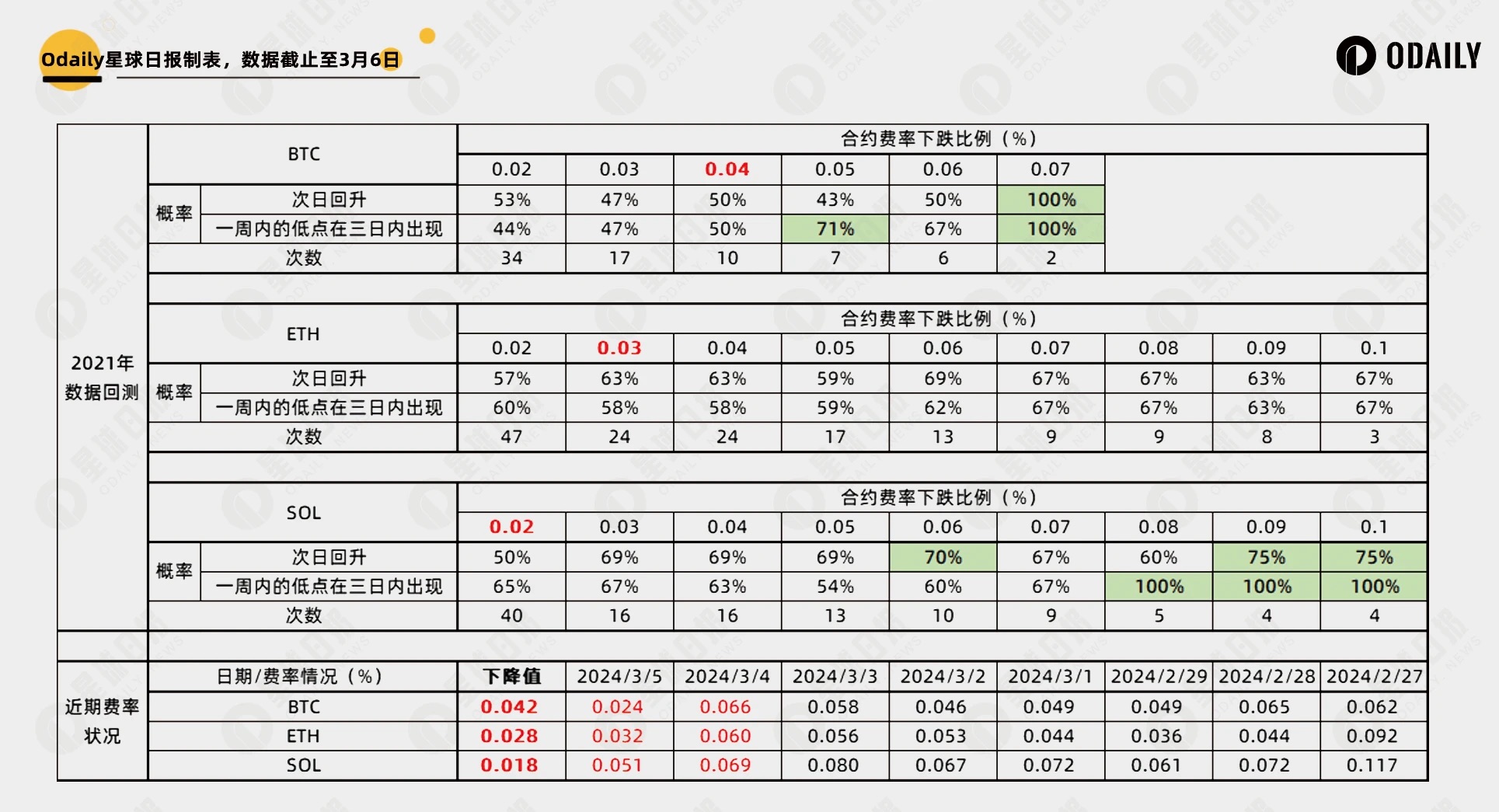
Based on the above parameters and methodology, the results are shown in the table below. Key findings include:
-
Price bottoms are positively correlated with funding rate bottoms—the larger the rate decline, the higher the probability of a price rebound;
-
When the decline is small (around 0.02%–0.03%), it shows little predictive power for future price action, with roughly equal chances of rising or falling;
-
The correlation varies significantly across tokens. For BTC and SOL, only substantial funding rate drops serve as a basis for recovery. ETH tends to rebound after rate drops, but the rebound strength has little relation to the magnitude of the drop.
Conclusion
Funding rate declines can serve as a partial indicator for future market direction. However, the recent drop in funding rates was not significant enough to be meaningful or reliable for forecasting. That said, during bull markets, episodes of high leverage and elevated funding rates followed by flash crashes frequently occur and may offer useful reference points going forward.
Join TechFlow official community to stay tuned
Telegram:https://t.me/TechFlowDaily
X (Twitter):https://x.com/TechFlowPost
X (Twitter) EN:https://x.com/BlockFlow_News
 Odaily









