Stablecoin Chronicles: Learning to Coexist with Volatility
TechFlow Selected TechFlow Selected
Stablecoin Chronicles: Learning to Coexist with Volatility
If volatility cannot be eliminated, there are two ways to coexist with it: reducing volatility or increasing returns.
 Navigating Web3 tides with focused insights
Author: Zuo Ye
Bitcoin and stablecoins are surging—signs of a bull market or just overheated speculation are strikingly clear, absorbing capital both off-chain and on-chain. Let’s start with three data points showing what’s happening.
-
Just looking at stablecoin yields, USDe offers an annualized 27%. If you recall, that surpasses UST’s peak of 20%, and far exceeds DAI’s 8% yield during the height of the U.S. Treasury bond craze last August.
-
Another data point: existing stablecoins exceed $140 billion, second only to the $180 billion seen just before the Luna-UST collapse in May 2022. Using the stablecoin market as a signal, we’re now likely in the mid-phase of a bull cycle.
-
Within the entire stablecoin market, USDT dominates with over 70% share—the first time since Binance rose after FTX's collapse that someone has reached this level. Sun Hongbin’s Tron chain accounts for more than 50% of USDT issuance; whether to laugh or cry is unclear.
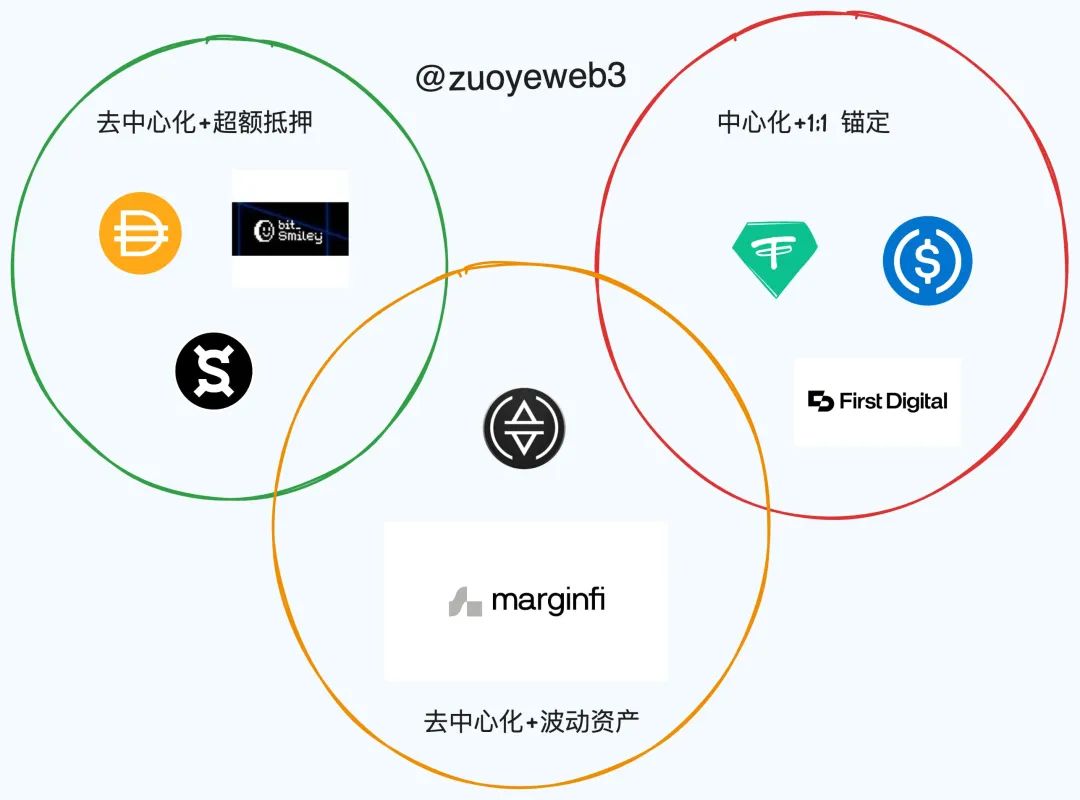
In this round of stablecoin competition, there are essentially two dominant models: on-chain stablecoins with over-collateralization mechanisms, and tokenized stablecoins backed by dollar reserves. Occasional algorithmic-like stablecoins exist but aren’t pure; traditional rebase-style algorithmic models have largely disappeared. Surprisingly, Solana’s YBX, built by Marginfi on LSD, shows traces of a new algorithmic approach. Then there’s Ethena’s USDe, which takes a hybrid route incorporating volatility and ETH collateral to balance decentralization with value anchoring.
Overall, innovation centers on Bitcoin and volatility management. This isn’t to suggest they could replace USDT, but rather, in my view, USDT and USDC have become de facto retail digital dollars—and may well represent the latent form of official digital dollars.
Stablecoin Landscape
As can be seen, USDT leads by a huge margin. USDC dreams of going public. FDUSD, backed by Binance, replaces BUSD. TUSD suffers bad luck. And given all this uncertainty, one can only感慨 (sigh) that Sun Hongbin’s ghost lingers on.
Doubt Volatility, Understand Volatility, Leverage Volatility
Set USDT aside as background. The U.S. government remains hesitant about digital dollars, leaving USDT and USDC to serve as de facto retail digital dollar proxies. USDT has effectively become part of the dollar system, increasingly exhibiting "too big to fail" characteristics—not because its $100 billion market cap alone is critical, but because it functions as the cornerstone of DeFi, the primary medium for CEX trading, and a quasi-legal tender in the developing world.
USDT’s lack of reserve transparency has long been questioned—but it doesn’t really matter. Disclosures and audits are mostly face-saving gestures. If the U.S. government truly wanted to eliminate USDT, it could do so—just look at what happened to BUSD.
Technically, USDT relies on Tether Ltd. as guarantor, issuing a 1:1 dollar-pegged on-chain asset. Minting and burning are fully controlled by Tether. Its profit comes from investing the collected dollars into “dollar-equivalent” assets like cash and short-term deposits.
But once those assets shift away from dollars, either the collateral or the issued stablecoin faces significant volatility. UST’s de-peg was merely symptomatic; the core issue was a run without rescue. Lido’s stETH also faced a de-peg crisis but ultimately recovered. A counterexample is FTX and FTT. So volatility itself isn’t scary—it’s being left without a lifeline that’s deadly.
-
Collateral volatility: Non-dollar, non-Bitcoin, non-Ethereum collaterals haven’t seen real success yet. UST was minted through burning Luna—a risky or perhaps bold experiment now echoed in YBX’s use of LSD asset yields.
-
Stablecoin volatility: Rebase mechanisms failed not due to flawed math, but due to lack of scalability solutions. Issuing $100 of stablecoins backed by $50 reserves isn’t problematic—it allows manageable liquidations during runs. But when market cap hits $10 billion, no simple loan can plug the gap.
We won’t dive deeper into collateral volatility—if both dollars and Bitcoin collapse, the problem goes far beyond gains or losses.
Let’s focus instead on managing stablecoin volatility. Over-collateralization suppresses volatility, but at a steep cost—lost liquidity. Ratios of 150% to 200% mean at least half the circulating supply sits idle—an absolute disaster for capital efficiency.
If volatility can’t be eliminated, two paths remain: coexist by reducing volatility or increasing yield.
Currently, boosting yield is the mainstream approach. On Bitcoin, bitSmiley offers BitUSD + BitLending lending model. On Solana, Marginfi issues YBX, a liquidity staking-based stablecoin. Benefits include exposure to SOL’s underlying “stability” plus LST yield, ensuring baseline returns—similar in concept to LRT restaking mechanics.
Moreover, pegged assets are diversifying, especially toward real-world linkages:
-
Frax has launched three distinct products: the standard dollar-pegged FRAX, FPI linked to CPI, and frxETH, an LSD product pegged to ETH;
-
bitSmiley plans to introduce CDS (credit default swaps) for bitLending. Yet overall, BTC ecosystem founders must grapple with how to outperform simply holding BTC—a fundamental challenge. Most BTC holders prioritize its store-of-value function over derivative yields. So the road ahead, in my view, won’t be smooth.
-
USDe is designed using ETH spot and futures hedging mechanisms, aiming to offer a globally accessible internet bond allowing individuals to earn stable, savings-like returns. USDe’s mechanism is complex, but in simple terms, ETH’s stability and scale are sufficient to absorb market volatility. Yield sources can be summarized as interest income, capital gains, and potential leveraged returns. Both spot pricing and trading generate revenue. Leveraged gains, combined with hedging, form a closed-loop system perfectly aligned with USDe’s design.
When Stablecoins Are No Longer Stable
USDT was first issued in 2014 on Bitcoin’s OmniLayer—over ten years ago. It has since abandoned OmniLayer for RGB, but the broader landscape is set: Ethereum handles large transfers, while Tron dominates daily usage. This structure is now largely irreversible.
Join TechFlow official community to stay tuned
Telegram:https://t.me/TechFlowDaily
X (Twitter):https://x.com/TechFlowPost
X (Twitter) EN:https://x.com/BlockFlow_News
 @zuoyeweb3