









Restaking continues to gain momentum: analyzing nine protocols across seven dimensions to understand their characteristics and selection criteria
TechFlow Selected TechFlow Selected
Restaking continues to gain momentum: analyzing nine protocols across seven dimensions to understand their characteristics and selection criteria
ether.fi has the highest asset liquidity, while Renzo offers the highest fixed yield.
 Navigating Web3 tides with focused insights
By Nan Zhi, Odaily Planet Daily
Last week, EigenLayer, a crypto restaking service provider, announced a $100 million funding round with participation from a16z. Meanwhile, Binance Labs announced investments in two restaking protocols—Puffer Finance and Renzo. Additionally, in early February, on-chain analysts reported that three addresses linked to Justin Sun had deposited 271,328 stETH into restaking, valued at approximately $880 million.
Interest in restaking continues to grow.
This article by Odaily Planet Daily provides an overview of major restaking protocols, comparing their differences and highlights across multiple dimensions. The image below lists the protocols ranked by TVL in descending order.
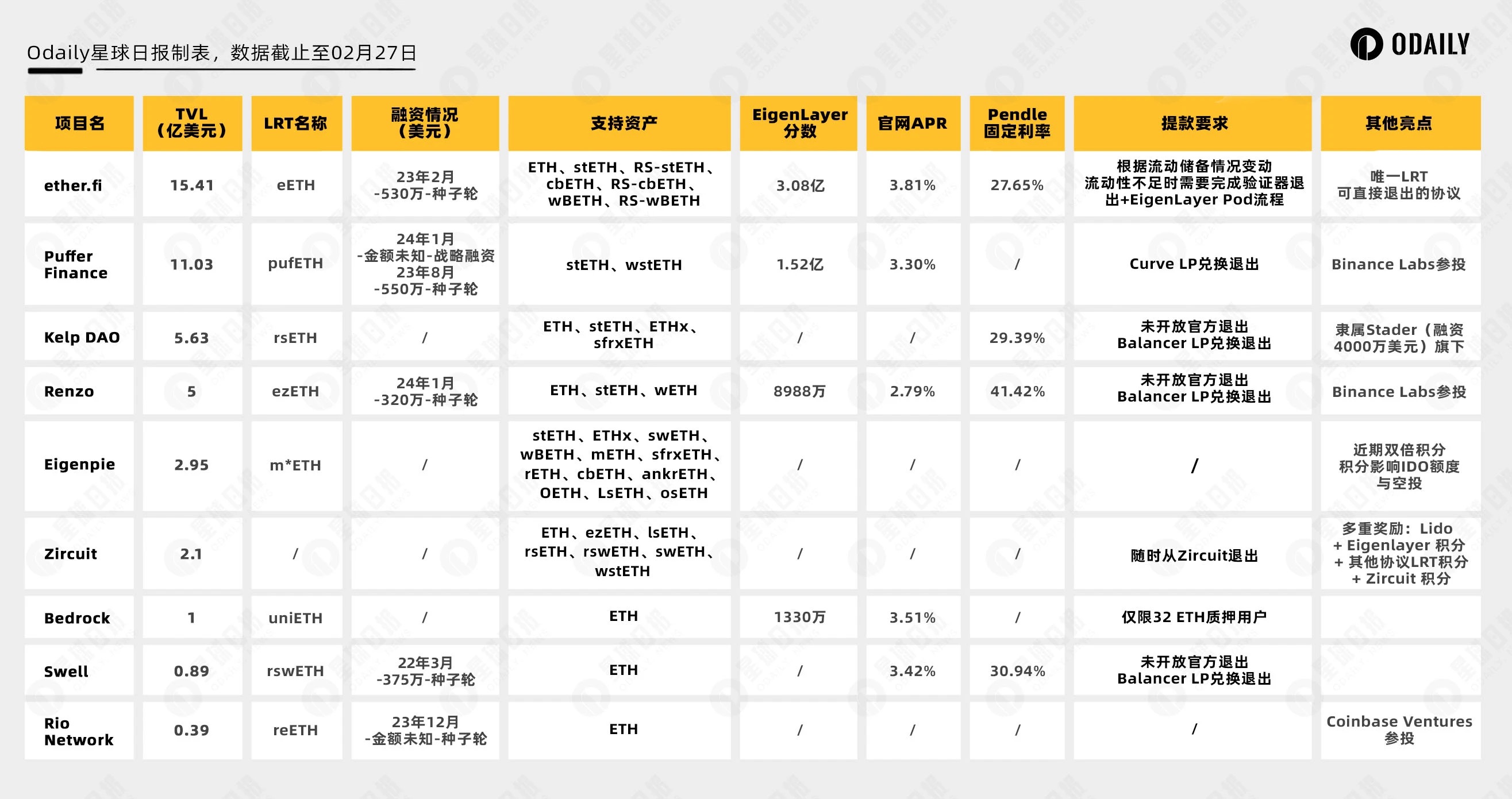
Protocol Comparison
Funding
So far, only a few protocols have publicly disclosed funding details, mostly concentrated at the end of 2023 and beginning of 2024 (Swell’s funding was primarily for its LSD business at the time), with amounts generally in the millions of dollars.
Moreover, the investor overlap among these protocols is relatively low. ether.fi, currently leading in TVL, was led by North Island Ventures and Chapter One, while Puffer Finance was led by Lemniscap and Faction, among others. The most impactful funding news came when Binance Labs announced investments in both Puffer Finance and Renzo. The market interpreted this as a strong signal that these tokens may be listed on Binance Exchange, which contributed to rapid TVL growth following the announcements.
Pendle Fixed Yield
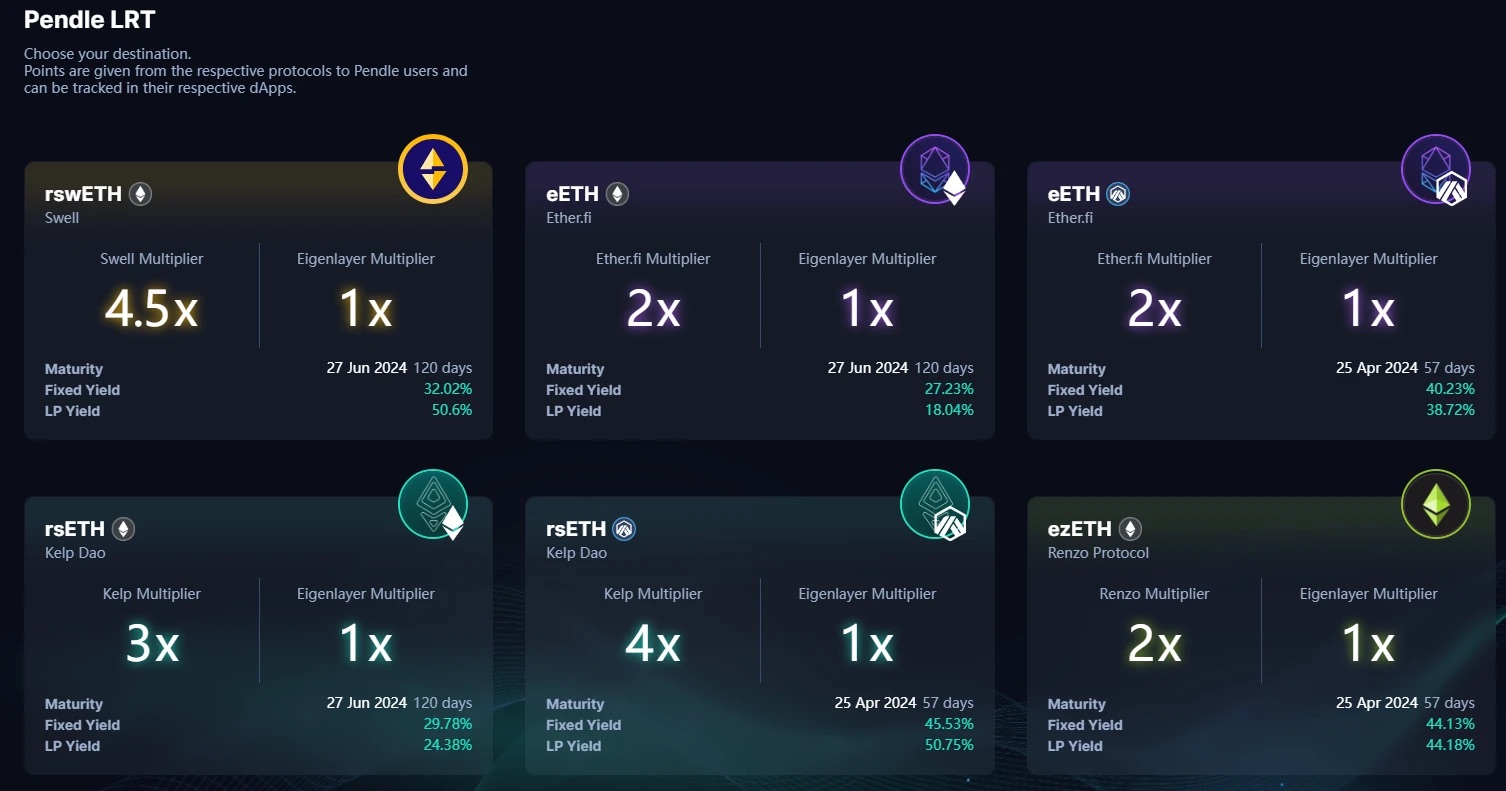
Pendle wraps interest-bearing tokens into SY (Standard Yield tokens), which are then split into two components: PT (Principal Tokens) and YT (Yield Tokens). Users holding PT can redeem the full principal amount upon maturity, while all accrued yield goes to YT holders. The difference between the current price of PT and its face value at maturity represents the fixed yield.
Pendle has launched a dedicated navigation interface for LRTs, shown in the image below. Fixed yields across various protocols range between 30% and 40%, with maturities at either 120 days or 57 days. It's worth noting that holding only PT means receiving fixed returns but forfeiting points rewards and staking yields.
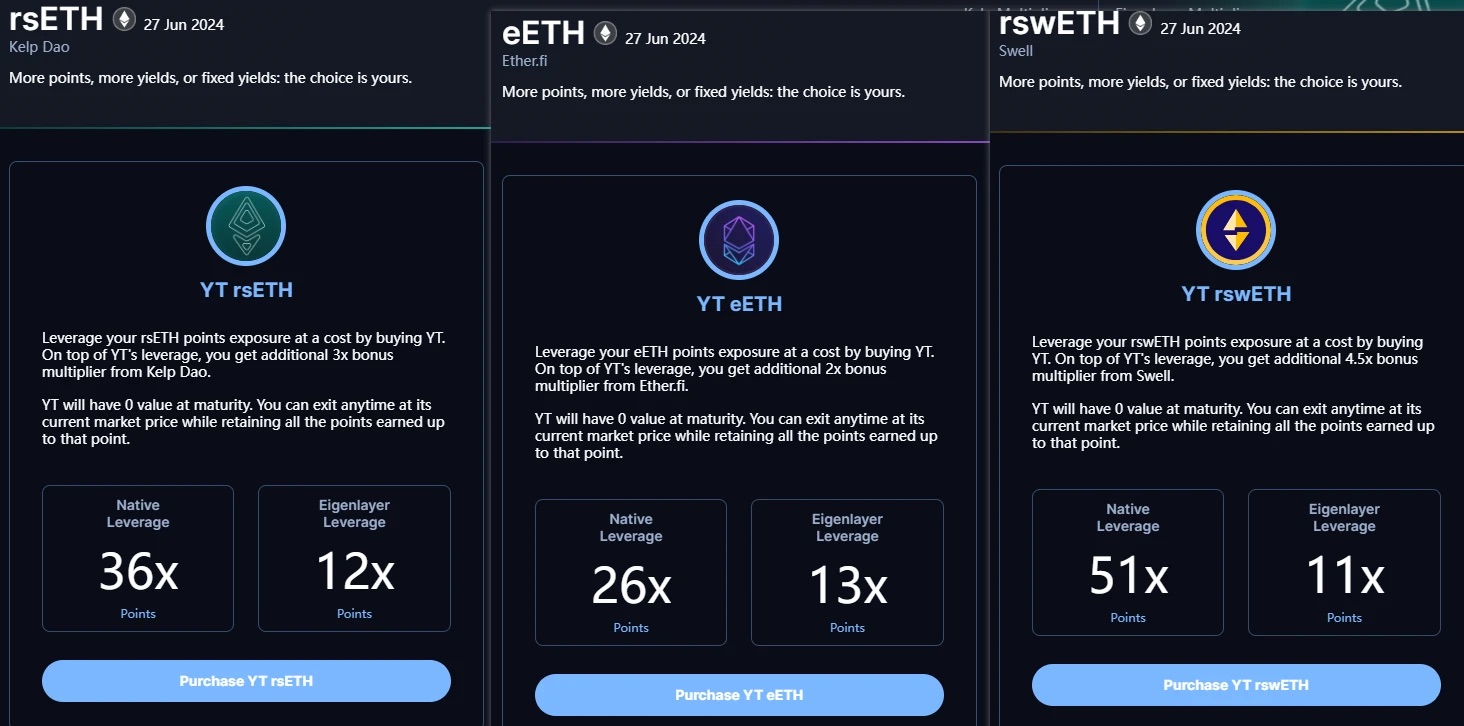
Purchasing YT is equivalent to leveraged exposure to EigenLayer points and project-specific points. As captured by Odaily Planet Daily, several YT products offer approximately 10x leverage on EigenLayer points, along with varying multipliers on additional incentive points.
EigenLayer Points
Currently, only four protocols have disclosed their EigenLayer points allocations, with ether.fi leading at 308 million points, and Bedrock trailing at 13.3 million points.
Additionally, according to data from Whales Market, the current floor price for EigenLayer points is around $0.15 per point. For ether.fi stakers, this translates into a total points asset value of $46.2 million, roughly 3% of its TVL. Readers can similarly calculate the EigenLayer points value for other disclosed protocols or estimate based on TVL ratios.
Whales Market has also listed ether.fi’s project-specific loyalty points, though current market depth is poor. Based on a floor price of 0.00074 USDT per point, ether.fi’s 22.1 billion loyalty points are valued at approximately $16.42 million. Other protocols’ points currently lack publicly available pricing references.
Withdrawal Mechanism
Most restaking protocols currently do not support native withdrawal functionality and require users to exit via DEX swaps, which incurs slippage and impermanent loss. ether.fi is currently the only protocol offering direct withdrawals and has established a liquidity reserve fund to meet immediate withdrawal demands.
However, ether.fi has faced accusations of “point farming exploitation” (“stealing points”). Community members noted that, relative to other protocols’ TVL and corresponding EigenLayer point distributions, ether.fi’s actual earned points appear significantly lower than expected. In response, ether.fi explained that the discrepancy stems from timing differences in deposits and the existence of its instant withdrawal pool, which reduces effective participation duration. The team affirmed that all eligible EigenLayer points will ultimately be distributed to users.
Conclusion
Each restaking protocol offers distinct features, enabling users to choose based on individual needs:
-
For users prioritizing liquidity, staking with ether.fi allows flexibility to exit quickly and participate in other opportunities;
-
For users seeking stable returns, purchasing Renzo’s PT tokens may be suitable;
-
For moderately risk-tolerant users, Puffer presents an attractive option due to high expectations for a potential Binance listing and significant whale participation—Justin Sun being Puffer’s top staker.
Other protocols such as Zircuit and Eigenpie, which offer diverse reward structures, are ideal for users aiming to maximize capital efficiency and balance return expectations.
Join TechFlow official community to stay tuned
Telegram:https://t.me/TechFlowDaily
X (Twitter):https://x.com/TechFlowPost
X (Twitter) EN:https://x.com/BlockFlow_News
 Odaily









