









Crypto is the illusion of AI
TechFlow Selected TechFlow Selected
Crypto is the illusion of AI
The belief that crypto can change AI's hallucination is a confidence, yet also a standard hallucination.
 Navigating Web3 tides with focused insights
Author: Zuo Ye
-
Emergence: A phenomenon where many small individual components interact to produce a larger whole that exhibits new properties not present in the individual parts. For example, the biological phenomena studied in biology are emergent properties of chemistry.
-
Hallucination: The tendency of models to generate deceptive data—AI model outputs that appear correct but are actually wrong.
The connection between AI and Crypto shows clear cyclical fluctuations. After AlphaGo defeated human professional Go players in 2016, the crypto world spontaneously gave rise to projects like Fetch.AI that attempted to combine the two. Since the emergence of GPT-4 in 2023, the AI + Crypto trend has reignited, symbolized by WorldCoin's token launch. Humanity seems poised to enter a utopian era where AI handles productivity while Crypto manages distribution.
This sentiment peaked when OpenAI unveiled its text-to-video application Sora. But as with any emotional surge, there is an irrational component—at least Li Yizhou was among those mistakenly caught up. For instance:
-
Practical applications of AI are often conflated with algorithm development; although the Transformer principles behind Sora and GPT-4 are open-source, using these models requires payment to OpenAI;
-
The integration of AI and Crypto remains largely driven by Crypto’s proactive outreach, whereas major AI companies have shown little interest so far. Currently, what AI can offer Crypto outweighs the reverse;
-
Using AI technology within Crypto applications ≠ fusion of AI and Crypto—for example, digital avatars in blockchain games/GameFi/metaverse/Web3 games/AW;
-
What Crypto can contribute to AI development mainly lies in enhancing decentralization and token incentives across AI’s three pillars: computing power, data, and models;
-
WorldCoin represents a successful case of combining the two fields, zkML sits at the technical intersection of AI and Crypto, and UBI (Universal Basic Income) theory has seen its first large-scale implementation.
In this article, I will focus on how Crypto can enhance AI. Current Crypto projects primarily focused on AI applications are mostly gimmicks and thus excluded from discussion.
From Linear Regression to Transformer
For a long time, discussions around AI have centered on whether "emergence" could lead to machine intelligences or silicon-based civilizations like those depicted in *The Matrix*. Concerns about humanity’s relationship with AI have persisted, most recently following the release of Sora, and earlier after GPT-4 (2023), AlphaGo (2016), and IBM’s Deep Blue defeating chess champions in 1997.
Yet such fears have never materialized. Instead of worrying, perhaps it’s better to calmly review how AI works.
Let’s start with linear regression—essentially a simple linear equation. Take Jia Ling’s weight loss mechanism as an example: x and y represent caloric intake and body weight respectively—eating more leads to gaining weight, so losing weight means eating less.
However, this approach has flaws. First, human height and weight have physiological limits—three-meter giants or thousand-pound individuals rarely exist, making extreme scenarios meaningless. Second, simply eating less and exercising more doesn’t align with scientific weight-loss principles and may even harm health.
We introduce BMI (Body Mass Index)—weight divided by the square of height—to measure the rational relationship between height and weight. Furthermore, we consider three factors—eating, sleeping, and training—to assess their combined impact on body composition. With three input variables and two outputs, linear regression clearly falls short. This is where neural networks emerge. As the name suggests, neural networks mimic brain structure—the more “thinking” steps involved, the more reasonable the outcome might be. Thinking thrice before acting, increasing depth and complexity—that’s deep learning (a loose analogy, but conveys the idea).
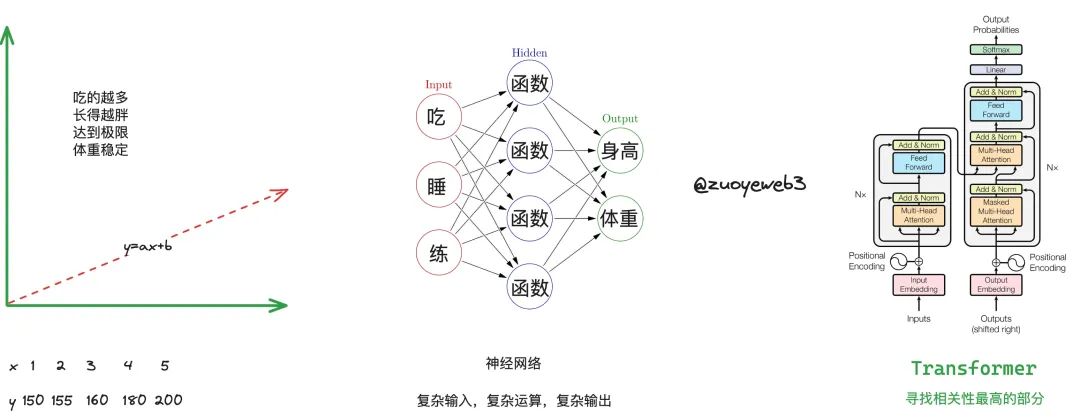
Brief history of AI algorithms
But increasing layers isn’t infinitely effective—there’s still a ceiling. Beyond a certain threshold, performance may degrade. Therefore, understanding relationships among existing information becomes crucial—such as uncovering finer details in the relationship between height and weight, discovering previously overlooked factors, or having a top-tier coach interpret Jia Ling’s indirect hints about wanting to lose weight.

What “meaning” really means
In this scenario, Jia Ling and her coach form an encoder-decoder pair, exchanging messages whose true meanings are hidden beneath surface-level communication. Unlike bluntly saying “I want to lose weight and here’s a gift,” the real intentions are veiled in subtlety.
We observe one fact: if the back-and-forth continues long enough, the underlying meanings become easier to infer, and the connections between each message and the participants grow clearer.
Extending this model leads us to what’s commonly known as large language models (LLMs). More precisely, these models analyze contextual relationships between words and sentences. However, today’s LLMs have expanded beyond text to include images, video, and other modalities.
Across the AI spectrum, both simple linear regression and highly complex Transformers are merely different types of algorithms or models. Beyond models, two other key elements are computing power and data.
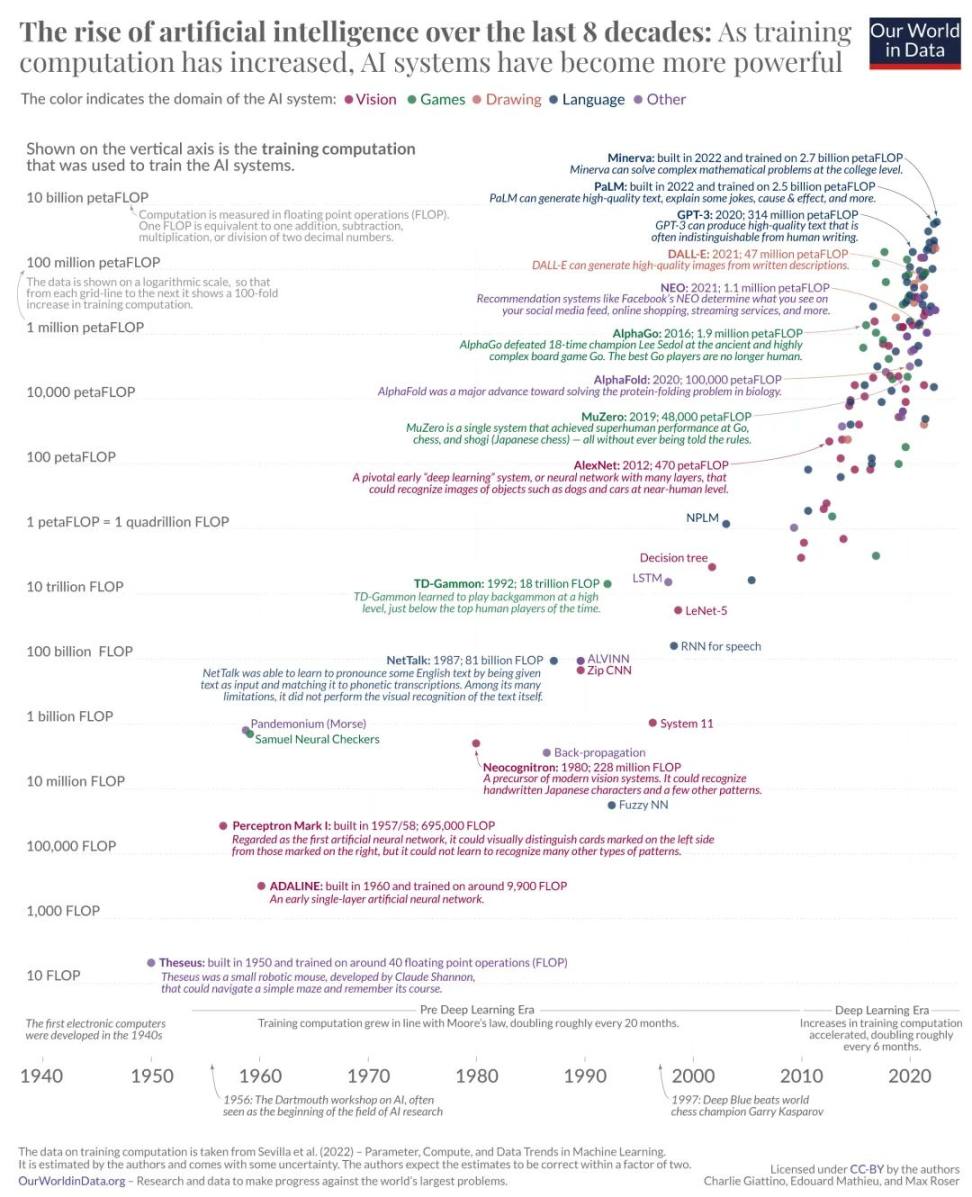
Note: Brief history of AI, image source: https://ourworldindata.org/brief-history-of-ai
Simply put, AI is a machine that ingests data, performs computations, and produces results. Compared to physical robots, AI is more abstract. Within the triad of computing power, data, and models, current Web2 commercial operations follow this workflow:
-
Data includes public datasets, proprietary corporate data, and commercial data. Professional preprocessing—including annotation—is required before use. Companies like Scale AI provide data preprocessing services for mainstream AI firms;
-
Computing power comes via self-built infrastructure or cloud rentals. In hardware, NVIDIA dominates GPU supply. Its CUDA library has been developed over years, creating a dominant software-hardware ecosystem. Alternatively, cloud providers like Microsoft Azure, Google Cloud, and AWS offer rental services, often including end-to-end deployment solutions;
-
Models fall into frameworks and algorithms. The framework battle is largely settled—Google’s TensorFlow arrived early but faded, while Meta’s PyTorch surged ahead. Despite pioneering Transformer or owning PyTorch, neither Google nor Meta leads commercially compared to OpenAI, though their technical strength remains formidable. Algorithm-wise, Transformer dominates, with most large models differing only in data sources and fine-tuning details.
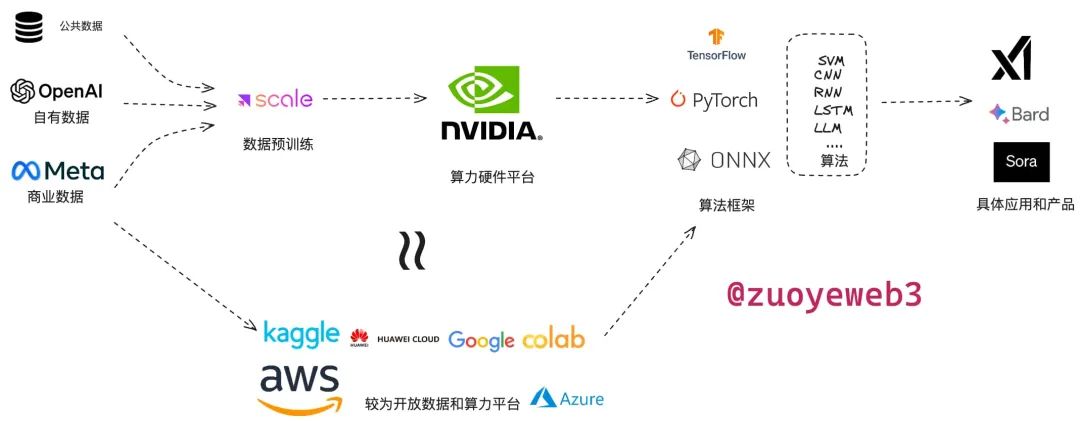
How AI works
As noted above, AI has broad applications—for instance, code correction suggested by Vitalik is already in use. From another perspective, Crypto’s contributions to AI lie primarily outside core technology—such as decentralized data markets and decentralized computing platforms. While some experiments in decentralized LLMs exist, it must be emphasized that analyzing Crypto code with AI is fundamentally different from running AI models extensively on blockchains. Merely adding Crypto elements into AI models hardly qualifies as true integration.
Currently, Crypto excels more in creation and incentivization. Attempting to forcibly reshape AI’s production paradigm using Crypto is unnecessary—it’s like inventing problems to fit solutions, bringing a hammer looking for nails. The sensible path forward is integrating Crypto into AI workflows and leveraging AI to empower Crypto. Below are potential convergence points I’ve identified:
-
Decentralized data generation—for example, DePIN-based data collection and the openness of on-chain data, which contains rich transactional data useful for financial analysis, security monitoring, and training;
-
Decentralized preprocessing platforms—traditional pretraining lacks insurmountable technical barriers. Behind Western large models lies intense labor from low-paid annotators in developing countries;
-
Decentralized computing platforms—incentivizing and utilizing distributed personal resources such as bandwidth and GPU computing power;
-
zkML—conventional data anonymization fails to fully address privacy concerns. zkML hides data directionality and enables effective evaluation of the authenticity and efficiency of both open- and closed-source models.
These four areas represent viable ways Crypto can empower AI. As a general-purpose tool, AI’s applications in Crypto are vast and won’t be covered here—readers are encouraged to explore independently.
It’s evident that Crypto currently plays roles in encryption, privacy protection, and economic design. Only zkML shows meaningful technical integration. Let’s speculate: if Solana’s TPS could truly reach 100K+, and Filecoin integrates seamlessly with Solana, could we build an on-chain LLM environment? Such a system might enable genuine on-chain AI, transforming the current asymmetric dependency of Crypto on AI into a balanced partnership?
Web3 Integration into AI Workflows
Needless to say, NVIDIA’s RTX 4090 graphics card is hard currency—currently difficult to obtain in certain Eastern nations. More critically, individuals, small companies, and academic institutions face GPU shortages, as large corporations dominate procurement. If a third pathway emerges beyond direct purchase and cloud providers, it would hold real commercial value—moving beyond pure speculation. The logic should be: “Without Web3, this project cannot operate.” That’s the right way for Web3 to serve AI.
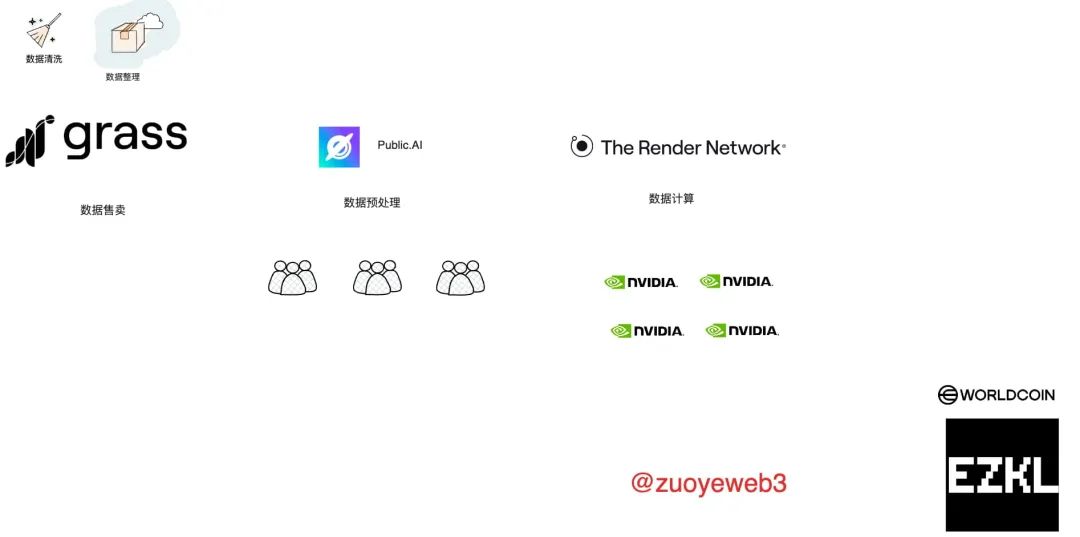
AI workflow through a Web3 lens
Data Sources: Grass and DePIN Automotive Suite
Grass, launched by Wynd Network, operates as an open network data acquisition and distribution channel. Wynd Network itself is a marketplace for selling idle bandwidth. Unlike simple data collection and resale, Grass offers data cleaning and validation features to navigate increasingly restricted internet environments. Moreover, Grass aims to directly connect with AI models, providing ready-to-use datasets. These datasets require expert handling—such as extensive human fine-tuning—to meet specific AI model requirements.
Expanding further, Grass addresses data monetization, while Web3’s DePIN space generates AI-relevant data—especially in autonomous driving. Traditional approaches rely on companies building proprietary data sets. Projects like DIMO and Hivemapper run directly on vehicles, collecting growing volumes of driving behavior and road condition data.
Previously, autonomous driving relied on vehicle recognition tech and high-precision maps—information long accumulated by companies like NavInfo, forming de facto industry barriers. Latecomers leveraging Web3-generated data may now gain a competitive edge through disruptive innovation.
Data Preprocessing: Liberating Humans Enslaved by AI
Artificial intelligence consists of two parts: manual labeling and intelligent algorithms. Workers in developing regions—such as Kenya and the Philippines—perform low-value data annotation tasks, while Western AI preprocessing firms capture most of the revenue, reselling processed data to AI developers.
As AI advances, more firms target this segment, driving down annotation prices due to competition. This work involves basic tagging—similar to CAPTCHA solving—with no technical barrier, sometimes priced as low as ¥0.01 RMB.

Image source: https://aim.baidu.com/product/0793f1f1-f1cb-4f9f-b3a7-ef31335bd7f0
In this context, Web3 data labeling platforms like Public AI find real market demand—connecting AI companies with annotators through incentive systems rather than cutthroat pricing. However, established players like Scale AI ensure high-quality annotations. Decentralized platforms must enforce quality control and prevent sybil attacks—a critical requirement. At heart, this is a C2B2B enterprise service; sheer volume alone won’t convince enterprises.
Hardware Freedom: Render Network and Bittensor
It should be clarified that unlike Bitcoin ASICs, there are currently no dedicated Web3 AI hardware devices. Existing computing platforms repurpose conventional hardware layered with Crypto incentives. These belong broadly to the DePIN category, though distinct enough from data-sourcing projects to warrant separate discussion under AI workflows.
For a definition of DePIN, refer to my previous article: DePIN Before Helium: Bitcoin, Arweave, and STEPN
Render Network is a “veteran” project—not exclusively built for AI. Originally focused on rendering tasks (fitting its name), it launched in 2017 when GPUs weren’t yet prohibitively expensive. Yet market opportunities were emerging: NVIDIA monopolizes the GPU market, especially high-end cards, whose steep prices hinder access for users in rendering, AI, and metaverse sectors. Creating a bridge between demand and supply could enable a sharing-economy model akin to bike-sharing.
Moreover, GPU resources don’t require physical transfer—only software-level allocation. Notably, Render Network migrated to the Solana ecosystem in 2023, abandoning Polygon. This move, made before Solana’s recovery, proved prescient. High-speed networking is essential for efficient GPU utilization and distribution.
If Render Network is the old guard, Bittensor is the rising star.
Built on Polkadot, Bittensor uses economic incentives to train AI models, rewarding nodes that achieve the lowest error rates or highest efficiencies. It follows a classic “AI on blockchain” model and resembles Kaggle-style competitions. However, actual training still depends on NVIDIA GPUs and traditional platforms.
zkML and UBI: The Two Faces of Worldcoin
Zero-Knowledge Machine Learning (zkML) applies zk techniques to AI model training to solve issues of data leakage, privacy breaches, and model verification. The first two benefits are straightforward: encrypted data can still be used for training without exposing personal or sensitive information.
Model verification refers to evaluating closed-source models. With zk technology, a target benchmark can be set, allowing a black-box model to prove its capability via verifiable results without revealing internal computation processes.
Worldcoin is not only an early mainstream adopter of zkML but also advocates UBI (Universal Basic Income). In its vision, AI productivity will vastly exceed human needs, making fair distribution of AI-generated wealth the central challenge. $WLD tokens will distribute this wealth globally, requiring biometric identity verification to ensure fairness and prevent fraud.
Of course, both zkML and UBI remain in early experimental stages—but undeniably fascinating. I’ll continue monitoring their progress.
Conclusion
AI development, particularly along the Transformer and LLM trajectory, will eventually hit bottlenecks—just as linear regression and neural networks did. Infinite scaling of parameters or data volume isn’t sustainable; marginal returns diminish over time.
AI may be a contender for emergent intelligence, but hallucinations remain severe. Believing Crypto can resolve AI hallucinations reflects confidence—but ironically, this belief itself is a classic hallucination. Technically, Crypto cannot easily fix hallucinations. However, it can promote fairness and transparency, gradually reshaping the status quo from ethical and structural angles.
Join TechFlow official community to stay tuned
Telegram:https://t.me/TechFlowDaily
X (Twitter):https://x.com/TechFlowPost
X (Twitter) EN:https://x.com/BlockFlow_News
 @zuoyeweb3









