









Pantera Partner: Re-evaluating Bitcoin's Programmability
TechFlow Selected TechFlow Selected
Pantera Partner: Re-evaluating Bitcoin's Programmability
Bitcoin will inevitably follow its own path, but clearly, a new design space has opened up for Bitcoin builders.
 Navigating Web3 tides with focused insights
Author: Franklin Bi, Partner at Pantera Capital
Translation: Luffy, Foresight News
Bitcoin is the world's most overlooked asset. What if I told you there’s an asset with the following characteristics:
-
A $900 billion market cap (60% higher than Visa)
-
Daily trading volume reaching $26 billion (250% more than Apple)
-
50% annualized volatility (20% lower than Tesla)
-
Over 220 million holders globally (only six countries have populations exceeding 220 million)
And this asset has been ignored and rejected for a decade by the so-called "leading" financial institutions of the world? For such an asset, would one ETF really be enough?
No. Relative to its size, Bitcoin remains one of the most underserved and least financialized assets in the world.
Bitcoin is one of the most unique assets in the crypto ecosystem. Its market cap and trading volume are roughly 2.5 times that of Ethereum. The Bitcoin network functions as a digital Fort Knox. Bitcoin is a fortress whose computing power exceeds the world’s fastest supercomputer by 500 times. It has over 200 million global holders—compared to Ethereum, the second-largest, which has only 14 million. Yet Bitcoin still stands uniquely within a sea of regulatory gray, recognized, classified, and treated as a digital commodity.
If Wall Street’s financial system won’t build for Bitcoin, then Bitcoin must build its own financial system.
If blockchain technology can help the unbanked gain access to financial services, the most obvious path is through Bitcoin’s global distribution across Latin America, Africa, and Asia. This already covers millions. If we expect trillions of value to eventually flow on blockchains, no network offers greater security or resilience than Bitcoin. As Bitcoin reaches billions—or more—users, they will want to do more than just store and transfer their assets. Capital and technology rarely stand still, and this time will be no exception.
Bitcoin is a Technology
Just as Bitcoin as an asset has been overlooked, it may be even more overlooked as a technology. Bitcoin lags behind blockchain networks like Ethereum in scalability, programmability, and developer interest. My first attempt to build on Bitcoin was in 2015, during the early days of JPMorgan’s cryptocurrency R&D. Beyond colored coins and sidechains—early ancestors of today’s NFTs and Layer 2 rollups—there was little else to explore.
The conclusion back then was clear: building on Bitcoin was simply too hard. Ask David Marcus, former PayPal president and co-creator of Meta’s stablecoin project Diem, who is now building Lightspark, a Bitcoin payments company. David recently tweeted: “Building on Bitcoin is at least five times harder than building on other protocols.”
As both money and technology, Bitcoin’s blessings are also its curses:
-
Resistance to change: This reflects both Bitcoin’s robustness and its slowness. Upgrades to Bitcoin are difficult to approve and can take 3–5 years to deploy.
-
Simplicity of design: This reduces Bitcoin’s exploitability but also its flexibility. Bitcoin’s UTXO model is ideal for serving a simple ledger of payment transactions, but incompatible with the complex logic or loops required by most advanced financial applications.
-
10-minute block time: The Bitcoin network has maintained 100% uptime since 2013 (a rare achievement), thanks to its 10-minute block interval—but this makes it inaccessible to many consumers.
Today, signs suggest that Bitcoin’s stagnation is temporary and non-structural. A decentralized finance (DeFi) ecosystem built on Bitcoin may finally emerge. Its potential could match or exceed today’s Ethereum-based DeFi, despite following a different evolutionary path.
Why Now?
Over the past few years, Bitcoin has opened new developmental trajectories:
-
Taproot Upgrade (November 2021): Expanded the amount of data and logic Bitcoin transactions can store.
-
Ordinal Inscriptions (January 2023): A Taproot-enabled protocol allowing rich metadata to be written into individual satoshis (totaling 21 quadrillion), opening a metadata layer for non-fungible tokens (NFTs).
-
BRC-20 Tokens (March 2023): An Ordinals inscription enabling deployment, minting, and transfer functionality.
The release of fungible and non-fungible assets foreshadowed the first wave of DeFi and NFTs on Ethereum in 2016–2017. The Bitcoin ecosystem is now showing similarly early signs of growth. Driven by Ordinal inscriptions, average transaction fees on Bitcoin rose 20-fold in 2023.
Bitcoin will inevitably follow its own path, but clearly, a new design space has opened for Bitcoin builders.

Broader macro trends have triggered a psychological shift in the Bitcoin community and reignited investor interest in Bitcoin DeFi:
-
Layer 2 Adoption: Layer 2 networks like Arbitrum dominated new DeFi activity on Ethereum in 2023, proving that blockchain capacity and programmability can be expanded without altering the base layer.
-
Institutional Acceptance: Bitcoin broke through major regulatory barriers via ETF approvals, bringing capital flows and entrepreneurial thinking back into its ecosystem. BlackRock and Fidelity are activating Wall Street’s slow but powerful engine. Trading firms are scrambling to find every marginal source of Bitcoin liquidity. This could soon draw them into DeFi, especially through new institutional DeFi gateways like Fordefi.
-
Failures of Crypto-Native Institutions: The collapse of FTX, BlockFi, Celsius, and Genesis marked a crypto-native financial crisis. An entire generation of investors now distrust entrusting Bitcoin to centralized financial service providers.
In hindsight, it’s clear: technological unlocks and macro trends are converging, and Bitcoin DeFi may be approaching its breakthrough moment. Now is the time to seize it.
A $500 Billion Opportunity
The potential rewards of DeFi on Bitcoin are compelling. Beyond social and economic significance, every early builder and investor should ask: What happens if it succeeds? How much is DeFi on Bitcoin worth?
Ethereum, valued at around $300 billion, hosts most of today’s DeFi activity. Historically, DeFi applications built on Ethereum have represented between 8% and 50% of Ethereum’s market cap. Currently, this ratio is about 25%. Uniswap, the largest DeFi app on Ethereum, is valued at $6.7 billion, accounting for roughly 9% of all Ethereum-based DeFi apps.
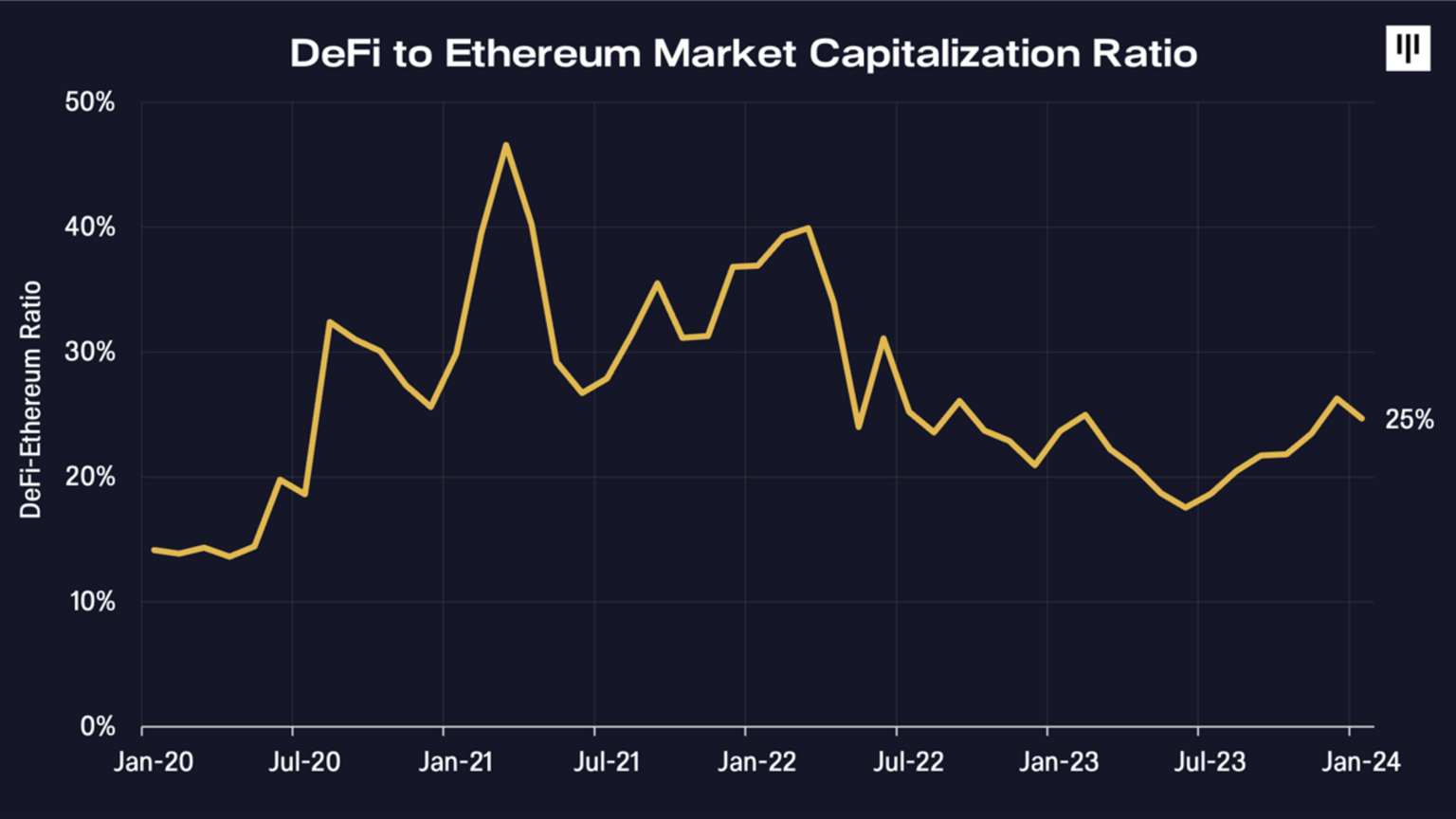
If DeFi on Bitcoin reaches the same proportion as on Ethereum, we could expect Bitcoin-based DeFi apps to reach a total value of $225 billion (25% of Bitcoin’s market cap). Over time, this could range between $72 billion and $450 billion (8% and 50%). This assumption holds Bitcoin’s current market cap constant.
The leading DeFi application on Bitcoin could eventually be valued at $20 billion (2.2% of Bitcoin’s market cap), ranging between $6.5 billion and $40 billion. That would place it among the top 10 most valuable assets in the crypto ecosystem. Bitcoin has already re-emerged as a trillion-dollar asset—and still has room to grow fivefold (reaching a $5 trillion market cap).
Looking Ahead
Over the past three years, a wave of advancements in Bitcoin programmability has been brewing. Examples include Stacks, Lightning Network, Optimistic Rollups, ZK Rollups, Sovereign Rollups, and Discreet Log Contracts. Recent proposals include Drivechains, Spiderchain, and BitVM.
But the winning solution won’t break through on technical merit alone. A successful approach to enabling DeFi on Bitcoin must meet these criteria:
-
Economic Alignment with Bitcoin: Any programmable Bitcoin extension layer should be directly tied to Bitcoin’s economic value and security. Otherwise, users may perceive it as hostile or parasitic toward Bitcoin. Alignment could involve bridging BTC as collateral and gas payment on L2s, or using the Bitcoin network for settlement and data availability.
-
Feasibility Without Base Layer Changes: Some proposed solutions require hard forks or soft forks to Bitcoin—system-wide upgrades. Given how rare these are, such solutions are unlikely to be early frontrunners. Still, some are worth pursuing long-term.
-
Modular Architecture: The winning solution must be sufficiently upgradable to incorporate new technological advances. We’ve already seen rapid evolution in on-chain custody, consensus design, virtual machine execution, and zero-knowledge applications. Semi-closed systems with proprietary stacks won’t keep pace.
-
Trustless Cross-Chain Bridges: Bridging assets between chains is extremely difficult. When done well, considering risks ranging from latency mismatches to catastrophic exploits, it’s as challenging as interstellar transport. Few decentralized cross-chain bridges have been truly battle-tested and verified. tBTC is one example, continuously evolving its design and decentralization.
-
A Ruthless Grind Game: Two audiences are critical to Bitcoin’s growth: 1) Current Bitcoin holders and 2) Future Bitcoin builders. Both groups are fragmented in peculiar ways. Exchanges hold about 10–20% of Bitcoin’s total supply. Around $10 billion worth of Bitcoin exists in various tokenized forms on Ethereum. Developer attention is scattered across multi-chain, multi-layer stacks. Attracting both groups requires a “meet them where they are” mindset.
The era of Bitcoin being overlooked may finally be ending. In the post-ETF era, Wall Street has at last recognized Bitcoin’s obviousness as an asset. The next era will be about Bitcoin as a technology—and the revival of passion for building on Bitcoin.
Join TechFlow official community to stay tuned
Telegram:https://t.me/TechFlowDaily
X (Twitter):https://x.com/TechFlowPost
X (Twitter) EN:https://x.com/BlockFlow_News
 Pantera Capital









