









Exploring Crypto Positive-Sum Design: A New Path Toward Positive-Sum Games
TechFlow Selected TechFlow Selected
Exploring Crypto Positive-Sum Design: A New Path Toward Positive-Sum Games
To sustain positive-sum games, a design is needed that continuously generates positive externalities as it scales.
 Navigating Web3 tides with focused insights
Author: Shinya Mori
Translation: Luffy, Foresight News
There is a phenomenon in today's world where an increasing number of issues—such as environmental protection, public health, and human rights—can only be resolved through global cooperation. Digital public goods fall into this category. Since digital public goods are used by people worldwide, their provision and management require global collaboration. The choices made must benefit not just specific individuals but all of humanity. Indeed, political economist Elinor Ostrom won the Nobel Prize for her research on common-pool resource governance, demonstrating that resources can be self-governed by user communities (i.e., commons) rather than being managed solely by governments. While it is commonly believed that community-based resource management leads to the tragedy of the commons, Ostrom clarified that proper governance based on specific principles can prevent such tragedies.
However, the commons studied by Ostrom were local communities, such as fishing villages. In contrast, the digital public goods I refer to present a global challenge. Therefore, for a resilient or sustainable regenerative world, coordination with people globally is necessary—and it must not be extractive. In this context, humanity faces shared problems, and the outcome of coordination should be a positive-sum game rooted in cooperation, rather than the traditional zero-sum game based on competition.

Positive-Sum Games and Positive Externalities
Positive-Sum vs. Zero-Sum Games
What exactly does a positive-sum game mean? To understand the concept of a positive-sum game, one must also be familiar with its counterpart—the zero-sum game. Terms like zero-sum and positive-sum were originally used frequently in economics. A zero-sum game refers to a situation where one party’s gain is exactly equal to another party’s loss—in other words, a game where the total gains and losses among players sum to zero. An example of a zero-sum game is poker. In poker, the money won by one player equals the money lost by others; overall profits do not increase or decrease, hence the term "zero-sum." In contrast, a positive-sum game is one in which all participants can cooperate to increase the total payoff. In such games, the aggregate benefit exceeds zero. A classic example is knowledge sharing: when someone shares knowledge or information, the recipient can use it to accomplish something, while the original provider doesn’t lose that knowledge—thus both parties benefit. However, a well-known concept in standard game theory is the prisoner’s dilemma, where even though mutual cooperation would yield better outcomes, each individual choosing their own optimal strategy results in a worse collective outcome. In other words, achieving a positive-sum game requires some form of coordination.
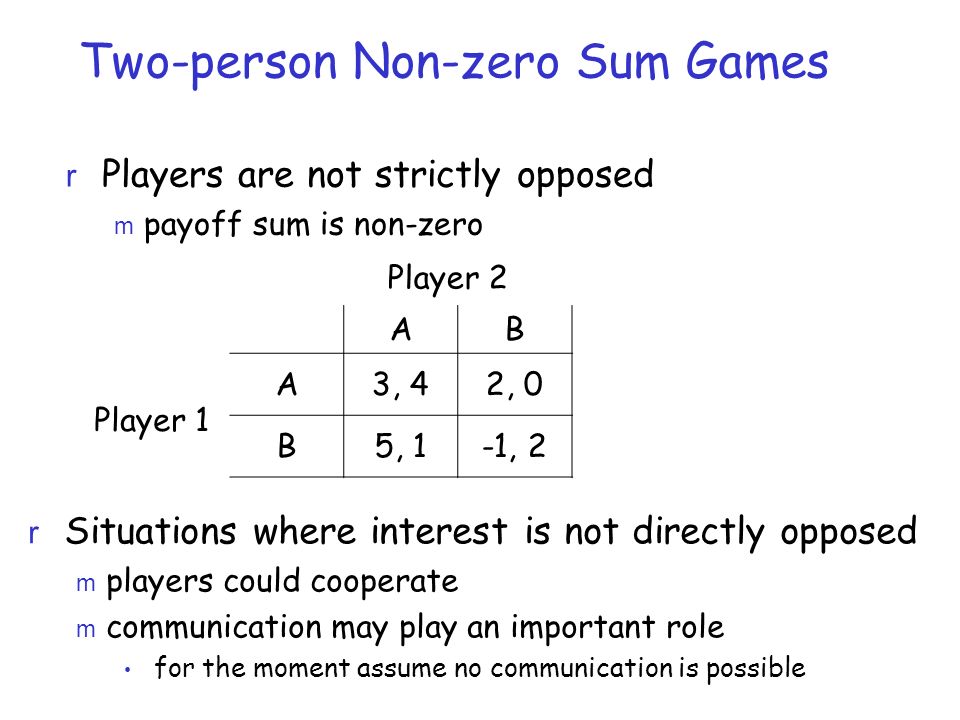
Positive Externalities Enable Positive-Sum Outcomes
One mechanism for achieving coordinated positive total returns is “positive externalities.” A positive externality occurs when an economic activity benefits third parties who are not directly involved in that activity. Because of these positive externalities, benefits extend beyond specific participants, enabling positive-sum outcomes.
Mass Positive Externalities: Public Goods
Public goods are known for generating positive externalities. Public goods are assets characterized by non-excludability and non-rivalry, meaning anyone can use them freely. Examples include air and parks, from which everyone can benefit at no cost. As such, public goods inherently create positive externalities. For instance, a park can serve as a playground for children and a venue for community interaction, enhance cultural and environmental standards for nearby residents, and function as a tourist attraction.
It may seem that the more public goods there are, the greater the positive externalities they generate, leading to a positive-sum state. However, due to the free-rider problem, supplying public goods is difficult, and they are typically maintained through government taxation and subsidies.
Unpopular Positive Externalities: Anti-Rival Goods
Among what are commonly called public goods, certain assets are considered anti-rival. Anti-rivalry means that the more a good is consumed, the greater the benefit it provides to third parties. Goods that are both anti-rival and excludable are called network goods; those that are anti-rival and non-excludable are called symbolic goods. Together, we refer to them as anti-rival goods. Anti-rival goods are defined as “goods whose value increases the more they are used or shared.” Examples include ideas and knowledge. When someone shares an idea or piece of knowledge, many others can use it to create new ideas, knowledge, products, or services. Indeed, the more ideas and knowledge are utilized, the more valuable they become. Another example is language: the more people who speak a particular language, the more useful it becomes. Some argue that transactions involving goods with these properties inherently avoid the free-rider problem. Anti-rival goods may welcome free riders because the more they are shared, the more valuable they become. Nevertheless, in a market economy, knowledge and ideas can be monetized and made excludable, creating asymmetries between supply and demand, thus forming business models. Regardless, anti-rival goods undoubtedly generate more positive externalities and enable positive-sum outcomes.

The Relationship Between Positive Externalities and Scale
It is believed that the scope of positive externalities varies with the scale of the good itself. Here, “scale” refers to how widely a good is used or consumed. Referring to earlier examples, for a public good like a park, comfort is maintained whether one or two people use it, or even three. But if hundreds or thousands use it simultaneously, discomfort may arise, leading to negative effects. On the other hand, for anti-rival goods like knowledge and ideas, expanding scale amplifies externalities, thereby increasing their value. Thus, there is a close relationship between positive externalities and the scale of goods. Moreover, it is generally believed that the provision of such goods leads to free-rider problems, resulting in under-provision. Hence, it is thought that the expansion of positive externality effects will eventually plateau.
Then, what is the relationship between positive externalities and scaling in the digital world? It is considered to fall into three main types.
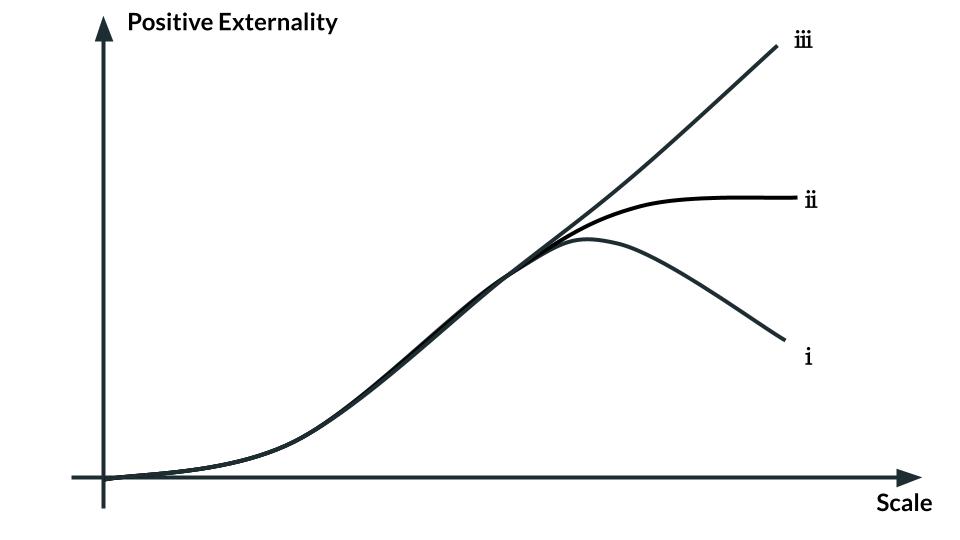
Relationship between positive externalities and scale
(i) Positive externalities increase monotonically with scale, but beyond a certain point, their effect begins to diminish.
Web 2.0 services are typical of this type. Web 2.0 services bring benefits to more people through network effects, yet many operate according to market principles that are competition-based, always producing winners and losers. Their primary goal is to win within the market framework, maximizing revenue and returns, while positive externalities are secondary. Meta (formerly Facebook) is an illustrative example. Meta derives value from widespread user adoption of social networks like Facebook and Instagram. Yet, it has consolidated dominance in the social networking industry by acquiring competing projects or launching similar services. While it operates under network externalities, its fundamental game remains a zero-sum contest in the marketplace. Consequently, coordination among different services is difficult. Additionally, Web 2.0 platforms centrally store user data, raising concerns about user privacy. As Web 2.0 scales, increased user numbers expose privacy risks stemming from centralized data control. Although some Web 2.0 services are free and accessible to all—resembling public goods—they tend to be centralized and potentially excludable, so they are not true public goods. For instance, the controversy surrounding X (formerly Twitter) suspending former President Trump’s account highlights the potential for exclusion inherent in Web 2.0 platforms. They lack credible neutrality.
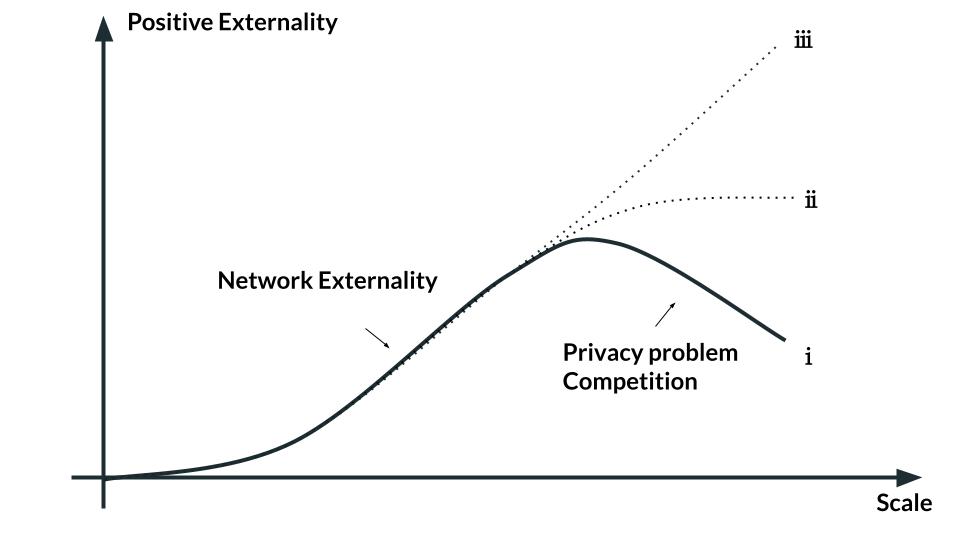
Relationship between positive externalities and scale in centralized systems
(ii) Positive externalities increase monotonically with scale, but their effect converges to a constant value as scale expands.
Open-source software (OSS) is a prime example of this case. OSS refers to software with publicly available source code, allowing anyone to use, modify, and distribute it. Its value increases as more people adopt it. Initially, OSS might be seen as a public good due to its non-rivalry and non-excludability, but it is more accurately classified as an anti-rival good. Take the open-source operating system Linux: its open nature has enabled integration into diverse services. Cloud providers such as AWS, Google Cloud, and Microsoft Azure have adopted Linux, expanding its role as mainstream cloud infrastructure. Furthermore, standardization efforts like the Linux Standard Base (LSB) improve compatibility across different Linux distributions. As a result, Linux’s value grows with broader usage and the development of complementary features. However, it is widely acknowledged that OSS faces the free-rider problem, leading to under-provision and sustainability challenges. This appears to contradict the assumed anti-rival nature of OSS, yet we generally recognize the existence of free-riding. Thus, as scale continues to expand, positive externalities eventually converge to a fixed level.
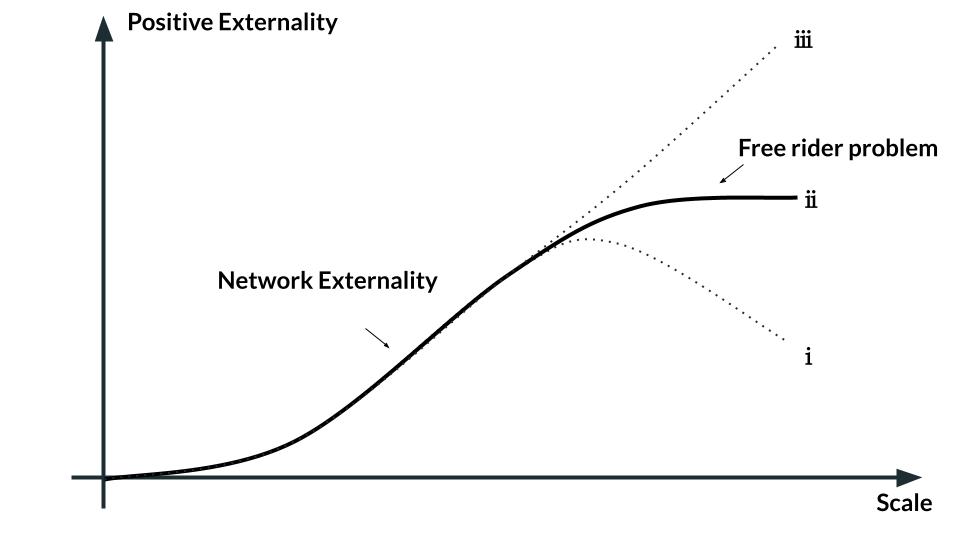
Relationship between positive externalities and scale in OSS
(iii) Positive externalities continue to increase monotonically as scale expands.
This scenario is the focus of this article, and we call such a design a “positive-sum design.” It is believed that positive-sum designs can be realized through cryptographic protocols. Let us explore why cryptocurrencies can achieve such positive-sum designs.
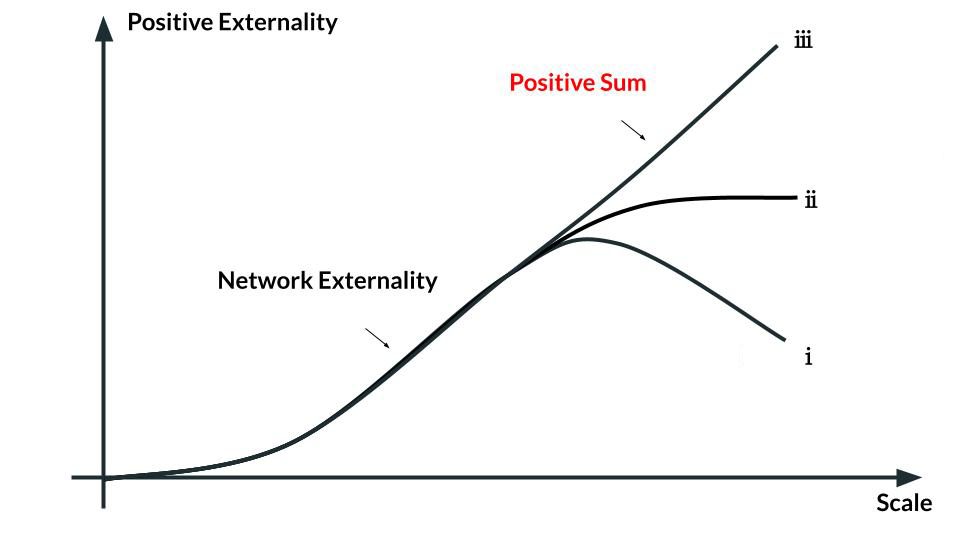
Relationship between positive externalities and scale in positive-sum design
Positive-Sum Design
The central argument of this article is: “To sustain positive-sum games, we need designs that continuously generate positive externalities as they scale.” Indeed, some advocate the importance of positive-sum states. This article discusses how such positive-sum designs can be achieved through cryptocurrencies.
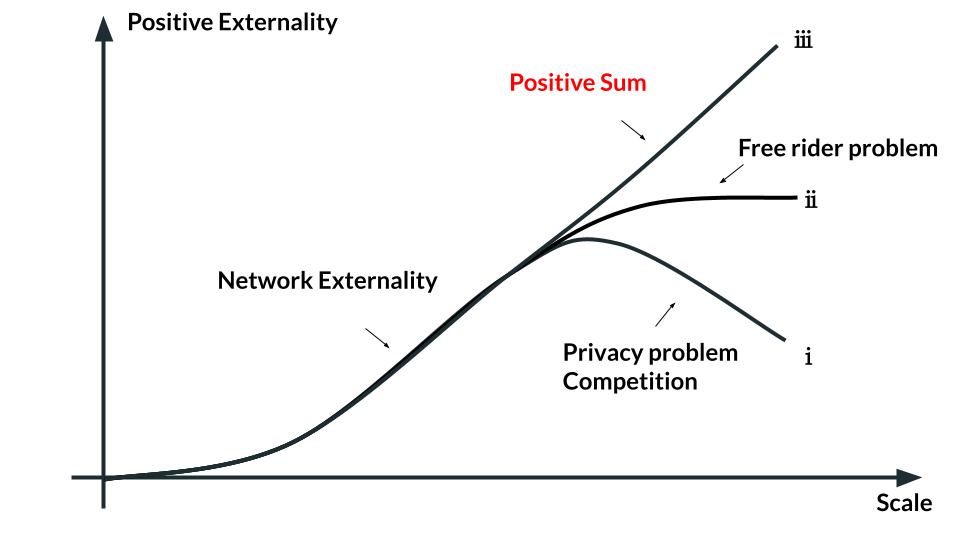
Summary of the relationship between positive externalities and scale
Reducing Negative Impacts
When Web 2.0 services scale, privacy issues often arise. Regulations like Europe’s GDPR represent movements to address such concerns. However, the emergence of blockchain technology has significantly altered this landscape. Blockchain enables data storage and management across multiple nodes instead of a single central server, enhancing data transparency, security, and fault tolerance. By holding private keys, users gain full control over their data, assets, and identities, enabling self-sovereign management. This can be seen as a technical complement to the negative impacts caused by the scaling of Web 2.0 services. It offers an architectural solution built into the protocol design itself, rather than relying on legal frameworks like GDPR.
Regarding open-source software, the free-rider problem may lead to under-provision, making sustainable supply generally difficult. Traditionally, governments intervene via taxation and subsidies to resolve free-riding. However, cryptographic protocols can maintain their own treasuries through protocol revenues or native token issuance. As discussed later, funding OSS through protocol revenue holds the potential to mitigate the free-rider problem.
Examples of Positive-Sum Design
As mentioned previously, blockchain and smart contracts can solve traditional coordination problems, notably through programmable design and incentive alignment. In particular, the ability to create self-contained economic systems via programmable design can continuously generate positive externalities. Protocols built on blockchain often exhibit these characteristics. Below, we list designs that sustainably produce positive externalities to maintain positive-sum dynamics.
Interacting with Other Projects: Tasks and Competitions
This type functions more as a tool for continuously generating positive externalities. By directly interacting with other protocols, it creates direct positive externalities. These services do not end with the protocol itself but guide users toward other services. For example, RabbitHole issues various tasks related to different protocols; completing these tasks earns users rewards. This mechanism allows users, driven by economic incentives and gamification, to engage with other protocols through RabbitHole in a game-like manner. Such engagement promotes beneficial actions within other protocols, generating positive externalities. Code4rena, also known as AuditDAO, is a protocol enabling community audits of protocol code. Using Code4rena, users audit other protocols’ code, encouraging actions beneficial to those protocols. Participating in hackathons and competitions can also prompt users to build products using certain protocols or find solutions to protocol issues, creating valuable contributions across various protocols. Specific projects include RabbitHole, Layer 3, buidlbox, Code4rena, Jokerace, Phi, and others.
Easy to Fork: SDKs
This is one of the most distinctive features of OSS. In OSS, source code is open, allowing anyone to download, customize, and use it as desired. This is a key advantage of OSS. Indeed, forking code has led to the creation of numerous new protocols. For instance, Moloch DAO is a protocol designed to fund Ethereum infrastructure as a critical digital public good, governed by stakeholders. Forking the Moloch codebase gave rise to protocols based on Moloch, such as MetaCartel. While forking in OSS essentially means duplicating a codebase, development kits and no-code tools have been created to make forking easier. DAOhaus is a tool specifically designed for forking Moloch. With DAOhaus, users can easily build a protocol with functionality similar to Moloch. Other examples include Cosmos SDK, which enables the creation of Layer 1 blockchains using Tendermint consensus, and OP Stack, which supports building Optimistic Rollups (same type as Optimism). These development kits make it easier to leverage the advantages of OSS and foster the creation of positive externalities. Specific projects include DAOhaus, Nouns Builder, Cosmos SDK, OP Stack, Conduit, Gitcoin Grants Stack, Zora, and others.
Composability
Composability is a familiar term in the crypto space, especially in DeFi, where it has become so prevalent that the phrase “money Legos” emerged. Many protocols are constructed by combining existing smart contracts—a trend particularly evident in DeFi. Similar tendencies appear in governance: for example, Compound’s on-chain governance contracts Governor Alpha & Bravo have been adopted even outside DeFi. However, a drawback of Governor Alpha and Bravo is that projects with differing needs must fork the code and customize it, posing high risks of introducing security vulnerabilities. To address this, OpenZeppelin built the “Governor” contract as a modular component within its OpenZeppelin Contracts system. Modular governance tools like Zodiac can be seen as extensions of this approach.
This is possible because the focus is on creating relatively small, modular components. If these components are open-source and lightweight, other protocols can adopt them more easily—just as bricks are more versatile than the grand castles built from them. Indeed, on Ethereum, the ERC20 token standard is more accessible than the Ethereum Virtual Machine (EVM). By building protocols from modular components, they become more composable, friendlier to other protocols, and help cultivate a positive-sum environment.
Incidentally, Ethereum Improvement Proposals (EIPs) on the Ethereum platform use the CC0 (Creative Commons Zero) license. CC0 is a public domain dedication that waives all copyright claims, allowing third parties to freely remix and build upon the work without permission—even commercially. By relinquishing all rights, proposers on Ethereum allow others to reuse their ideas on different blockchains or build new proposals permissionlessly. The adoption of CC0 facilitates smoother collaboration, makes network externalities easier to generate, and contributes to positive-sum outcomes.
Funding Public Goods
This may be the most unique aspect of cryptocurrency. While traditional OSS projects struggle to build self-sustaining economic ecosystems, cryptocurrencies enable programmable economics and treasury mechanisms.
Ethereum has long considered the issue of funding public goods and has conducted various experiments over time. The Ethereum Foundation and Gitcoin run funding programs. Gitcoin implements quadratic funding, proposed by Glen Weyl, Vitalik Buterin, and Zoe Hitzig. DAOs like Moloch DAO contribute to the Ethereum ecosystem, and various grant DAOs based on the Moloch protocol offer grant programs and retroactive public goods funding—Optimism has notably advanced and experimented with this in its third round. These initiatives involve not only funding their own protocols but also investing in peripheral tools that support their ecosystems. This approach attempts to address under-provision of public goods caused by free-riding. However, some entities appear more inclined to expand their own products rather than fund public goods. While ecosystem-expansion funds can still generate ongoing positive externalities, creating even greater positive impact may require approaches that transcend individual ecosystems.
Conclusion
It is well known that public goods and anti-rival goods generate positive externalities. Scaling to continuously create positive externalities is essential for nurturing a positive-sum state. This article summarizes pathways toward achieving such a state. While cryptocurrencies can address traditional coordination problems, the focus should not merely be on mitigating negative effects, but on pursuing greater positive impact. For us, designing protocols that sustainably generate positive externalities to maintain positive-sum games is crucial—and cryptocurrencies make this possible. Moreover, I believe positive-sum design may give rise to a regenerative economy, antifragile protocols, and resilient societies.
Special thanks to Scott Moore, Toby Shorin, and Naoki Akazawa for feedback, review, and inspiration.
Join TechFlow official community to stay tuned
Telegram:https://t.me/TechFlowDaily
X (Twitter):https://x.com/TechFlowPost
X (Twitter) EN:https://x.com/BlockFlow_News
 @fractonresearch









