








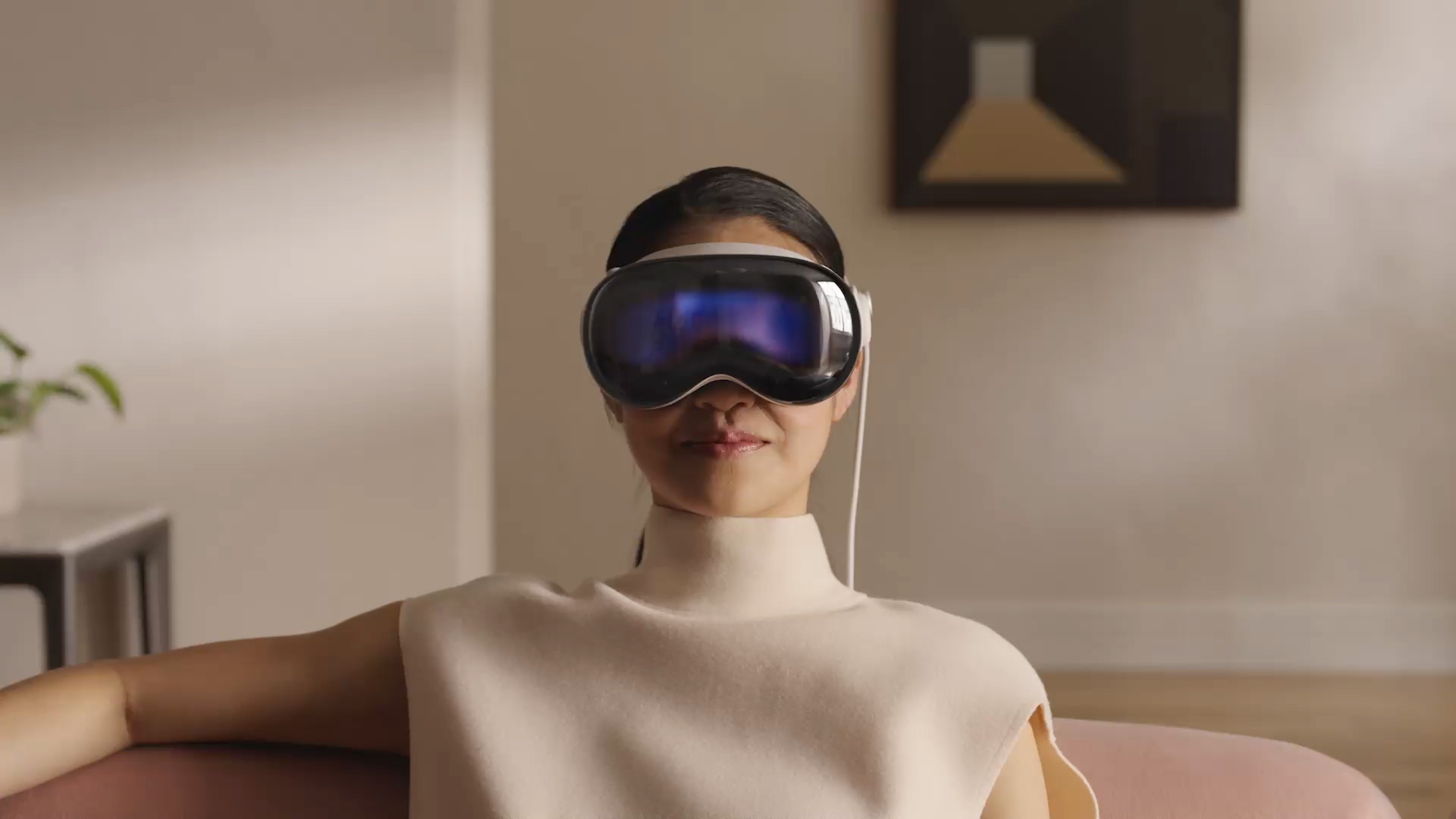
Has Vision Pro sparked a new round of privacy leak "nightmares"?
TechFlow Selected TechFlow Selected
Has Vision Pro sparked a new round of privacy leak "nightmares"?
The "spatial computing era" initiated by Vision Pro will bring privacy risks, content risks, and intellectual property risks alongside a new wave of intelligent hardware and software transformation.
 Navigating Web3 tides with focused insights
By Xiaosa Team
As early as June 6, 2023, during its Worldwide Developers Conference, a certain fruit company unveiled its latest flagship product—the MR headset. Users who have experienced the device describe it as "the best mixed-reality device to date." At the start of the launch event, CEO Tim Cook directly declared the revolutionary significance of the MR headset: "The Mac brought us into the personal computing era, the iPhone brought us into the mobile computing era, and Vision Pro will bring us into the spatial computing era."
Just one month ago, this "groundbreaking" MR headset began pre-sales in North America. Around February 2nd this year, the first batch of global users started receiving their units. According to the official purchase policy, customers who received their devices on February 2nd had a 14-day trial period, meaning they could return the product unconditionally by February 16th. As expected, just two days ago, news spread widely across various self-media platforms that "Vision Pro is facing massive returns." The main complaints centered on the device being bulky, causing discomfort when worn, and lacking a complete ecosystem of supporting applications. In fact, recent reports from self-media sources indicate that 50% of the pre-installed apps on Vision Pro remain unoptimized. Snazzy Labs, citing insiders, reported that only about half of the pre-loaded applications have been properly optimized for Vision Pro, with several running merely as windowed iPadOS apps.
Of course, market investors currently maintain a cautious stance toward Vision Pro. Beyond the aforementioned issues—such as bulkiness, user discomfort, and incomplete app support—there may be an even more serious concern: regulatory compliance in foreign countries. In particular, Vision Pro could potentially violate citizens' personal information privacy rights.
External Privacy Risks
As a novel hardware platform distinct from smartphones, smartwatches, and computers, Vision Pro integrates significantly more sensors and cameras. For instance, typical laptops such as the MacBook Pro or ThinkPad usually feature only one or two cameras—one for video conferencing and another for Windows facial recognition. Smartphones have more: typically 1–3 rear cameras of varying focal lengths, plus a lower-resolution front-facing camera. In contrast, Vision Pro is equipped with 12 cameras, two depth sensors, and six microphones! While these additional cameras, microphones, and depth sensors undoubtedly enhance sensory interaction experiences, they also provide attackers with broader attack surfaces. Reports of hackers exploiting device cameras to breach privacy are common. As early as 2014, CCTV aired a special report titled "Home Surveillance Cameras Pose Security Risks," revealing how hacker groups exploit system vulnerabilities to hijack cameras and invade privacy. Incidents involving hackers taking over laptop webcams to spy on users are nothing new. In fact, hackers have openly admitted that "hijacking a laptop's camera is extremely simple—just scan certain IP ranges, locate the webcam’s web login interface, crack the password, and you gain full access." Compared to traditional devices like smartphones and PCs, MR devices such as Vision Pro present a higher number of potential entry points for attackers due to their increased number of cameras, thereby posing greater risks of external privacy breaches.
Beyond threats from external attackers, Vision Pro also introduces media-sharing risks among users. For example, when riding the subway and noticing a passenger holding up a smartphone across from you, you naturally feel uneasy and worry whether they might be secretly photographing you. With MR devices like Vision Pro, which contain numerous cameras capable of discreet image capture, imagine encountering a passenger wearing a Vision Pro headset on the subway—you might be photographed without even realizing it. Of course, the fruit company has considered this issue during the design phase and implemented a solution: when Vision Pro takes photos or records videos, the device screen lights up with an indicator, signaling to those nearby that the user is capturing spatial images or videos, thus warning of potential privacy implications. However, the effectiveness of this measure remains questionable. Technically, bypassing the screen notification during recording via methods like jailbreaking would likely not be difficult. Moreover, as XR devices evolve, this is not just a challenge for Apple's Vision Pro—other MR manufacturers must also address the privacy risks associated with media sharing.
Internal Compliance Risks in Personal Information Protection
In addition to external threats from hackers and privacy concerns arising from user-generated media sharing, MR devices like Vision Pro also face compliance risks related to personal data collection within China. As previously noted by the Xiaosa team in their article "MR Headsets: Vision Pro, Legal Risk Pro in the Virtual Reality Industry?", some VR headsets currently collect and scan biometric data such as facial contours, irises, and retinas during use. Lawsuits concerning VR devices collecting sensitive personal information have already emerged overseas. Under China's Personal Information Protection Law (PIPL), such biometric data may qualify as sensitive personal information, raising significant compliance concerns around data collection. Industry players must pay close attention to ensuring proper compliance measures are in place.
In fact, information such as iris patterns, facial recognition features, and eye-gaze dwell time holds substantial commercial value and could trigger compliance risks. Take eye-gaze dwell time as an example: when devices collect data on where users focus their gaze, they can analyze attention patterns in specific environments. This capability can be widely used for personalized advertising. For instance, an MR device could gather a user’s eye-gaze data, identify content that captures the longest viewing duration, and then serve similar ads to improve customer acquisition rates. Such commercially valuable data poses clear risks of user privacy exposure. Beyond eye-tracking, Apple has developed Optic ID—a security authentication system based on iris recognition for Vision Pro—that analyzes users’ iris data under non-visible LED light to verify identity. Although Apple’s official website claims this iris data is fully encrypted and stored locally, users find it difficult to verify the authenticity of this claim. Furthermore, the compliance risks associated with devices collecting iris data are inherently high.
Final Thoughts
Beyond the privacy risks mentioned above, MR systems also face multiple compliance challenges including content governance and intellectual property anti-fraud obligations. China’s Regulations on the Governance of Network Information Content require online platforms to fulfill primary responsibilities for content management and strengthen oversight of information posted on their services. Developers and operators of XR devices and applications must comply with these content governance requirements to ensure regulatory compliance.
Additionally, XR device and application developers face critical intellectual property protection issues. For example, in digital twin technologies within virtual reality, should buildings in a digital twin city be protected under copyright law? Does virtualizing a copyrighted object constitute infringement? These questions require thorough legal analysis to avoid potential IP violations. Anti-fraud and anti-misleading obligations represent another major legal risk for the virtual reality industry. In recent years, virtual reality has increasingly converged with artificial intelligence—particularly AIGC (AI-Generated Content) technology. AIGC can produce vast amounts of hyper-realistic "fake" content, which, when amplified through VR technology, gains immense destructive potential. Industry practitioners must take these legal risks seriously, fulfill anti-fraud and anti-misleading duties, and strengthen their overall compliance frameworks.
The "spatial computing era" initiated by Vision Pro, while ushering in a new wave of intelligent hardware and software transformation, simultaneously brings privacy, content, and intellectual property risks. These compliance challenges may not be limited to Vision Pro alone but could affect the entire XR market. Each compliance aspect must be carefully addressed.
Join TechFlow official community to stay tuned
Telegram:https://t.me/TechFlowDaily
X (Twitter):https://x.com/TechFlowPost
X (Twitter) EN:https://x.com/BlockFlow_News










