








Variant Investment Partner: New Opportunities in the Farcaster Stack
TechFlow Selected TechFlow Selected
Variant Investment Partner: New Opportunities in the Farcaster Stack
Farcaster's two latest features are that user data is not limited to a single interface, and each account is connected to a wallet.
 Navigating Web3 tides with focused insights
Author: Alana Levin, Investment Partner of Variant Fund
Translation: TechFlow
We are witnessing the emergence of a new real-time social graph: Farcaster. Until two weeks ago, the most popular client today (Warpcast) superficially resembled a clone of Twitter. Then the team launched Frames, triggering a wave of growth as it became clear that Farcaster’s permissionless infrastructure enabled novel distribution channels.
But even beyond Frames, the Farcaster network has unbundled rich layers and opened them up to developers. This unbundling creates new opportunities.
In my view, the Farcaster stack consists of four layers. At each layer, different work is required and different resources exist. From bottom to top:
-
On-chain: Storage units, accounts (keys), and on-chain namespaces (like ENS). These are things requiring global consensus.
-
Off-chain (Farcaster Protocol): The Farcaster namespace (fname) and data generated by accounts interacting on the network.
-
Applications (clients; interface layer): The layer where users log in and interact. Depending on the client, features may include channels (think: subreddits-like) or special in-app currencies (e.g., Warps in Warpcast).
-
Headless Layer: These can be bots leveraging client distribution (e.g., Bountycaster), applications (all Frames), assets originating from clients but extending far beyond their scope (e.g., memecoins), NFTs benefiting from in-client distribution, and more.
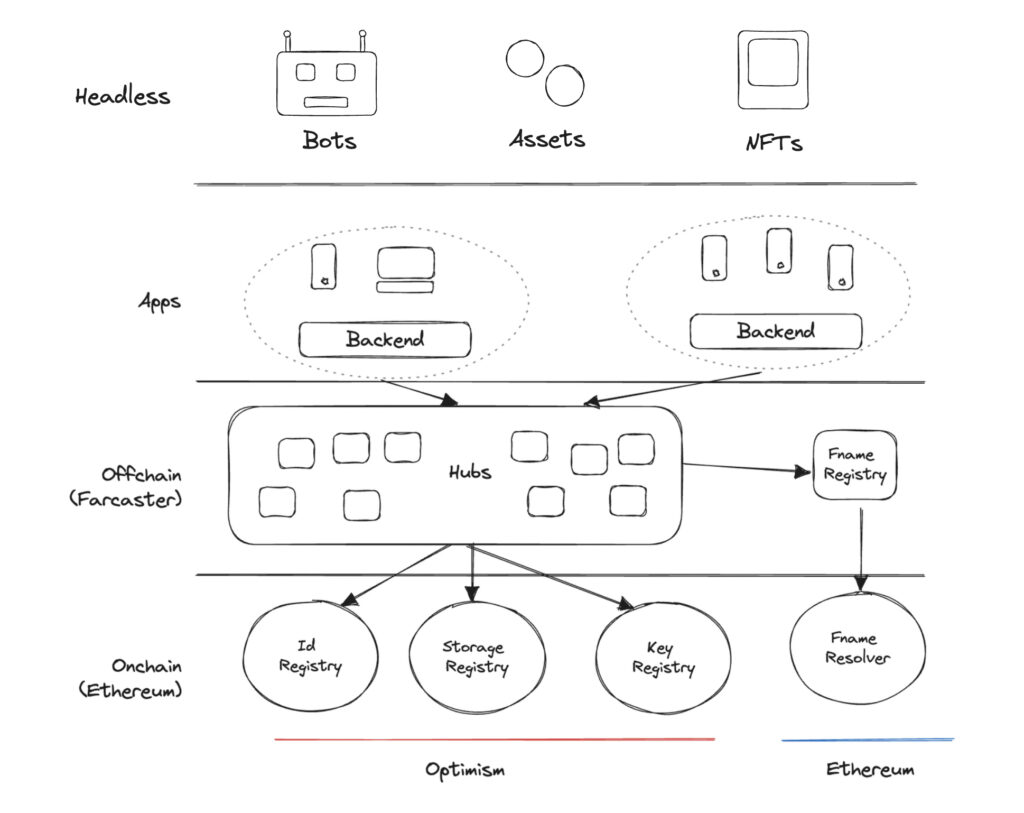
Modified from Farcaster documentation, provided by Omer Demirtas
The good news for startup founders is: every layer of the stack offers open opportunities!
At the on-chain layer, real-time resources include storage contracts and accounts. These are net-new assets—where there are assets, there are opportunities for issuance and exchange. The Farcaster team controls issuance, but exchanges may emerge. We’ve already seen early signs of account marketplaces, where early adopters’ accounts (represented by their Farcaster ID, or FID) are being sold at a premium. We haven’t yet seen markets for renting unused storage (partly because storage units are permissioned), but this could change at some point in the future.
At the Farcaster protocol (off-chain) layer, the main resources are fnames and API-generated data (maintained by hubs). We’ve already seen one company—Neynar—become a one-stop shop that makes building on Farcaster easier: it runs hubs on behalf of clients, maintains API versions, helps create tools like bots and frames, and more. It’s essentially “Farcaster support as a service.” FaaS is a category I expect could have multiple winners, especially as the network grows.
To my knowledge, no one has truly experimented with f-names yet—possibly because the Farcaster team owns the registry. But perhaps this presents an opportunity. Could the registry be forked? One might imagine a new protocol maintaining a resolver between its forked namespace and the canonical f-namespace, keeping user accounts synchronized. Benefits could include making the off-chain namespace more permissionless or adding application-specific functionality for how certain names interact on the network. Currently, the Farcaster team can revoke names from accounts (e.g., if someone squats on a popular brand name or impersonates another). These are valuable safeguards, but forking the registry could open design space to test alternative rules about what is and isn’t allowed in names.
The client and headless layers are where I’m personally most excited. Today, they appear as two distinct layers: clients have their own feeds, while headless apps live within other feeds. Two of Farcaster’s newest features are that user data isn’t confined to a single interface, and every account is connected to a wallet. Clients leverage the former; headless projects take advantage of the latter.
If we anticipate many Farcaster clients participating in the world, the question becomes, how do we get there? One path for developers is to build new clients directly: identify a non-first-party media type and build a client offering first-class experience for it. One might argue this mirrors how successful web2 apps found product-market fit—from Instagram (images) to Twitter (microblogging) to YouTube (video) to Vine (very short videos). Perhaps new Farcaster clients will follow similar patterns—but I’d look for emerging data types (like assets or frames), rather than media types developers have iterated on for years. Twitter started as microblogging but is now multimedia. So did YouTube, Spotify, and many others. Thus, the unlock may lie in something new: first-party clients tailored to data types people haven’t yet mastered.
However, if I were starting a “client” company today, I’d begin with a headless architecture. In practice, this means finding a tool that meets current user needs and delivers value, while cross-posting any content generated by that tool into a new client.
We’ve seen this model succeed before: YouTube first gave users a tool to embed videos on their personal websites. As the content catalog grew, YouTube cross-posted these videos onto the YouTube website itself, creating a valuable video library that became the primary reason consumers visited YouTube. Headless applications can follow the same playbook: build a bot (or frame) that provides a service within existing feeds, but use initial engagement to gradually drive adoption of another interface. Bountycaster is my favorite example so far. I’m optimistic there will be many more!
There are many opportunities. It’s incredibly exciting. Six months ago, Farcaster looked nothing like it does today. Six months from now, it may look vastly different again (in a good way!). As Sheryl Sandberg once said: “If you’re offered a seat on a rocket ship, don’t ask what seat.” Farcaster is a rocket ship. In fact, founding companies within the ecosystem means building your own seat. Maybe you’ll still wonder which seat excites you most to build—but the key takeaway should be that there are indeed many seats left to build.
Finally, if you’ve made it this far without knowing what Farcaster is, you can (and should!) sign up here for an account.
Join TechFlow official community to stay tuned
Telegram:https://t.me/TechFlowDaily
X (Twitter):https://x.com/TechFlowPost
X (Twitter) EN:https://x.com/BlockFlow_News
 Variant






