A Comprehensive Analysis of the BTC Ecosystem: Reshaping History or Ushering in the Next Bull Market?
TechFlow Selected TechFlow Selected
A Comprehensive Analysis of the BTC Ecosystem: Reshaping History or Ushering in the Next Bull Market?
A Ten-Thousand-Word Analysis: How Will the Future of Bitcoin's Ecosystem Unfold?
 Navigating Web3 tides with focused insights
Author: Fred, Ryze Labs
*This article contains approximately 24,000 Chinese characters and takes about 25–30 minutes to read.
I. Introduction: The Historical Development of the BTC Ecosystem
The recent boom in Bitcoin inscriptions has sparked excitement among crypto users. Bitcoin, once primarily seen as "digital gold" and a store of value, is now drawing renewed attention to its ecosystem’s development and potential due to the emergence of the Ordinals protocol and BRC-20 tokens.
As the first blockchain, Bitcoin was created in 2008 by an anonymous entity known as Satoshi Nakamoto, marking the birth of a decentralized digital currency that challenged traditional financial systems.
Born as an innovative response to the inherent flaws of centralized finance, Bitcoin introduced the concept of a peer-to-peer electronic cash system—enabling trustless and disintermediated transactions. Its foundational technology—blockchain—revolutionized how transactions are recorded, verified, and secured. The Bitcoin white paper released in 2008 laid the groundwork for a financial system emphasizing decentralization, transparency, and immutability.
Following its creation, Bitcoin experienced gradual and steady growth. Early adopters were mainly tech enthusiasts and cryptography advocates who began mining and trading Bitcoin. The first documented real-world transaction occurred in 2010 when programmer Laszlo bought two pizzas in Florida with 10,000 BTC—a historic moment in cryptocurrency adoption.
As Bitcoin gained visibility, supporting infrastructure began to form. Exchanges, wallets, and mining pools emerged to meet the needs of this new digital asset. As blockchain technology and markets evolved, the ecosystem expanded to include more stakeholders such as developers, startups, financial institutions, and regulators, driving greater diversification within the Bitcoin ecosystem.
In 2023, after a long period of market dormancy, the rise of the Ordinals protocol and BRC-20 tokens brought forth the "summer of inscriptions," refocusing attention on Bitcoin—the oldest public blockchain. What will be the future of the Bitcoin ecosystem? Could it become the engine of the next bull market? This report will delve into the historical evolution of Bitcoin’s ecosystem and explore its three core directions—asset issuance protocols, scalability solutions, and infrastructure—to analyze their current state, advantages, challenges, and future prospects.
II. Why We Need a Bitcoin Ecosystem
1. Bitcoin's Characteristics and Development History
Before discussing why we need a Bitcoin ecosystem, let’s first examine Bitcoin’s fundamental characteristics and development history.
Unlike traditional financial accounting methods, Bitcoin has three core features:
-
Decentralized distributed ledger: At the heart of the Bitcoin network lies blockchain technology—a decentralized distributed ledger recording all transactions on the Bitcoin network. The blockchain consists of blocks, each containing the hash of the previous block, forming a chain structure that ensures transaction transparency and immutability.
-
Proof-of-Work (PoW) for transaction validation: The Bitcoin network uses PoW to validate transactions and maintain the ledger. This mechanism requires nodes to solve complex mathematical puzzles to verify transactions and record them on the blockchain, ensuring network security and decentralization.
-
Mining and Bitcoin issuance: New bitcoins are issued through mining. Miners solve computational puzzles to validate transactions and create new blocks, earning newly minted bitcoins as rewards.
It is important to note that unlike common payment systems like PayPal, Alipay, or WeChat Pay—which operate on account models by directly adjusting balances—Bitcoin uses the UTXO (Unspent Transaction Output) model.
Here is a brief explanation of the UTXO model to help readers understand the technical foundations of subsequent ecosystem projects. UTXO is a method for tracking Bitcoin ownership and transaction history. Each unspent output represents a transaction output on the Bitcoin network that hasn’t been spent yet and can be used to construct new transactions. Key characteristics of the UTXO model include:
-
Each transaction creates a new UTXO: When a Bitcoin transaction occurs, it consumes prior UTXOs and generates new ones, which serve as inputs for future transactions.
-
Transaction verification relies on UTXOs: To validate a transaction, the Bitcoin network checks whether the referenced UTXOs exist and have not been previously spent, ensuring transaction validity.
-
UTXOs act as transaction inputs and outputs: Each UTXO has a value and an owner address. In a new transaction, some UTXOs are consumed as inputs, while others are created as outputs, potentially usable in future transactions.
The UTXO model offers higher security and privacy because each UTXO has its own owner and value, allowing finer-grained transaction tracking. Additionally, the design enables parallel transaction processing since individual UTXOs can be independently utilized without resource contention.
However, due to limitations on block size and the non-Turing-complete scripting language, Bitcoin has largely remained confined to the role of "digital gold," unable to support broader applications.
After Bitcoin’s launch, Colored Coins appeared in 2012, using metadata on the Bitcoin blockchain to represent other assets; in 2017, a hard fork over block size disputes led to chains like BCH and BSV; following these forks, BTC continued exploring scalability improvements, including the SegWit upgrade in 2017, which introduced extended blocks and block weight metrics to increase capacity; and the Taproot upgrade starting in 2021, enhancing transaction privacy and efficiency. These critical upgrades laid the foundation for later scalability and asset issuance protocols, ultimately enabling the popularity of the Ordinals protocol and BRC-20 tokens.
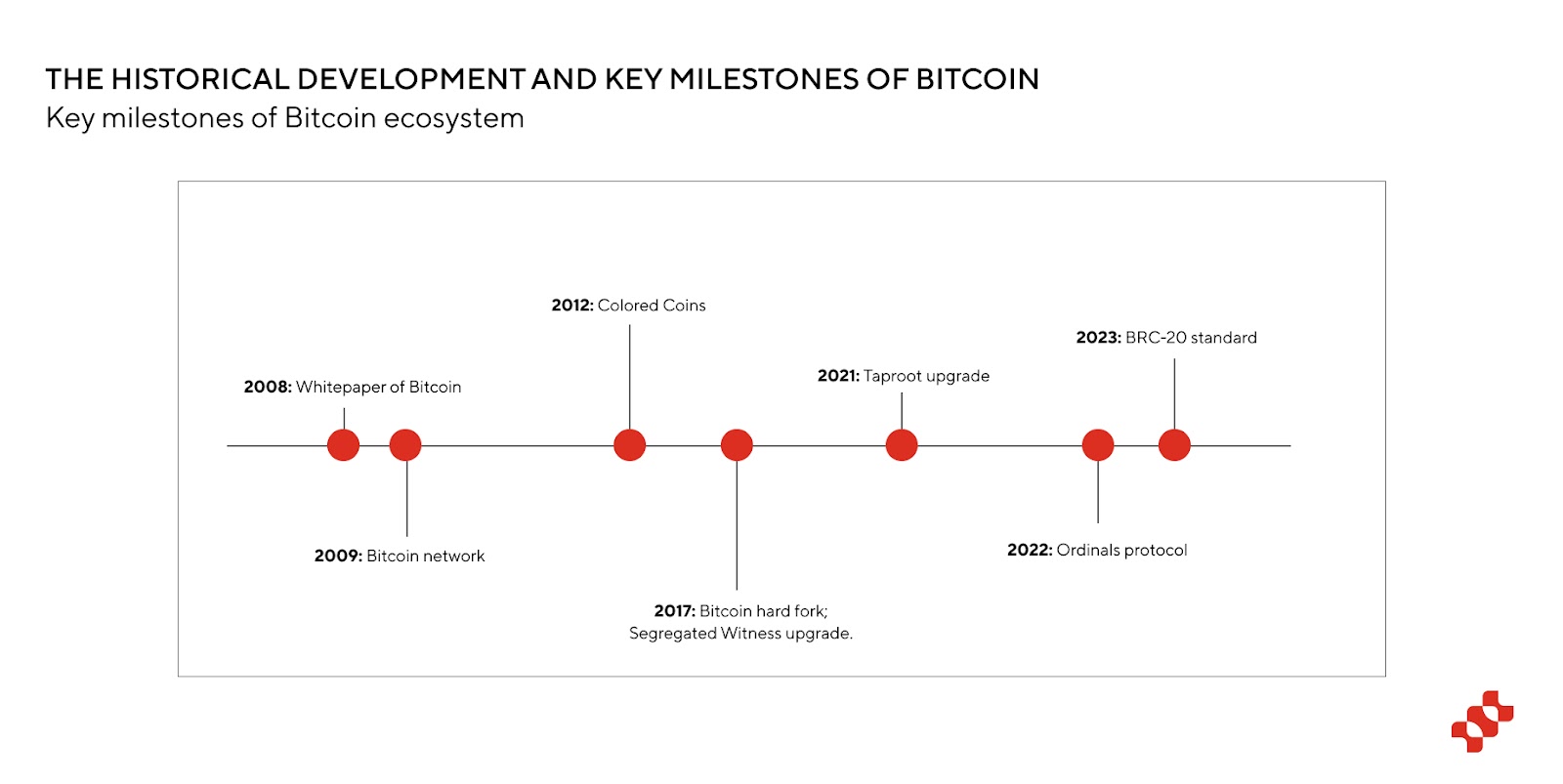
Although Bitcoin was originally designed as a peer-to-peer electronic cash system, many developers have consistently aimed to expand beyond its “digital gold” status, striving to enhance Bitcoin’s scalability and enable richer applications built directly on the Bitcoin blockchain.
2. Comparison Between Bitcoin Ecosystem and Ethereum Smart Contracts
During Bitcoin’s development, in 2013 Vitalik Buterin proposed another blockchain—Ethereum—which he co-founded with Gavin Wood and Joseph Lubin. Ethereum’s core innovation is providing a programmable blockchain where developers can build various applications beyond simple monetary transactions. This programmability makes Ethereum a smart contract platform, enabling automated agreements executed without third-party trust.
Ethereum’s most notable feature is its support for smart contracts, allowing developers to build diverse applications. Thanks to this capability, Ethereum gradually became the leader in the entire crypto space, hosting numerous Layer 2s, dApps, and token standards like ERC-20 and ERC-721, attracting a large developer community to enrich its ecosystem.
Given that Ethereum already supports smart contracts and dApp development, why do people still want to return to BTC for expansion and application development? The core reasons can be summarized in three aspects:
-
Market consensus: As the earliest blockchain and cryptocurrency, Bitcoin enjoys the highest recognition and trust among the public and investors. It holds a unique advantage in acceptance and credibility, with a current market cap of around $800 billion—nearly half of the total crypto market.
-
High degree of decentralization: Among mainstream blockchains, Bitcoin is the most decentralized. Its creator, Satoshi Nakamoto, has disappeared, leaving the chain entirely driven by the community. In contrast, Ethereum still has active leadership from Vitalik and the Ethereum Foundation.
-
Retail demand for fair launches: Web3 innovation depends heavily on new asset issuance mechanisms. In traditional token launches—whether FTs or NFTs—projects are typically initiated by teams, and retail gains depend strongly on project teams and behind-the-scenes VCs. In contrast, the Bitcoin ecosystem introduced innovative fair launch platforms via inscriptions, giving retail participants greater influence and attracting more capital and wealth into the BTC ecosystem. Much of Bitcoin’s renewed attention stems from this fair-launch characteristic.
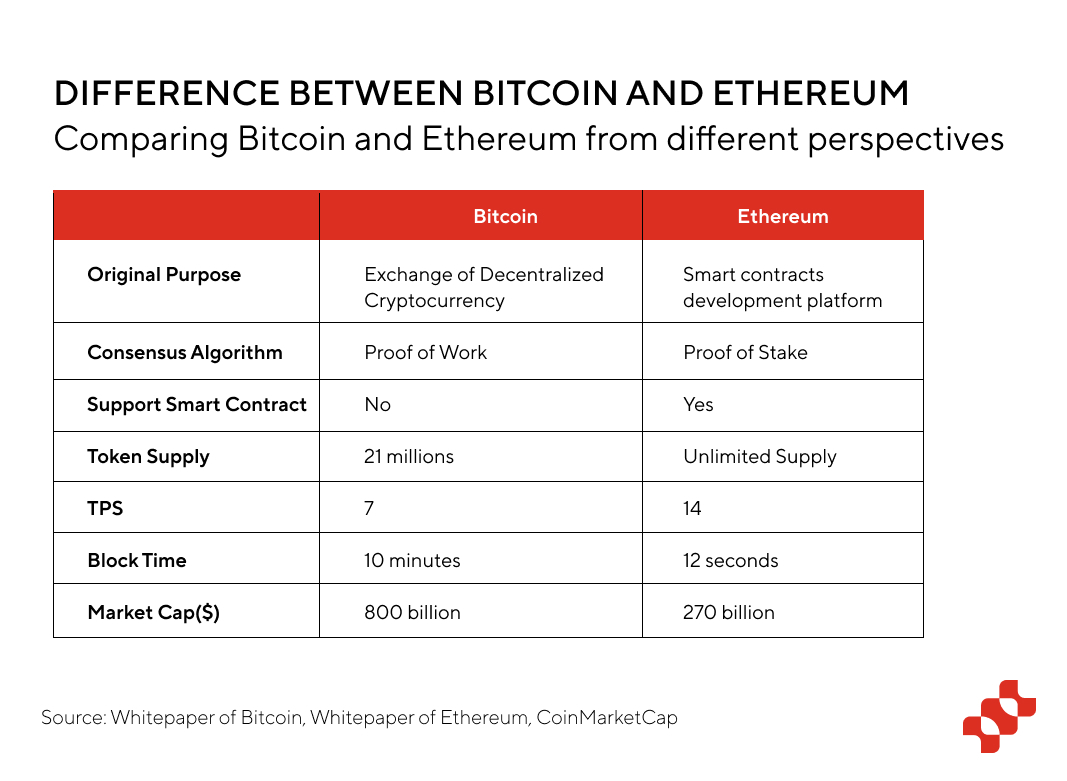
This explains why, despite BTC’s inferior TPS and block time compared to Ethereum, many developers still strive to introduce smart contract capabilities and build applications on top of Bitcoin.
In summary, just as BTC’s rise stemmed from value consensus—widespread belief in Bitcoin as a valuable digital asset and medium of exchange—the evolution of the crypto world remains deeply tied to asset properties. Currently, the heat in the Bitcoin ecosystem is primarily driven by inscription-based assets like those enabled by the Ordinals protocol and BRC-20. This momentum feeds back into the broader Bitcoin ecosystem, re-attracting interest toward Bitcoin-based innovations.
Unlike previous bull markets, retail investors now wield increasing influence. Traditionally, VCs and project teams dominated the crypto market, funding and advancing many blockchain initiatives. However, as retail interest grows, individuals seek greater participation in market dynamics and project governance. To some extent, retail investors have helped drive this wave of Bitcoin ecosystem development and revitalization.
Therefore, although the Ethereum ecosystem offers greater flexibility in smart contracts and decentralized applications, Bitcoin’s role as digital gold and stable value storage—combined with its leading position and strong market consensus—ensures its unparalleled importance across the cryptocurrency landscape. Hence, ongoing efforts continue to develop and explore Bitcoin’s full potential.
III. Current State Analysis of Bitcoin Ecosystem Projects
From observing the development of the Bitcoin ecosystem, two main challenges currently stand out:
-
Bitcoin’s limited scalability means better scaling solutions are required to support application development;
-
The Bitcoin ecosystem lacks diverse applications. For sustained growth, it needs breakout apps/projects to attract more developers and foster further innovation.
To address these issues, the Bitcoin ecosystem is focusing on three key areas:
-
Asset issuance protocols;
-
Scalability solutions: on-chain scaling and Layer 2;
-
Infrastructure projects such as wallets and cross-chain bridges.
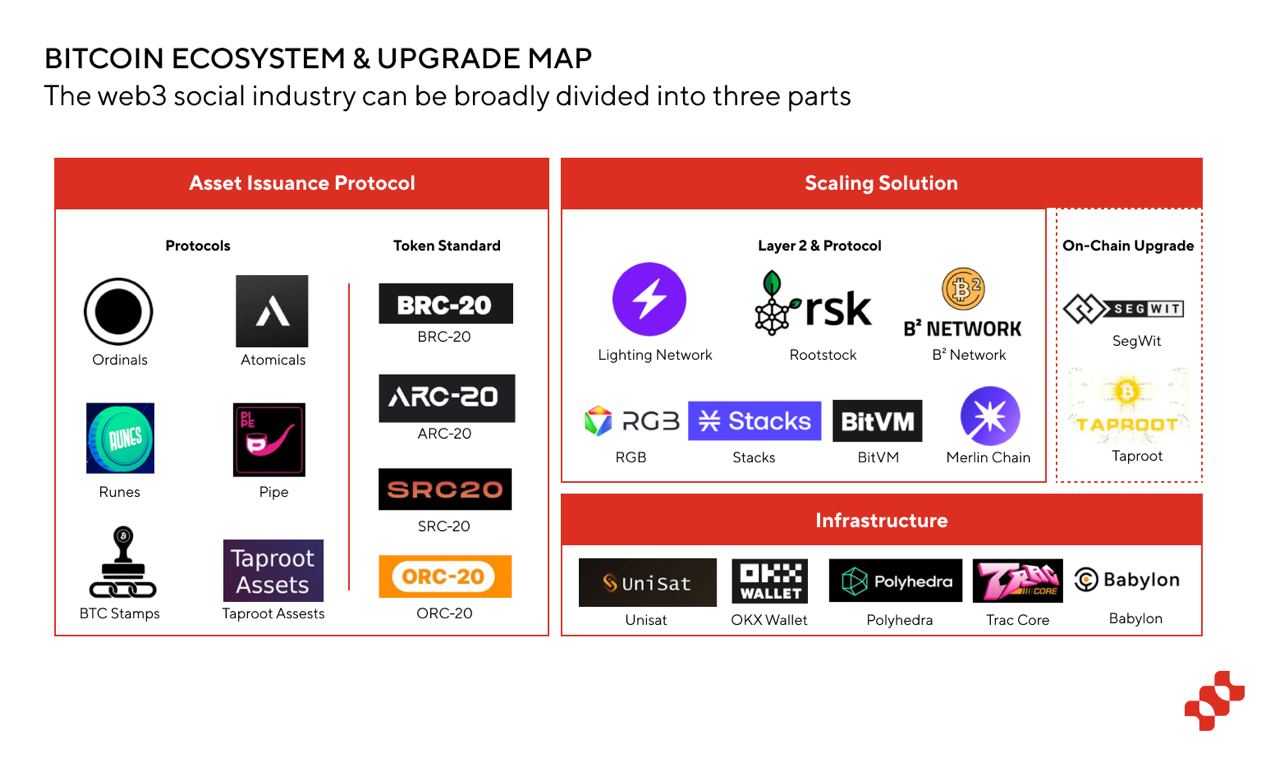
Since the overall Bitcoin ecosystem remains in its early stages—with use cases like DeFi still emerging—this article focuses on analyzing developments in four areas: asset issuance, on-chain scaling, Layer 2, and infrastructure.
1. Asset Issuance Protocols
The surge in Bitcoin ecosystem activity since 2023 has been fueled by the Ordinals protocol and BRC-20, transforming Bitcoin from a mere store of value into a platform for asset issuance, greatly expanding its utility.
Beyond Ordinals, various alternative protocols—including Atomicals, Runes, and Pipe—have emerged to support asset issuance on BTC.
1) Ordinals & BRC-20
Let’s begin with the Ordinals protocol. Simply put, Ordinals allows users to mint NFT-like assets on Bitcoin similar to those on Ethereum. Notable early examples include Bitcoin Punks and Ordinal Punks. Later, the popular BRC-20 standard emerged based on the Ordinals protocol, sparking the “summer of inscriptions.”
The Ordinals protocol was launched in early 2023 by Casey Rodarmor, who has worked at Google, Chaincode Labs, and Bitcoin Core since 2010 and now co-hosts SF Bitcoin BitDevs, a Bitcoin discussion group.
Casey became interested in NFTs in 2017 and experimented with Solidity-based Ethereum smart contracts but abandoned the idea, calling Ethereum NFTs a “Rube Goldberg machine”—overly complex for simple tasks. In early 2022, he revisited the idea of building NFTs on Bitcoin. During his research, he drew inspiration from references to “atoms” in Satoshi Nakamoto’s original Bitcoin codebase. In part, Casey aimed to make Bitcoin fun again—leading to the birth of Ordinals.
How does the Ordinals protocol enable what users commonly call BTC NFTs—Ordinal Inscriptions? Two core elements are involved:
-
First, assigning serial numbers to individual Satoshis (the smallest unit of Bitcoin), enabling non-fungible identification of each satoshi and tracking their movement during transactions—an innovative approach.
-
Second, supporting the attachment of arbitrary content—including text, images, videos, audio—to individual satoshis, creating unique native digital items on Bitcoin—inscriptions (commonly known as NFTs).
By numbering satoshis and attaching content, Ordinals enables users to possess NFT-like assets on Bitcoin comparable to those on Ethereum.
Now let’s dive deeper into the technical details. Regarding serial number assignment, new ordinals only originate from Coinbase Transactions (the first transaction in each block). By tracing UTXO transfers back to corresponding Coinbase transactions, one can determine the ordinal number of satoshis within a UTXO. Crucially, this numbering system isn't derived from on-chain data—it's established off-chain by external indexers. Effectively, it’s a numbering system imposed by the off-chain community onto on-chain satoshis.
After Ordinals’ launch, numerous interesting NFTs emerged—such as Ordinal Punks and TwelveFold. As of now, Bitcoin inscriptions exceed 54 million. Building upon Ordinals, the BRC-20 standard emerged, launching the BRC-20 summer.
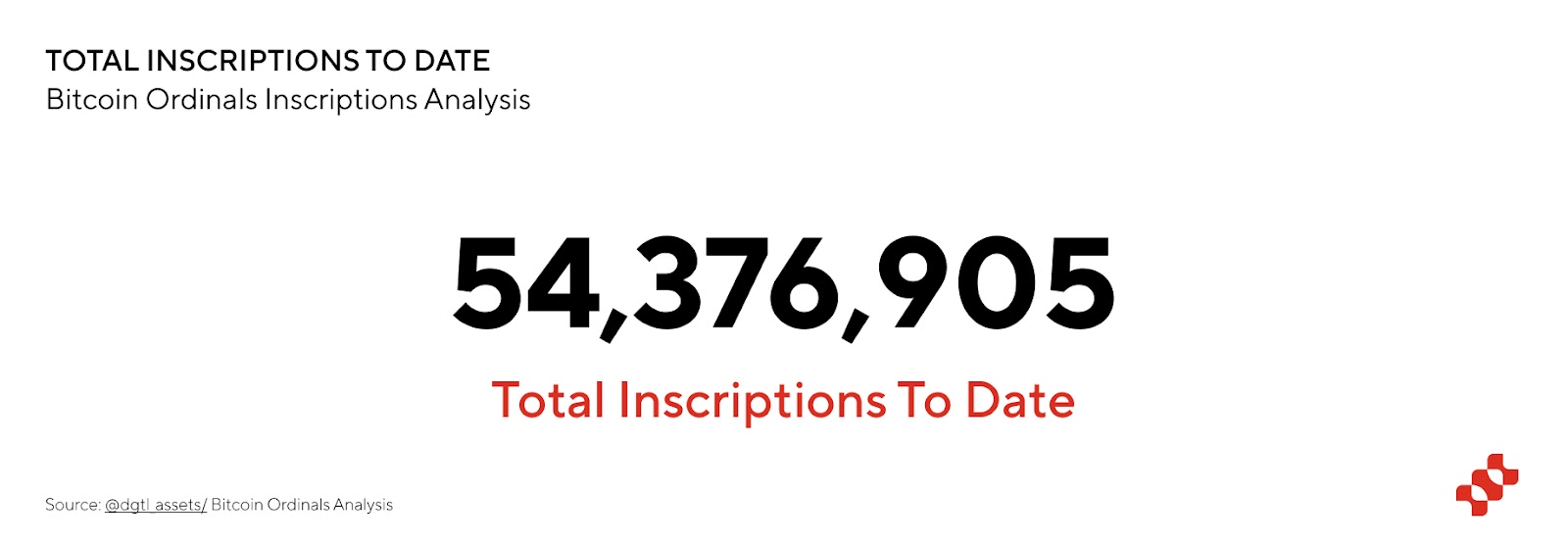
(Source: Dune – Total Number of Ordinals Inscriptions)
The BRC-20 protocol builds on Ordinals by embedding token functionalities—deployment, minting, and transfer—into script data.
-
Token deployment: Specify “deploy” in script data, indicating token name, total supply, and per-mint limits. Indexers detect this information and begin recording minting and transfers.
-
Token minting: Indicate “mint” in script data, specifying token name and amount. Indexers update recipient balances accordingly.
-
Token transfer: Mark “transfer” in script data, stating token name and quantity. Indexers deduct the sender’s balance and credit the recipient’s.
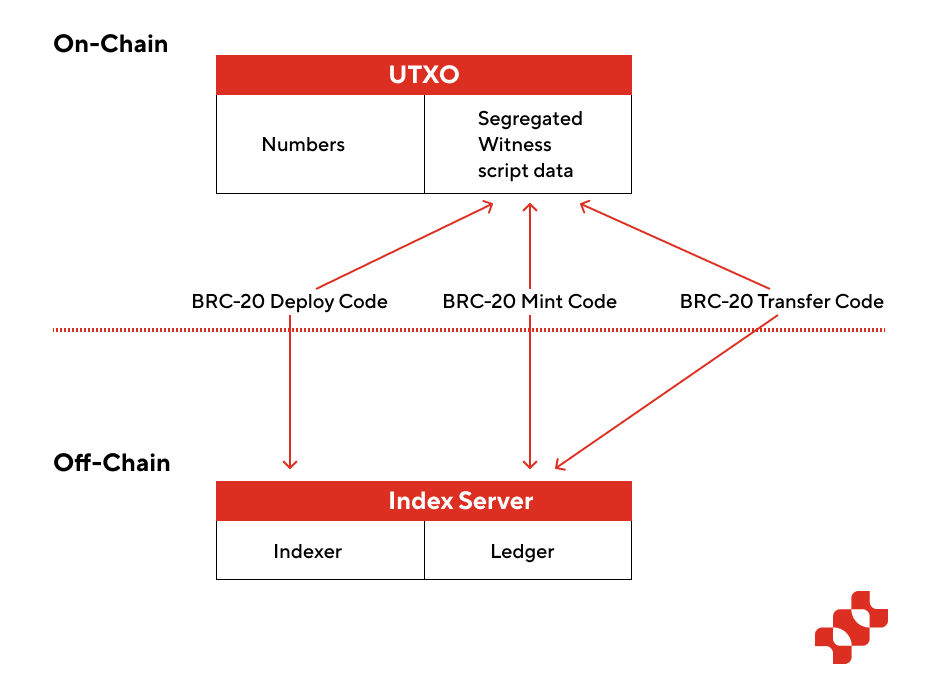
From a technical standpoint, since BRC-20 token balances are embedded in SegWit script data—not natively recognized or recorded by the Bitcoin network—they must be tracked locally by indexers. Essentially, Ordinals treats the Bitcoin network merely as storage space—recording metadata and operation descriptions on-chain—but performs all actual computation and state updates off-chain.
After its launch, BRC-20 ignited the inscription market, dominating Ordinals-based assets. As of January 2024, BRC-20 accounts for over 70% of all Ordinals asset types. From a market cap perspective, BRC-20 tokens have reached $2.6 billion, with leading token ORDI valued at $1.1 billion and SATS around $1 billion. The emergence of BRC-20 has injected fresh energy into both the Bitcoin ecosystem and the broader crypto world.
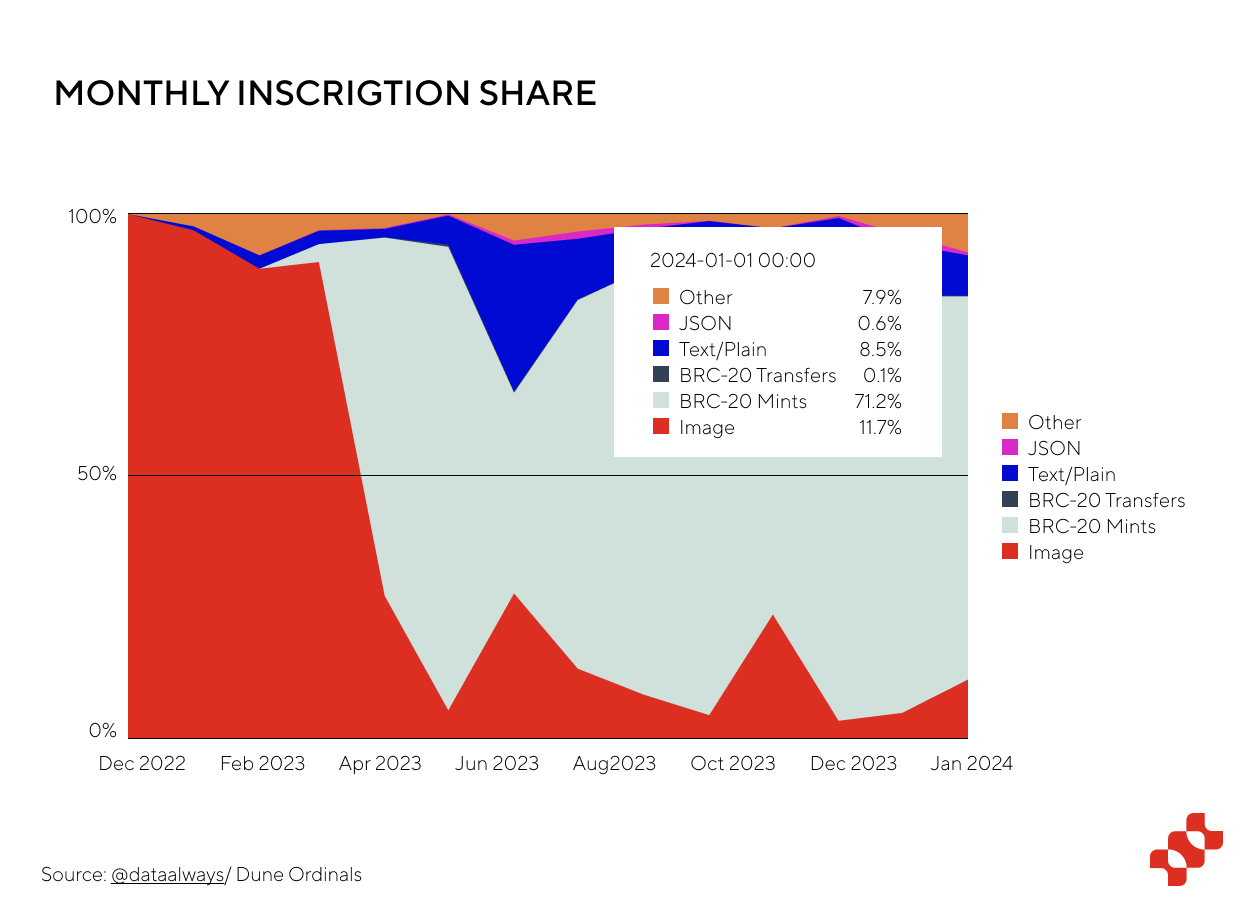
(Source: Dune – Distribution of Different Ordinals Asset Types)
Behind BRC-20’s success lie several core factors:
-
Wealth-generation effect: The explosion of Web3 protocols and projects often hinges on wealth generation. As a new asset class on BTC, BRC-20 naturally attracts massive user attention and mindshare.
-
Fair Launch: BRC-20 inscriptions offer fair distribution—no one starts as an insider. Compared to traditional Web3 projects, Fair Launch levels the playing field between retail investors and VCs, encouraging broader participation. Even malicious actors face real costs when attempting to hoard BRC-20 tokens.
Overall, while the Ordinals protocol has faced criticism from parts of the Bitcoin community—concerns that Bitcoin NFTs and BRC-20 may rapidly inflate block sizes, raising node operation requirements and reducing decentralization—from a positive view, Ordinals and BRC-20 demonstrate a new use case for Bitcoin beyond “digital gold,” injecting vitality into the ecosystem and attracting developers to innovate in scaling, asset issuance, and infrastructure.
2) Atomicals & ARC-20
The Atomicals protocol was launched in September 2023 by an anonymous Bitcoin community developer, aiming to enable asset issuance, minting, and trading without relying on external indexing—building a more native and robust asset issuance protocol than Ordinals.
What distinguishes Atomicals from Ordinals? Their key technical differences include:
-
Indexing: Instead of assigning IDs to satoshis off-chain, Atomicals indexes at the UTXO level.
-
Content embedding (“engraving”): Rather than attaching content to satoshis within SegWit script data, Atomicals embeds content directly into UTXOs.
Additionally, Atomicals introduces a PoW mechanism, adjusting mining difficulty via prefix character length. Minters must use CPU power to compute matching hash values, achieving fairer distribution.
Under Atomicals, three asset types emerge: NFTs, ARC-20 tokens, and Realm Names. Realms represent an innovative domain system where domains act as prefixes rather than suffixes.
Now let’s focus on ARC-20. Unlike BRC-20, which is community-developed atop Ordinals, ARC-20 is officially supported by the Atomicals protocol. While BRC-20 writes tokens into SegWit script data, ARC-20 follows a colored coin model—registering token info directly on UTXOs and handling all transactions via the BTC network. This leads to significant differences across multiple dimensions—see table below:
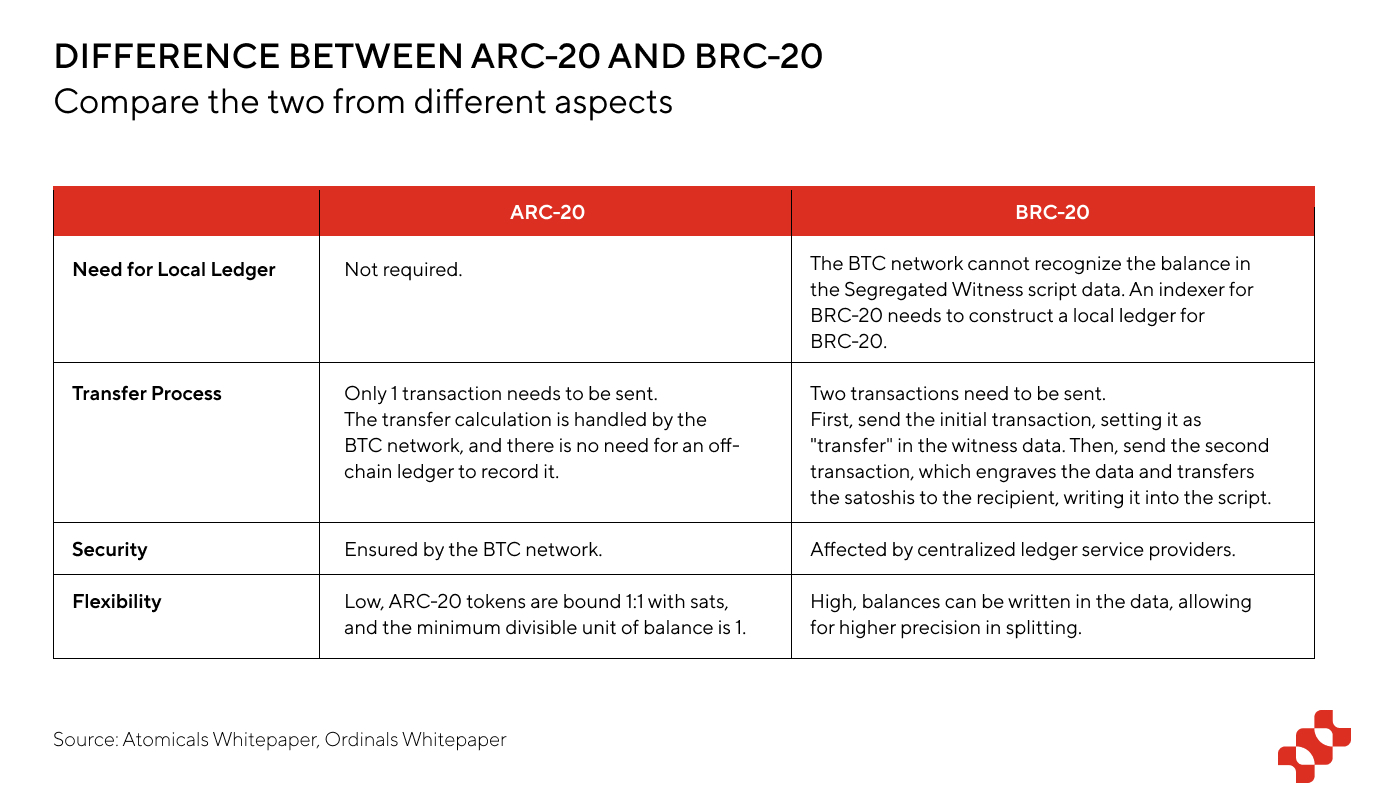
In summary, Atomicals transactions rely on the BTC network, avoiding redundant and meaningless transactions, minimizing impact on network fees. Without reliance on off-chain ledgers, it achieves greater decentralization. Moreover, transfers require only one transaction (versus two for BRC-20), significantly improving performance.
On the downside, unlike fair-launch-driven retail participation, ARC-20’s mining mechanism shifts cost burdens to the market, weakening its fair-launch appeal. Additionally, preventing accidental spending of ARC-20 tokens remains a challenge.
3) Runes & Pipe
As mentioned earlier, BRC-20 led to excessive meaningless UTXOs—an issue that frustrated even Ordinals creator Casey Rodarmor. In September 2023, he proposed Runes, a UTXO-based token protocol.
Overall, Runes resembles ARC-20: both engrave token data in UTXO scripts and rely on the BTC network for transfers. A key difference is that Rune quantities are customizable—unlike ARC-20, where minimum precision is fixed at 1.
However, Runes remains conceptual. One month after its proposal, Trac founder Benny introduced the Pipe protocol—functionally similar to Runes—and expressed ambitions to support additional asset types akin to Ethereum’s ERC-721 and ERC-1155 standards.
4) BTC Stamps & SRC-20
BTC Stamps is a fundamentally different asset issuance protocol from Ordinals. Since Ordinals stores data in SegWit script data—which could theoretically be pruned by full nodes or erased during hard forks—Twitter user @mikeinspace created the BTC Stamps protocol to mitigate this risk by embedding data permanently within BTC UTXOs.
This integration ensures data remains permanently on-chain, immune to deletion or modification—offering enhanced security and immutability. Once embedded as a Bitcoin Stamp, data persists forever on the blockchain. This property is invaluable for applications requiring tamper-proof records—such as legal documents, digital art provenance, and historical archives.
Technically, the Stamps protocol encodes image binary data into base64 strings, appends them as suffixes to a “STAMP:” key in transaction descriptors, then broadcasts these transactions onto the Bitcoin ledger via the Counterparty protocol. Data is split across multiple transaction outputs, making it impossible for full nodes to prune—thus ensuring permanent storage.
Under the Stamps protocol, the SRC-20 token standard emerged as a counterpart to BRC-20.
-
BRC-20 stores all transaction data in SegWit fields, which carry pruning risks due to incomplete SegWit adoption.
-
SRC-20 stores data within UTXOs, making it a permanent part of the blockchain, immune to removal.
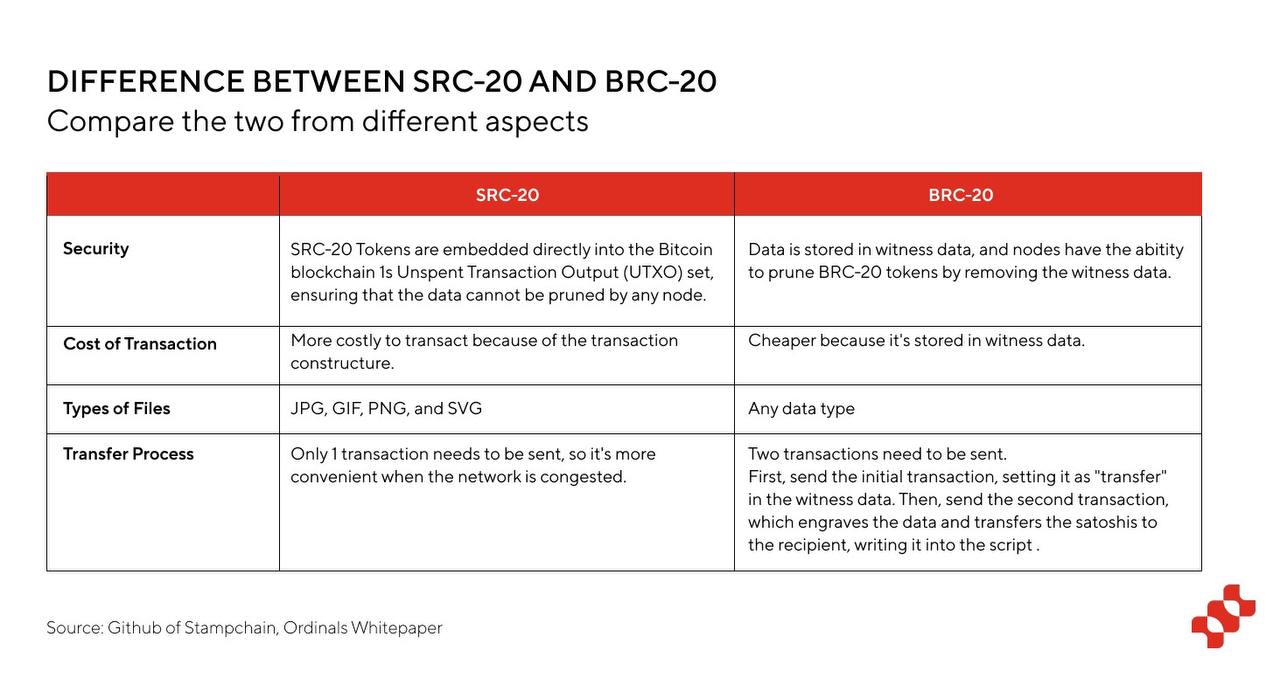
BTC Stamps supports multiple asset types, including NFTs and fungible tokens (FTs). SRC-20 serves as the FT standard, offering superior data security and resistance to tampering. However, minting costs are high—initially around $80 per mint, several times that of BRC-20. After an SRC-21 upgrade on May 17 last year, single mint fees dropped to ~$30—comparable to ARC-20—but still about six times higher than current BRC-20 minting costs (~$4–5).
Despite higher minting costs, SRC-20 requires only one transaction for minting—same as ARC-20—whereas BRC-20 minting and transfers require two separate transactions. Under smooth network conditions, this doesn’t matter much, but during congestion, initiating two transactions increases time and gas costs significantly. Notably, SRC-20 supports four BTC address formats: Legacy, Taproot, Nested SegWit, and Native SegWit—while BRC-20 only supports Taproot addresses.
In sum, SRC-20 tokens offer clear advantages over BRC-20 in terms of security and transaction convenience. Their non-prunable nature aligns well with the security-conscious Bitcoin community, and their flexible divisibility surpasses ARC-20’s constraint of 1 satoshi = 1 token. On the flip side, high transfer costs, file size limits, and format constraints remain challenges for SRC-20. Future exploration and refinement are anticipated.
5) ORC-20
The ORC-20 standard aims to expand BRC-20’s use cases and address existing shortcomings. Currently, BRC-20 tokens can only be traded on secondary markets, with fixed supplies and no mechanisms like staking or inflation to stimulate economic activity—features available in ERC-20.
Moreover, BRC-20 heavily depends on external indexers for bookkeeping. Double-spending attacks are also possible: for example, if a BRC-20 token has already been fully minted, attempting to mint extra tokens via the mint function should be invalid. However, since fees are paid to the Bitcoin network, such transactions get recorded anyway. Thus, validity determination falls entirely to external indexers. For instance, in April 2023, during Unisat’s early stage, hackers exploited this vulnerability through double-spending attacks—fortunately resolved quickly before major damage occurred.
To resolve these issues, the ORC-20 standard was developed. ORC-20 maintains compatibility with BRC-20 while enhancing adaptability, scalability, and security—and eliminating double-spending risks.
Technically, ORC-20 tokens, like BRC-20, are JSON files added to the Bitcoin blockchain, with key differences:
-
ORC-20 imposes no restrictions on names or namespaces and allows flexible keys. It supports a wider range of JSON formats and treats all data case-insensitively.
-
While BRC-20 fixes maximum mint values and supply upon deployment, ORC-20 allows dynamic adjustment of initial and maximum mint values.
-
ORC-20 uses the UTXO model: senders specify both the amount received by the recipient and the change returned to themselves. For example, holding 3,333 ORC-20 tokens and sending 2,222 would simultaneously return 1,111 to the sender as new input. This mirrors Bitcoin’s native UTXO process. If either step fails, the transaction can be canceled mid-way. Since each UTXO can only be used once, double-spending is fundamentally prevented.
-
ORC-20 adds unique ID identifiers during deployment, enabling differentiation even between identically named tokens.
Simply put, ORC-20 can be viewed as an upgraded version of BRC-20—offering greater flexibility and richer economic modeling. Due to backward compatibility, BRC-20 tokens can easily be wrapped into ORC-20 format.
6) Taproot Assets
Taproot Assets is an asset issuance protocol developed by Lightning Labs, Bitcoin’s Layer 2 development team, and integrates natively with the Lightning Network. Its core features and current status can be summarized as follows:
-
Fully UTXO-based, enabling seamless integration with native Bitcoin technologies like RGB and Lightning.
-
Like Runes (but unlike Atomicals), users can customize token amounts and create/transfer multiple tokens in a single transaction.
-
Native integration with the Lightning Network: Users can initiate Lightning channels via Taproot transactions, depositing both BTC and Taproot Assets into the channel within a single Bitcoin transaction—reducing costs.
However, notable drawbacks exist:
-
Risk of malice: Taproot Assets metadata isn’t stored on-chain but maintained off-chain by indexers, introducing additional trust assumptions. Ownership data resides locally or in Universe servers (a collection storing specific asset histories and validation data).
-
Not a fair launch: Users cannot mint tokens autonomously on the Bitcoin network. All tokens are issued and controlled by project teams, transferred to the Lightning Network—losing the fair-launch attribute.
Lightning Labs co-founder Elizabeth Stark aims to revive Bitcoin through Taproot Assets and transform the Lightning Network into a multi-asset network. Thanks to native integration, users don’t need to bridge assets to sidechains or other Layer 2s—simply deposit Taproot Assets into Lightning channels for seamless trading.
7) Summary of Current Status
In summary, the arrival of the Ordinals protocol and BRC-20 standard sparked the inscription boom, redirecting attention to Bitcoin-based asset issuance. This led to a proliferation of protocols—including Atomicals, Runes, BTC Stamps, and Taproot Assets—and new standards such as ARC-20, SRC-20, and ORC-20.
Beyond the above, many other asset protocols are under development—such as BRC-100, a decentralized computing protocol based on Ordinals theory aiming to enable DeFi and GameFi applications; BRC-420, analogous to ERC-1155, capable of bundling multiple inscriptions into complex assets suitable for gaming and metaverse use cases; and meme coin communities launching new standards on BTC (e.g., Dogecoin’s DRC-20)—creating a vibrant, diversified landscape.
Currently, asset issuance protocols fall into two camps: BRC-20-style and UTXO-based. The former includes BRC-20 and its enhanced variant ORC-20, which embed data in SegWit script fields and rely on off-chain indexers. The latter includes ARC-20, SRC-20, Runes/Pipe goals, and Taproot Assets—all leveraging UTXO-level operations.
These two approaches reflect divergent philosophies in BTC asset protocols:
-
One exemplified by BRC-20 emphasizes elegant simplicity—minimalist design satisfying basic needs with concise code, serving as an excellent MVP.
-
The other, like ARC-20, adopts a problem-solving approach—iteratively addressing bugs and inefficiencies, reflecting a bottom-up evolutionary path.
Currently, BRC-20 dominates due to first-mover advantage. Whether SRC-20, ARC-20, or others can claim second place—or even surpass BRC-20—remains to be seen.
At its core, the “inscription” trend has delivered a novel fair-launch model to retail users, generating immense attention for the Bitcoin ecosystem. Meanwhile, according to OKLink data, miner fee revenue has exceeded 10% of total income since last December—providing tangible benefits. Driven by shared economic incentives, the Bitcoin inscription ecosystem and asset issuance protocols are poised to enter a new phase of exploration and growth.
2. On-Chain Scaling
Asset issuance protocols reignited interest in the Bitcoin ecosystem. Yet, given Bitcoin’s scalability and transaction confirmation limitations, on-chain scaling remains a critical area demanding attention for sustainable growth.
Currently, two primary paths exist for improving Bitcoin’s scalability: on-chain optimization (Layer 1 enhancements) and off-chain scaling (commonly known as Layer 2). This section and the next will examine both. For on-chain scaling, attempts to increase TPS via larger block sizes or structural changes—like BSV and BCH—lack broad BTC community consensus. Among widely accepted on-chain upgrades, SegWit and Taproot stand out.
1) SegWit Upgrade
In July 2017, Bitcoin underwent the Segregated Witness (SegWit) upgrade—a soft fork significantly boosting scalability.
SegWit primarily addressed Bitcoin’s transaction throughput limits and high fees. Before SegWit, Bitcoin transactions were capped at 1MB per block, causing congestion and elevated fees. SegWit restructured transaction data by separating witness data (signatures and scripts) into a new “witness area,” effectively increasing block capacity.
SegWit introduced a new block size metric called weight units (wu). Pre-SegWit blocks had 1 million wu; post-SegWit blocks support up to 4 million wu. This change allows effective block sizes exceeding 1MB, increasing network throughput and enabling more transactions per block—reducing congestion and lowering fees.
Beyond immediate benefits, SegWit paved the way for major subsequent developments—most notably the Taproot upgrade, which relied heavily on SegWit’s foundation. Similarly, the 2023 boom in Ordinals and BRC-20 leveraged SegWit’s segregated data space—making SegWit an enabler and cornerstone of the inscription summer.
2) Taproot Upgrade
The Taproot upgrade, implemented in November 2021, combined three related BIPs—BIP 340, BIP 341, and BIP 342—to enhance Bitcoin’s scalability. Its goals were improved privacy, security, and functionality—achieving greater transaction flexibility, safety, and confidentiality through new smart contract rules and cryptographic signatures.
Key advantages include:
-
Schnorr signature aggregation: BIP 340 introduced Schnorr signatures, allowing multiple public keys and signatures to be compressed into a single key-signature pair—reducing transaction data size. This saves block space, improves throughput, and lowers fees.
-
Enhanced privacy: BIP 341’s P2TR script combines features of P2PK and PSH, adding privacy layers. All Taproot outputs appear identical, obscuring distinctions between single-signature and multi-signature transactions—making participant identification harder.
-
Support for more complex smart contracts: Previously limited, Bitcoin’s smart contract capabilities expanded with Taproot. Using Merkle trees, multiple parties can sign a single transaction. The new “Tapscript” enables
Join TechFlow official community to stay tuned
Telegram:https://t.me/TechFlowDaily
X (Twitter):https://x.com/TechFlowPost
X (Twitter) EN:https://x.com/BlockFlow_News
 @RyzeLabs