









Interview with Meow, Founder of Jupiter: Token Value Originates from Community Consensus
TechFlow Selected TechFlow Selected
Interview with Meow, Founder of Jupiter: Token Value Originates from Community Consensus
In the future, crypto will not only be an asset class but also become a way of life.
 Navigating Web3 tides with focused insights
Interview: Luke Belmar
Translation: Luccy, BlockBeats
One week before the official launch of the JUP token, Capital Club founder Luke Belmar conducted an exclusive interview with Jupiter's founder, Meow.
Prior to developing Jupiter, Meow served as chief advisor at Instadapp, Kyber, and Blockfolio, was a co-founder of wBTC—the largest wrapped token—and one of the founding contributors to the Handshake project. Currently, Meow is the founder of Raccoons Labs, building Solana’s liquidity aggregator Jupiter and liquidity protocol Meteora, conducting multi-chain research, and deeply interested in social infrastructure.
Many know Luke Belmar as a successful entrepreneur, but his secret lies in combining digital advertising, e-commerce, direct sales, and investments in cryptocurrency and NFTs. Belmar once said, "Money tends to flee those who chase it, yet flows easily toward those who realize that money is merely monopolized currency."
Luke Belmar hosts Money Talks, an interview series featuring exclusive conversations with some of the most brilliant minds in business, entrepreneurship, and finance. In the latest episode, Belmar sat down with Meow to discuss the "Theory of Monetary Consensus," through which Meow shared profound insights into how the crypto world operates and Jupiter’s role within this transformation.
Meow believes traditional financial systems have created a beautiful illusion—like an invisible prison where people live unaware. Cryptocurrency, he says, is the key to breaking free. It made him realize consensus is an incredibly powerful force: it shapes money, and it is cultivated collectively by communities. Building the crypto world cannot happen without consensus. Compared to an invisible prison, crypto is more like a garden—open to all, welcoming participation. Jupiter’s goal is to become exactly such a garden.
Thus, Meow deeply values the community ecosystem involved in cultivating this garden. He emphasizes that every distinct community should have its own character and charm. Describing the Jupiter community, Meow likens it to a "global decentralized securities exchange," where anyone can trade, and every process and detail is visible to all members of the community.
BlockBeats presents the following translated transcript of the interview, with minor edits for clarity.
Money Originates from Consensus
According to Meow, the "Theory of Monetary Consensus" holds that creating money requires investing corresponding consensus. This process involves a form of control—you essentially hold power. The purpose of this control is clear: if someone prints vast amounts of virtual currency beyond a certain threshold, legal systems intervene, enforcing penalties including imprisonment. This consensus is reinforced across entire networks involving governments, central banks, commercial banks, and branches.
In this theory, fiat currency derives its consensus from the ability to enforce usage. Meow cites Bitcoin and Ethereum communities as examples of strong consensus, arguing that when sufficient collective belief is invested, money becomes real.
To explain this idea, Meow introduces the concept of "Infinite Tsukuyomi"—a jutsu from the Japanese anime Naruto that traps individuals in an eternal illusion they perceive as reality.
The Illusion of Traditional Finance
Luke Belmar: Start from the beginning—what brought you to this point?
Meow: I've worked extensively in technology, particularly in social networks and viral marketing. I believe we were among the first to build recommendation systems using social data. Early tech recommendations were semantic-based—like “if you're into computers and tech.” But we found social data far more interesting, so we built our engine around it. For example, if you follow someone, the system connects you with others who also follow them.
I successfully promoted it through various viral marketing tactics. We achieved a lot and stuck with this philosophy. We experimented with many mechanisms and invented new concepts, but something always felt missing—like a piece of the puzzle wasn't quite right. If you try to build a fintech company, you’re dealing with regulation. That’s not inherently wrong—it’s just how the world works. I comply with rules, but I don’t truly enjoy doing so.
I’ve always been deeply interested in economics and finance, but whenever I approached the field, I realized no fintech company was actually innovating—they were just building on top of an existing stack. The underlying architecture is massive and immutable: banks, credit card systems, processors, energy grids.
Essentially, I had to play by their rules. But reading economics books, I kept thinking: none of this makes sense. All these established theories—even newer ones like behavioral economics—seem fundamentally flawed. They don’t align with what happens in the real world. It’s almost as if economics is a branch of pseudoscience.
And I could never understand why the entire world lives under this "Infinite Tsukuyomi." I studied economics in Silicon Valley, absorbed countless ideas, but economics feels like "Infinite Tsukuyomi" to me—financial markets don’t correspond to reality; predictions are always wrong. When everyone around you is trapped in the illusion, how can you possibly muster the courage to break through the inflation-driven army? Then came cryptocurrency. I finally realized: "Here’s proof—the audit is nonsense."
Luke Belmar: Like catching a glimpse outside your prison cell and realizing freedom exists.
Meow: Exactly. One of the most effective ways the British controlled colonies was ideological indoctrination—telling people, “You’re stupid, we’re superior, your culture is inferior, everything about you is worse.” And people internalized it, becoming obedient.
We’ve freed ourselves from many such mindsets, but in economics and other areas, coercive control still persists. Since controlling individuals directly is hard, the only viable method is education. That’s why governments invest heavily in education and history—what you’re taught early in life creates an endless economic cycle. Crypto revealed to me that it’s all an illusion.
Luke Belmar: When did you first encounter cryptocurrency?
Meow: Around 2013, maybe slightly earlier. I had a close friend who was one of the top experts in crypto. I met him at a Dogecoin party and we started collaborating. At the time, I knew nothing about crypto. I asked him, “Hey, how much do you know about crypto?” He said he didn’t know anything. I kept asking, and each time he replied the same. But we clicked—he had great ideas, excelled at technical marketing, while I focused on coding. He also had deep expertise in cryptography and financial systems, so we worked well together.
If you look at academic textbooks, the foundational concept is price—whether left or right, everything revolves around price. Economics curricula emphasize price above all. And price usually means fiat currency. So the very thing economists care about most—fiat—is inherently problematic. Beyond corruption, consider AEI (American Enterprise Institute), where 99% come from the same school. They live together, cook together—despite ideological differences, they’re friends.
From birth, we’re forced to accept the fiat system. Then Bitcoin arrived and said: “You don’t need to possess trillions in value or print money to stimulate growth.” A “glitch” emerged—Bitcoin and DeFi—and people began questioning the status quo. Today’s meme coins, new networks—they’ve shattered our old frameworks.
This raises a crucial question: what is real money? To create money, you must invest corresponding consensus. It involves control—you effectively hold authority. The purpose? If someone prints excessive virtual currency, laws intervene, leading to arrest and imprisonment.
Luke Belmar: Technically, possessing a replica of a ruler’s or king’s currency, coin, or denomination is counterfeiting their authority.
Meow: That authority is reinforced through government, central banks, and the entire network of banks and branches. Thus, fiat currency’s consensus stems from enforcement capability and compels people to use it. You must accept fiat—or face jail or worse. Crucially, this is achieved through consensus.
Now consider crypto: how do you distinguish real from fake money? I could explain using technical metrics—liquidity, distribution, holder count, longevity—but these are surface-level. When enough consensus is invested, the currency becomes real.
Ethereum became real money because the entire network invested life-long consensus to make it function exceptionally well. Though I build heavily on Solana, I must say Ethereum is remarkable. Led by Vitalik, it united financiers, geeks, holders, fanatics—people who forged this consensus. It became real money: a sincere human consensus transformed into other forms—proof-of-work, code, infrastructure.
For governments to create money, you need a central bank, coordination, police enforcement—all requiring consensus. Do it well, and you have money. It’s business—a nearly hallucinatory mindset. I love the consensus theory: the more a currency represents a vast network of people investing genuine consensus, the more real it becomes.
Luke Belmar: Because consensus can neither be created nor destroyed—only transformed—fiat isn’t real. When you conjure 6 trillion dollars out of thin air, you aren’t creating consensus, only illusion. At $15/hour, that’s roughly 400 billion hours of minimum-wage labor injected as false labor value to stimulate growth—devaluing real work. People feel things are getting pricier—not because goods cost more, but because printing money introduces false value, eroding consensus and labor worth.
Meow: I agree completely. The monetary consensus theory is a powerful lens. It explains why certain economic policies lead to inequality. Consensus is finite. Creating money from nothing steals the real value of people’s labor.
Imagine creating a system that prints dollars or other currencies equivalent to 400 billion human labor hours. This stimulus provides initial momentum—but fails. Governments can’t serve everyone. Instead, they grant a select few the power to distribute funds. Consider what happens when immense capital is given to a small group?
Luke Belmar: There’s a famous saying: power corrupts, absolute power corrupts absolutely. Once you control the printing press, why not print and give to friends, save your buddies, gamble like a fallen addict? You recently tweeted there’s no difference between degens and Wall Street—except degens and crypto are at least honest.
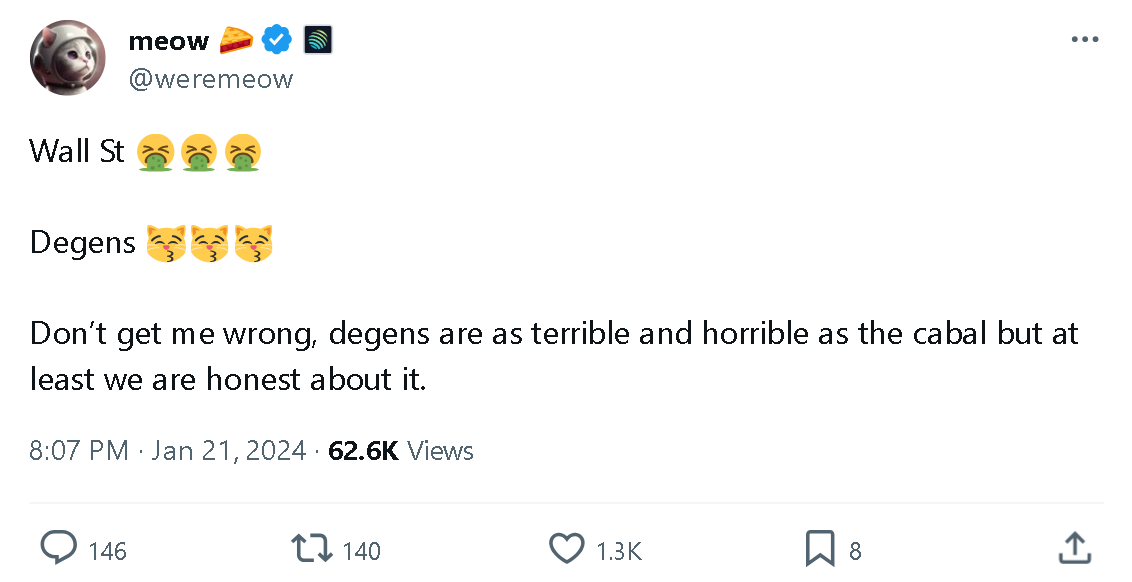
Meow: And I’ll add—you can be a degen too. I won’t claim any degen is better than Wall Street. Ultimately, they’re the same.
Luke Belmar: The difference is Wall Street’s degens act like jerks, while we face real consequences.
Meow: It’s a tiny club. You climb step by step, proving loyalty to the system at each stage. Every closed system demands loyalty—that’s the game. Your status, reputation, rank, and power all stem from being part of this system. We live in a financial hierarchy—even those complaining about rising costs. When you talk to me about money, it’s so practical. Few pause to reflect on what money really is. Most can’t even define it.
Jupiter Breaks the Illusion
Luke Belmar: What moment made you decide, “I’m going all-in and building in crypto”?
Meow: From everything I’ve done, you can see I’m an experimenter, not a theorist—that’s my strength. Many are highly theoretical, claiming to be “in crypto,” visible at Bitcoin conferences. I’m more pragmatic.
I didn’t jump in early. Doing things right mattered more. Early crypto discussions were overly theoretical. I wasn’t passionate about trading, but about utility. That’s why I built Jupiter—the most used DeFi trading platform—on the most adopted chains.
My entry point was when crypto matured enough for me to make an impact. Since then, I’ve collaborated with many excellent projects. Wanting people to escape the “Infinite Tsukuyomi,” I helped build wBTC three years ago—the most widely used wrapped token in DeFi.
Luke Belmar: To break the Infinite Tsukuyomi, you must first realize you’re in an illusion.
Meow: Many here sensed something was off. Why do all economic reports show rosy numbers while my life sucks? Why do job reports claim prosperity when my Denny’s meal tastes awful? People began noticing economists spout nonsense. Then excitement arose—especially over crypto’s accessibility. As most started using crypto, it became important. That’s why I care deeply about “use.”
If most view crypto merely as a stock-trading tool, whether on Robinhood, buying Tesla or Bitcoin, they appear identical—though fundamentally different. What matters is a mental shift I call migration. We guide people to see crypto not as another asset, but a radically different concept. You need to witness it, feel awe—as if seeing light. It’s a parallel universe where actions like sending money require minimal effort.
Luke Belmar: In traditional finance, you call the bank, seek permission to send funds, and must know all transfer details to ensure correct receipt. None of that happens in crypto.
Meow: Yes, banks must follow procedures—our inherited tradition. But what separates protection from freedom, regulation? Who are you really protecting in this structure? Some claim crypto enables money laundering and terrorism, but so does the dollar.
Luke Belmar: With blockchain, I can trace every Bitcoin transaction—and even track fiat.
Meow: Those protections may exist for reasons, accumulated over decades, achieving consensus. But they’ve become a prison. People assume prisons only lock people in, forgetting they also block things from entering. You can’t bring in toothpaste or cash. A prison is like a secret money box—built by people.
Last week I was furious—everyone in crypto eagerly awaited Gary Gensler’s approval of a Bitcoin ETF. Hype was sky-high. When SEC approved it, Larry Fink called it the first step toward asset tokenization. Clearly, BlackRock will build and own the Bitcoin ETF. Then Gary said, “We’re violating Satoshi’s vision—ETFs mean we’re centralizing crypto.” He seemed thrilled, proud of shattering crypto’s decentralization illusion.
I don’t hate banks, governments, or SEC—I love them. They believe in their systems and do their jobs. The world is simple: fight for your own. We must believe in ours. That’s why I’m angry at our industry.
Look at BlackRock—they want a Bitcoin ETF to profit. Fine—that’s their job. If I ran BlackRock, I’d want the same. I’m no saint. But that’s precisely why I’d never run the SEC—I don’t trust myself with a billion dollars. I wouldn’t even trust myself with $100 in a casino. Give me $1,000 in chips, I’d blow it all. That’s reality. I love money. I can’t help it.
You must place yourself beyond corruption. Yesterday we launched Launchpad, tweeting clearly we won’t invest in anything. Because one major issue with Launchpad is self-promotion. I believe positioning yourself technically incorruptible shows the world a better way—that’s what Jupiter does.
Money as a Medium of Action
Building on the “Theory of Monetary Consensus,” Meow explains JUP token’s core mission: to genuinely cultivate community, working groups, and DAOs. Unlike the prison-like rigidity of traditional finance, this community resembles a garden—its purpose is to attract people and spread outward. Through sufficient collective consensus and thought, the token becomes a true medium of exchange.
The Crypto Garden
Luke Belmar: You describe the prison as a closed ecosystem. Yet technological progress and digital tribes now enable people to build competing ecosystems—returning to money’s essence. Money was once personalized—by individuals, villages, companies. Companies issued their own currencies, crafted by private rather than public sectors.
Meow: Know what’s craziest about crypto today? We criticize them while supporting them. Everyone wants ETF approval—even Bitcoin purists. Sure, do what you want. But we should focus on building a fully decentralized, astonishing parallel economy—an alternative “garden.” Take Jupiter: unlike a prison, we have many users, but we can’t lock them in or exclude anyone. This beauty is indescribable.
Luke Belmar: Moreover, looking back at 2017’s DeFi model: get a MetaMask wallet, send ETH to a random address during an ICO to receive tokens. Today, grab your phone, download any mainstream wallet, go to mini-apps, click Jupiter Exchange, and within 2–5 minutes enter a highly optimized alternative financial ecosystem.
Meow: That’s the main driver behind Jupiter and the JUP token. A key goal of JUP is to authentically build community, working groups, and DAOs—its mission is to attract and spread. You can’t build a prison—Jupiter’s culture dislikes prisons.
Luke Belmar: Like when centralized exchanges introduce heavy KYC or strict limits—users leave immediately.
Meow: Users don’t want their money locked up—that’s all. Many ask if I’ll implement token locking—I’m not interested. We live in a world obsessed with building prisons—Facebook, every company, every bank. Every subscription, every printer ink purchase—massive money and resources spent constructing prisons.
Luke Belmar: Apple changes charging ports, forcing users to buy their cables, blocking third-party sales—locking users into a closed ecosystem.
Meow: We’re at a fascinating turning point—returning to the era of private money. Why did we transition from abundant private currencies to fiat, then back again?
Consider Eric S. Raymond’s book The Cathedral and the Bazaar. It argues small teams execute strategies efficiently, but coordinating armies is hard. Achieving scale requires tight structure—like TSMC, the renowned chipmaker, with hierarchical layers, processors, performance testing—all ensuring order and enabling rapid, efficient systems.
Conversely, markets resemble open networks—everyone pursuing individual goals, forming organic systems. Open-source software and cryptography existed long before crypto.
These networks foster cultural phenomena—Burning Man exemplifies both: a market gathering 50,000 people pursuing personal expression, and a cathedral imposing precise rules. It combines tight coordination with chaotic freedom—both systems have strengths.
Applying this lens: today we live in a world where nation-states enforce fiat systems. The dollar is imposed through various means. Before national currencies, banks and towns each had their own systems.
Turning 'Tokens' into 'Money'
Luke Belmar: Every ecosystem, large or small, has its own monetary system—because money is created by the private sector, not public.
Meow: Yes. This concern is externally imposed, yet people still want to trade across monetary systems—requiring methods to enforce legitimacy. Now, on Solana, people have their own currencies—represented by letters, backed by communities.
Like emailing on Twitter, forming a massive email community where people trade emails—and trust them. My coins can be traded similarly, but the key difference is everything happens on-chain, enabling trust in circulation. I can see everything: exchange ratios, liquidity levels—numbers are transparent.
Blockchain isn’t the sole answer—community is. If I create a “meow coin,” I must prove sufficient community consensus supports its infrastructure. I dislike calling them tokens—anyone creating a new coin or token should strive toward becoming real money. That’s a high bar for most projects.
Literally, anyone can press a button and mint a coin—yet its value may be less than toilet paper. Toilet paper involves logging, packaging, recycling—I can calculate its worth. But here you just create flashy graphics, constantly pushing people to buy, extracting temporary consensus from those hoping the price rises. That’s not real consensus—it’s unsustainable.
I deeply appreciate consensus theory—it emerges wherever money is discussed. Money is a medium of action, valid because enough people invested enough consensus and thought to make it usable for exchange.
Luke Belmar: Wars were fought over salt, which was once used as currency—hence “salary” derives from “salt,” as people were paid in salt. Sufficient effort and consensus went into harvesting, packaging, and distributing salt, creating demand that made it viable as money.
Meow: True—salt later lost monetary use due to scarcity and other factors. But as you said, it was highly measurable, hard to counterfeit, and genuinely usable as real money—even after becoming obsolete.
Luke Belmar: DeFi assumes a monetary standard exists. Technological advancement enables new monetary forms, freeing us from standard constraints.
Meow: Crypto has too many scams—and degens are as bad as Wall Street. I’m bad too. Put me in a leveraged fee position, I might do worse. But the key difference is, if I launch “Meow,” I must demonstrate real consensus, attention, and sustainability—spend 10–15 minutes showing I didn’t just mint “Meow.” That’s why community matters.
Community Consensus Embodies Token Value
Meow believes “community” has become an abused term in crypto—only those with strong consensus truly deserve the label. In such a community, users matter most—their suggestions and feedback must be seriously addressed to strengthen the community. As a community leader, understanding what community truly means is paramount. Every community must have a unique, authentic vision, atmosphere, and character—traits reflecting the currency’s real value.
Let Users Become the Community
Luke Belmar: Talk about the importance of community. During the last NFT boom, owning 10,000 units meant you had a community. It’s a fascinating part of crypto gaming—and why Jupiter and JUP entered the space. Like many NFT projects whose first interaction with community is a financial transaction, you establish a foundation from day one—not just financial gain, but innovation, progress, experimentation-driven. Now communities want more than profits—they want to participate, belong, grow the garden with you.
Meow: We have a massive community—we’re building it. You understand this topic better—“community” is one of crypto’s most misused terms. You create something, open a Discord, give five tokens to joiners, and suddenly thousands flood in. Then you claim success—20,000 Discord members!—thinking you’ve built a community.
Like at a comedy club—if I say something dumb in the first minute (“Hi, your mom’s fat”), they laugh. But after one minute, I must deliver a solid show. I tried stand-up—I know comedy is brutally honest. So is money.
You can become a YouTube star, call yourself a YouTuber, attract followers wanting to join the game. That’s why crypto loves hype—any audience size gets hyped because it’s profitable. Everyone plays their own game. So you must be cautious: unless you sincerely demonstrate commitment to community, answer questions, you’ll be laughed at for one minute—then discarded as trash.
Luke Belmar: What’s the role of a community leader? Historically, to build a metropolis, utopia, or civilization, you needed fresh water—like Egypt along the Nile. I think crypto communities seek trustworthy leaders—those who won’t destroy the Nile, but truly build around it. The leader’s job is preserving community integrity—everything built around it is merely a protective byproduct.
Meow: Excellent point. We care about our roots—we’re eager to protect the Nile. The Nile is like life itself—its integrity sustains us.
But the industry’s problem today: when a celebrity endorses us, we think “maybe some fertilizer helps”—but it’s toxic. Pour fertilizer into the river, algae bloom wildly, polluting the water. Crypto is like that—while we preach integrity, decentralization, community, the moment opportunity arises, we happily dump fertilizer into the river.
Fertilizer seems harmless at first—but ruins everything. I always say we tolerate scams, but we’re too eager to embrace anything hyped. That doesn’t mean we’re fools. I now grasp how vital consensus utilization is—something I never considered before. People keep asking me about tokens, so let me discuss leveraging consensus.
A year ago, we were already hugely popular. But I realized: it was time to take a step—transform users into community. That’s when we built consensus. That’s why my Solana Breakpoint hackathon speech was hailed as the best—because accumulated consensus infused everything we wrote. Everyone knows Jupiter, uses Jupiter, wonders what’s next, wants JUP tokens. I want them too—excited for the upcoming airdrop.
I felt I had a full community and people trusting us—because we built credibility over years: prioritizing user experience, users, technology, ecosystem. For instance, we integrate many systems, often serving as testbeds. Testing frequently breaks things—when embedded in our system, they crash under massive user traffic and orders. But users don’t know that. When systems fail, they don’t revolt—they ask how we’ll fix it. So we absorb all complaints.
We’re like shoes—used by the entire community. Despite issues, errors, and outages over the past year, the community saw our relentless efforts—from stack development to community management—accumulating enough consensus to build will and trust.
Someone tweeted: “You had three years to prepare token launch—why so slow? Useless.” I replied: “I won’t deny I’m useless—I’m a zero-IQ clown. But these past three years weren’t spent preparing the token. I spent them agonizing over every product detail, collaborating with every DEX and platform provider to ensure integration. I spent three years communicating with the ecosystem, supporting it when things went south. Whenever morale dipped, I was there, uplifting it with words. Three years of community scrutiny—that’s what I’ve done.”
Luke Belmar: Fundamentally, JUP as a unit holds no intrinsic value. Its value comes from everything built over the past three years—and future efforts—and the community and individuals comprising it.
Meow: Exactly. If you issue a good token today, value isn’t in founders promising future actions, or talking about things they won’t do—but in delivering what they said they would. So token value breaks into three parts: past—consensus accumulated, materializing what people wanted; present—what you say now; future—what you commit to.
You transform token value into tangible embodiment. Interestingly, you won’t find this in any economics textbook. Every Wall Street textbook and technical analysis peddles nonsense—like P/E ratios. Look at Tesla, GameStop, anything—clearly absurd.
Take Singapore Dollar—Singapore’s a small country, can print freely. But if it just prints, SGD depreciates against USD. The dollar gets away with it because of the narrative—the dollar index. The index can’t depreciate against other assets. Once the dollar or index falls, everything collapses.
It’s fascinating—all based on indices, and all economics textbooks rely on indices. We don’t even know what’s happening. When TikTok women complain about a group, it’s because everything’s index-based—and indices are severely abused. The entire financial system runs on this index.
Embrace Community Uniqueness
Luke Belmar: Many builders in crypto face a harsh, unforgiving environment—stressful, anxiety-inducing. A new wave of builders is emerging—newcomers anxious about building communities or products facing criticism. What advice do you have for this new generation?
Meow: Most importantly, understand what community means—you need your own perspective. Every community must reflect your unique, authentic vision. Great communities have distinct atmospheres, unique traits. As someone wisely said: every great thought is different. When you speak with extraordinary people, their words, their thoughts—they differ.
Likewise, in community-building, embrace your uniqueness. Ethereum, Bitcoin—every successful community has its own vibe. Jupiter aims for the same. Don’t fear this—lean into it. Avoiding it brings comfort—doing exactly what others do invites no criticism.
If you launch a meme coin today, you follow the playbook: build a group, sell, recruit followers, claim it’ll rise—indistinguishable from thousands of others. I’m not exaggerating—some meme coin teams today mint 30–40 coins daily, seeking investment. Cost is near-zero—Twitter and everything else is free. If you fail, it’s just because you were late, didn’t scale.
Know this: some teams are literally copying Uniswap’s code line by line, hosting community events. It’s become an industry. But they’ll never be you—being yourself is your only edge. That’s why Jupiter succeeded—everyone knows Jupiter has always been here, and always will be.
Luke Belmar: You’ve worked in this space for three years. What are your mid-to-long-term outlooks?
Meow: Mid-term is simple. I’m no idealist—I focus on embodiment. I’ll manifest a future by turning ideas into reality through consensus. This isn’t a mystical fairy tale. Everyone is vision-driven. Easiest way to get a vision? Ask ChatGPT: “Give me a vision for X.” Our difference? Users drive our embodiment.
Any third-grader can write a beautiful vision statement. But how many inspire masses to share a common vision, a unified belief? Extremely rare. Ultimately, getting a critical mass to embody a specific idea, spirit, culture—requires real commitment and integrity.
Mid-term, I want lower barriers—lightweight, frictionless. I collaborate relentlessly with everyone I need to, striving to build the decentralized meta. Meta is like air—freely flowing in and out of prison, unblockable, yet hard to capture.
Jupiter is perfectly positioned as an entry point for those moving activity from centralized to decentralized networks—that’s our goal. We migrate people in, show them cool things they can actually do.
Jupiter’s Vision
Luke Belmar: Please share your long-term vision. In the grand picture of how decentralized finance permeates the world, what role will Jupiter play?
Meow: I prefer to say it’ll be like oxygen—permeating among people. Once you gather gamers, we can achieve incredible things: remittances, operations. But you need markets. For example, a SGD/USD market, a PHP/USD market—enabling full transactions between them. Transaction costs approach zero—no need to go anywhere, do anything. I believe this is entirely achievable—we’re very close.
Take remittances: many crypto firms now pay in USDC or USDT instead of fiat. With stablecoin-to-bank or wallet exits, all forex issues resolve. Jupiter will build these markets alongside the ecosystem.
Then you can pay for anything at minimal cost. Crucially, the whole process is transparent. If you pay 1%, you know exactly where that 1% goes. You know the platform’s security level, how much the provider earns. Achieving this requires Jupiter being the largest routing system—handling ~80% of traffic.
Take stock exchanges: listing there gives no user or media access—you just get junk. But if we had a listing process—a Global Decentralized Securities Exchange (GDSE)—when you list, any investor could verify your authenticity: whether you’re trading, your business nature, product validity, trending topics. It’s holistic—that’s what Jupiter aims to build.
Suppose you’re a mid-sized e-commerce company raising funds. Who better judges your product or business? Some random Wall Street auditor? Or the community—the users interacting with your product? You must involve all users in the community to build real credibility. Once supported, they help improve you.
Luke Belmar: Today’s stock exchanges are run by bots, Wall Street, actors. Stocks rise only because people keep dumping garbage into the market. Truth is, if I buy $100,000 in Meta stock today, I’m not part of the community. Small players don’t seek rule-making power—just participation.
Meow: Once people become part of the business, they engage deeply—empowered. Community is vital, but ignoring money is foolish. Ignoring people’s desire to be part of something exciting is equally foolish. We’re building a global decentralized exchange so anyone can list, letting the entire community act as auditors—auditing you and helping you. Decentralized IPOs, decentralized crowdfunding—these will happen.
You’ll have a global decentralized market ecosystem—with all forex pairs, including shitcoins and meme coins—whatever type of coin—traded on one network. Use newly earned token proceeds to buy things, transfer to others—all on one network.
Luke Belmar: You have a grand vision for Jupiter DAO. How will you build the Jupiter DAO ecosystem?
Meow: Recognizing current DAOs have untapped potential, I find today’s DAOs somewhat silly. Every DAO in crypto seems constrained, agendas narrow. Uniswap DAO focuses on managing Uniswap governance, token supply—yet ACCC picks preferred suppliers due to voting power. Even great DAOs like MakerDAO turned DAI—a cool concept—into managing returns, treasury, ensuring growth, paying huge sums.
I want to build crypto’s most vibrant, forward-thinking, non-insider community—whose agenda is building the metaverse: migration. This needs three elements. First, people must stop using banks or Western Union. Second, you need sufficiently large markets—ambitious entrepreneurs willing and able to prove collaboration benefits. Now, I ask any ecosystem if they’ll partner with Jupiter—they almost always say yes. Maybe we’ll screw up after January, but currently, it’s low-hanging fruit.
Third, you need a single network aggregating all markets—like my proposed GDSE—delivering real enterprise value. Migration requires bridges—GDSE is that bridge.
These three aren’t sequential steps—they’re parallel. First attract users, then build markets. Remember: you don’t need tokens—you need markets. That’s where people get confused. Create a PHP/USD market, but if it’s undiscoverable, it’s useless. But create it on Solana or future networks, and it becomes discoverable—recorded in every account, allowing transfers of anything into that market.
No matter how many market types exist on one network, it hasn’t happened yet—but this is how we break the illusion. People in the U.S. or Singapore might find the prison comfortable. But what about Africans, Central Americans, South Americans? Those denied banking and traditional tools?
We’ll open the ledger, prove ourselves worthy, earn community welcome, then begin migration. My goal is IPO—but few achieve IPOs because banks gatekeep. But imagine sufficient capital on-chain—supporting a business means buying a token, opening Jupiter to purchase. Say you use token balance to buy ice cream at a shop—you get ice cream. Whenever I share this, people think it’s distant. It’s not.
Join TechFlow official community to stay tuned
Telegram:https://t.me/TechFlowDaily
X (Twitter):https://x.com/TechFlowPost
X (Twitter) EN:https://x.com/BlockFlow_News
 BlockBeats









