









Are Solana memecoins more cost-effective? Using the Kelly Criterion to calculate the real odds of playing memecoins
TechFlow Selected TechFlow Selected
Are Solana memecoins more cost-effective? Using the Kelly Criterion to calculate the real odds of playing memecoins
The game for doge looks highly profitable, but it ignores the survivorship bias.
 Navigating Web3 tides with focused insights
Author: Frank, PANews
Trading meme coins seems to be the eternal wealth code in the crypto world. It's filled with the most magical rags-to-riches stories in cryptocurrency and serves as a dedicated arena for those hoping to turn small bets into big gains. From Ethereum to BSC, and now Solana—on one hand, explosive price surges have enabled a few lucky individuals to achieve financial freedom. On the other hand, the vast majority of investors repeatedly lose their entire capital chasing meme coins.
Currently, there is a prevailing argument: although trading meme coins results in more losses than wins, a single successful trade can yield massive returns, making it an attractive gold-mining opportunity. From a scientific investment perspective, is investing in Solana projects a rational decision? Below, PANews will conduct a comprehensive analysis of this sector using the Kelly Criterion from practical, win rate, and payout ratio perspectives.
Suppose you have $1,000 in capital, and each time you invest in a Solana meme coin, you either lose everything or earn a 10x return. Should you invest at all, and if so, what percentage of your capital should you allocate?
Is Trading Meme Coins on Solana More Cost-Effective?
Solana has emerged as the brightest smart contract platform in this market cycle. Its price surged up to 15x within a year, backed by strong growth in on-chain data. According to Defillama, on December 22, 2023, Solana reached a peak daily transaction volume of $2.6 billion—surpassing Ethereum’s highest daily volume of $2.5 billion in 2023—and briefly became the most active blockchain. This high activity is largely driven by the popularity of trading meme coins on Solana.
Compared to traditional Ethereum meme coins, trading meme coins on Solana has several distinguishing features: lower gas fees, higher trading activity, and fewer malicious contract backdoors.
Gas Fees: Average on-chain transaction fees on Ethereum range from several dollars to tens of dollars. In contrast, Solana’s transaction costs are nearly negligible.
Fewer Contract Backdoors: Compared to the wide variety of scam contracts on Ethereum—such as貔貅 (Ponzi) schemes, high-tax traps, and liquidity-draining scams—Solana, due to its technical design, essentially has no hidden backdoors beyond minting functions and contract ownership (both of which are easily visible on on-chain data platforms).
Lower Trial-and-Error Costs: The native token SOL is priced significantly lower than Ethereum’s ETH, offering a much friendlier entry barrier for users hunting for potential “golden dogs” on Solana. Many players invest 0.1 SOL (about $10), an amount that often wouldn't even cover a single transaction fee on Ethereum.
These conditions make trading Solana meme coins appear to be a promising chance to turn a small bet into life-changing gains. But is this really true?
The Eternal "Slaughterhouse" for Players
Experienced meme coin traders know that trading meme coins is almost purely a game of luck. This activity is less like investing and more akin to gambling or playing the lottery. If we treat meme coin trading as a gambler’s game, the Kelly Criterion becomes the mathematical formula for determining whether participation is justified and how much capital should be allocated each time.
The Kelly Criterion is a mathematical formula used to optimize capital management in gambling and investing. Its core idea is: when facing bets with positive expected value, how should one allocate funds to maximize long-term growth? Proposed by John L. Kelly Jr. in 1956 initially for signal transmission problems, it was later proven highly effective in gambling and investment contexts.
The basic form of the formula is:

F: The proportion of capital to invest
B: The net odds received on the bet (e.g., if you risk $1 to gain $10, the payout is 9:1)
P: Win probability (e.g., winning 3 out of 100 trades means P = 3%)
Q: Loss probability (Q = 1 - P)
Using this formula, one can calculate the optimal fraction of capital to wager in order to maximize long-term growth. A key feature of the Kelly Criterion is that it balances risk and reward, helping avoid excessive betting that could lead to ruin.
Let us apply the Kelly Criterion to determine how much capital should be allocated when trading meme coins on Ethereum versus Solana.
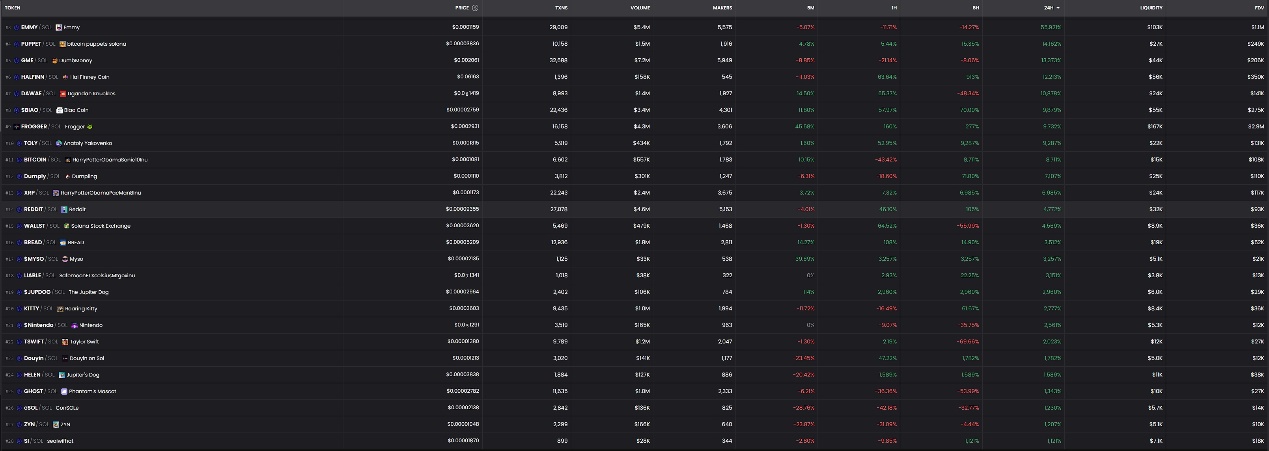
We analyze 24-hour data. During this period, Solana saw 1,743 newly launched meme coin projects, while Ethereum averaged around 213 new projects.
We define a potential “golden dog” as a project with over 100 unique holders and a 24-hour price increase exceeding 10x.
Under this definition, Ethereum had 7 potential golden dogs in 24 hours, while Solana had 28.

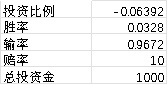
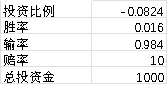
Assume you have $1,000 in capital, and your success condition is buying a meme coin and achieving a 10x gain. Thus, the payout (B) is 9 (net profit of $9 per $1 invested). Ethereum win rate: 7 / 213 ≈ 3.28%. Solana win rate: 28 / 1,743 ≈ 1.6%.
Kelly Criterion results:
Ethereum:
Solana:
Interpretation:
From the calculations, the Kelly value for Ethereum is -0.06, and for Solana it is -0.08. A negative result from the Kelly Criterion indicates that, given the specified odds and win rate, the expected return is negative—in other words, this is a losing proposition over time. The formula is effectively advising against participating in this game.
Even as a professional meme coin trader who monitors the market 24/7, buying every new project at launch and selling upon a 10x gain, the Kelly Criterion suggests you should not participate at all—long-term participation would only erode your entire capital.
Conclusion
The reason meme coin trading appears attractive is due to high perceived payouts (commonly seeing screenshots of 10x or 100x gains), but this overlooks survivorship bias. Ordinary players face several challenges in winning consistently: first, they cannot possibly buy every newly launched project at inception; second, very few can withstand volatility and fully capture a 10x move; third, raising win rates above 10% is extremely difficult. Therefore, from a mathematical standpoint, even though Solana offers more accessible advantages compared to Ethereum, meme coin trading remains an eternal "slaughterhouse" where players always lose.
Of course, the Kelly Criterion only provides a rational guideline for capital allocation. With a 10x payout ratio, you would need to maintain a win rate above 10% to even consider participating in this game.
Join TechFlow official community to stay tuned
Telegram:https://t.me/TechFlowDaily
X (Twitter):https://x.com/TechFlowPost
X (Twitter) EN:https://x.com/BlockFlow_News
 PANews









