








Using "Beauty" as a Mirror: Exploring the Future Development of Hong Kong's Bitcoin Spot ETF
TechFlow Selected TechFlow Selected
Using "Beauty" as a Mirror: Exploring the Future Development of Hong Kong's Bitcoin Spot ETF
Hong Kong financial firms entering the Bitcoin spot ETF—does it still make sense?
 Navigating Web3 tides with focused insights
Author: Hedy Bi, OKLink Research Institute
According to a report by The Block on January 29, Harvest Fund Management International became the first institution to submit an application for a spot Bitcoin ETF to the Securities and Futures Commission (SFC) of Hong Kong. As early as December 22 last year, the SFC issued its "Circular on SFC-authorized Funds Investing in Virtual Assets," clearly stating its readiness to accept recognition applications for spot virtual asset ETFs.
On the other side of the Pacific, developments following the approval of spot Bitcoin ETFs in the United States offer valuable lessons for Hong Kong. However, due to Grayscale’s continuous selling of Bitcoin, U.S. spot Bitcoin ETFs have not delivered impressive market performance in the 19 days since their launch. In this context, does it still make sense for Hong Kong financial firms to enter the spot Bitcoin ETF space?
Choosing Between Central or Wall Street: Multiple Subscription and Redemption Methods Could Be the Key Advantage
Comparing the two markets, Hong Kong holds certain regulatory advantages over the U.S. in virtual asset ETFs. According to the SFC's "Circular on SFC-authorized Funds Investing in Virtual Assets," spot Bitcoin ETFs in Hong Kong can allow both physical (in-kind) and cash-based subscription and redemption mechanisms (hereafter referred to as “sub-redemption”).
Although U.S. applicants initially stated in early filings that both in-kind and cash sub-redemption methods would be allowed, they ultimately revised their applications to adopt only the lower-risk “cash-only” sub-redemption method due to risk concerns. Compared to U.S. spot Bitcoin ETFs, which are limited to cash-only sub-redemption, Hong Kong’s allowance of multiple sub-redemption methods is expected to become a major competitive advantage in its future spot Bitcoin ETF market based on current SFC guidance.

Due to the unique nature of Bitcoin as a virtual asset, enabling in-kind sub-redemption introduces additional challenges related to exchange, custody, and transfer of Bitcoin assets. For example, in compliance with local regulations, participating dealers must first transfer virtual assets to SFC-recognized and licensed custodial accounts, including virtual asset trading platforms (VATPs) or authorized institutions (or their subsidiaries), primarily to prevent illicit actors from using in-kind sub-redemption for Bitcoin conversion or money laundering.
In-kind subscription and redemption involve on-chain asset transfers, requiring financial institutions and regulators to adopt a compliance approach different from traditional markets—on-chain compliance. On-chain compliance shares similarities with traditional off-chain compliance, covering areas such as KYC (Know Your Customer), AML (Anti-Money Laundering), and cross-border regulatory requirements. To meet these compliance demands, institutions typically rely on compliance technology tools designed to verify asset risks associated with blockchain addresses and continuously monitor asset flows for suspicious transactions.
Despite the immutability, transparency, and public visibility of blockchain transactions, the anonymity of on-chain addresses often deters many institutions from engaging in compliance efforts. One viable solution to address this anonymity is to cross-reference addresses against databases of known high-risk addresses marked for sanctions, money laundering, phishing, or other illicit activities to determine whether an address has been involved in risky behavior. Therefore, the availability of a rich and comprehensive database of labeled addresses has become a key criterion for financial institutions and regulators when selecting compliance technology tools.
Regarding continuous monitoring of asset flows, when selecting compliance tech solutions, financial institutions should not only prioritize tools with extensive and multidimensional address labeling databases but also assess the speed of risk detection and response during ongoing monitoring. Once a suspicious transaction is flagged—for instance, OKLink can detect risks within milliseconds—the system can quickly proceed with follow-up actions such as determining the risk level and implementing appropriate risk controls, including freezing accounts or rejecting transactions.

Figure: Simplified illustration showing how compliance technology supports spot Bitcoin ETF issuance and trading, using OKLink Onchain AML as an example. Note: This is a simplified process flow; requiring all intermediaries to use compliance technology represents a more rigorous approach.
What Qualifications Are Required for Custodians Under In-Kind Sub-Redemption?
Hong Kong has already approved futures-based Bitcoin ETFs, with two listed products currently available—CSOP Bitcoin Futures and Samsung Bitcoin Futures—both relatively small in scale, with AUM under $100 million each. The trustee for both funds is HSBC Institutional Trust Services (Asia) Limited. Notably, HSBC is the first bank in Hong Kong to allow clients to buy and sell virtual asset ETFs listed on the Hong Kong Stock Exchange and launched a virtual asset investor education center last year.
Unlike futures ETFs, which only require cash custody, the main challenge for spot ETFs lies in the custody of actual Bitcoin holdings. According to the SFC’s "Circular on SFC-authorized Funds Investing in Virtual Assets," trustees/custodians of SFC-authorized virtual asset funds may only delegate virtual asset custody functions to licensed virtual asset service providers (VATPs) regulated by the SFC or to financial institutions (or their local subsidiaries) meeting the virtual asset custody standards set by the Hong Kong Monetary Authority (HKMA).

Figure: Excerpt from the “Circular on SFC-authorized Funds Investing in Virtual Assets”
In other words, given the current development landscape of Hong Kong financial institutions and virtual asset service providers (VASPs), traditional financial institutions and licensed VATPs will likely handle fiat and virtual asset custody respectively, and their coordination will be crucial to the success of spot Bitcoin ETFs.
The same model applies in the U.S., where among the 11 approved ETFs, eight have selected Coinbase as their virtual asset custodian. Taking Grayscale and BlackRock—the two largest ETFs by AUM—as examples, both have chosen Coinbase for digital asset custody and BNY Mellon for fiat custody, adopting a dual-custody structure separating virtual assets and fiat currency.
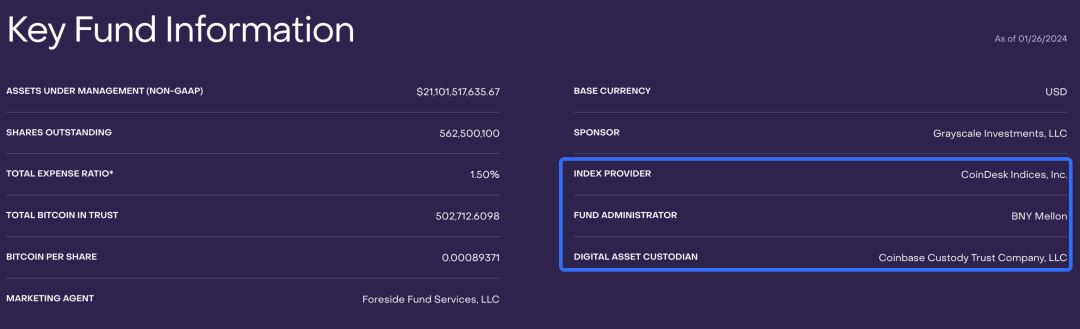
Figure: GBTC Basic Information
On the VATP front, several companies in Hong Kong are actively applying for relevant licenses, indicating that fund managers will soon have multiple VATP options, avoiding the “single point of failure” risk seen in the U.S., where most Bitcoin ETFs rely on a single custodian.
Grayscale Is an Exception—Hong Kong Won’t Repeat Its Mistakes
Since the U.S. approved spot Bitcoin ETFs, one of the most discussed topics has been Grayscale’s sustained large-scale selling. However, Hong Kong does not currently have a Bitcoin trust of comparable size to Grayscale. Even if existing trusts were converted into ETFs and redemptions began, it is unlikely that Hong Kong would see a similar magnitude of sell-off.
Moreover, despite Grayscale’s continued outflows, the overall net inflow into U.S. spot Bitcoin ETFs remains positive. As of 9:00 AM today (UTC+8), OKLink data shows a total net inflow of approximately $605 million. Specifically, only Grayscale has experienced sustained outflows, while all other funds have recorded net inflows.

There are two main reasons behind Grayscale’s continuous selling: First, compared to other fund providers, Grayscale charges the highest management fees. For example, investing $1 million in IBIT versus GBTC saves $13,800 annually in management costs. Second, unlike newly issued spot Bitcoin ETFs, Grayscale transitioned from a trust structure to an ETF. This allows investors who previously purchased GBTC at a discount to profit from arbitrage by selling into the rising Bitcoin price without needing to go through formal redemption and repurchase processes.
According to observations by OKLink Research Institute and on-chain data from OKLink, Grayscale has been transferring assets to Coinbase Prime hot wallet addresses almost daily over the past two weeks. Furthermore, since January 23, 2024, Grayscale’s seven-day consecutive outflow trend has gradually weakened.
The launch of spot Bitcoin ETFs marks a significant step toward tighter integration between traditional finance and virtual assets, symbolizing the opening of structured financial markets to the digital asset sector. According to Technavio, the global structured financial market (Note 1) is projected to grow by approximately $997.68 billion between 2023 and 2028, with a compound annual growth rate of 11.8%.
As regulatory frameworks mature and market sophistication improves, the introduction of spot Bitcoin ETFs signifies the standardization of Bitcoin as a financial product through ETF structures.
Spot ETFs offer investors a more accessible and standardized investment vehicle. Furthermore, standardized products enhance market efficiency and enable more effective risk management and investor protection. The widespread adoption of compliance assistants we predicted at the beginning of 2023 is now unfolding in full force.
Note 1: The global structured financial market encompasses various complex financial instruments characterized by being backed by underlying asset pools. Common structured financial products include securitization products, derivatives, debt instruments, structured derivatives, and financial engineering products. In this context, Bitcoin ETFs fall under securitized products and thus belong to the structured financial market.
Join TechFlow official community to stay tuned
Telegram:https://t.me/TechFlowDaily
X (Twitter):https://x.com/TechFlowPost
X (Twitter) EN:https://x.com/BlockFlow_News
 @OKGResearch












