









Are the new forms of BTC L2 a flash in the pan, or a revival of something long dormant?
TechFlow Selected TechFlow Selected
Are the new forms of BTC L2 a flash in the pan, or a revival of something long dormant?
Bitcoin was originally designed without emphasis on scalability, and the reason we now see a large number of scaling solutions stems from two major upgrades driven by Bitcoin's inherent limitations.
 Navigating Web3 tides with focused insights
Author: YBB Capital Researcher Zeke
Preface
Since Bitcoin's official inception in 2009, exploration into asset issuance and scaling solutions has long been a rarely challenged domain. There are three primary reasons for this:
First, "BTC OGs" have historically upheld Bitcoin as "digital gold"—a pure store of value—and resisted any scaling proposals that might introduce security risks;
Second, since Bitcoin was originally conceived as an electronic payment system, security and stability are foundational to its operation. Thus, Satoshi adopted an extremely minimalistic design. Bitcoin’s scripting language only enables basic payments, and its non-Turing-complete nature prevents arbitrary computation or loops. By sacrificing extensibility, the network ensures robust security and stability;
Third, Vitalik’s vision of the EVM (Ethereum Virtual Machine) made Turing-complete public chains a reality. The more developer-friendly environment attracted a large number of developers, leading to a flourishing blockchain ecosystem beyond Bitcoin.
However, today, with the continued popularity of inscriptions and the maturation of modular concepts, Layer 2 projects building novel scaling solutions on Bitcoin—resembling Ethereum rollups but implemented in wildly diverse ways—are experiencing explosive growth. This article aims to analyze two key questions: What are the implementation methods for BTC scaling, and are these BTC L2s merely fleeting hype or signs of renewed vitality for the oldest public chain?
The Key to Pandora’s Box
As mentioned in the preface, Bitcoin was originally designed without extensibility in mind. The reason numerous scaling solutions are now possible stems from two critical upgrades driven by Bitcoin’s inherent limitations—high transaction fees, slow speeds, inability to handle complex smart contracts, etc.
SegWit (Segregated Witness)
SegWit is a Bitcoin scalability improvement proposal (BIP141) jointly introduced in December 2015 by Bitcoin Core developers Eric Lombrozo (CTO of Ciphrex), Bitcoin enthusiast Johnson Lau, and Blockstream co-founder Pieter Wuille. Implemented in 2017 as a soft fork to the Bitcoin network, its main goal was to address network congestion at the time. Block size plays a crucial role in determining how many transactions can be confirmed per block. SegWit’s core idea revolves around reorganizing block data. By separating signature data from transaction data, it increases the number of transactions each block can confirm.
One of the most significant benefits post-SegWit is increased block capacity. By removing signature data from transaction inputs, effective block size expanded from 1 MB to approximately 4 MB, enabling more transactions to fit within a single block. Additionally, it fixed Bitcoin’s transaction malleability issue (paving the way for the Lightning Network). By isolating signatures from transaction data, it prevents tampering with signatures, effectively eliminating the risk of invalid transactions being permanently recorded on the blockchain.
Taproot
The Taproot proposal was initially put forward in January 2018 by Bitcoin Core developer Greg Maxwell. In October 2020, Pieter Wuille initiated a pull request to merge Taproot into the Bitcoin Core codebase. Full deployment required node operators to adopt Taproot’s new consensus rules. The proposal eventually gained support from 90% of miners and officially activated on November 14, 2021, at block 709,632. Taproot represents a major upgrade since SegWit, aiming to enhance privacy, simplify transaction verification, improve efficiency, and enable handling of more complex smart contracts. It consists of three BIPs: BIP340, BIP341, and BIP342.
BIP340: Introduces Schnorr signatures—a cryptographic signature scheme developed by Claus Schnorr in 2008—designed to optimize Bitcoin’s validation process. Prior to Taproot, Bitcoin used the Elliptic Curve Digital Signature Algorithm (ECDSA). Although Satoshi believed ECDSA was more favorable, Schnorr signatures offer improvements in signature aggregation, batch verification, and privacy, significantly enhancing efficiency and confidentiality;
BIP341: Introduces the Taproot protocol, improving Bitcoin transaction privacy and flexibility. Taproot hides multi-signature (multisig) and smart contract transactions under a single public key hash, making multi-party transactions and complex smart contracts appear like regular single-signature transactions on-chain, thereby enhancing privacy;
BIP342: Introduces Tapscript, an upgraded version of Bitcoin’s original script (the programming language defining how transactions are locked and unlocked). While often referred to as a language, it is essentially a set of opcodes with commands supporting the other two BIPs. Tapscript also removes the 10,000-byte script size limit, creating a better environment for smart contract creation on Bitcoin. (This upgrade also laid the foundation for Ordinals, as the Ordinals protocol leverages Taproot’s script-path spend scripts to attach data.)
Thanks to the SegWit and Taproot upgrades, both the Lightning Network and inscription ecosystems (BRC-20, ARC-20, etc.) rapidly developed and emerged. Meanwhile, to compensate for Bitcoin’s inability to execute complex smart contracts, various execution layers with different implementations have begun entering the BTC ecosystem.
Overview of Scaling Solutions:
Unlike Ethereum Layer 2s, which are relatively unified (though Vitalik hasn’t explicitly defined what constitutes a Layer 2, most currently refer to rollups with similar implementations differing mainly in data validity proof mechanisms), BTC Layer 2s lack a standardized definition or approach. If we consider any scaling solution as a Layer 2, then based on current implementation methods, they can generally be categorized into five types. (Descriptions of some projects in the classification are excerpted from our previous articles "A Thousand Blossoms in Full Bloom: A Comprehensive Overview of the Bitcoin Ecosystem" and "New Journey for Digital Gold: Diversified Exploration and Protocol Innovation in the Bitcoin Ecosystem". Read the full articles for details.)
1. Sidechains:
○ Overview: The first complete technical paper on Bitcoin sidechains was authored by Blockstream researchers and published in 2014, but the proposal was later abandoned. In 2016, Blockstream reintroduced the concept of pegged sidechains as a potential path to scale Bitcoin. Sidechains typically refer to minimally trusted blockchains—often independent chains connected to the main chain via two-way bridges—enabling payments using foreign crypto assets (native assets from another blockchain). Benefits include user-driven asset issuance, stateful smart contracts supporting DeFi solutions, commitment chaining, faster settlement finality, and enhanced privacy.
○ Verification: Sidechains usually employ their own consensus mechanisms with independent validator nodes. Assets are locked when transferred from the main chain to the sidechain and unlocked upon return. Validator nodes ensure the legitimacy of these transfers.
○ Drawbacks: Potential centralization due to few nodes, lack of inherited security from the main chain.
Stacks
Stacks, while not directly branding itself as a sidechain, remains controversial in classification. It aims to link itself to the Bitcoin chain through its unique Proof of Transfer (PoX) consensus mechanism, achieving high decentralization and scalability without additional environmental impact.
Stacks is an open-source Bitcoin Layer 2 blockchain that brings smart contracts and decentralized applications to Bitcoin. Originally named Blockstack, foundational work began as early as 2013. Stacks’ architecture includes a core layer and subnets, allowing developers and users to choose between them: the mainnet offers high decentralization but lower throughput, while subnets offer lower decentralization but higher throughput.
Liquid
Liquid is not just a Bitcoin sidechain but also a settlement network connecting global cryptocurrency exchanges and institutions. Its core features include fast settlement, strong privacy, digital asset issuance, and Bitcoin pegging, enabling faster Bitcoin transactions and asset issuance. Members can tokenize fiat currencies, securities, and even other cryptocurrencies.
Like RSK, Liquid relies on federated multisignature schemes to lock BTC issued as native sidechain currency. However, their actual peg designs differ significantly. Both currently operate with 15 functionary entities: Liquid requires 11 signatures to issue BTC, whereas RSK requires 8. Liquid prioritizes security over availability, while RSK favors availability over security.
Overall, Liquid is a sidechain platform designed to provide shared liquidity among exchanges, emphasizing protocol simplicity, security, and privacy.
RSK:
RSK is another sidechain with native token RBTC, aiming to serve as a cornerstone for financial inclusion, focusing on decentralized finance (DeFi). Secured by Bitcoin miners, RSK is a stateful smart contract platform that enhances Bitcoin’s ecosystem value by expanding its monetary utility. dApps can be written using the Solidity compiler and Web3 standard libraries, achieving Ethereum compatibility. It also extends Bitcoin payments via the RIF Lumino off-chain payment channel network, offering greater on-chain space and off-chain transactions.
RSK targets broader use cases by adopting a stateful VM to improve openness and programmability. Its Ethereum compatibility allows migration of Ethereum dApps and tools to RSK, while Liquid focuses on being an ultra-efficient tool.
Drivechain
Drivechain is an open sidechain protocol for Bitcoin, allowing customization of various sidechains based on specific needs. BIP-300/301 proposes the idea of “allowing developers to add features and functionality to the Bitcoin world without modifying Bitcoin Core code.” By creating a Bitcoin sidechain secured by Bitcoin miners—with Bitcoin serving as the secure Layer 1 foundation—Drivechain enables various Layer 2 scalability use cases on the sidechain. Notably, BIP-300 (“Hashrate Escrows”) compresses 3–6 months of transaction data into 32 bytes via “Container UTXOs,” while BIP-301 (“Blind Merged Mining”) maintains network security through merged mining, similar to RSK.
BEVM (Emerging Project)
BEVM is an EVM-compatible decentralized Bitcoin L2 that uses BTC as gas. It enables all dApps running in the Ethereum ecosystem to operate on the Bitcoin L2.
Technically, BEVM introduces the concept of Bitcoin light nodes. These nodes sync full Bitcoin block headers to prove the finality of BTC network data. BEVM also synchronizes cross-chain transactions and Merkle proofs. Through consensus on this data, BEVM achieves decentralized bridging of Bitcoin assets to Layer 2.
Additionally, to enable decentralized cross-chain transfer of assets and data back to the Bitcoin mainnet, BEVM employs threshold signatures implemented via Taproot and PoS consensus nodes. These PoS nodes hold three private keys responsible for block production, management, and BTC threshold signing. The BTC threshold private key generates N threshold contract private keys, managing assets and data interacting with the BTC network. Through BFT consensus, these nodes form a ⅔ threshold custody contract, enabling a secure and decentralized process for transferring assets and data from BEVM back to the Bitcoin mainnet. Compared to other sidechain solutions, BEVM stands out as one of the most decentralized and secure options available today.
2. State Channels:
○ Overview: The concept of state channels dates back to 2015 with Joseph Poon and Thaddeus Dryja’s “Lightning Network” proposal. It is a payment-channel-based technology enabling low-cost, high-speed, highly scalable transaction confirmations through off-chain transactions.
○ Verification: Transactions within state channels occur off-chain and are only submitted to the Bitcoin main chain when the channel closes. This reduces main chain load while maintaining security. Channel transactions are signed by participants and submitted on-chain, requiring on-chain validation only during dispute resolution.
○ Drawbacks: Slow development progress, complexity of channels may lead to uncertainty.
Taproot Assets
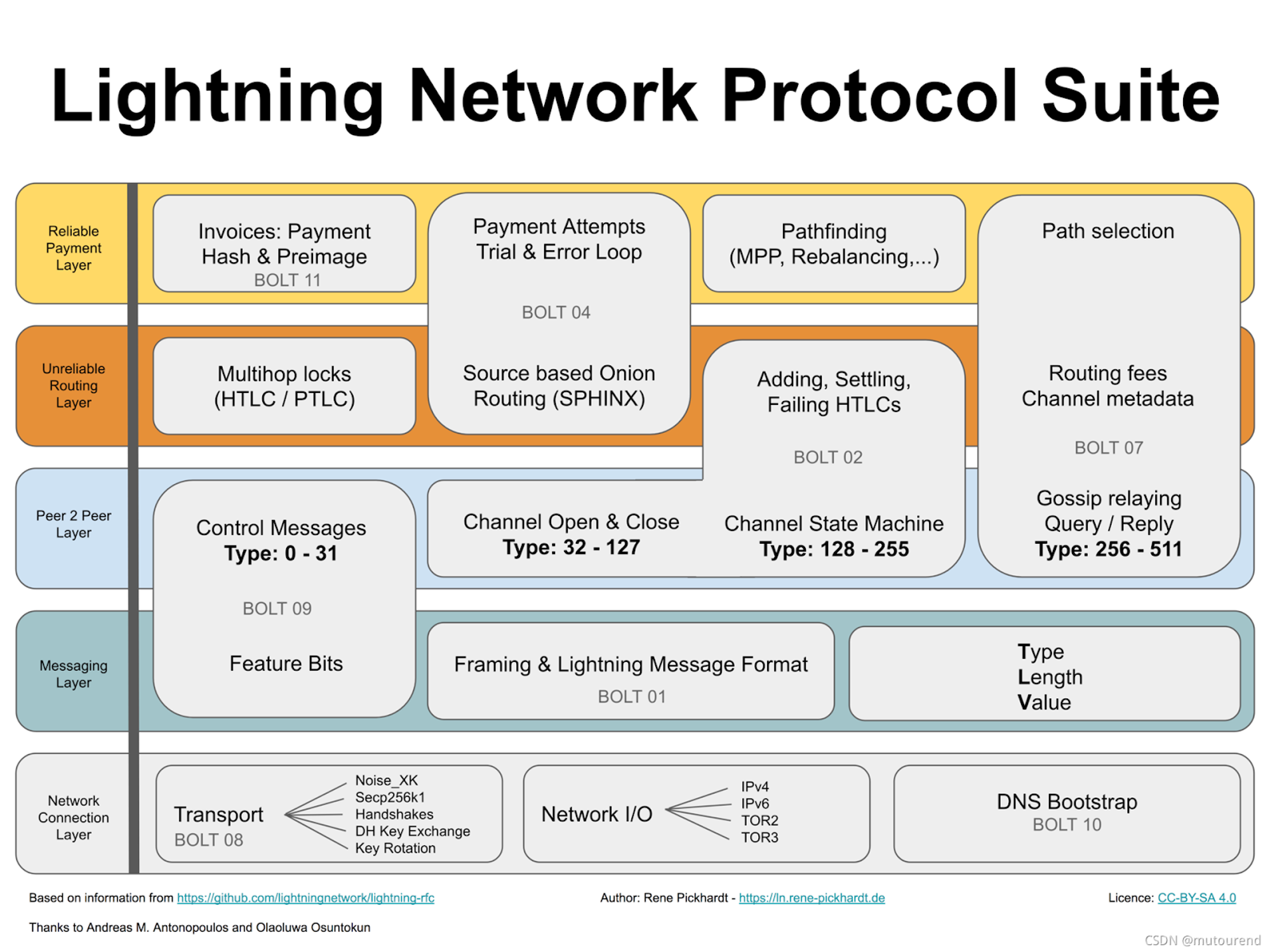
On October 18, 2023, Lightning Labs launched the mainnet Alpha version of Taproot Assets based on UTXO. With the completion of the mainnet version, the Bitcoin Lightning Network will become a true multi-asset network, primarily targeting institutions and asset issuers, enabling instant, low-fee, high-capacity transaction application protocols via the Lightning Network.
It allows all participants to deposit funds into a shared off-chain wallet address (smart contract), then instantly send funds to another participant on the same contract. Only the final transaction result is confirmed on-chain. While the Lightning Network marks a major upgrade to Bitcoin, it introduces a new challenge—the liquidity issue for recipients within the channel.
3. Client Verification & Single-use Seals:
○ Overview: In traditional blockchain systems like Bitcoin or Ethereum, transaction and smart contract validation are performed collectively by network nodes—known as “full-node validation.” In 2016, Bitcoin Core developer Peter Todd introduced a new paradigm called client verification, ensuring privacy so only involved parties know contract details, achieving full decentralization without third-party involvement. This approach also introduced the concept of single-use seals, discussed below in the context of the RGB protocol.
○ Verification: Off-chain data storage, on-chain commitments, client-side verification.
○ Drawbacks: Years of development with slow progress, inability for smart contracts to interact.
RGB Protocol
RGB is managed by the LNP/BP Standards Association (Lightning Network Protocol / Bitcoin Protocol), a nonprofit organization overseeing development across Bitcoin layers, including the Bitcoin protocol, Lightning Network protocol, and RGB smart contracts. RGB is a scalable, privacy-preserving smart contract system for Bitcoin and the Lightning Network, designed to run complex smart contracts on UTXOs and integrate them into the Bitcoin ecosystem. Officially described as a scalable and confidential smart contract suite for Bitcoin and the Lightning Network, it supports asset issuance, transfer, and broader rights management. The protocol operates on client verification and smart contracts on Bitcoin’s second layer or off-chain, based on Peter Todd’s 2016 concepts of client verification and single-use seals. Understanding RGB requires grasping four key components:
1.Single-use Seals:
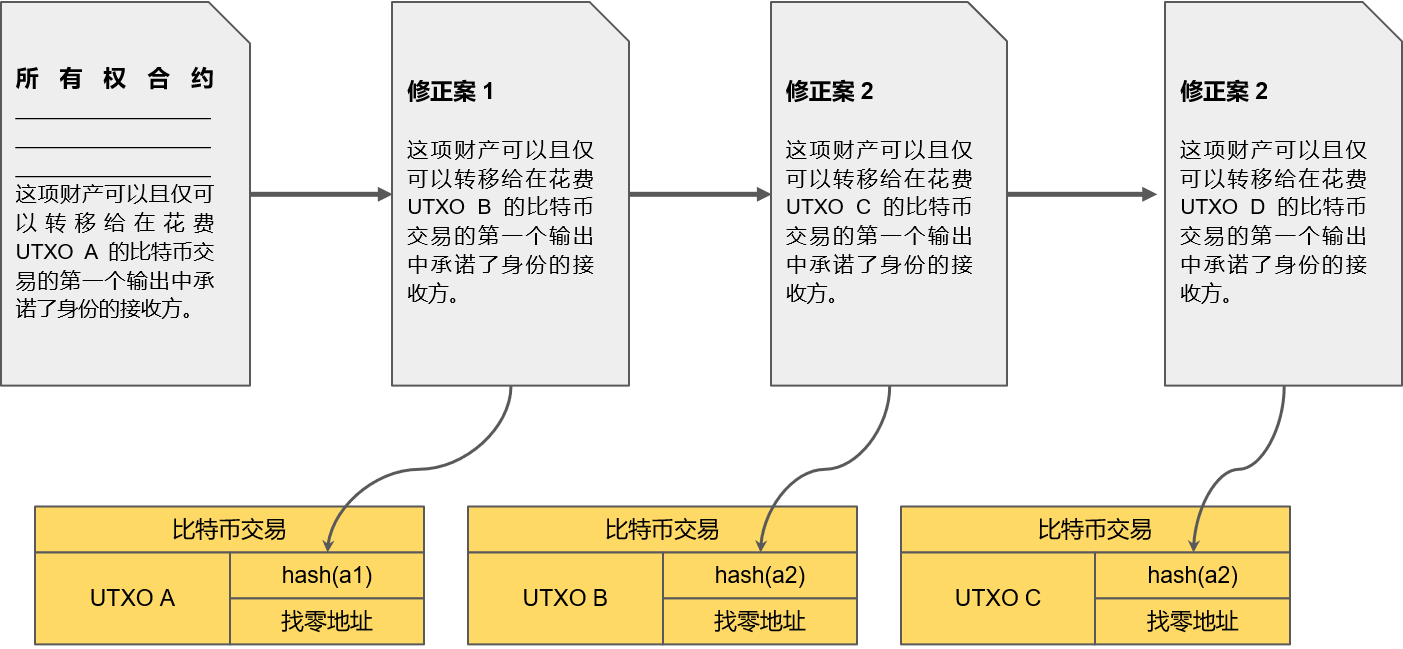
Simply put, it’s like placing a tamper-evident seal on an object, allowing only two states—sealed or broken—to ensure content is used only once, preventing double-spending. Unlike Ethereum accounts, Bitcoin’s network only has wallet addresses, where unspent transaction outputs (UTXOs) can serve as seals.
To understand single-use seals, one must first grasp UTXO—an accounting model where every transaction generates inputs and outputs. Transaction outputs consist of the recipient’s Bitcoin address and amount, stored in the UTXO set tracking unspent outputs. Each input references an output from a prior block, making transactions traceable. Hence, Bitcoin transaction outputs can act as single-use seals.
According to the RGB official documentation, a UTXO can be viewed as a seal: sealed upon creation, opened upon spending. Per Bitcoin’s consensus rules, an output can only be spent once. Therefore, if used as a seal, the economic incentives ensuring consensus rule compliance guarantee the seal opens only once【2】;
2. Client Verification and Deterministic Bitcoin Commitments:
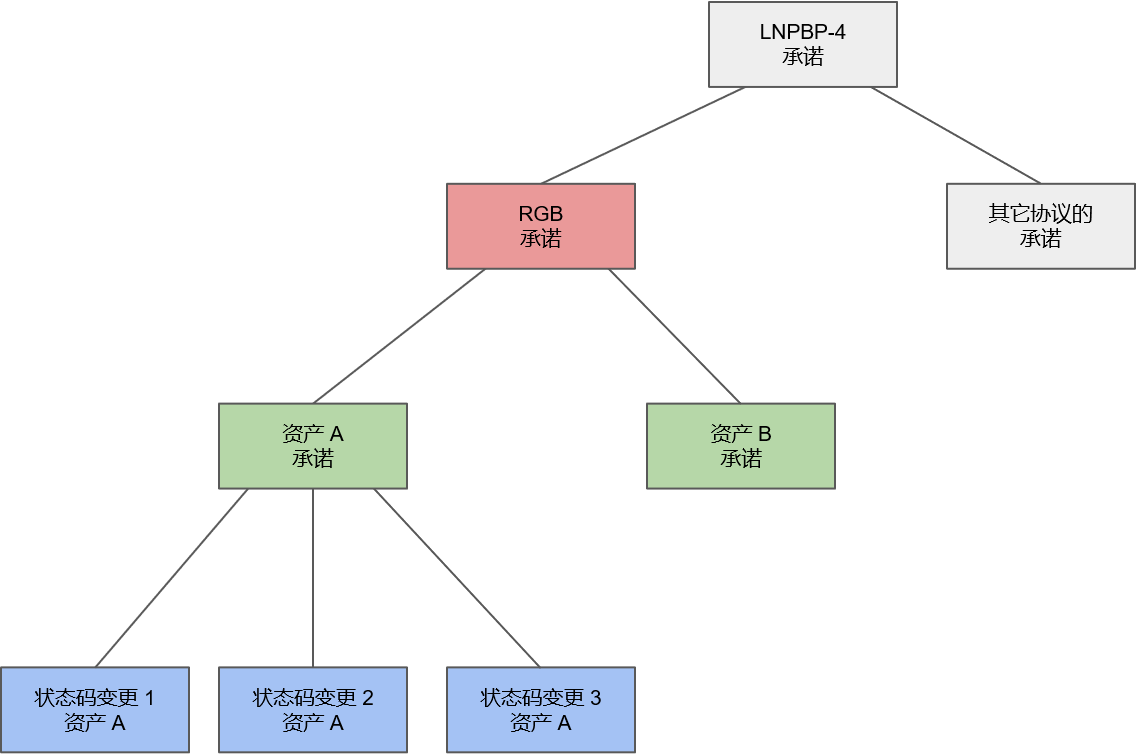
In Bitcoin’s PoW consensus, state validation doesn’t require all decentralized protocol participants to globally execute but rather specific parties verifying particular transitions. This is transformed into a short deterministic Bitcoin commitment via cryptographic hash functions, requiring some “Proof-of-Publication” with receipt proof, non-publication proof, and membership proof as key characteristics. Overall, OpenTimeStamps can be seen as the first protocol in this field, RGB the second, and others may build upon these ideas to form a series of client verification protocols【3】.
RGB leverages the Bitcoin blockchain to prevent double-spending by committing RGB state transitions—spending the UTXO currently holding the right to be transferred—in specific Bitcoin transactions. This allows multiple state transitions to be committed in a single Bitcoin transaction, with each transition only commitable once (to avoid double-spending);
3. Compatibility with the Lightning Network:
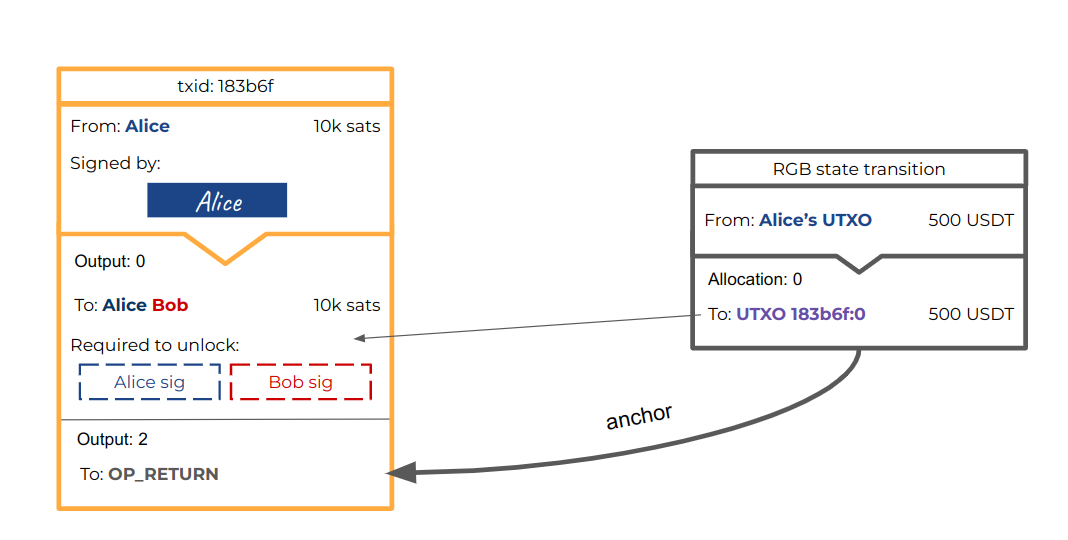
When an RGB state transition is committed to a Bitcoin transaction, it doesn’t need immediate on-chain settlement—it can instead become part of a Lightning Network payment channel, deriving security from it and leveraging Lightning’s payment channels for broader digital asset circulation;
4. Updates in RGB v0.10:
According to Waterdrip Capital’s analysis, the upgrade mainly improves flexibility and security, summarized as follows:
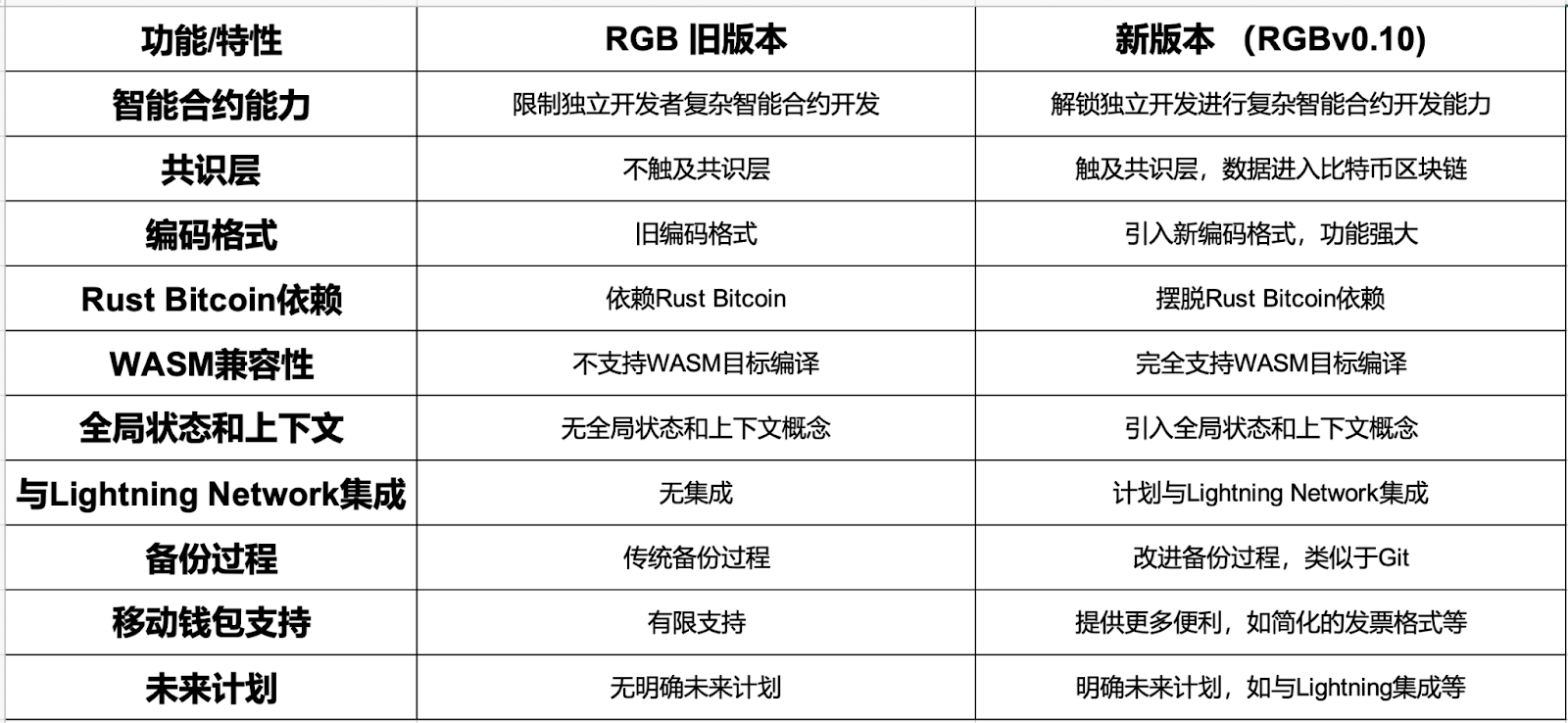
Although the concept of RGB was proposed in 2016, it has yet to gain widespread attention or adoption after years of development, likely due to limited functionality in early versions and high learning barriers for developers. With the arrival of RGB v0.1, we can look forward to whether RGB will unlock greater potential in the future.
4. Inscriptions:
○ Overview: In January 2023, Bitcoin developer Casey Rodarmor released the Ordinals protocol—an asset issuance protocol built on Bitcoin comprising two core components: Ordinals number theory and Inscription. Author Casey Rodarmor embeds content onto UTXOs via inscription, assigning unique identifiers to each of Bitcoin’s smallest units—210 quadrillion Satoshis. Inscription refers to associating content with an unspent transaction output (UTXO). The asset issuance process under the Ordinals protocol resembles writing information into witness data and recording token details in JSON format under the BRC20 standard.
○ Verification: Inscriptions require indexers to extract JSON data from inscriptions and record balance information in off-chain databases. Verifying inscriptions involves extracting JSON data and ensuring compliance with specified rules.
○ Drawbacks: Indexers pose various centralization issues (even causing exchange balance errors), consume mainnet space, and lead to excessive fragmentation.
Ordinals Protocol (BRC-20):

1. BRC-20 Tokens
BRC-20 is an experimental Bitcoin token standard created by Domo on March 8, 2023. Its core concept utilizes JSON data within Ordinal Inscriptions. Through the BRC-20 standard, users can easily perform key functions such as Token contract creation (Deploy), Token minting (Mint), and Token transfers (Transfer). As of December 18, 2023, the total market cap of the BRC-20 sector reached $640 million, highlighting the standard’s significance within the Bitcoin ecosystem and opening new possibilities for digital asset development.
2.BRC-100
BRC-100 is a Bitcoin DeFi protocol built on Ordinals. Beyond its token attributes, BRC-100 is also an application protocol, enabling developers to build DeFi and other application products. According to developer MikaelBTC, BRC-100 introduces protocol inheritance, application nesting, state machine models, and decentralized governance, bringing computational capabilities to the Bitcoin blockchain and making native Bitcoin decentralized applications like AMM DEXs and lending platforms possible.
3. Ordinals NFTs
Software engineer Casey Rodarmor launched the Ordinals NFT protocol on the Bitcoin blockchain, now live. Users can now create and own NFTs on Bitcoin’s smallest unit, the Satoshi (SAT). Using a random yet logical numbering system, each sat becomes unique. Compared to Ethereum NFTs, Ordinals NFTs differ in three main aspects:
○ All related data is stored directly on the Bitcoin network, without reliance on external storage like IPFS or AWS S3;
○ Permissionless: transactions can be completed in a decentralized manner via PSBT without requiring “approval”;
○ Minting cost scales proportionally with transaction volume.
4. BRC-420
According to RCSV’s official Gitbook, BRC-420 focuses on modularizing on-chain inscriptions, featuring two key components: a metaverse standard and a royalty standard, defining open, flexible formats for metaverse assets and establishing specific on-chain protocols for creator economies. Unlike other Ordinals protocols based on single inscriptions, BRC-420 uses recursive combinations of multiple inscriptions.
Atomicals Protocol (ARC-20):

Atomicals, also known as the Atomic Protocol, supports multiple asset types, including fungible token standard ARC20, NFTs, Realms, and Collection Containers. As a UTXO-based blockchain asset issuance protocol, Atomicals offers two minting methods: decentralized minting and direct minting. Decentralized minting introduces Bitwork Mining, a PoW-based minting method. The protocol treats Bitcoin’s smallest unit, the Satoshi, as the smallest unit for issuing assets. Currently, ATOM’s minimum divisible unit is 546, and a minimum of 546 ATOMs can be sold or transferred.
Unlike Ordinals, Atomicals does not rely on third-party sorters for asset transaction ordering. It can be used to create (mint), transfer, and upgrade various digital items, including native NFTs, games, digital identities, domains, and social networks. Additionally, it supports creation of interchangeable tokens named ATOM (distinct from Cosmos’ ATOM despite sharing the name).
Recently, founder Arthur shared his views on meta-protocols in an interview on December 13. He believes meta-protocols represent a novel approach allowing developers to create their own data structures and rules without being constrained by existing rigid frameworks. Protocols representing meta-protocols, such as the Atomicals Protocol, continue to emerge, providing developers opportunities to leverage smart contracts to build entirely new structures. This trend allows creators to focus more intently on the Atomicals Virtual Machine (AVM). The launch of AVM enables developers to build smart contract programs on the Bitcoin network, offering unprecedented creative experiences. This means creators can more deeply engage with smart contracts within the Bitcoin ecosystem, driving forward digital innovation.
Atomicals Asset Types:
○ ARC20: A token format standard similar to BRC20 on Ordinals;
○ Realm: A new concept introduced by Atomicals aiming to disrupt traditional domains, intended for use as prefixes;
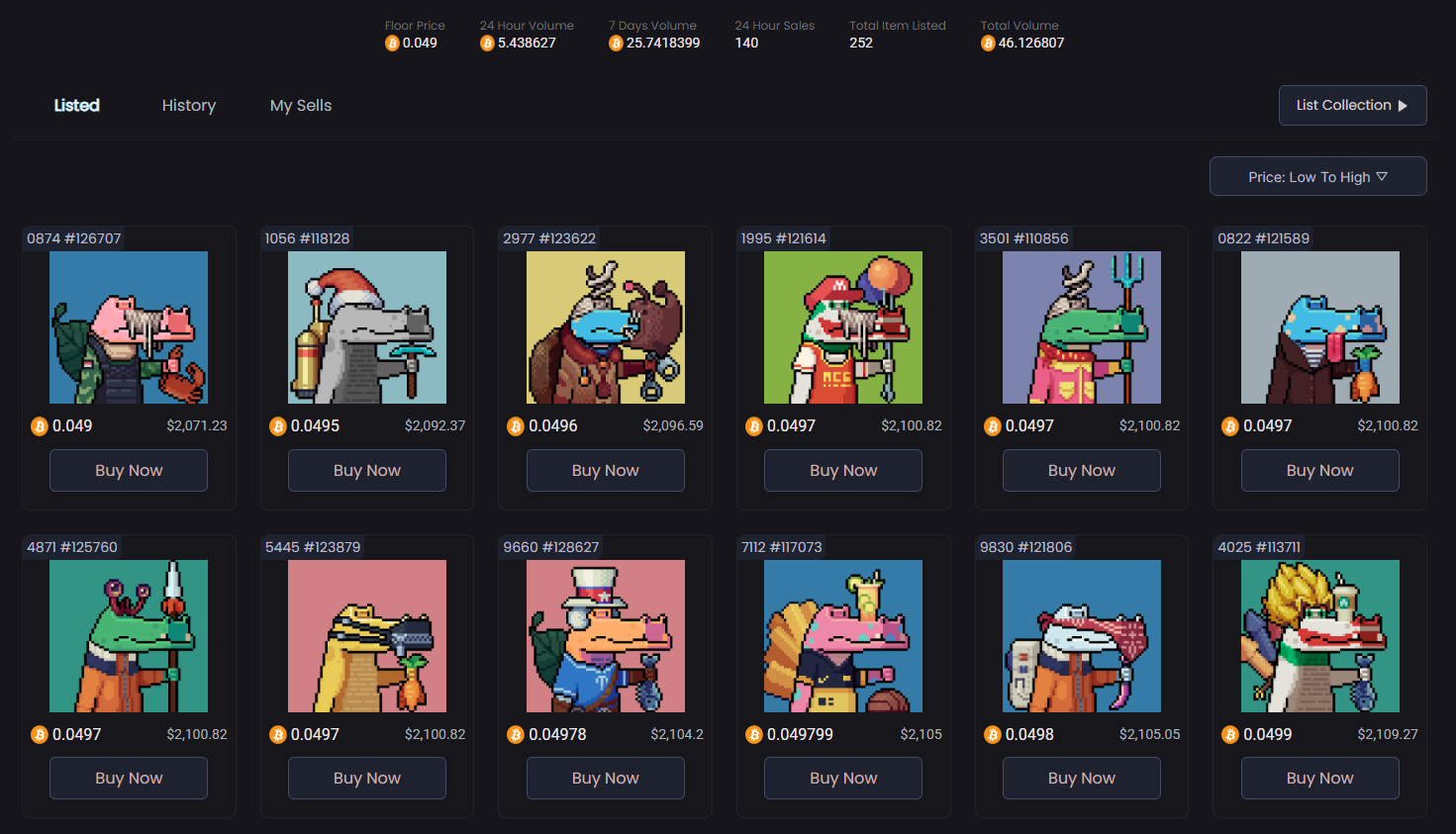
○ Collection Containers: A data type for defining NFT Collections, primarily used to store readable NFTs and associated metadata. As of December 20, 2023, TOOTHY, the top-ranked collection by market cap, had a total market cap of 46.12 BTC and a 7-day trading volume of 25.74 BTC.
5. Rollup:
○ Overview: Rollup is a Layer 2 scalability solution designed to improve blockchain network performance and throughput, particularly for smart contract platforms like Ethereum. Rollup moves most transaction data and computation off-chain, recording only transaction summaries or aggregates on-chain, thus reducing main chain burden and enhancing overall performance. The core idea is combining on-chain security with off-chain efficiency.
○ Verification: The base blockchain only needs to compute proofs submitted to a smart contract to verify activities in the Layer 2 network (for Optimistic Rollups, verification occurs only during disputes), storing unexecuted raw transaction data as calldata. However, since Bitcoin itself cannot verify DA (data availability), current DA verification methods use special approaches—such as engraving DA into inscriptions on the mainnet and validating via custom schemes—or techniques like BitVM, which uses Taproot address matrices or Taptrees to replicate binary circuit-like program instructions, mimicking Ethereum’s verification of Rollups. Hence, architectures of such projects vary wildly.
○ Drawbacks: No project perfectly replicates Ethereum Rollup verification; most remain theoretical or make trade-offs in the impossible trinity. The current market is mixed with varying quality.
BitVM (Emerging Project & New Idea)
BitVM originates from a whitepaper titled “BitVM: Compute Anything On Bitcoin” by Robin Linus, lead of the ZeroSync project. BitVM stands for “Bitcoin Virtual Machine.” It proposes a Turing-complete Bitcoin contract solution without altering Bitcoin’s network consensus, enabling verification of any computable function and allowing developers to run complex contracts on Bitcoin.
BitVM’s system resembles Optimistic Rollup and the MATT proposal. Based on fraud proofs and challenge-response protocols, it doesn’t require changes to Bitcoin’s consensus rules, relying instead on hash locks, time locks, and large Merkle trees. The core idea is that a prover claims a specific input can be computed via a given function to yield a specific output. If the claim is false, a verifier can submit a succinct fraud proof to penalize the prover (similar to Optimistic Rollups). In this system, the prover commits bit-by-bit to the program’s correctness, while the verifier concisely refutes incorrect claims through a series of well-designed challenges. Both parties pre-sign a sequence of challenge and response transactions to resolve potential disputes. Implementation begins with the prover and verifier compiling the program into a massive binary circuit. The prover submits this circuit in a Taproot address containing leaf scripts for each logic gate. They pre-sign a series of transactions for use in the challenge-response game. A key component is bit-value commitment, allowing the prover to definitively set a bit to “0” or “1,” enforced via time locks to compel decisions within specific timeframes.
BitVM realizes logic gate commitments using simple NAND gates, proving any circuit can be expressed. Any circuit can be encoded via gate commitments and combined step-by-step under a single root address. To refute incorrect claims, verifiers use pre-signed transactions to challenge the prover’s assertions. Provers set input values by revealing corresponding bit commitments, while uncooperative provers can be forced by verifiers to reveal inputs on-chain.
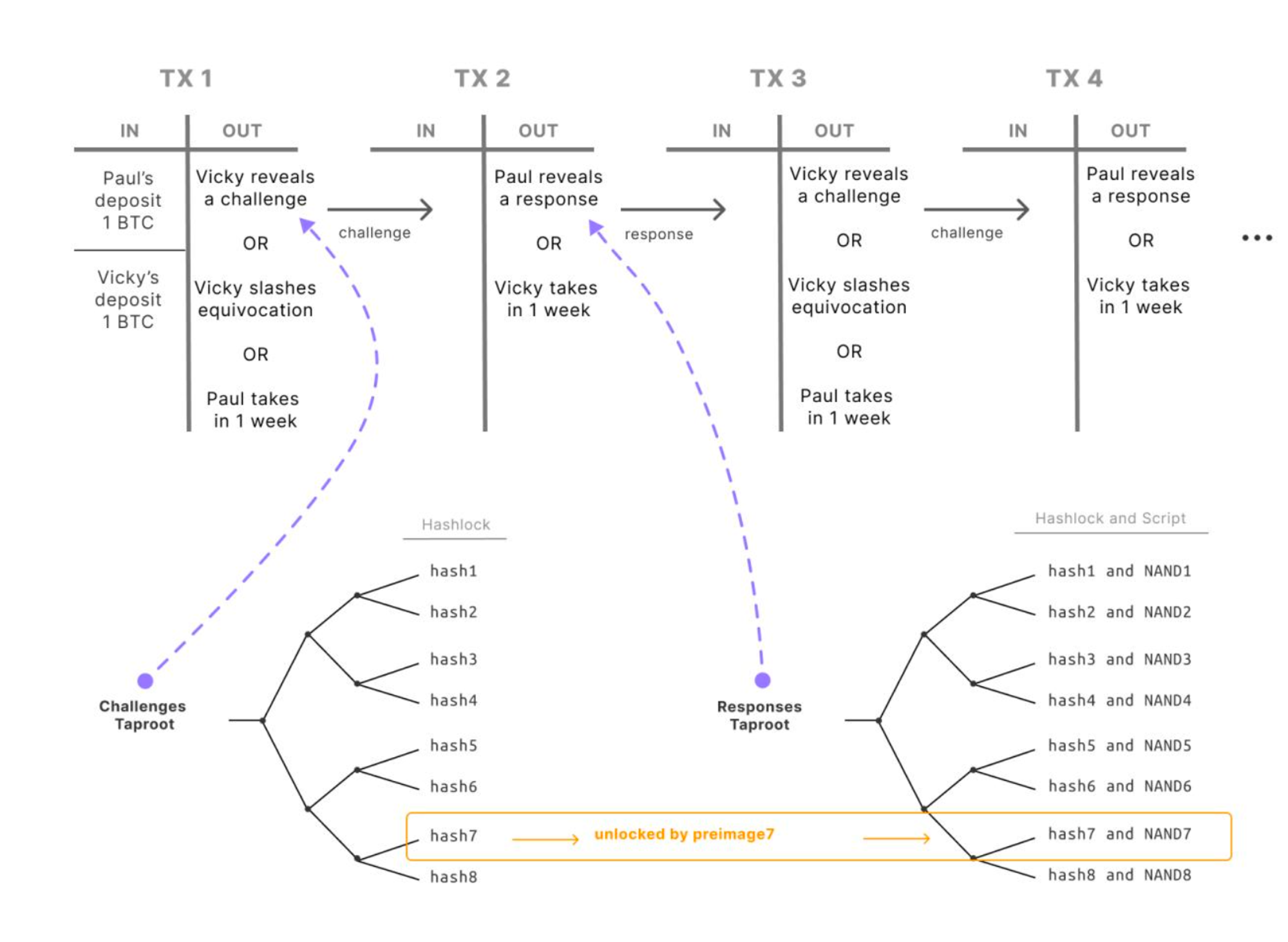
BitVM is currently the closest attempt to replicate Ethereum Rollups. By infinitely stacking binary circuits (via Taproot addresses), a Turing-complete virtual machine could theoretically exist. However, the implementation is extremely difficult—akin to running complex computer programs on a basic calculator. Though still just an idealistic concept, it provides valuable inspiration for future efforts.
ARC-20 AVM (Emerging Project)
On December 13, 2023, Atomicals founder Arthur stated in an interview that meta-protocols represent a new method for developers to create their own data structures and rules, free from constraints of existing rigid frameworks. Meta-protocols like Atomicals Protocol continue to emerge, empowering developers to leverage smart contracts to build entirely new structures. This allows creators to focus on the Atomicals Virtual Machine (AVM), enabling developers to construct smart contract programs on the Bitcoin network.
Bison (Emerging Project)
Bison is a native Bitcoin ZK Rollup that increases transaction speed while enabling advanced functionalities on native Bitcoin. Developers can use ZK Rollups to build innovative DeFi solutions such as trading platforms, lending services, and automated market makers. Unlike other L2s using EVM compatibility, Bison adopts Cairo VM (same as StarkNet) and primarily builds its ecosystem around inscriptions.
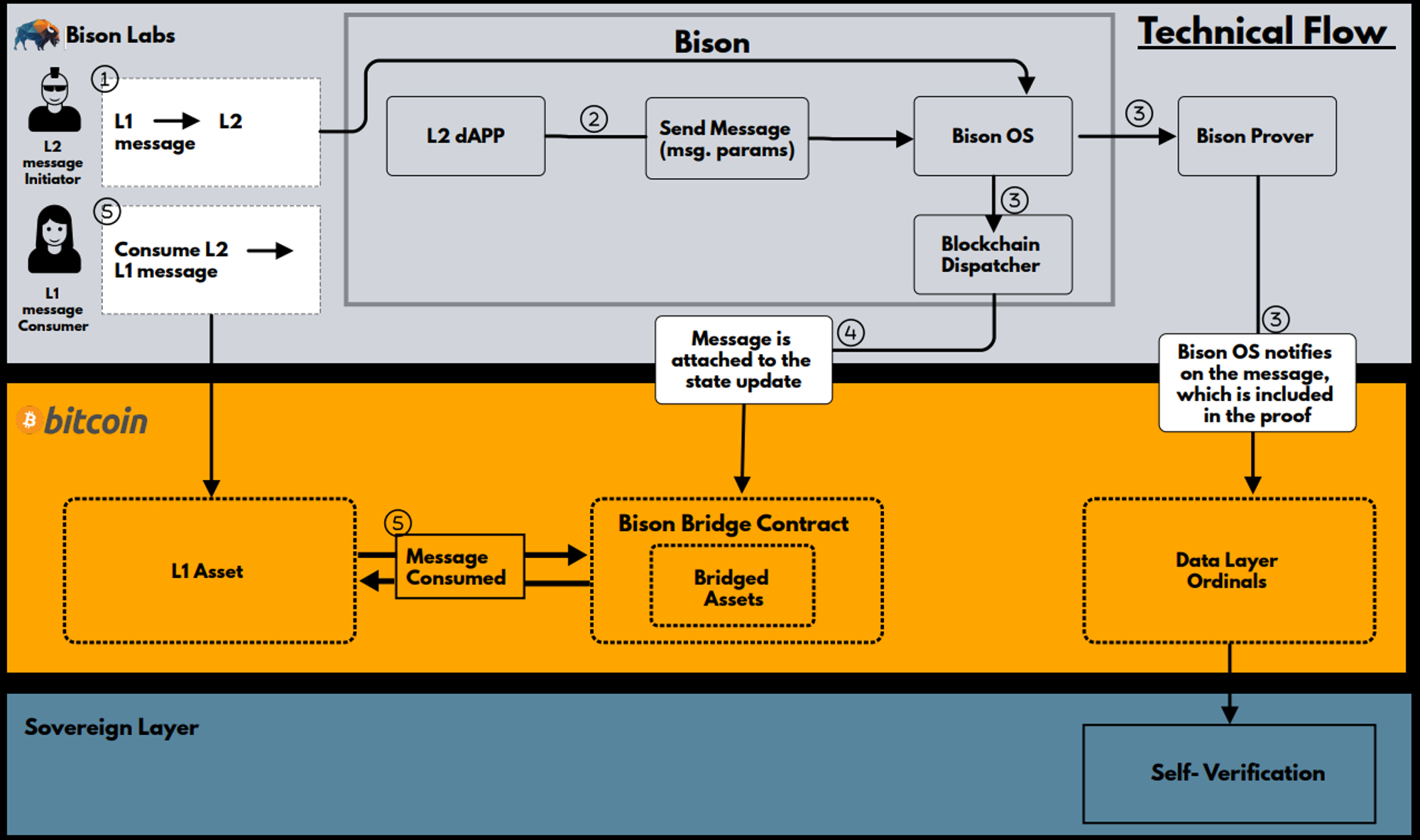
Technically, Bison resembles most Ethereum Rollups—execution layers built atop the base blockchain—but differs in verification.
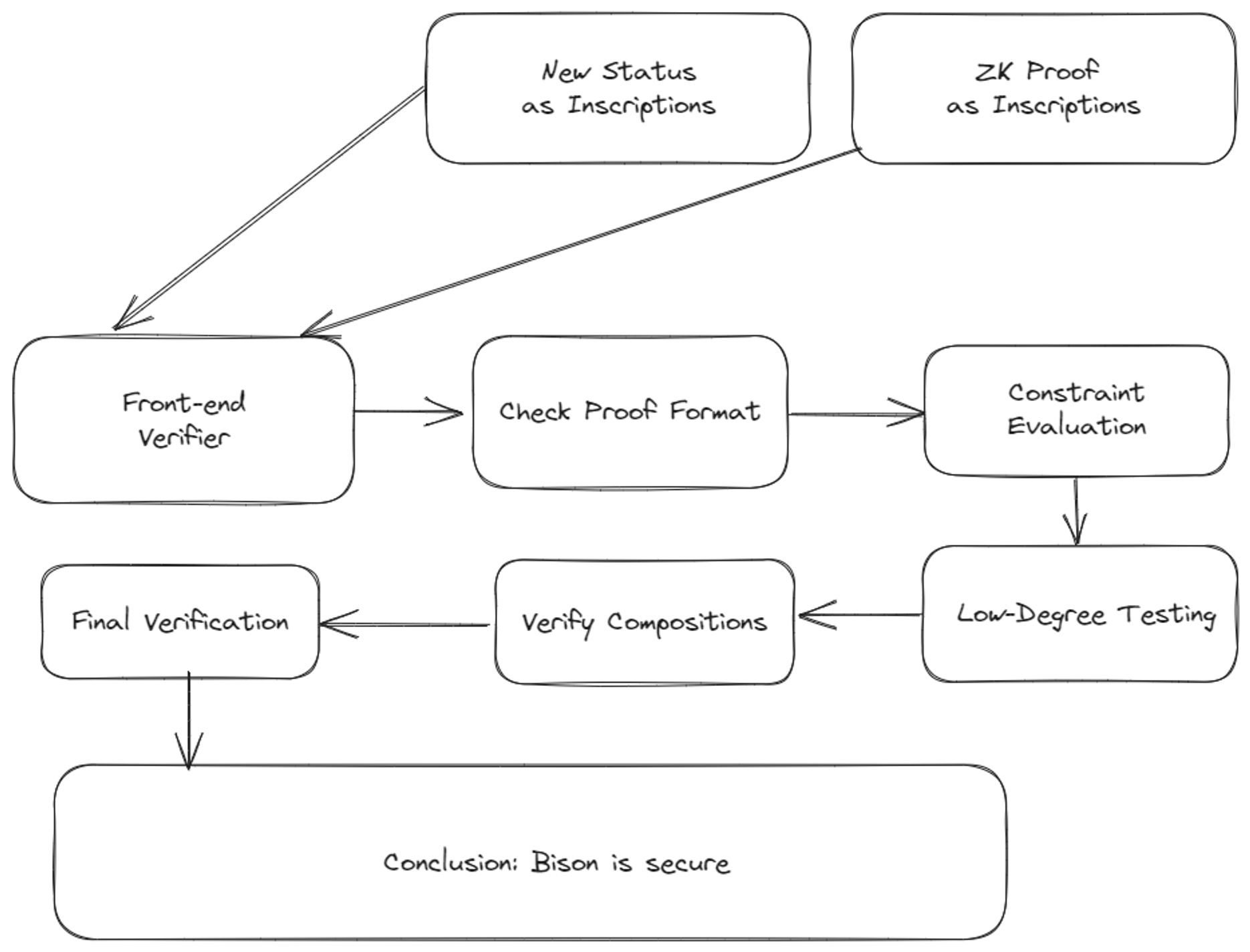
Bison engraves state and ZK proofs as inscriptions onto Ordinals, then verifies them via validators’ front-end clients. First, validators receive ZK proofs and public inputs—values publicly known in the computation. Then, validators check proof format correctness and evaluate constraints without constructing polynomials. Using low-degree tests ensures polynomial degrees stay low, followed by verifying combined polynomials for correctness. Finally, validators check cryptographic commitments and primitives like Merkle proofs for consistency with the proof and public inputs. If all steps pass, the proof is accepted; otherwise, rejected. In practice, Bison remains a sovereign rollup—validated by its own nodes—while DA is merely preserved and published on the BTC mainnet via inscriptions, failing to fully inherit BTC’s value.
B² Network (Emerging Project)
B² Network is an EVM-compatible ZK Rollup based on zero-knowledge proof commitments verified on Bitcoin. Transaction data and ZK proof commitments are recorded on the Bitcoin mainnet and ultimately confirmed via challenge-response mechanisms. However, the sole remaining issue is Bitcoin’s inability to verify DA.
B² Network’s technical architecture includes two fundamental layers and a challenge mechanism: the Rollup layer and the DA layer. On the Rollup layer, B² employs ZK Rollup combined with zkEVM solutions to execute user transactions on Layer 2 and generate corresponding proofs. User transactions are submitted and processed at this layer, with user states stored here. Batch proposals and generated ZK proofs are then forwarded to the DA layer for storage and verification.
The DA layer comprises decentralized storage, B² nodes, and the Bitcoin network. This layer permanently stores copies of Rollup data, verifies ZK proofs, and finally engraves this data as inscriptions onto the mainnet. Simultaneously, the verification system performs decentralized checks and generates Bitcoin Commitments. Since the mainnet cannot verify DA, the Bitcoin Committer Module writes the ZK proof’s Commitment onto the mainnet and sets a time-locked challenge period, allowing challengers to contest the ZK proof verification commitment. If no challenger appears during the time lock, or if the challenge fails, the Rollup is finalized on Bitcoin. Conversely, if the challenge succeeds, the Rollup is rolled back. Successful challengers are rewarded by claiming assets locked on the BTC mainnet, while failed attempts allow nodes to reclaim assets. The project’s concept is commendable, but it still cannot fully inherit Bitcoin’s decentralization and security.
Conclusion
For years, BTC has served primarily as digital gold for value storage. Today’s ecosystem boom offers Rollup projects a chance to escape Ethereum’s dominance (OP, ARB, Zks, Stark) and transform BTC into a productive asset. Unfortunately, however, resemblance remains superficial—no solution has fully inherited BTC’s decentralized and secure value, primarily because none overcome Bitcoin’s inability to verify data availability. The current market is chaotic, with recent cases of outright forks (e.g., SatoshiVM) misleading investors under the guise of BTC L2s, raising funds through deception. Amid the BTC gold rush, investors must carefully scrutinize projects to avoid falling into traps driven by FOMO.
References
1. From BTC Script to Subscript: Analysis of Smart Contract Languages: https://www.sohu.com/a/439259721_120969128
2. Reviewing Five Types of Bitcoin Scaling Solutions and Their Pros and Cons: https://www.odaily.news/post/5190588
3. Off-chain Transactions: Evolution of Bitcoin Asset Protocols: https://www.btcfans.com/zh-tw/article/107183
4. Could the RGB Protocol Be the Ultimate Form of Smart Contracts?: https://www.techflowpost.com/article/detail_15076.html
5. Bitcoin Programmability: https://www.btcstudy.org/2022/09/07/on-the-programmability-of-bitcoin-protocol/#二-基本模块与特性
6. Bitcoin = Panda? Deep Dive into Investment Methodology in the Bitcoin Ecosystem: https://www.odaily.news/post/5191166
7. The First Roar of the Bull Market: Will BTC L2 Create the Next Alpha King?: https://twitter.com/blockpunk2077/status/1748652961436492288
8. Haotian: https://twitter.com/tmel0211/status/1749322402079887551
9. What Is Taproot and How Does It Benefit Bitcoin?: https://academy.binance.com/zh/articles/what-is-taproot-and-how-it-will-benefit-bitcoin
Join TechFlow official community to stay tuned
Telegram:https://t.me/TechFlowDaily
X (Twitter):https://x.com/TechFlowPost
X (Twitter) EN:https://x.com/BlockFlow_News
 @YBBCapital









