









Bankless: Re-staking Summer is Here — How Big Will the EigenLayer Airdrop Be?
TechFlow Selected TechFlow Selected
Bankless: Re-staking Summer is Here — How Big Will the EigenLayer Airdrop Be?
This article delves into the core concepts behind EigenLayer and provides a detailed introduction to its points mechanism.
 Navigating Web3 tides with focused insights
Written by: Jack Inabinet, Bankless
Translated by: Luccy, BlockBeats
Editor's Note: On January 25, according to EigenLayer’s official website, EigenLayer's TVL reached 806,700 ETH, worth approximately $1.788 billion. Additionally, the team is introducing a new method for distributing restaking points, which will cap the allocation of restaking points to any LST, LRT, or individual deposit at 33% of future total issuance.
Bankless analyst Jack Inabinet dives deep into the concept behind EigenLayer and provides a detailed explanation of its points mechanism, analyzing its potential airdrop value. BlockBeats translates the article as follows:
Only a handful of crypto projects have created at least a billion dollars in wealth for early users right from the start of their airdrops—but we may soon see another hot protocol join that list.
Restaking promises to become a transformative cryptoeconomic primitive, and EigenLayer stands at the forefront of making it a reality.
Today, we’ll explore why EigenLayer is a disruptive game-changer, provide examples of services built on top of it, explain why EigenLayer could be the next billion-dollar airdrop opportunity, and estimate the scale of airdrop participants might expect from engaging with EigenLayer.
Why Is EigenLayer a Disruptive Game-Changer?
EigenLayer creates a decentralized marketplace enabling Ethereum holders to "restake" their tokens, providing security not only for Ethereum but also for other crypto applications.
As a programmable trust network, EigenLayer allows developers to build decentralized networks while avoiding the complexities of launching and operating their own trust infrastructure.
Since protocol developers no longer need to worry about running validator node networks, they can focus more on what matters—building their applications—rather than spending excessive effort supporting the market cap of a stakable token designed to secure their decentralized network.
This lowers the barrier to entry for creating decentralized networks and empowers the long tail of crypto-secured applications.
Protocols using EigenLayer are effectively “renting” economic security from Ethereum’s existing stakers. This reuse of staked Ethereum to secure multiple applications brings capital efficiency to staking, reduces the cost of securing additional networks, and maintains strong trust guarantees for individual services.
For EigenLayer restakers, the protocol offers two enhanced yield opportunities. Restakers not only earn boosted yields by securing other networks, but they’re also eligible for airdrop allocations from protocols utilizing their services.
What Services Can Be Built on EigenLayer?
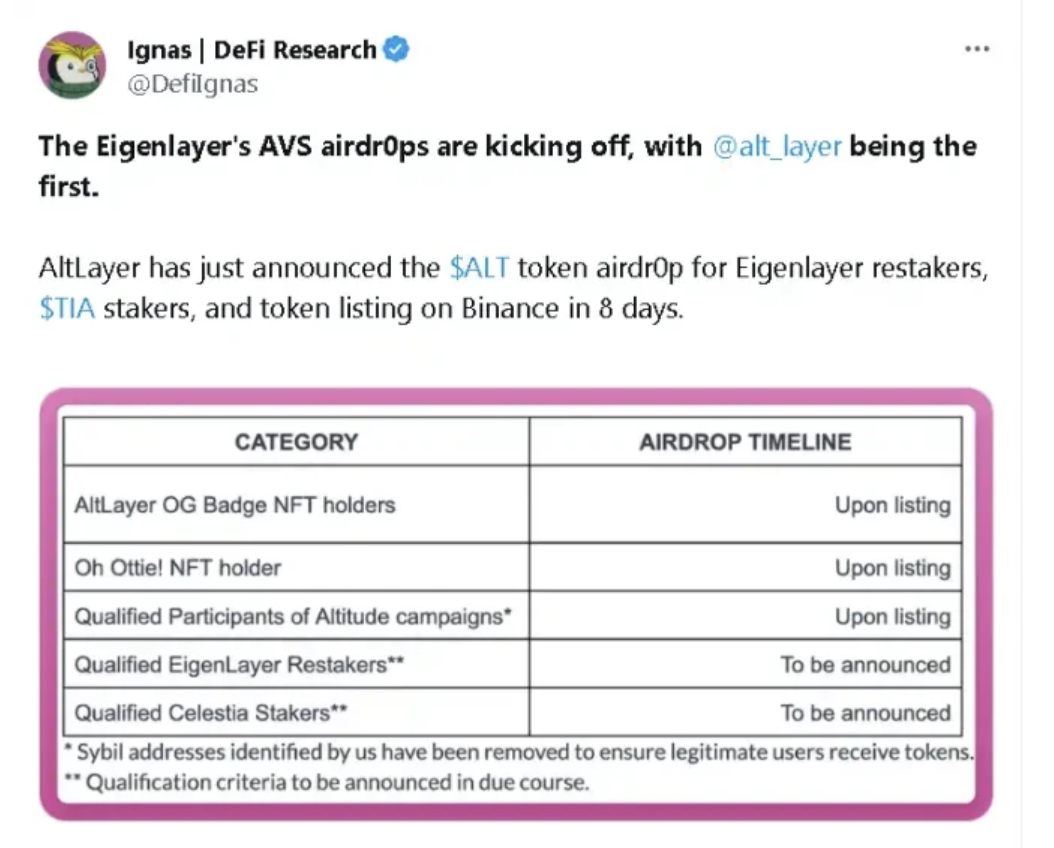
EigenLayer Active Validation Services (AVS) refer to any system requiring its own distributed validator network for validation and relying on EigenLayer for security. The term "AVS" is truly a catch-all, applicable to any decentralized validation application across a wide range of use cases.
Restakers delegate their stake to AVS operators who run EigenLayer’s infrastructure and use restakers’ Ethereum as collateral for their services, in exchange for the ability to use that staked ETH as security.
The most well-known AVS is EigenLayer’s data availability solution, EigenDA.

Although EigenDA is not yet live, it is expected to significantly reduce the cost of posting data on rollups and is projected to offer a more cost-effective solution than leading DA provider Celestia, thanks to the capital efficiency of restaking compared to operating an independent L1 blockchain under Celestia’s model.
However, EigenLayer’s ability to secure networks extends far beyond the Ethereum ecosystem, with various applications being built on Cosmos.
Cosmos Hub (ATOM) has long been the primary interchain security provider for networks unwilling to launch their own tokens and validator sets within the Cosmos ecosystem, but EigenLayer aims to soon take over this crown.
Ethereum os and Lay3r are two AVSs that will allow Cosmos chains to launch their L1s using EigenLayer’s existing trust network, offering a more attractive—and cost-efficient—security alternative to Cosmos Hub.
Just as EigenLayer’s AVS can provide security for L1 and L2 blockchains, they can also validate various other crypto systems, including decentralized keepers and oracle networks.
EigenLayer also aims to enhance interoperability: its Fast Finality AVS will enable instant settlement benefits for any transaction, allowing bridge protocols to leverage EigenLayer’s restaked Ethereum network as collateral, reducing waiting times during user transaction transfers.
While the intersection of artificial intelligence and cryptography is only beginning to be explored, EigenLayer could become a key player unifying these two domains. Onchain AI interfaces may soon leverage AVS to verify algorithmic integrity through zero-knowledge proofs, and EigenLayer’s capital-efficient restaking model makes it more cost-effective than alternative ZKML technologies.
How Big Will the EigenLayer Airdrop Be?
Accurately valuing crypto protocols with real cash flows is already difficult enough—let alone ones that don’t yet exist. While there’s no direct equivalent to EigenLayer, Celestia offers a close-enough competitor to base estimates upon.
Celestia’s sole utility may be as a data availability layer, yet its TIA token currently holds a fully diluted valuation (FDV) of $15 billion, slightly below last week’s brief peak of $20 billion.
Compared to Celestia, EigenLayer has the advantage of offering multiple additional services beyond data availability, meaning multiple revenue drivers—suggesting the market may view EigenLayer as a more attractive investment opportunity than Celestia.
Unfortunately, EigenLayer’s valuation is affected by one key fact: it is not a blockchain network, meaning the EIGEN token cannot accrue the same L1 premium as expected.
In practice, this means EIGEN has lower utility than TIA, as it won’t be the asset used to stake AVSs—a factor that will reduce demand for the token, potentially causing EigenLayer to trade at a lower valuation.
EigenLayer could choose to enhance EIGEN’s utility by using it as the payment token for services offered on the network. However, this would be a less effective source of demand and would be partially offset by inevitable sell pressure from restakers and AVS operators receiving it as compensation and seeking to cash out into another asset.
Considering all these factors, it seems reasonable to assume EigenLayer will trade at an FDV similar to Celestia’s—likely in the $10–20 billion range at initial launch.
While EigenLayer’s tokenomics remain unknown, it wouldn’t be surprising if they airdropped 10% of the total EIGEN supply to early users—an allocation that would easily make this a multi-billion dollar airdrop.
What Does This Mean for Individual Depositors?
Currently, 760,000 ETH have already been deposited into EigenLayer, and the upcoming increase in the LST deposit cap will further boost this amount. Depositors earn one point per hour for each staked ETH, with total points accumulated reaching around 1 billion.
We don’t know how many EigenLayer points will ultimately exist, since the timing of the airdrop is uncertain, as is the amount of ETH earning points by then—but Polymarket currently assigns only a 13% probability that the EigenLayer airdrop arrives before April.
Assuming the EIGEN airdrop occurs at least 180 days after the next deposit cap increase, and that managed ETH grows linearly to 1 million during that period, there would be approximately 4.8 billion points in circulation by airdrop time.
With a valuation range of $10–20 billion and assuming 10% of total EIGEN supply is airdropped, depositors could expect each point to be worth $0.21 to $0.41—translating to a claimable value of $907 to $1,814 per ETH deposited at each LST cap increase, such as the one scheduled for February 5.
Notably, while many assumptions must hold true for this estimate, this represents only the minimum allocation non-whale depositors can expect; tiered EIGEN token distribution with maximum caps would favor smaller depositors.
How to Maximize Your EigenLayer Airdrop Opportunity?
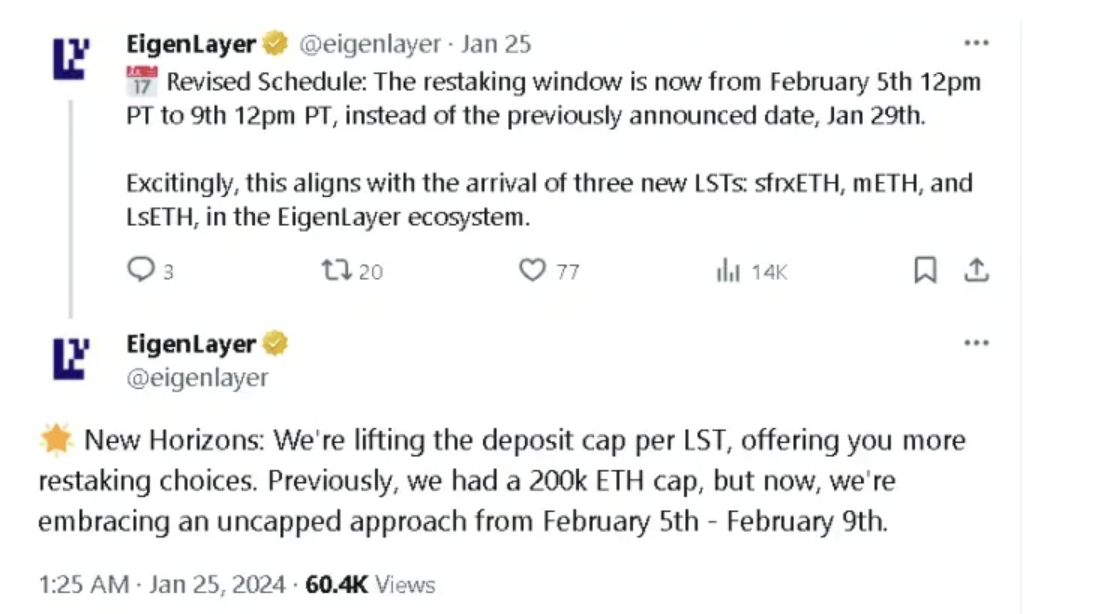
To qualify for the EigenLayer airdrop, the first thing you should do is set a calendar reminder to deposit ETH on February 5.
Join TechFlow official community to stay tuned
Telegram:https://t.me/TechFlowDaily
X (Twitter):https://x.com/TechFlowPost
X (Twitter) EN:https://x.com/BlockFlow_News
 Bankless









