









BTC Spot ETF's First Week in Numbers: Over $1.2 Billion Net Inflows in 6 Days, Price Down 14.8% on Average
TechFlow Selected TechFlow Selected
BTC Spot ETF's First Week in Numbers: Over $1.2 Billion Net Inflows in 6 Days, Price Down 14.8% on Average
Bitcoin spot ETFs saw a cumulative net inflow of approximately $1.208 billion in the six days following their listing.
 Navigating Web3 tides with focused insights
Author: Carol, PANews
On January 11, after a decade-long struggle, spot Bitcoin ETFs were finally approved. The U.S. Securities and Exchange Commission (SEC) officially greenlit 11 spot Bitcoin ETFs, including iShares Bitcoin Trust, Fidelity Wise Origin Bitcoin Fund, and Bitwise Bitcoin ETF.
The prevailing market view holds that the listing of spot Bitcoin ETFs could open institutional channels, attract more capital, and accelerate the expansion of the crypto economy. In simple terms, spot Bitcoin ETFs are widely expected to drive up Bitcoin prices and usher in a new bull market. However, within the first week following their launch (as of January 19), these optimistic expectations have yet to materialize, with Bitcoin’s price falling back to around $41,000.
What are the basic facts about spot Bitcoin ETFs? How did they perform during their first week of trading? And what impact do they have on Bitcoin? PAData, the data-focused column under PANews, analyzed the fundamental and trading data of these ETFs and found:
-
As of January 19, the total assets under management (AUM) of the 11 spot Bitcoin ETFs amounted to approximately $26.975 billion. The top three were Grayscale at $23.537 billion, iShares Bitcoin Trust at $1.199 billion, and Fidelity Wise Origin Bitcoin Fund at $1.017 billion. Between January 11 and 19, the AUM of the 11 ETFs declined by 8.41%.
-
As of January 19, eight ETFs that disclosed their Bitcoin holdings collectively held 635,700 BTC, with Grayscale holding about 567,000 BTC. iShares Bitcoin Trust, Fidelity Wise Origin Bitcoin Fund, and Bitwise Bitcoin ETF followed, holding approximately 28,600 BTC, 24,900 BTC, and 10,200 BTC respectively.
-
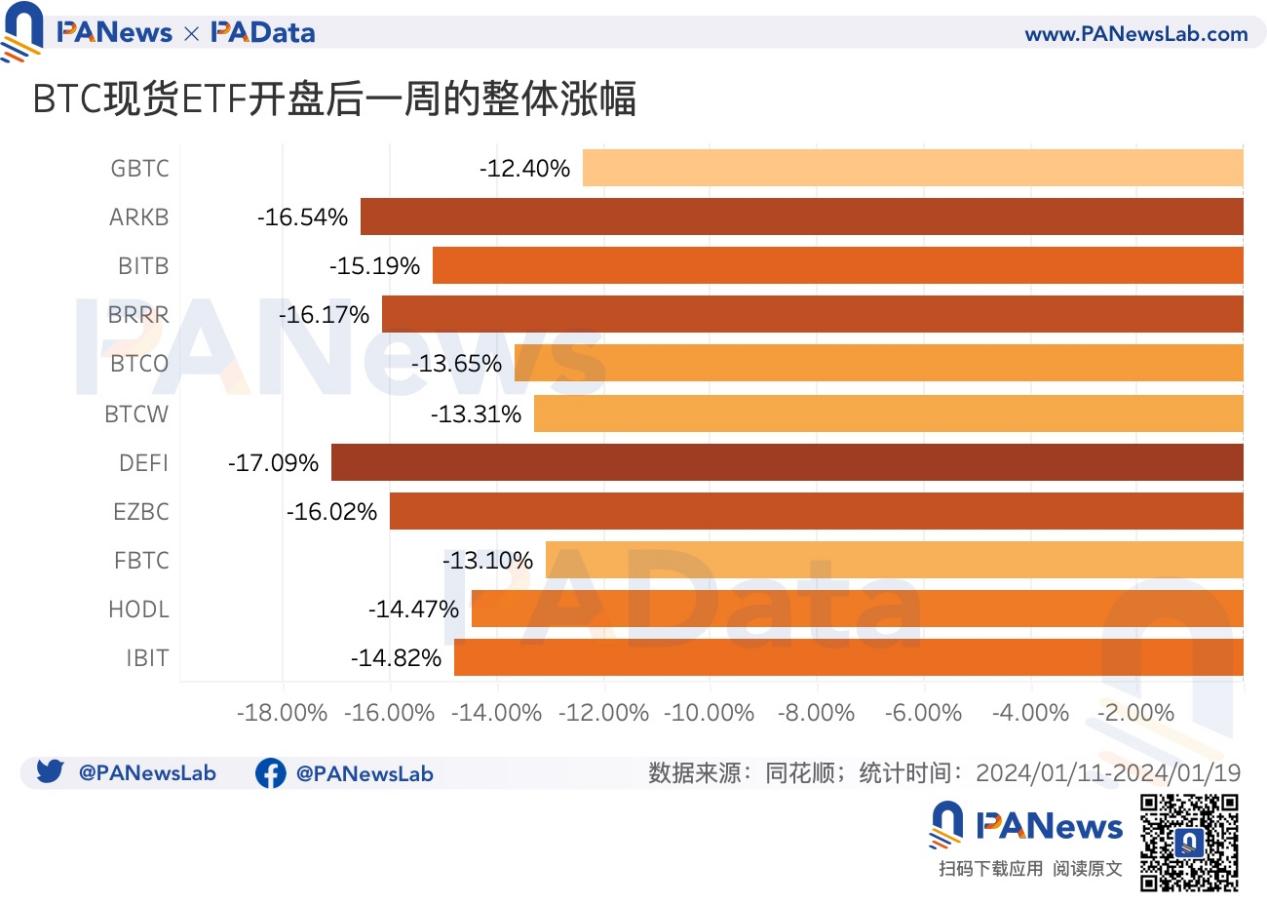
Since their market debut, spot Bitcoin ETFs have broadly declined. Measured by the percentage change from closing prices on January 19 relative to opening prices on January 11, the average price of the 11 ETFs dropped by 14.80%.
-
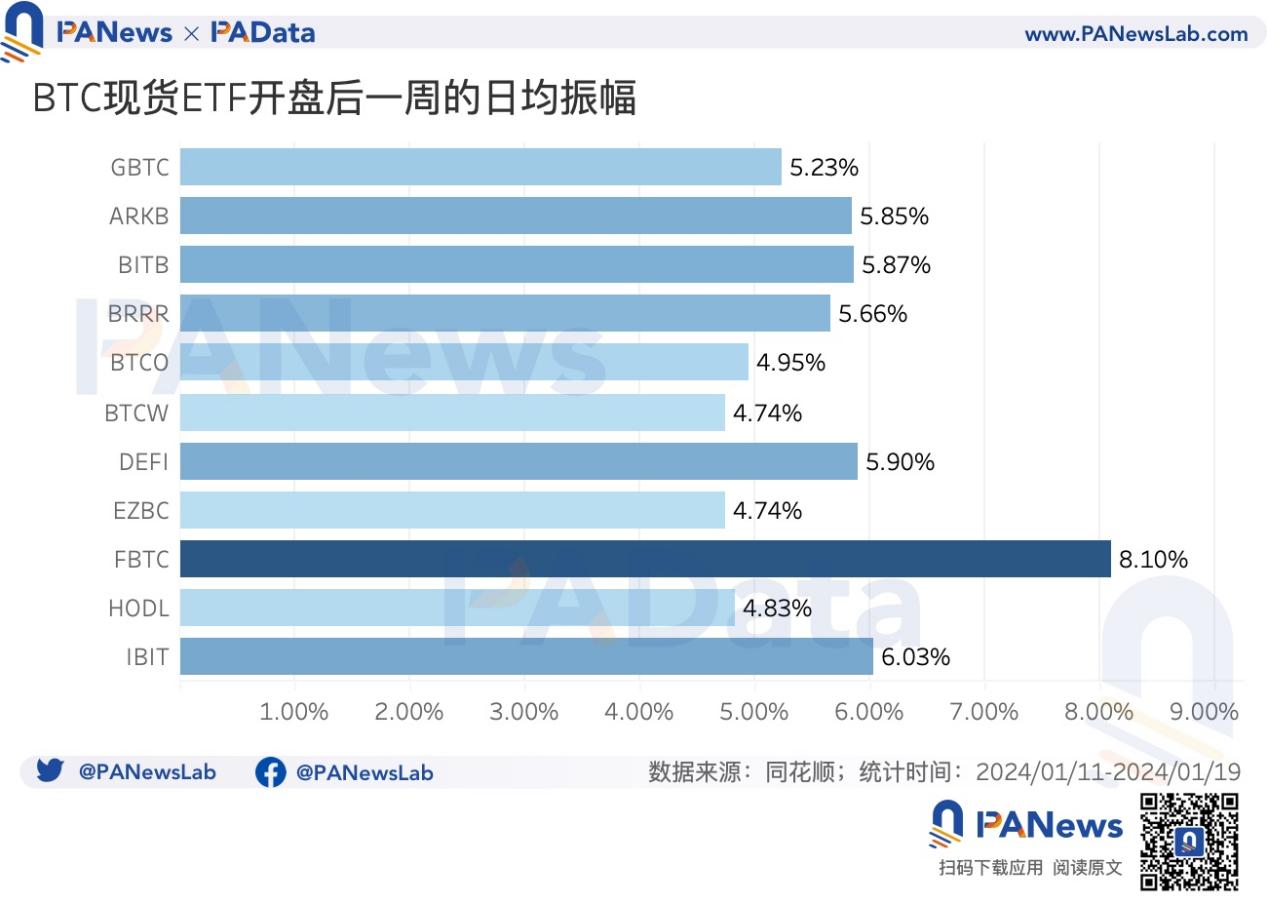
Price volatility among spot Bitcoin ETFs has been notable. The average daily price range across the 11 ETFs was approximately 5.63%, higher than Bitcoin’s同期 average of 4.78%.
-
Five of the 11 spot Bitcoin ETFs are trading at a discount. BRRR has the highest discount rate at 0.51%, while GBTC has the lowest at approximately 0.27%. The arbitrage opportunity based on GBTC’s discount has narrowed significantly, suggesting limited future impact on market sell pressure from such activities.
-
Total trading volume for the 11 spot Bitcoin ETFs reached approximately $16.691 billion over their first six days of trading. GBTC led with $9.012 billion in total volume, followed by IBIT and FBTC at $3.194 billion and $2.649 billion respectively.
-
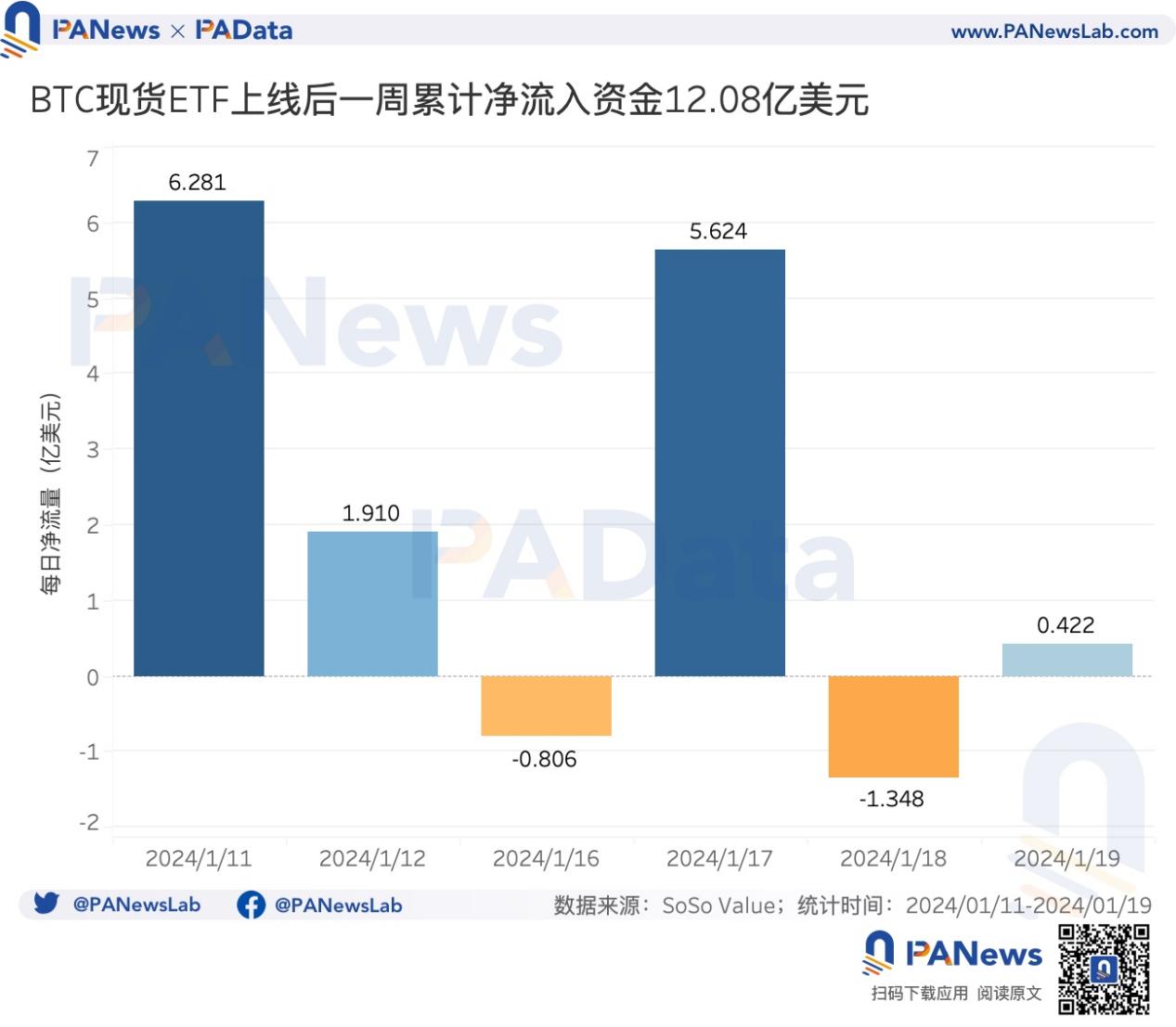
Net inflows into spot Bitcoin ETFs totaled approximately $1.208 billion over the first six days after listing, including $628 million on the first day. While these ETFs have injected fresh capital into the crypto market, they remain short of triggering a new “institutional bull run.”
-
Investors in the U.S. have expressed strong optimism about the approval and launch of spot Bitcoin ETFs, whereas investors in Asia have shown contrasting sentiment.
-
Bitcoin markets have recently exhibited several positive signs: increased market buying power, heightened on-chain transaction activity, and growing accumulation of Bitcoin.
01. Total AUM Exceeds $26.9 Billion; 8 ETFs Disclose Holdings of 635,700 BTC
Based on official data from the 11 issuers, cross-verified with third-party platforms like TradingView and Robinhood, the total AUM of the 11 spot Bitcoin ETFs reached approximately $26.975 billion as of January 19. Grayscale alone accounted for $23.537 billion, or 87.25% of the total. Only two other ETFs—iShares Bitcoin Trust and Fidelity Wise Origin Bitcoin Fund—have AUM exceeding $1 billion. The remaining ETFs currently have relatively small AUM, all below $500 million, with some even under $100 million.
According to SoSo Value's AUM data, the aggregate AUM stood at approximately $29.38 billion on January 11 but fell to $26.91 billion by January 19, representing an overall decline of about 8.41%.
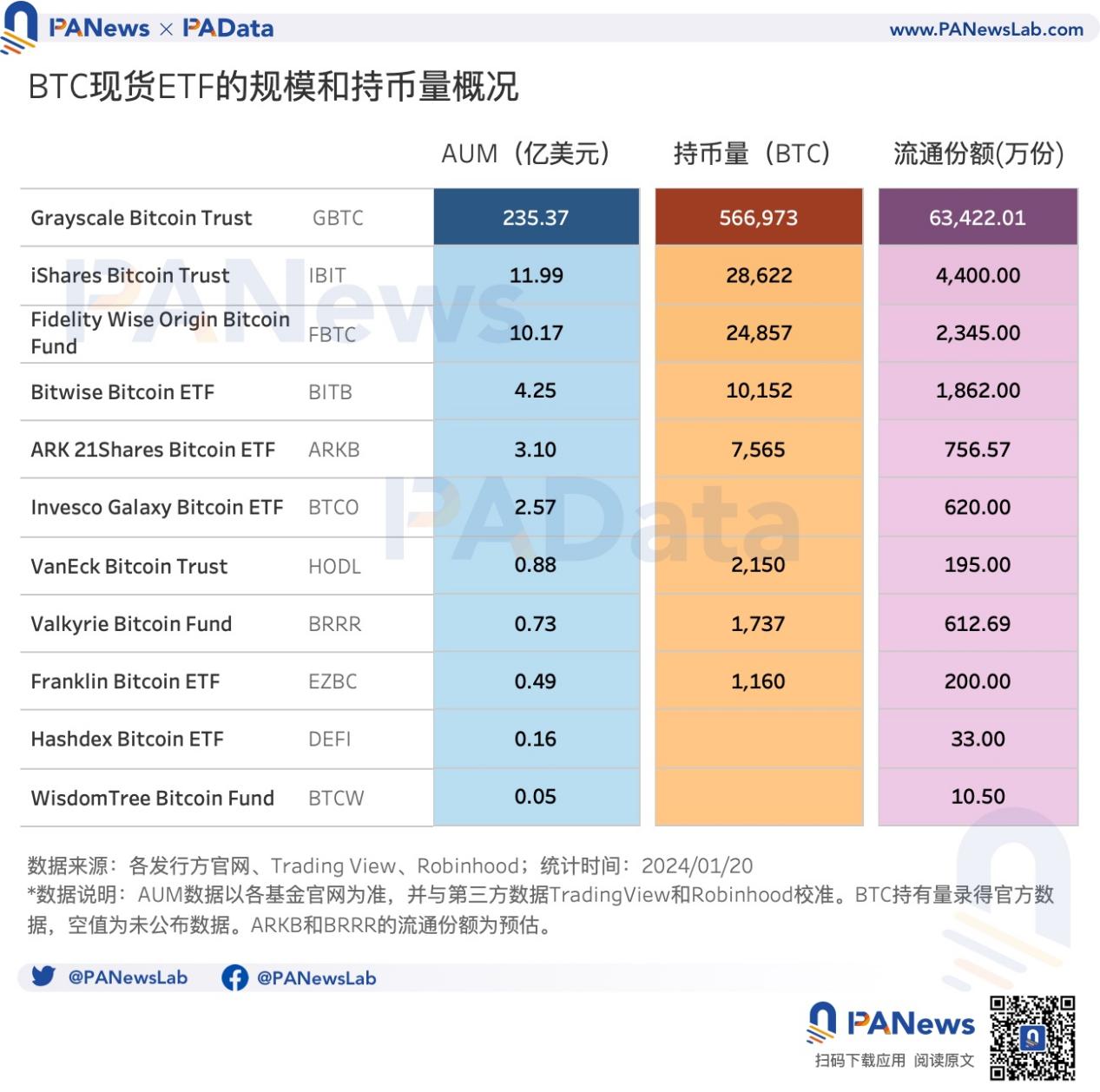
Among the 11 issuers, eight publicly disclosed their Bitcoin holdings. As of January 19, these eight ETFs collectively held 635,700 BTC, with Grayscale holding approximately 567,000 BTC—about 89.20% of the total. iShares Bitcoin Trust, Fidelity Wise Origin Bitcoin Fund, and Bitwise Bitcoin ETF ranked next, with holdings of approximately 28,600 BTC, 24,900 BTC, and 10,200 BTC respectively.
Facing intense competition from 11 newly launched spot Bitcoin ETFs, various issuers have adopted strategies to lower their Total Expense Ratios (TER) to attract investor capital. Currently, six ETFs—including FBTC, BITB, and BTCO—offer a 0% management fee during promotional periods. After these periods end, fees are expected to rise to between 0.2% and 0.3%, still below the industry average. In contrast, Grayscale, the largest issuer, maintains a high management fee of 1.5%, while Hashdex Bitcoin ETF charges a relatively high 0.9%.
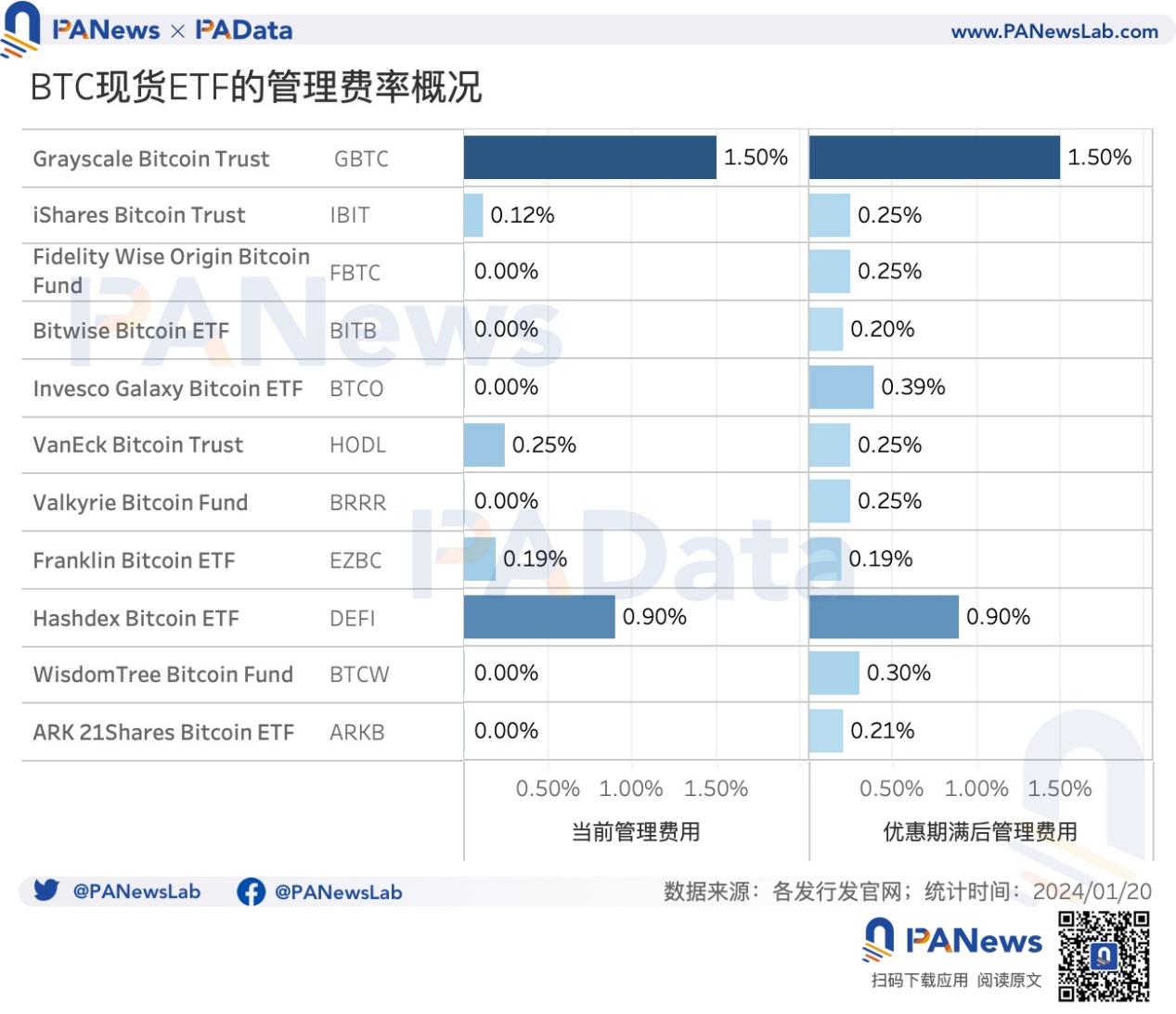
Public reports indicate that VanEck and Bitwise plan to donate 5% and 10% of their ETF profits respectively to core Bitcoin developers. Based on post-promotion management fees and current AUM, these donations are estimated to amount to roughly $96,100. If spot Bitcoin ETFs continue to grow successfully, both AUM and donation amounts could increase substantially in the future.
02. Over $16.6 Billion Traded in First 6 Days; Net Inflows Exceed $1.2 Billion
Since their market debut, spot Bitcoin ETFs have seen broad price declines. Measured by the percentage change from January 19 closing prices relative to January 11 opening prices, the average market price of the 11 ETFs dropped by 14.80%. DEFI experienced the steepest decline, falling over 17%, while GBTC saw the smallest drop at around 12%.
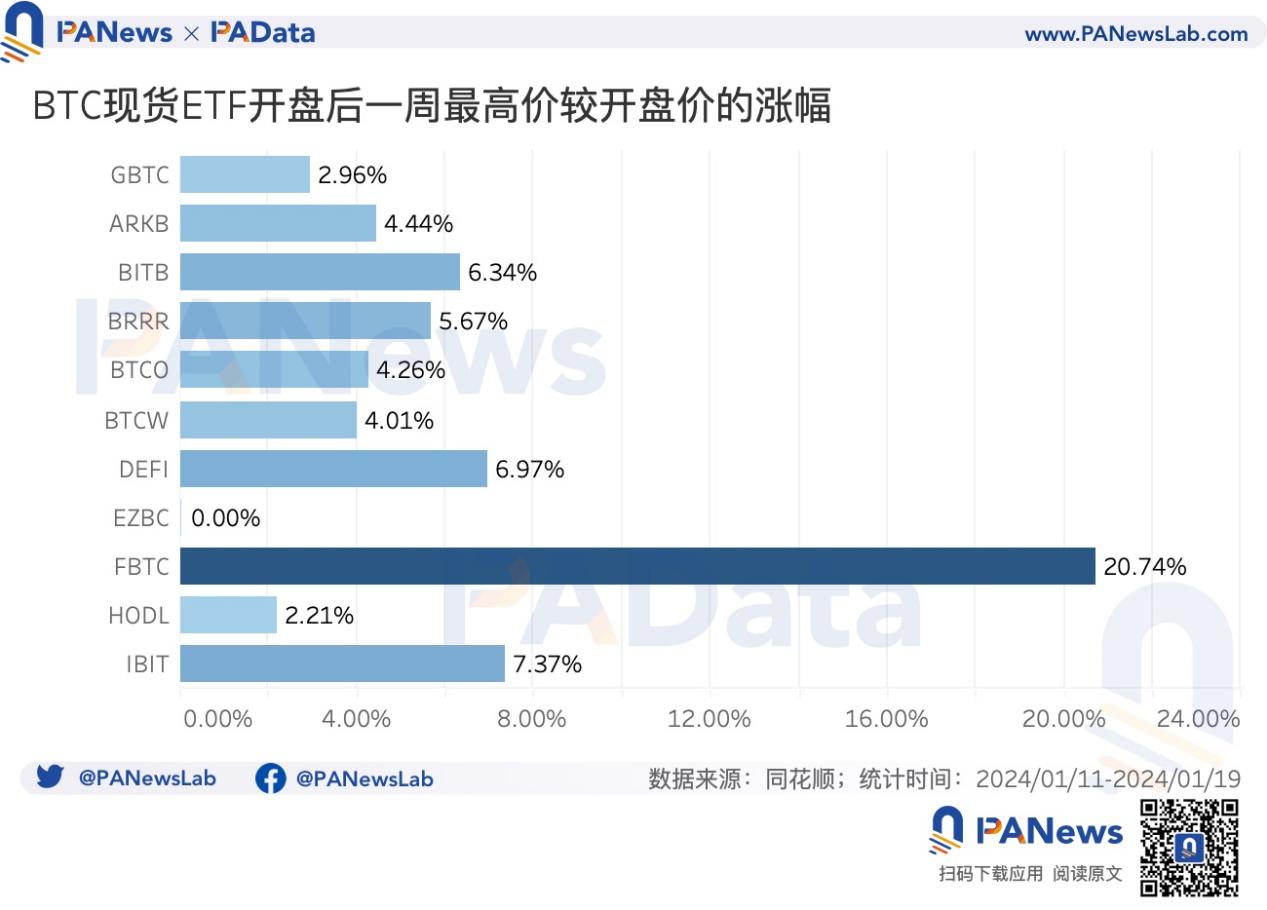
Except for Franklin’s EZBC, which peaked at its opening price and declined thereafter, investors who bought after launch still had opportunities to profit. Measured by theoretical peak gains from January 11 opening prices, the 11 ETFs averaged a maximum gain of about 5.91%. Among them, Fidelity’s FBTC achieved the highest peak gain of over 20%, far outperforming others. BlackRock’s IBIT followed with a peak gain exceeding 7%.
Newly listed spot Bitcoin ETFs have experienced significant price volatility. The average daily price range—the difference between daily high and low—across the 11 ETFs was approximately 5.63%. According to CoinMarketCap data, Bitcoin’s同期 average daily range was about 4.78%, indicating lower volatility compared to the ETFs.
Among these ETFs, Fidelity’s FBTC showed the highest average daily range at 8.10%. Most others, including GBTC, BITB, and IBIT, ranged between 5% and 6%. Only BTCW and EZBC had average daily ranges below Bitcoin’s同期 level.
Using the January 19 Net Asset Value (NAV) as a benchmark and comparing it with closing prices, five of the 11 spot Bitcoin ETFs were trading at a discount—meaning their market prices were below NAV. BRRR had the highest discount rate at 0.51%. FBTC, EZBC, and BTCW also showed discount rates above 0.3%. GBTC had the lowest discount rate at approximately 0.27%.
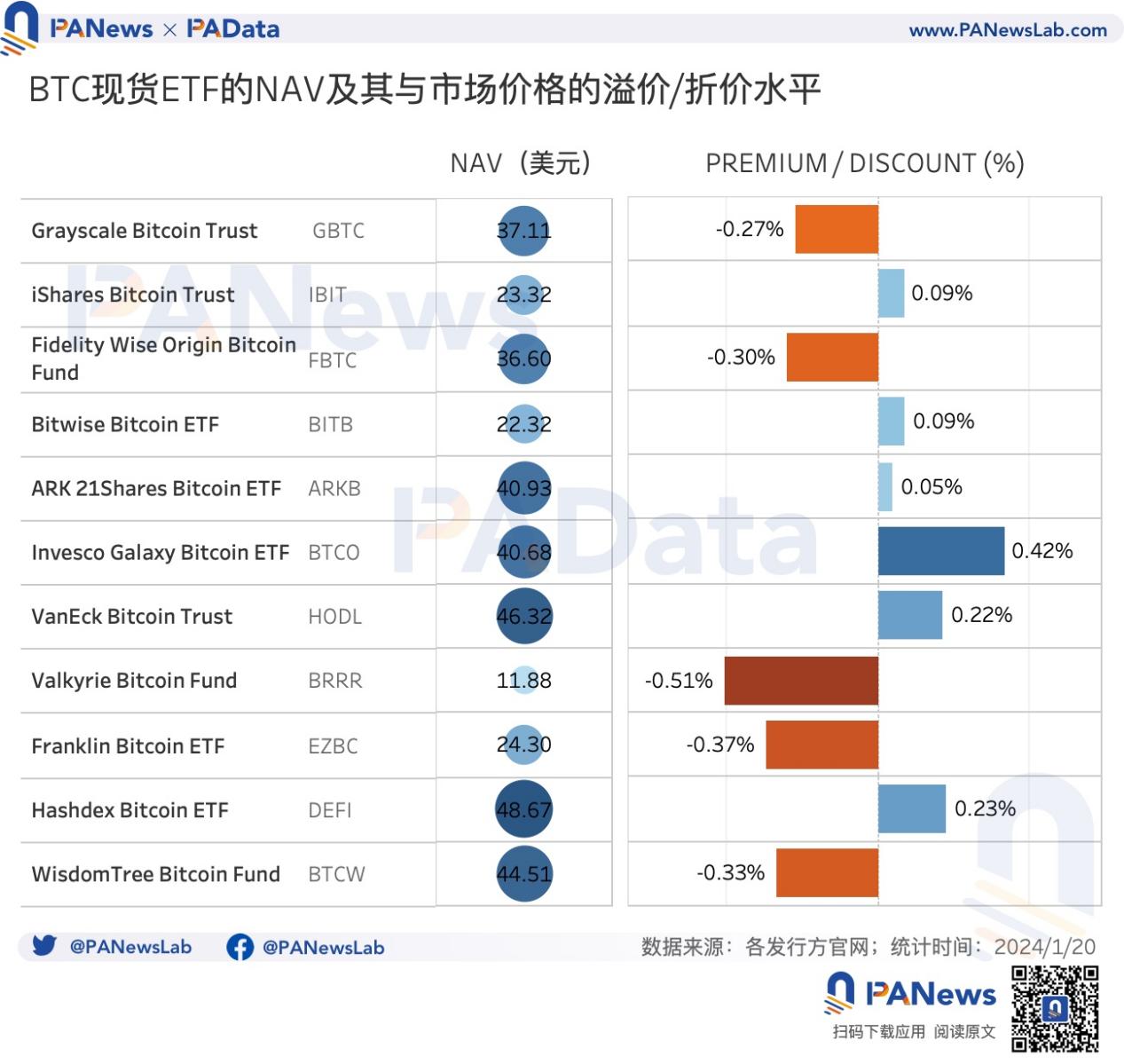
Some analysts suggest that arbitrage activities—such as buying discounted GBTC shares and shorting Bitcoin over-the-counter—have contributed to GBTC’s high sell-side pressure. Given the current narrow discount, this arbitrage window has shrunk further, and its future impact on market sell pressure is expected to be limited.
Six ETFs are currently trading at a premium. BTCO has the highest premium at 0.42%. HODL and DEFI are around 0.2%, while IBIT, BITB, and ARKB are all below 0.1%.
In terms of trading volume, the 11 spot Bitcoin ETFs recorded approximately $16.691 billion in total trading volume over their first six days, averaging about $2.782 billion per day. GBTC led with $9.012 billion in total volume, followed by IBIT and FBTC at $3.194 billion and $2.649 billion respectively. Four ETFs—BRRR, BTCW, DEFI, and HODL—each had trading volumes under $100 million.
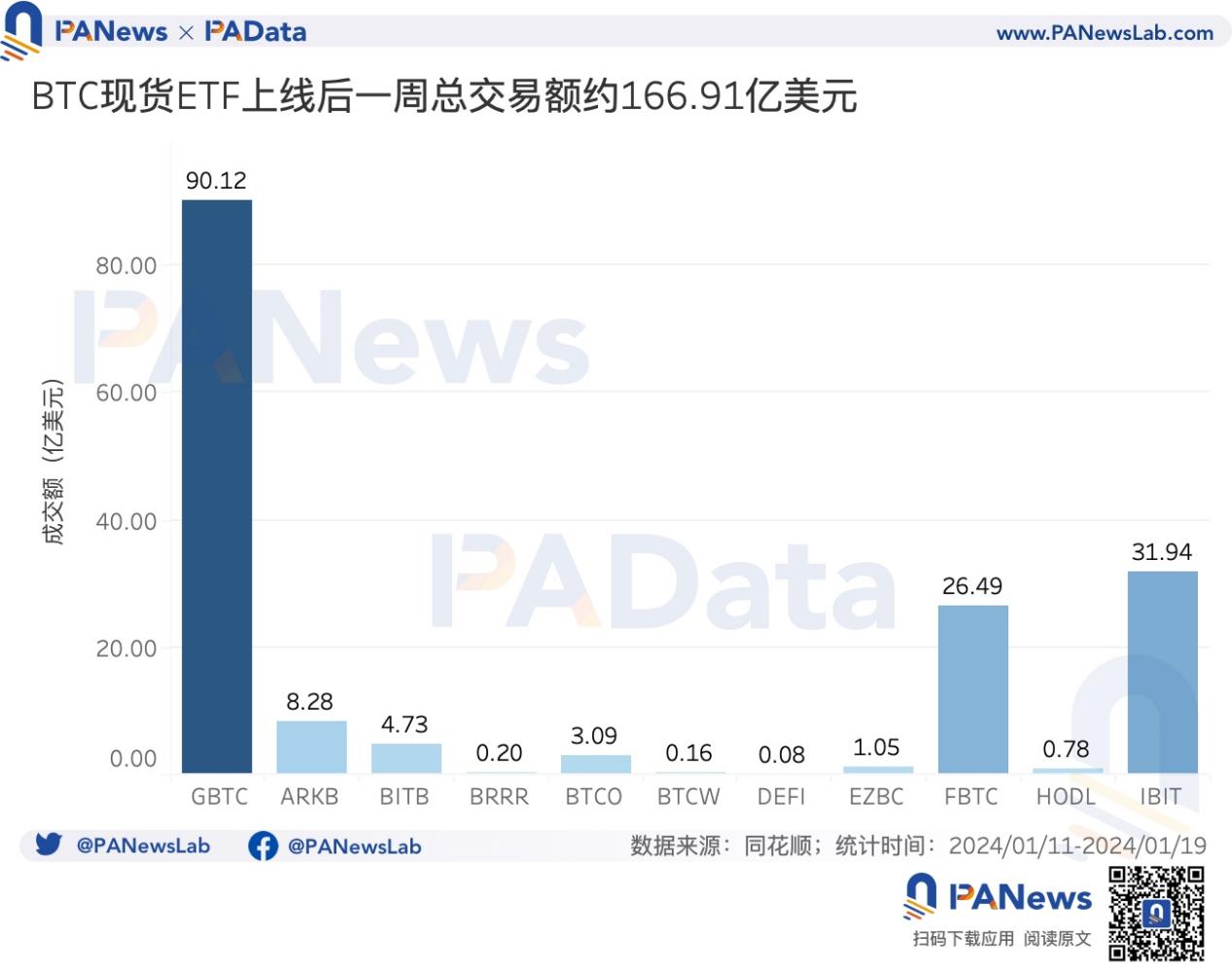
It should be emphasized that ETF trading volume does not equate directly to capital flow into Bitcoin markets. Only funds that actually enter Bitcoin trading markets will have a direct impact on the crypto ecosystem.
According to SoSo Value, net capital inflows into spot Bitcoin ETFs over the first six days were approximately $1.208 billion, calculated as (Today’s Shares – Yesterday’s Shares) × Current NAV. The first day saw inflows of $628 million, and January 17 brought in $562 million. Overall, the launch of spot Bitcoin ETFs has injected new capital into the crypto market, but it remains insufficient to trigger a new wave of “institutional-driven” bullish momentum.
03. BTC Price Retreats to ~$41K; On-Chain Velocity Rises; Accumulation Trend Strengthens
How have Bitcoin markets and on-chain metrics reacted since the launch of spot Bitcoin ETFs? What do these reactions suggest about future trends?
From a price perspective, Bitcoin reached a recent high of $46,936 two days before ETF approval (January 9), then began to correct. On the day of approval (January 11), the price was $46,632. By January 19, after the "buy the rumor, sell the news" effect, Bitcoin had fallen to $41,261—a 12.09% drop from its peak, reflecting clear downside pressure.
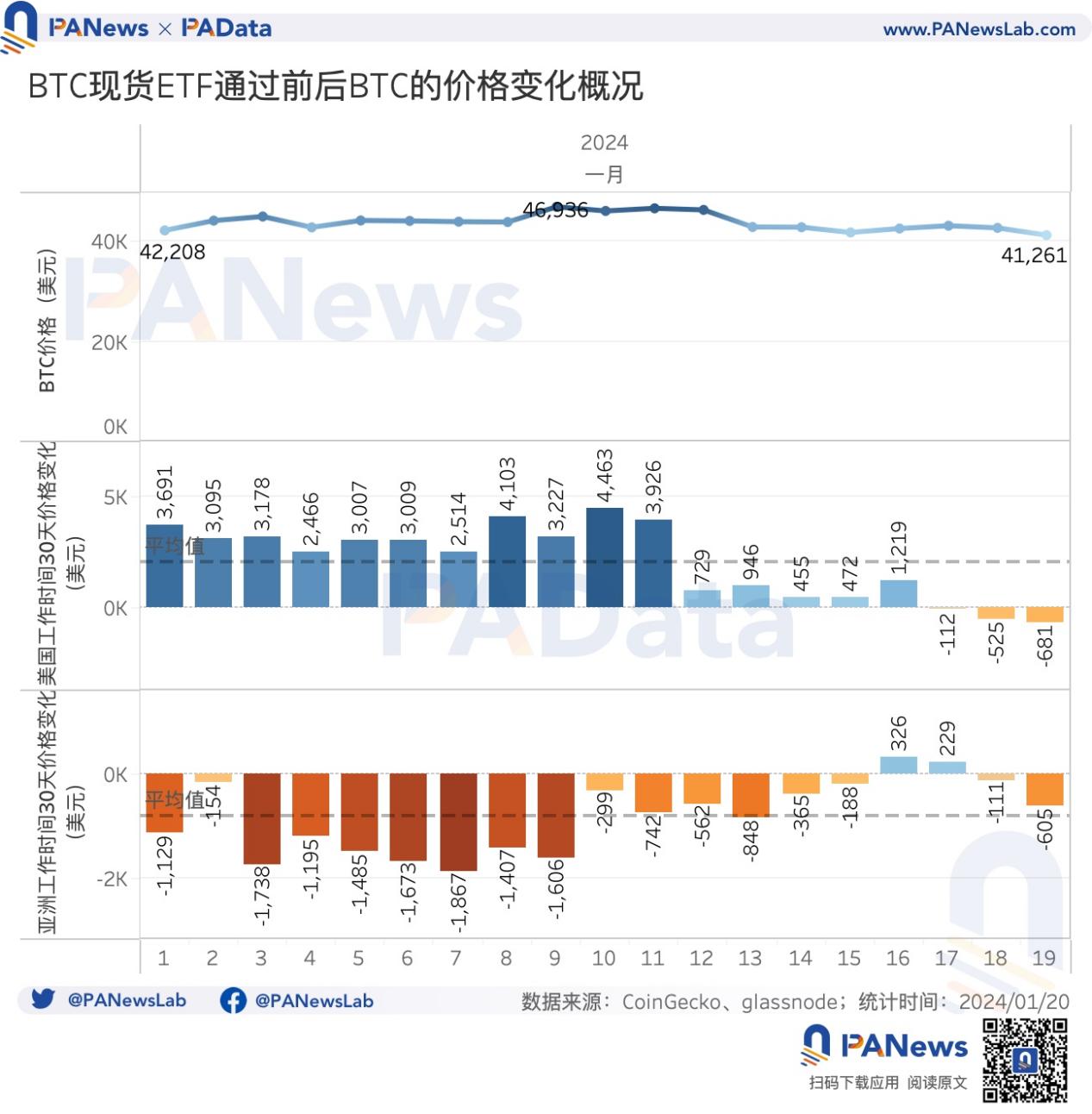
Breaking down price movements by regional business hours reveals stark differences between U.S. and Asian (primarily Chinese) markets.
During U.S. business hours (8 a.m. to 8 p.m. Eastern Time), Bitcoin prices showed consistent gains of $3,000–$4,500 compared to 30 days prior, both before and on the day of ETF approval. Even in the five days following the launch (before January 16), prices remained above 30-day levels, though gains narrowed to around $1,000.
Overall, U.S. investors have shown strong optimism about the approval and launch of spot Bitcoin ETFs, while Asian investors have displayed contrasting sentiment.
During Asian business hours (8 a.m. to 8 p.m. China Standard Time), Bitcoin prices generally declined relative to 30 days earlier, both before and after the ETF launch. Before the launch (including January 11), daily prices were nearly $1,000 lower than 30 days prior. After the launch, this gap narrowed to less than $1,000.
Beyond price, other market indicators show several positive developments in the Bitcoin market.
First, market buying power has strengthened. The Stablecoin Supply Ratio (SSR)—the ratio of Bitcoin’s market cap to stablecoin supply—indicates greater purchasing capacity when lower. After the ETF launch, SSR dropped from 13.022 to 11.662, a 10.44% decline, signaling increased “buying power” in the market, which helps absorb selling pressure from GBTC.
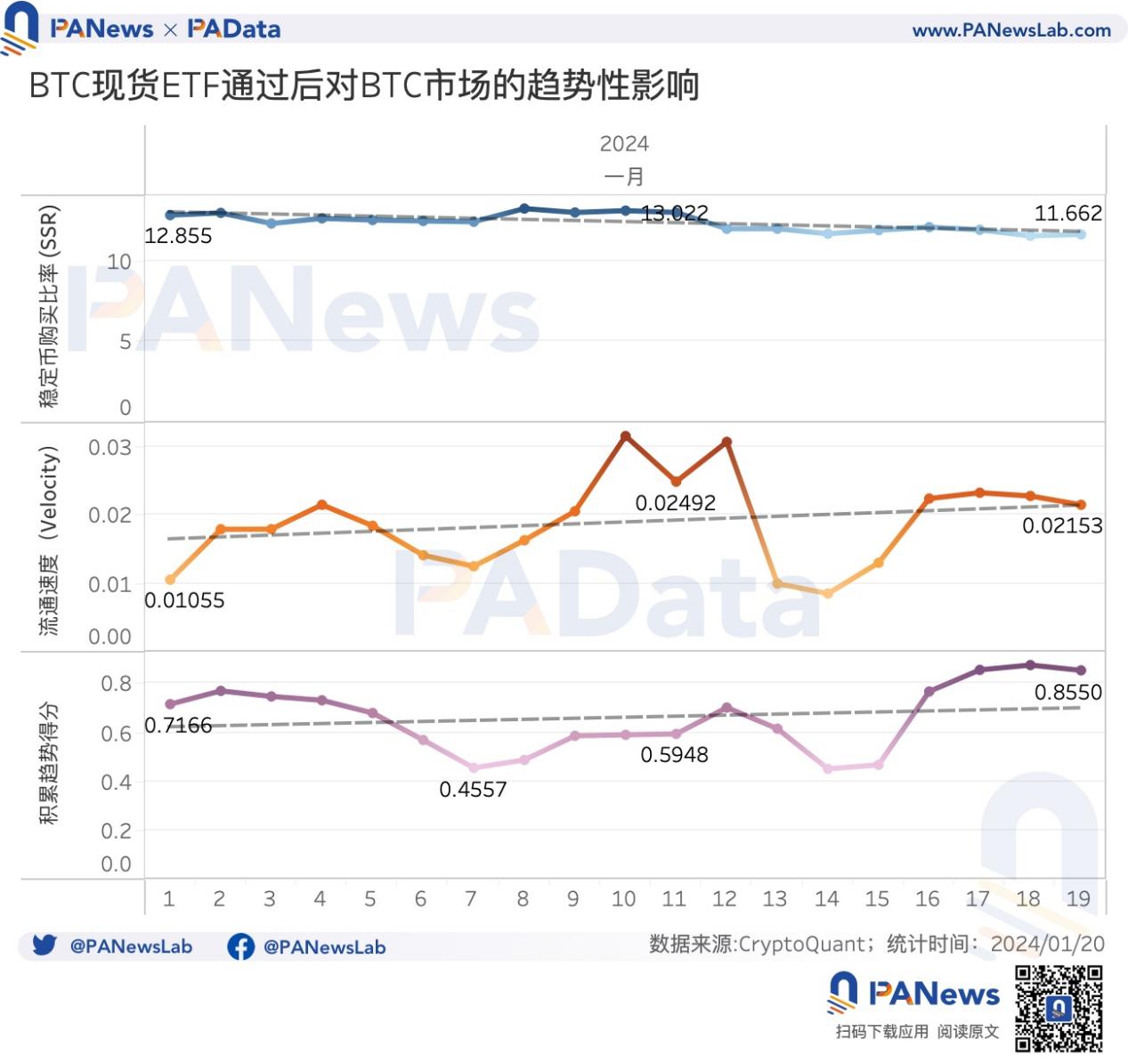
Second, on-chain transaction activity has increased. Velocity—a measure of how quickly units circulate on the network—rose from 0.011 to 0.022 this year, peaking at 0.032 on January 10 (the day before ETF launch). This indicates a clear rise in on-chain transaction velocity and overall market activity.
Third, more Bitcoin is being accumulated. The Accumulation Trend Score, which approaches 1 when more participants are accumulating tokens, rose from 0.72 to 0.86 this year. Despite briefly dropping below 0.5 before the ETF launch—likely due to profit-taking at higher prices—the trend has since resumed upward, indicating renewed accumulation behavior.
Overall, positive signals from Bitcoin trading and on-chain data reflect growing market confidence in future price performance. Additionally, Bitcoin is expected to undergo its fourth halving on April 22 this year. Following historical patterns from previous halvings, the market holds strong expectations for price increases afterward. Whether Bitcoin prices and spot ETFs can form a virtuous cycle in the coming months remains to be seen.
Join TechFlow official community to stay tuned
Telegram:https://t.me/TechFlowDaily
X (Twitter):https://x.com/TechFlowPost
X (Twitter) EN:https://x.com/BlockFlow_News
 PANews









