









Asia vs. North America: Projecting the Crypto Landscape — Who Will Prevail in the Post-ETF Era?
TechFlow Selected TechFlow Selected
Asia vs. North America: Projecting the Crypto Landscape — Who Will Prevail in the Post-ETF Era?
Against the backdrop of the arrival of Bitcoin spot ETFs, will Hong Kong become a trendsetting pioneer?
 Navigating Web3 tides with focused insights
By 0xShinChan, Meta Era Contributing Author
After years of delays, the U.S. Securities and Exchange Commission (SEC) last week finally approved the world's first spot Bitcoin exchange-traded fund (ETF). The ETF demonstrated strong performance on its debut, with trading volume reaching an astonishing $4.6 billion, injecting significant momentum into the cryptocurrency industry. The U.S. approval of a spot Bitcoin ETF has boosted the entire crypto market, fostering positive market expectations for the future.
Meanwhile, Hong Kong, an international financial hub and Asia’s fourth-largest ETF market (after Japan), has established a regulatory framework for crypto assets since 2022. The Hong Kong Special Administrative Region government has clearly stated its intention to actively embrace digital assets. This raises an important question: as the era of spot Bitcoin ETFs begins, could Hong Kong emerge as a pioneering leader? This article explores the key factors at play and the potential impact on the region within the evolving cryptocurrency landscape.
Hong Kong’s Regulatory Evolution: Virtual Asset Investment Channels Gradually Opening to Retail Investors
In December 2022, the Securities and Futures Commission (SFC) and the Hong Kong Monetary Authority (HKMA) issued a joint statement indicating that since the SFC established its "professional investors only" regulatory approach in 2018, the virtual asset sector has rapidly evolved, with increasingly diverse investment products providing both retail and professional investors access to virtual assets.
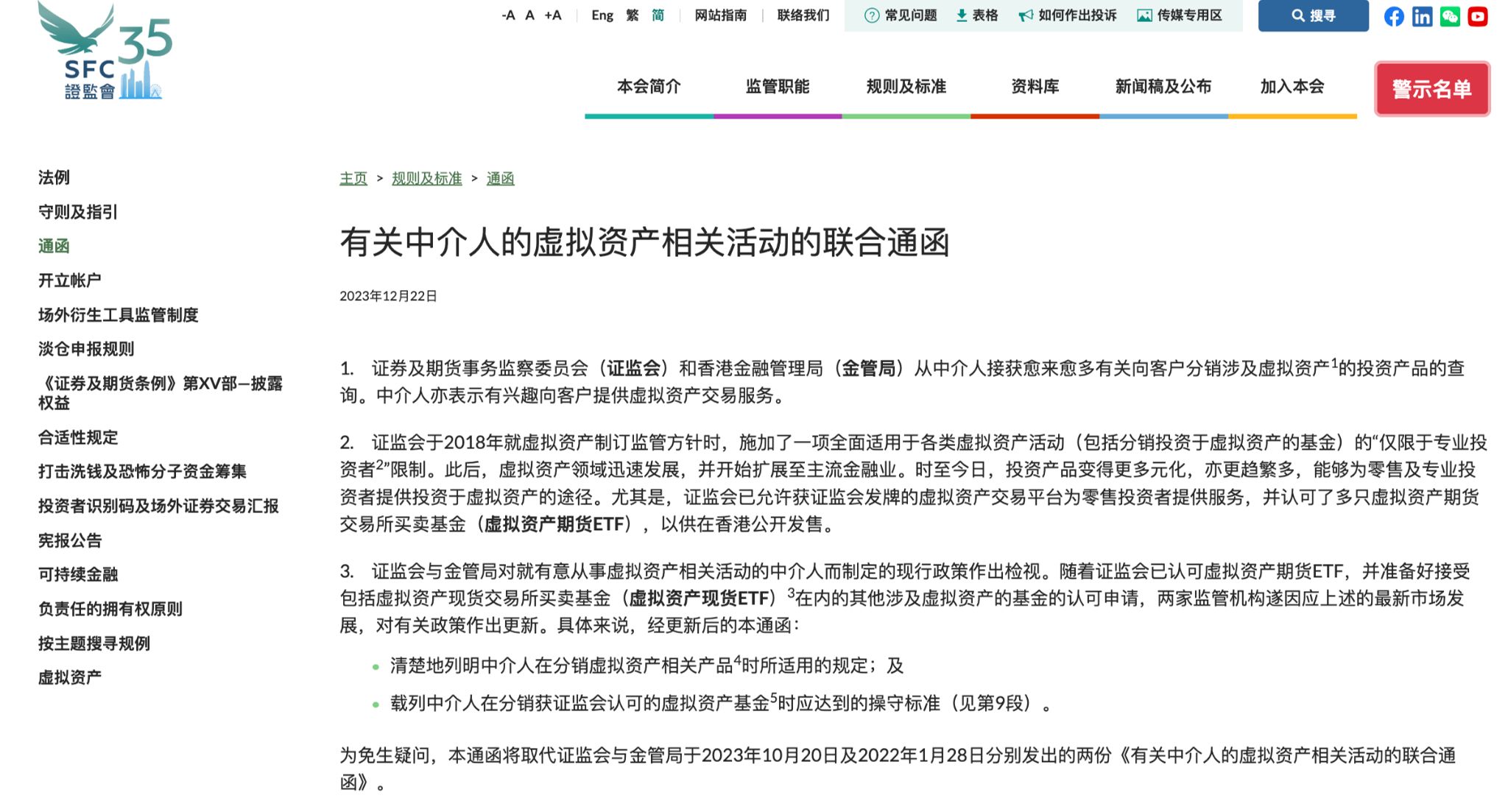
Joint Circular on Virtual Asset-Related Activities by Intermediaries
In recent years, Hong Kong has relaxed its regulations on cryptocurrencies, and regulators have shifted their stance toward greater openness for retail investors in digital assets. In October 2023, the SFC updated its regulatory guidance to allow broader investor participation in spot crypto and ETF investments.
In November 2023, the SFC moved closer to allowing retail investors to purchase spot cryptocurrency exchange-traded funds (ETFs). According to Bloomberg, SFC CEO Julia Leung said: "We welcome proposals that use innovative technologies to enhance efficiency and customer experience. As long as new risks are addressed, we are willing to experiment. Our approach is consistent across different asset classes."
Hong Kong Poised for a Cryptocurrency Market Transformation
The successful launch of U.S. spot Bitcoin ETFs is expected to bring Hong Kong regulators closer to authorizing similar cryptocurrency funds in the city. Spot crypto ETFs allow investors exposure to virtual assets without directly purchasing any crypto tokens.
Livio Weng, Chief Operating Officer of HashKey Group, revealed in an interview with Chinese media Caixin on Wednesday that approximately 10 fund management firms are preparing to launch spot virtual asset-backed ETFs in Hong Kong, with up to eight already in an "advanced stage."
Mao Shixing, Co-founder and CEO of digital asset custodian Cobo, said Hong Kong needs to quickly roll out spot virtual asset ETFs to "ensure the city remains competitive in the global cryptocurrency market and strengthens its position as a global financial center."
Mao added that the SEC’s approval could influence other jurisdictions because "the SEC is one of the most influential and prestigious financial regulators in the world," noting that its initiatives "often become important references for financial regulators elsewhere."
According to The Block, Yat Siu, Co-founder and Chairman of Animoca Brands, said the SEC’s approval of spot Bitcoin ETFs could have an even greater impact on Asian crypto markets. Younger generations in Asia tend to be more open-minded toward capitalism, and the U.S. ETF approval could generate positive ripple effects across the region. Financial hubs like Hong Kong and Singapore may become the next targets for launching spot crypto ETFs.
Hong Kong Legislative Council member Wilson Ng urged the HKSAR government to accelerate the approval of spot Bitcoin ETFs following the U.S. decision. Ng pointed out that the SFC had previously indicated it was ready to accept Bitcoin ETF applications: "I hope that amid the rapid development and intense competition in virtual assets, Hong Kong can secure its place on the global stage as soon as possible. This will be the first opportunity to implement relevant policies and products in Asia, solidifying Hong Kong’s chance to become a global virtual asset hub."
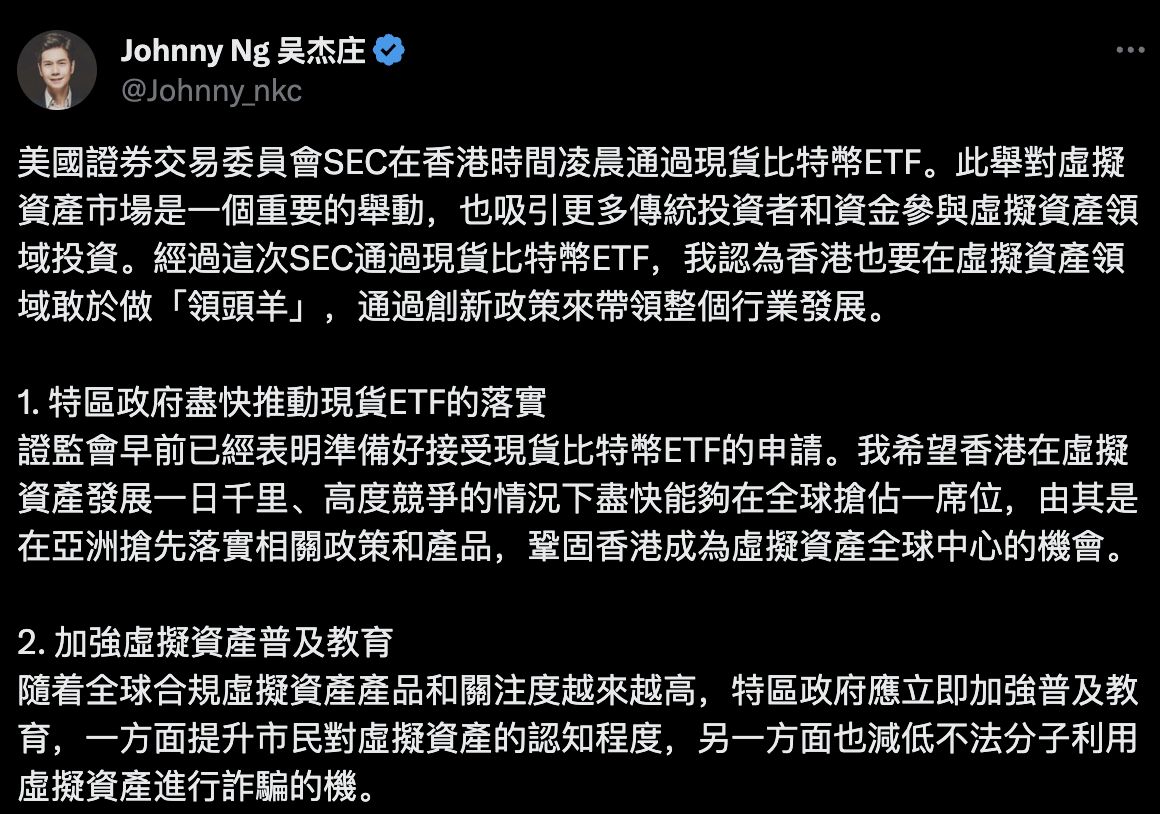
Legislative Councilor Wilson Ng’s tweet
Looking Ahead to the Web3 Landscape: Hong Kong Could Pioneer Asia’s First Spot Bitcoin ETF
Currently, apart from the United States, there are eight markets globally that allow spot cryptocurrency ETFs, including Canada, Germany, Switzerland, the Cayman Islands in the Caribbean, and Jersey off the northwest coast of France.
As discussions around spot Bitcoin ETFs in Asia intensify, crypto exchange WOO predicts the industry’s center of gravity will shift from West to East in the coming year.
WOO’s co-founder Jack Tan said: "The previous cycle was largely driven by the West—whether it was Saylor adding Bitcoin to MicroStrategy’s balance sheet or PayPal promoting various cryptocurrencies to millions of retail investors." "However, we believe the next cycle will be led by the East, with retail participation spearheaded by major regions such as South Korea, Hong Kong, and Japan."
Chengyi Ong, Head of Policy for Chainalysis in the Asia-Pacific region, labeled 2023 as a year of regulation for the region and expects practical implementation in 2024. "Over the next year, we anticipate the regulatory frameworks introduced in 2023 will begin to take shape."
In a statement shared with The Block, Ong added: "This isn’t limited to leading jurisdictions like Singapore and Hong Kong, but extends across the broader region." "For example, Australia is currently undergoing ongoing consultations on regulating digital asset platforms. In South Korea, the Virtual Asset User Protection Act has already been passed. By 2024, we’ll start seeing these frameworks implemented in practice—it will just take some time."
Looking back at the journey of spot Bitcoin ETF approval in the U.S., American officials long questioned whether such products would exacerbate crypto fraud and market manipulation. For over a decade, U.S. regulators repeatedly rejected Bitcoin ETF applications—until major Wall Street institutions like BlackRock entered the scene and favorable court rulings for the crypto industry ultimately shifted the tide.
As one of several jurisdictions striving to become a digital asset hub, Hong Kong may face similar challenges in pursuing its own local Bitcoin ETF. But unlike the resistance seen in the U.S., the Hong Kong government is proactively embracing the wave of virtual assets. Beyond that, with advancing regulatory efforts across Asia, the conditions for compliant growth in Web3 are gradually being built and refined. A new cycle has begun—the East is poised and ready to seize narrative leadership.
Join TechFlow official community to stay tuned
Telegram:https://t.me/TechFlowDaily
X (Twitter):https://x.com/TechFlowPost
X (Twitter) EN:https://x.com/BlockFlow_News










