









Bitcoin ETF approved, yet price drops? The future outlook isn't as simple as we thought
TechFlow Selected TechFlow Selected
Bitcoin ETF approved, yet price drops? The future outlook isn't as simple as we thought
7 Things to Know After Bitcoin ETF Approval
 Navigating Web3 tides with focused insights
Author: Mu Mu, Baigua Blockchain

Recently, the long-awaited spot Bitcoin ETF has finally been approved. Both domestic and international media have used terms like "milestone," "historic moment," and "major announcement" to highlight the significance of this event. However, after the news broke, the crypto market remained surprisingly flat—and even began trending downward two days later—leaving many confused: Is the approval of a Bitcoin ETF bullish or bearish? What are its short-term and long-term implications? Today, we’ll analyze in detail the changes that follow the approval of Bitcoin ETFs…
01 Spot ETF: Don’t Overestimate or Underestimate Its Impact
Markets are always influenced by emotional capital flows, moving primarily based on overwhelming consensus. When an event occurs, people often overestimate its short-term impact while underestimating its long-term effects—or misjudge due to information asymmetry. So, from a rational standpoint, what real impacts does the approval of spot Bitcoin ETFs bring?
1) “Bullish News Out, Only Bearish Left”? Not Necessarily
There’s a common saying in markets: once good news is out, only bad news remains. The approval of a spot Bitcoin ETF has indeed been a long-anticipated bullish catalyst. Overall, much of the positive sentiment was already priced in before the actual approval—as evidenced by Bitcoin’s strong performance over the past year.
But it doesn’t mean the news turning bearish afterward is inevitable. Beyond short-term profit-taking and pullbacks, we’ve already seen around $460 million in trading volume on the first day of spot ETFs’ launch—an impressive figure compared to other newly launched ETFs, aligning with expectations of becoming a new gateway for traditional finance capital. Over time, this could accumulate into a powerful source of sustained buying pressure.
2) A New Key Indicator for the Crypto Market
A close analog to Bitcoin spot ETFs is gold ETFs. Take the world’s largest gold ETF, SPDR Gold Trust, as an example. Given its large shareholding size, whether it increases or decreases its gold holdings is often used as a data point to predict gold price movements, making it a highly influential market indicator.
Given GBTC previously held hundreds of thousands of BTC, we expect Bitcoin spot ETFs will continue accumulating BTC without selling off, gradually becoming one of the key daily indicators for the crypto market, influencing market trends just like gold ETFs. In that case, historical patterns of how gold ETF holdings affect gold prices become highly relevant:
-
Trading volume rises, ETF gold holdings fall, price rises → suggests a potential near-term drop;
-
Trading volume rises, ETF gold holdings and price fall → price may rebound soon;
-
Trading volume and ETF gold holdings rise, price rises → indicates further upward momentum likely;
-
Trading volume and ETF gold holdings rise, price falls → short-term decline may persist;
-
Trading volume and ETF gold holdings fall, price falls → short-term downtrend may continue;
-
Trading volume and ETF gold holdings fall, price rises → hints at short-term upside, followed by a likely correction;
-
Likewise, when Bitcoin spot ETF holdings reach a significant scale, they will exert similar influence on the crypto market.
3) Beware of Grayscale GBTC Converting to ETF
Among the 11 approved spot ETFs, most are newly launched and currently in net-buying mode. However, Grayscale’s GBTC stands out as a notable exception. Previously, GBTC traded at a persistent discount, and many investors who had held over 600,000 BTC for years chose to cash out after a prolonged bear market—leading to substantial short-term outflows from GBTC.
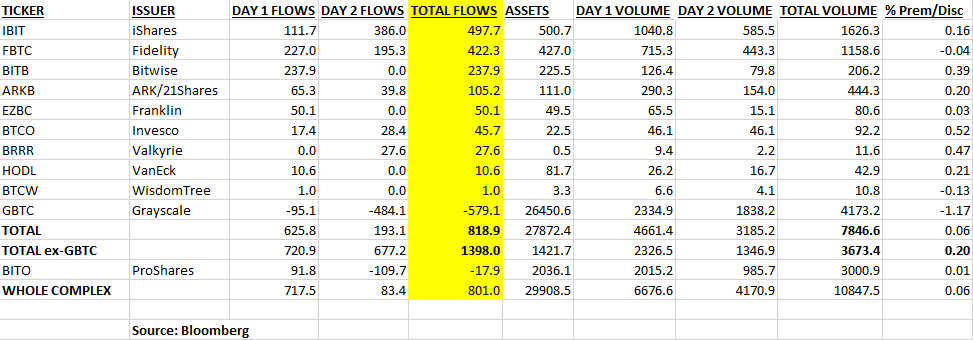
Fortunately, inflows into other spot ETFs have far exceeded GBTC’s outflows. Eric Balchunas, ETF analyst at Bloomberg, noted on X (formerly Twitter) that within the first two days of trading, nine issuers collectively absorbed $1.4 billion in new funds, surpassing GBTC’s $579 million outflow, resulting in a net inflow of $819 million.

Translation: To date, the nine newborn ETFs have attracted $1.4 billion in new capital, significantly exceeding GBTC’s outflow of $579 million, with a net inflow of $819 million. Currently, IBIT leads the pack with $5 billion in assets, followed closely by Fidelity. Trading volume among the new entrants reached $3.6 billion across 500,000 individual trades (total including GBTC: 1.2 million), an impressive start with an average premium of 20 basis points.
4) Has Bitcoin Become Centralized—Controlled by Wall Street and Held Hostage by ETFs?
Some oppose spot ETFs, arguing that although they help transition Bitcoin from an alternative asset to a mainstream one, they also undermine Bitcoin’s decentralization, as massive inflows of traditional capital via ETFs could dominate the market and place pricing power firmly in the hands of Wall Street.
This concern isn't entirely unfounded—but it may overstate the ETFs’ scale. Compared to the tens of billions in ETF trading volume and hundreds of millions in holdings, major crypto exchanges see daily Bitcoin trading volumes reaching $10–20 billion. The primary battleground for Bitcoin trading remains on these platforms. For now, new capital entering through ETFs tends to come from investors unfamiliar with Bitcoin who prefer regulated, compliant vehicles over direct exchange trading. With ETF approval, exchanges themselves may face tighter scrutiny, improving compliance and stability across the crypto market.
Currently, ETF assets are custodied by centralized platforms. If custody is centralized anyway, why not choose crypto platforms offering no management fees, lower costs, and more flexible control? Once new investors become familiar with crypto assets, many may shift their capital to regulated, globally distributed crypto platforms—limiting ETFs’ dominance. As these investors advance further, they might even explore DeFi for greater financial freedom and yield opportunities.
Moreover, U.S. stock markets are inherently competitive arenas where smaller-cap assets are easily manipulated, but larger ones resist control. Compared to the historically unregulated, lawless nature of crypto markets governed by jungle rules, strict SEC oversight brings much-needed discipline.
As for fears of “the rich taking over Bitcoin,” that’s beyond our control—but it won’t stop Bitcoin from operating transparently and as intended, because only then can even the wealthy ensure their own interests are protected.
True absolute decentralization doesn’t exist anywhere. The word “decentralization” never appears in the Bitcoin whitepaper—it’s an interpretation added later. The core idea is distribution of power, sufficient dispersion, anti-fragility, and transparency—to prevent concentrated entities from abusing the financial system behind closed doors.
Even physical, seemingly decentralized gold operates similarly: gold mining is highly centralized, controlled by a few institutions. Yet because global holdings are widely dispersed, even large gold ETFs have limited influence on prices. Furthermore, gold ETF rebalancing often lags market moves—meaning ETFs buy or sell after prices have already reacted to macroeconomic events, adjusting positions only after market close.
Rather than saying ETFs drive the market, it’s more accurate to say the market drives ETFs—ETFs follow the market.
5) Impact of ETFs on the Bitcoin Ecosystem
The approval of spot ETFs undoubtedly serves as a “confidence booster” for the entire crypto industry, especially the Bitcoin ecosystem. Bitcoin as an asset may become increasingly stable, with reduced volatility going forward.
In simple terms, during volatile bear markets, plunging prices often hinder ecosystem development. Founders and users lose confidence, tighten budgets, fundraising dries up, and talent drains away.
For native assets within the Bitcoin ecosystem, a steadily rising Bitcoin price supports sustainable growth, shielding projects from extreme market shocks.
Overall, the approval of spot ETFs gives the Bitcoin ecosystem stronger foundations and broader recognition.
02 Next Up: Will Market Focus Shift to Ethereum Spot ETF?
1) Expectations Around Ethereum ETF
After Bitcoin ETF approval, Ethereum saw a sudden price surge. Many attribute this to growing anticipation around the next expected product: a spot Ethereum ETF, attracting both profit-takers from Bitcoin and those who missed the Bitcoin ETF rally, hoping to catch gains from a potential Ethereum ETF approval.
This strategy is common: when one asset gets bullish news, related assets often see increased speculative interest. How long can this Ethereum ETF hype last? BlackRock’s Ethereum ETF application could receive a decision by May at the latest—will it be delayed like Bitcoin’s was?
Currently, the U.S. SEC views Ethereum as existing in a gray area between commodity and security—neither clearly defined as a commodity like Bitcoin nor outright classified as a security. The SEC nearly declared Ethereum not a security, but the shift from PoW to PoS consensus introduced new complications.
Additionally, for an Ethereum ETF to be approved, regulators must be convinced it cannot be easily manipulated by any single entity—a higher bar to clear. Bitcoin ETF approval came partly because no single exchange dominated trading, and numerous institutional applicants created pressure; denying them risked legal challenges.
Overall, Ethereum ETF still has several months ahead, enough time to build market attention. Immediate concerns about rejection or delay aren’t urgent yet—but approval odds remain uncertain.
The key variables are whether the SEC develops sufficient understanding and confidence in PoS Ethereum, and whether external pressure from major financial institutions driven by investor demand becomes strong enough. This again depends on how smoothly Bitcoin spot ETFs operate. If the broader crypto market performs well and attracts global investor interest, capital incentives will strongly push for Ethereum ETF approval.
2) Ethereum’s Mid-to-Long-Term Outlook Isn’t Tied to ETFs
Rather than focusing solely on short-term ETF prospects,Ethereum’s greater significance lies in its ongoing upgrades—including the recent “Dencun” upgrade. Ethereum remains the largest infrastructure layer for applications in crypto. Compared to Bitcoin’s ecosystem, Ethereum has advanced much further, with superior infrastructure, better deployment frameworks, successful Layer2 adoption, and Layer3 solutions on the horizon. Altogether, Ethereum is laying the groundwork for mass-scale applications across multiple sectors—one of the key foundations for the next major bull run.
Ethereum differs from Bitcoin. Bitcoin’s primary value proposition is as a digital store of value—“digital gold”—making ETFs crucial. Ethereum’s value stems from innovation and utility. In the medium to long term, Ethereum’s outlook hinges on its capacity for innovation. After Dencun, more critical upgrades are coming. Instead of fixating on ETF approval, we should pay closer attention to Ethereum’s technological roadmap.
03 Summary
The approval of Bitcoin ETFs isn’t an ending—it’s a milestone marking a new beginning, bringing profound changes and implications. We should approach it rationally. Both the Bitcoin and Ethereum ecosystems will remain central narratives in the future of crypto. One thing is certain: in 2024, we will witness crypto assets accelerating their growth at a visible pace.
Join TechFlow official community to stay tuned
Telegram:https://t.me/TechFlowDaily
X (Twitter):https://x.com/TechFlowPost
X (Twitter) EN:https://x.com/BlockFlow_News
 白话区块链
白话区块链









