








Some shallow thoughts on Bitcoin L2: Taking the Map protocol as an example
TechFlow Selected TechFlow Selected
Some shallow thoughts on Bitcoin L2: Taking the Map protocol as an example
Bitcoin L2 carries the mission of supporting OrdFi and unlocking Bitcoin's liquidity, but how to achieve Bitcoin L2 is a new challenge for the crypto industry.
 Navigating Web3 tides with focused insights
Author: NingNing
The emergence, growth, and explosive popularity of inscription protocols such as Ordinals, BRC20, BRC420, and Atomicals in 2023 have fundamentally reshaped the meaning of the Bitcoin ecosystem.
In the past, when referring to the Bitcoin ecosystem, industry professionals would immediately think of sophisticated protocols like the Lightning Network, the sidechain Liquid Network, and client-validated smart contracts such as RGB.
After the perfect storm of inscriptions in 2023, today, whenever Bitcoin's ecosystem is mentioned, people instantly envision a wide variety of inscription-based assets.
If we draw an analogy between the evolution of the Bitcoin ecosystem in 2023 and a biological ecosystem, early chaotic and meaningless Sub10K inscription NFTs were like fungi and microbes randomly spreading across barren soil; Yuga’s TwelveFold, ORDI—the first token minted under the BRC20 protocol—and Bitcoin Frog NFTs were akin to new plants sprouting from the substrate; the wave of meme inscriptions since October 2023 resembled rapidly growing weeds; and the recent deep market correction before Chinese New Year acted like a wildfire burning away the overgrowth, allowing application-oriented inscriptions to begin emerging.
By January 2024, the Bitcoin ecosystem has transformed into a vibrant and bustling new frontier within the crypto industry. During this time, Bitcoin L2 solutions, alongside Bitcoin VM, have become a prominent focus of attention.
The market has two primary expectations for Bitcoin L2: OrdFi (inscriptions-based DeFi) and unlocking Bitcoin liquidity.
OrdFi (inscriptions-based DeFi). Benny’s Trac team implemented an inscription swap function using Taproot scripts. However, its user experience still lags significantly behind DEXs built on EVM.
Under these circumstances, another solution—Bitcoin L2—has drawn increasing market attention.
Take Map Protocol as an example: users can bridge BRC20 inscriptions via Map’s ZK light node cross-chain bridge to the Map Relayer network.
Unlike conventional cross-chain bridge relayers, the Map Relayer network employs a PoS consensus mechanism and supports and is compatible with EVM.
Once BRC20 assets are bridged to the Map Relayer network, users can trade them just like ERC20 tokens on a DEX.
Unlocking Bitcoin liquidity. As shown in Figure 1, the current value of Bitcoin flowing out of its native chain stands at $9.139 billion, representing only ~1.08% of Bitcoin’s total market cap. In contrast, Ethereum’s outflow value is $5.711 billion, accounting for 1.8% of its total market cap. Bitcoin’s outflow ratio is thus 66.66% lower than Ethereum’s.
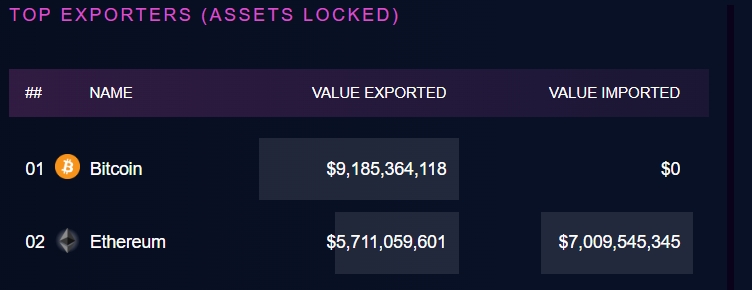
Currently, WBTC and REN are the main channels enabling Bitcoin value outflows, both of which rely heavily on trust in centralized entities.
The industry hopes that Bitcoin L2 solutions can unlock greater Bitcoin liquidity in a more trustless, verifiable, and transparent manner—at minimum, reaching Ethereum’s level of outflow ratio.
There is broad consensus on the functional expectations for Bitcoin L2. However, there is no agreement on how to achieve it. Available approaches include:
-
Classical approaches: state channels, client-side validation, sidechains, OmniLayer;
-
Newer approaches: ZK light nodes, oracles + light nodes, Rollup+DA, MPC multi-signature mechanisms. These newer Bitcoin L2 solutions closely resemble existing cross-chain bridge architectures.
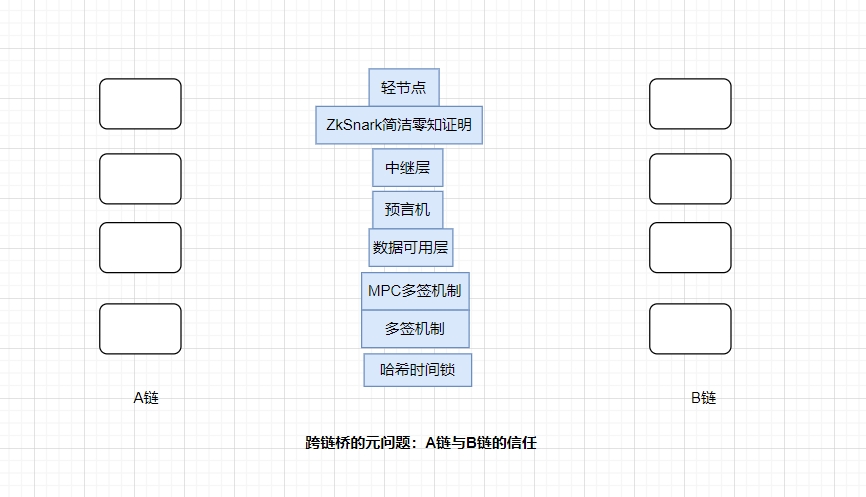
The fundamental problem in blockchain is solving trust between Alice and Bob; the core issue in cross-chain bridges is establishing trust between Chain A and Chain B; and the essential challenge for L2 is building trust between the L1 and L2 chains. At their core, they are all the same problem: how two entities can reach agreement without relying on trust.
As Jia Yi once said, “The essence of L2 is a cross-chain bridge.” Cross-chain bridges with relay layers supporting VMs—such as Map Protocol and ZetaChain—are already difficult to clearly categorize as either cross-chain bridges or L2s.
Bitcoin L2 differs significantly from Ethereum L2 in one key aspect:
Ethereum L2s can afford to batch-roll all state data onto the Ethereum mainnet without worrying about accelerating Ethereum’s state bloat.
In contrast, the first principle of Bitcoin L2 is to avoid overloading Bitcoin’s consensus layer. Therefore, most classical approaches adopt off-chain scaling methods, minimizing the load on the Bitcoin mainnet.
Among newer approaches, Map Protocol’s ZK light node solution and the Rollup+Celestia DA+Bitcoin-as-settlement-layer architecture better balance scalability, security, and minimal impact on Bitcoin’s mainnet load.
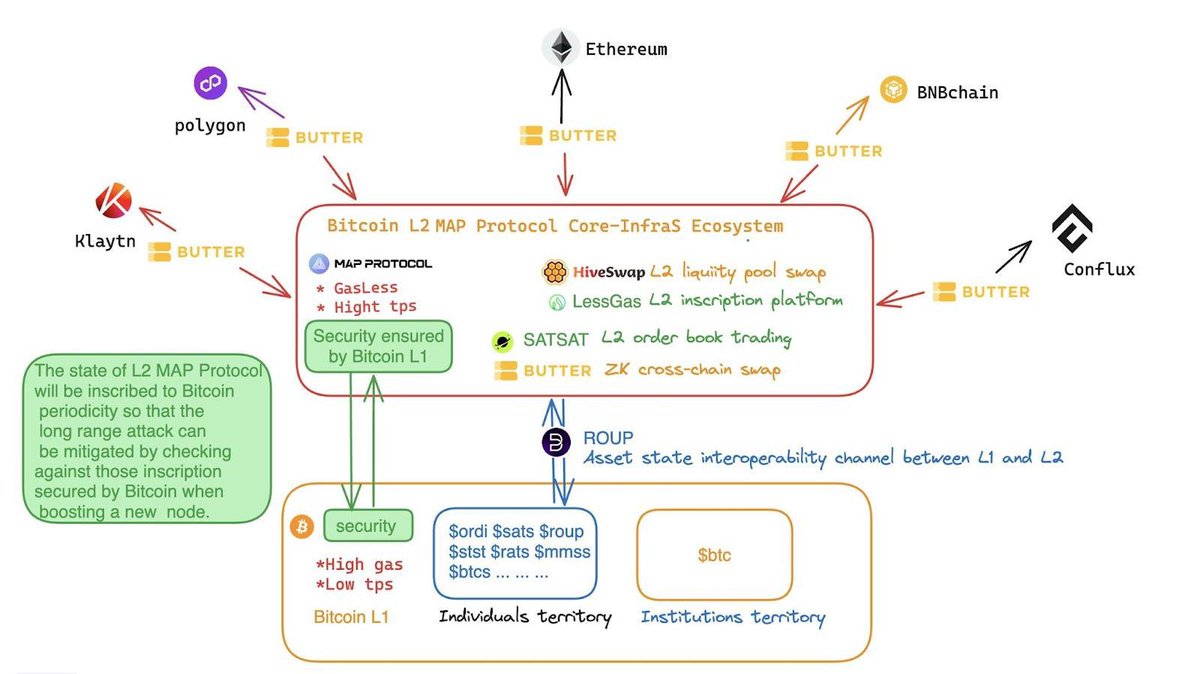
To conclude, Bitcoin L2 carries the dual mission of enabling OrdFi and unlocking Bitcoin liquidity. Yet how to realize Bitcoin L2 remains a new and open challenge for the crypto industry. Given the high degree of structural similarity between cross-chain bridges and L2s, novel Bitcoin L2 solutions based on cross-chain bridge architectures—such as Map Protocol—may become a key direction for future exploration.
Join TechFlow official community to stay tuned
Telegram:https://t.me/TechFlowDaily
X (Twitter):https://x.com/TechFlowPost
X (Twitter) EN:https://x.com/BlockFlow_News
 @0xNing0x









