









Arthur Hayes: Bitcoin ETFs will create arbitrage opportunities
TechFlow Selected TechFlow Selected
Arthur Hayes: Bitcoin ETFs will create arbitrage opportunities
People finally have a way to escape the global fiat currency devaluation frenzy.
 Navigating Web3 tides with focused insights
Author: Arthur Hayes
Translation: Joyce, BlockBeats
Editor's Note: After the approval of Bitcoin ETFs, both the crypto community and traditional financial institutions are closely observing the impact this event may have on global financial markets. In this article, Arthur Hayes analyzes why Bitcoin ETFs were finally approved — Bitcoin’s inflation-resistant properties make it an ideal asset in today’s globally inflationary environment. Bitcoin ETFs offer an opportunity for investors who wish to hedge against inflation but cannot fully exit the traditional government-controlled financial system. Hayes then provides an in-depth analysis of the potential market implications of spot Bitcoin ETFs, explaining the creation and redemption mechanisms and identifying potential arbitrage opportunities within the ETF structure.
BlockBeats translates the full article below:
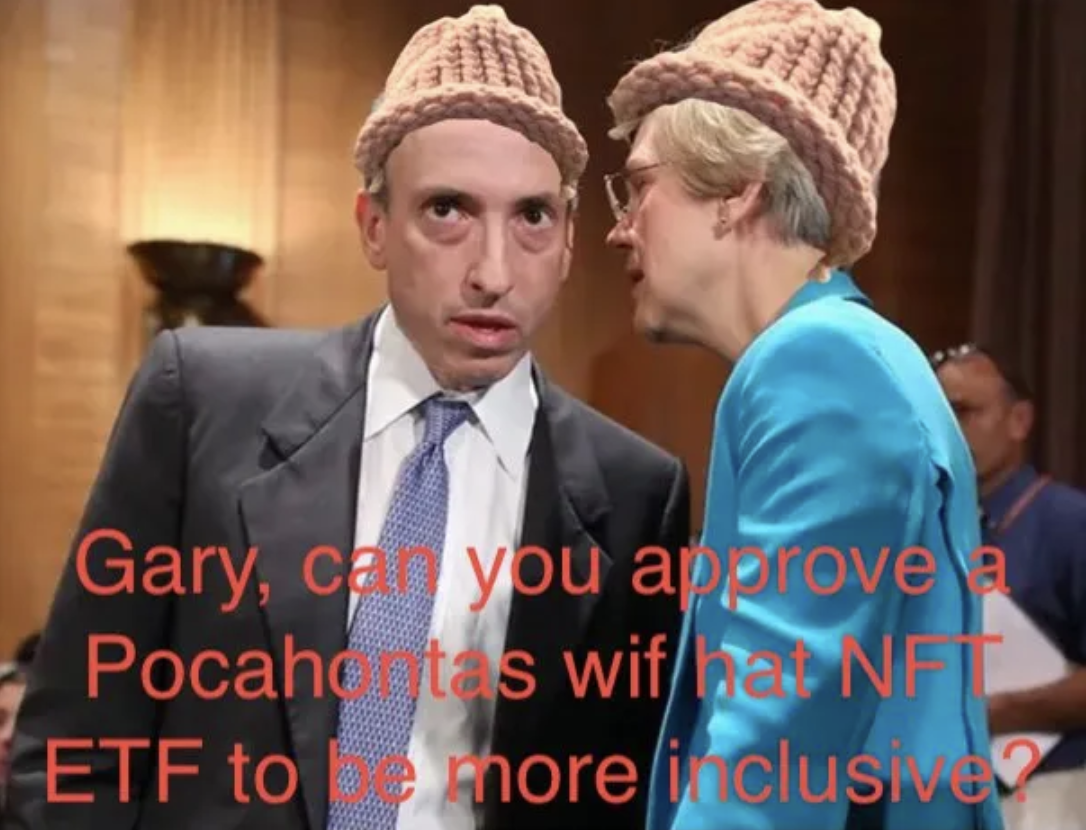
(The views expressed below are solely those of the author and should not constitute investment advice or a recommendation to buy or sell any securities. Images sourced from X user @CryptoTubeYT)
Why Now?
The final moments of life are, medically speaking, the most expensive. We are willing to spend infinite resources on treatments that delay the inevitable. Similarly, the elites responsible for maintaining the current world order — U.S. hegemony and its allied nations — are willing to do whatever it takes to preserve this system, as they benefit the most from it. But since 2008, when fraudulent subprime mortgages issued to destitute Americans triggered a global economic crisis comparable in severity to the Great Depression of the 1930s, American hegemony has been lying on its deathbed. And what prescription did the blind followers of Ben Bernanke, those medieval neo-Keynesian barbers, provide? The same one dying empires always reach for: "Print more money."
The United States, Europe, and several vassal, rival, and allied countries alike have resorted to printing money to treat different symptoms of the same underlying disease: a severely imbalanced global economic and political system. The U.S., led by the Federal Reserve (Fed), prints money and buys U.S. Treasuries and mortgage-backed securities. Europe, under the European Central Bank (ECB), prints money to purchase sovereign bonds of eurozone members to keep its flawed monetary (but not fiscal) union alive. Japan, led by the Bank of Japan (BOJ), continues printing money in pursuit of the illusory inflation that vanished after its 1989 real estate collapse.
This reckless money printing has caused the global debt-to-GDP ratio to accelerate rapidly. Global interest rates hit their lowest levels in 5,000 years. At its peak, nearly $20 trillion in corporate and government bonds carried negative yields. Since interest is compensation for the time value of money, does a negative interest rate imply that time itself no longer holds value?
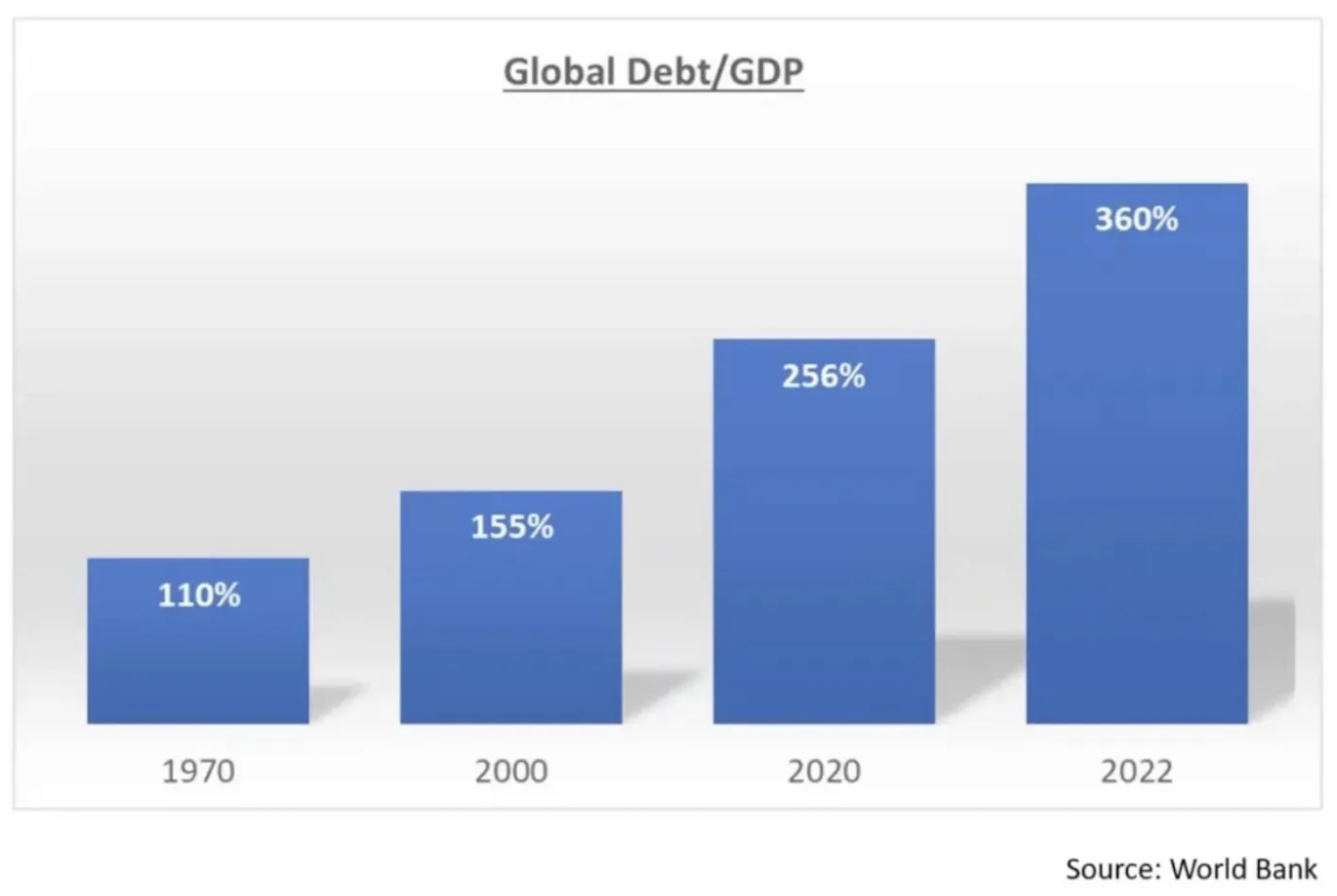
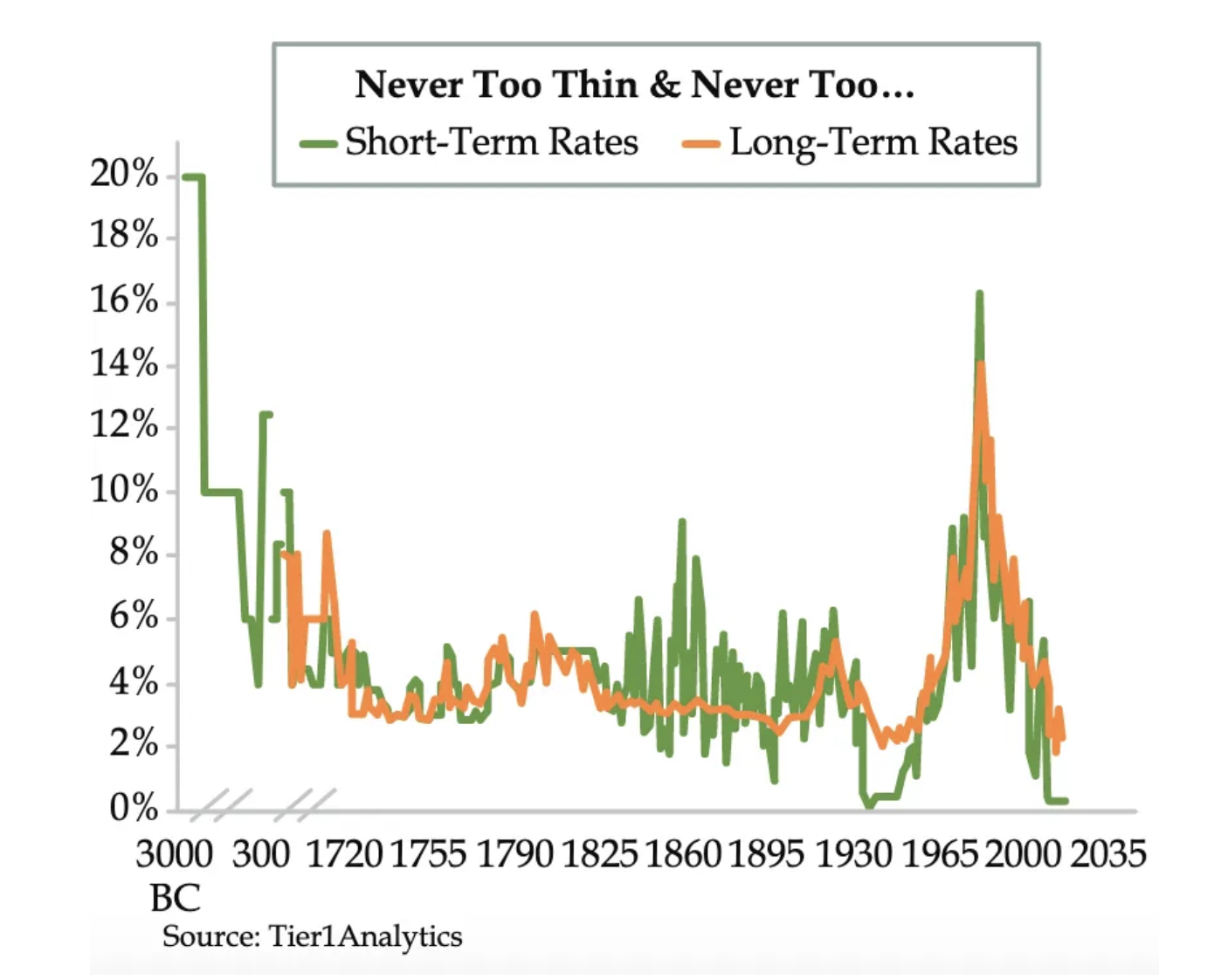
Chart courtesy of Danielle DiMartino Booth at Quill Intelligence.
As you can see, in response to the 2008 Global Financial Crisis (GFC), interest rates were pushed to their lowest level in 5,000 years.

This is Bloomberg’s index of total global negative-yielding debt. It grew from zero before the 2008 GFC to a peak of $17.76 trillion in 2020 — a direct result of central banks pushing interest rates to zero and below.
Most of the world’s population doesn’t hold enough financial assets to benefit from this global fiat currency devaluation. Instead, inflation across goods everywhere has sprung up like mushrooms after rain. Remember the Arab Spring in 2011? Remember when avocado toast cost less than $20 at every major global financial center? Remember when a median-income household could afford the median house price without tapping into the “Bank of Mom and Dad”?
The only somewhat viable escape was owning gold. But holding physical gold is impractical — it’s heavy, hard to hide in large quantities, and difficult to shield from greedy government oversight. Thus, ordinary people had no choice but to silently endure while the elite continued partying in Davos, as if time had frozen in 2007.
Yet, like a lotus blooming in a cesspool, Satoshi Nakamoto released the Bitcoin whitepaper during an era when the empire was morally, politically, and economically bankrupt. This document outlined a system where, for the first time in human history, money could be decoupled from the state through internet-connected machines and cryptographic proof — and crucially, in a globally scalable way. I say “globally scalable” because Bitcoin is weightless. Whether you hold 1 satoshi or 1 million BTC, the weight remains exactly 0. Moreover, you can safeguard your Bitcoin entirely in your mind by memorizing the recovery phrase for your wallet. Bitcoin gives everyone access to a complete financial system, independent of outdated institutions, accessible with just an internet-connected device.
People finally had a way out of the global fiat devaluation carnival. However, in the aftermath of the 2008 financial crisis, Bitcoin wasn’t yet mature enough to offer believers a credible escape route. Bitcoin and the entire crypto market needed to grow in user base and prove they could withstand severe crises.
We loyal believers faced our ultimate test in 2022. The Federal Reserve, followed by most other global central banks, began tightening financial conditions at the fastest pace since the 1980s. The U.S. banking system and bond market couldn’t withstand the Fed’s assault. In March 2023, three U.S. banks — Silvergate, Silicon Valley Bank, and Signature Bank — collapsed within two weeks. On a mark-to-market basis, the U.S. banking system remains insolvent today, especially considering the Treasury and mortgage-backed securities they hold. Hence, U.S. Treasury Secretary Yellen created the Bank Term Funding Program (BTFP) as a stealth bailout to save the entire U.S. banking system.
Crypto was not immune to the disruption caused by higher interest rates. Centralized lending platforms like BlockFi, Celsius, and Genesis collapsed due to loans made to over-leveraged trading firms such as Three Arrows Capital. Terra Luna, a dollar-pegged stablecoin, imploded when its governance token, Luna, crashed, undermining the UST stablecoin it backed. That single event erased over $40 billion in illusory value in just two days. Then centralized exchanges started failing, with FTX being the largest. Run by Sam Bankman-Fried — the “right kind” of white American under U.S. hegemony — FTX stole over $10 billion in customer funds, and his fraud unraveled as crypto prices plummeted.
What happened to Bitcoin, Ethereum, and DeFi protocols like Uniswap, Compound, Aave, GMX, and dYdX? Did they fail? Did they call central crypto banks for bailouts? Absolutely not. Over-leveraged positions were liquidated, prices fell, people lost significant amounts of money, and centralized companies disappeared — but Bitcoin blocks continued to be produced roughly every 10 minutes. DeFi platforms didn’t collapse on their own. In short, no bailouts, because crypto cannot be bailed out. We suffered, but we survived.
In the ashes of 2023, it became clear that U.S. hegemony and its allies could not continue with tight monetary policy. Doing so would bankrupt the entire system, as leverage and debt had piled too high. Something fascinating happened: as long-term U.S. Treasury yields began rising, Bitcoin and crypto rebounded, even as bond prices fell.
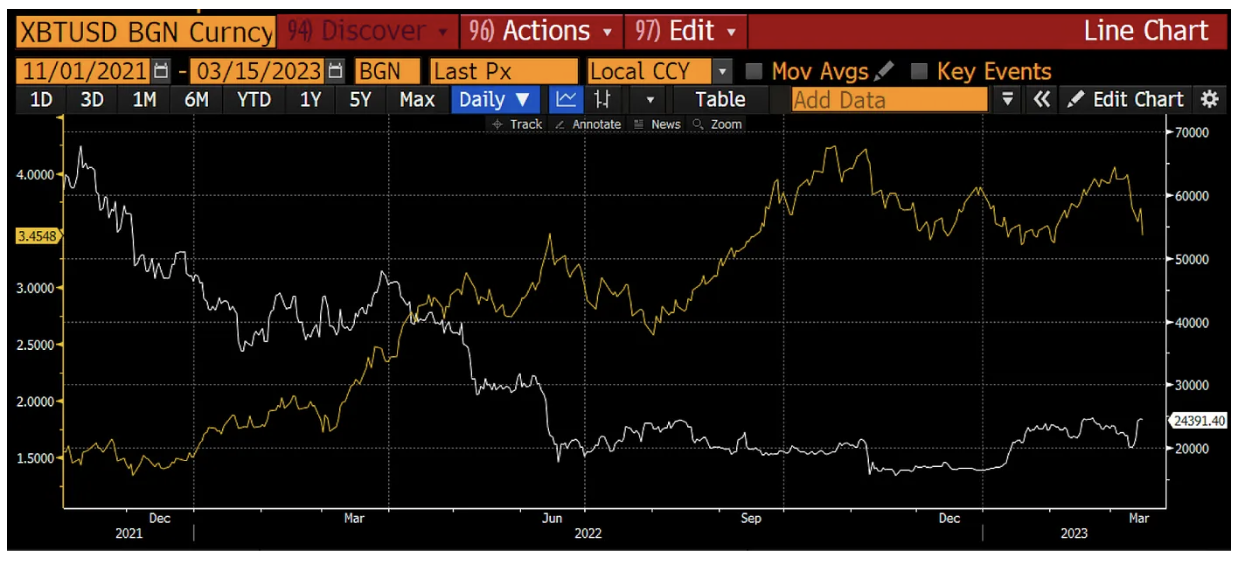
Bitcoin (white) vs. U.S. 10-Year Treasury Yield (yellow)
As seen in the chart above, Bitcoin behaved like other long-duration assets when rates rose — it declined.
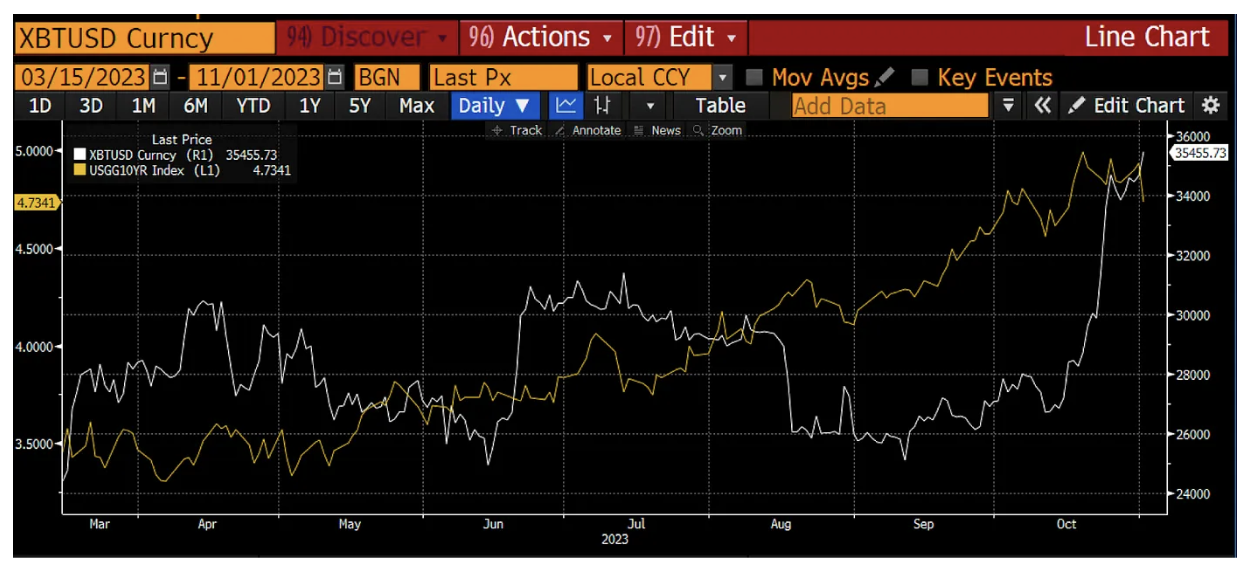
After the BTFP announcement, this relationship reversed. Bitcoin began rising alongside yields. Especially during the steep acceleration of the bear market, rising yields signaled investor loss of confidence in “the system.” In response, investors began dumping the safest government bonds of the American empire — U.S. Treasuries. Much of this capital flowed into the “Magnificent Seven” AI tech stocks (Apple, Alphabet, Microsoft, Amazon, Meta, Tesla, Nvidia), and to a lesser extent, into crypto. After nearly 15 years, Bitcoin finally revealed its true nature: “the people’s money,” no longer merely a derivative of imperial risk assets. This presents traditional finance with a very serious problem.
Capital must remain inside the system so inflation can erode massive unproductive debts. Bitcoin exists outside the system and now shows zero to slightly negative correlation with bonds (remember, bond prices fall when yields rise). If bond vigilantes express dissatisfaction with government bonds by selling them and buying Bitcoin and other cryptos, the global financial system collapses. It collapses because the inherent losses within the system are finally recognized, forcing large financial firms and governments to drastically downsize. Bitcoin is outside the system and now exhibits zero to slightly negative correlation with bonds (again, bond prices fall when yields rise).
To avoid this reckoning, the elite must financialize Bitcoin by creating a highly liquid exchange-traded fund (ETF). They played the same game in the gold market when the SEC approved ETFs like SPDR GLD in 2004, supposedly backed by physical gold bars stored in vaults worldwide. If all capital fleeing the collapsing global government bond market flows into Bitcoin ETFs managed by large traditional financial firms like BlackRock, then capital remains safely within the system.
It became evident that the Fed and all other major central banks must return to printing money to protect global bond markets. BlackRock formally applied for a Bitcoin ETF in June 2023. Spot Bitcoin ETFs were eventually approved in the U.S. By 2023, the SEC seemed to finally accept such applications. Let me highlight the strangeness of the ETF approval process. The Winklevoss brothers applied for a spot Bitcoin ETF in 2013, but the SEC rejected their application for over a decade. BlackRock applied and got approval within six months. One can’t help but say: “Hmm…”
As I wrote in my previous article, Expression, a spot Bitcoin ETF is a financial product. You buy it with fiat to earn more fiat. It is not Bitcoin. It is not a path to financial freedom. It does not exit the traditional financial system. If you want to escape, you must buy Bitcoin, withdraw it from the exchange, and self-custody it.
I wrote this lengthy prelude to explain “Why now?” Why, at this critical moment for the empire and its financial system, was the spot Bitcoin ETF finally approved? I hope you appreciate the significance of this development. The global bond market is estimated at $133 trillion; imagine the inflows into Bitcoin ETFs if bond prices continue falling, even as the Fed potentially begins cutting rates in March. If inflation bottoms and resumes upward, bond prices may keep falling. Remember, war causes inflation, and wars are definitely ongoing at the empire’s periphery.
Market Impact of Spot Bitcoin ETFs
The remainder of this article discusses the market impact of spot Bitcoin ETFs. I will focus exclusively on BlackRock’s ETF because it is the world’s largest asset manager, with the best global ETF distribution network. They can sell products to family offices, retail wealth advisors, retirement and pension plans, sovereign wealth funds, and even central banks. Other firms will try, but in terms of assets under management, the BlackRock ETF will undoubtedly dominate. Regardless of whether this prediction proves correct, the following strategies apply to any issuer with substantial ETF trading volume.
This article will cover the following topics, showing how the internal mechanics of ETFs will create extraordinary trading opportunities for those who can operate across both traditional finance and crypto markets: ETF creation and redemption processes, spot arbitrage and time-series trading analysis, ETF derivatives such as listed options, and the impact of ETF financing trades.
Enough preamble — let’s make some money!
Cash Rules Everything Around Me
Problem solved. Fund inflows (creations) and outflows (redemptions) occur only in cash. The most concerning aspect of this ETF would have been allowing ordinary people to buy ETF shares in fiat and redeem them in Bitcoin. But this product is designed to store fiat, not to offer an easy way for retirement accounts to buy Bitcoin.
Creation
To create ETF shares, authorized participants (APs) must wire the dollar value of a creation basket (a fixed number of ETF shares) to the fund by a specific time each day.
APs are large traditional financial trading firms. Major players in TradFi have registered as APs for various ETFs. Even companies that previously called for banning crypto — like JP Morgan, whose CEO Jamie Dimon once called Bitcoin a fraud — are now participating. Surprising, isn’t it? ;)
Example:
Each ETF share is worth 0.001 BTC. A creation basket contains 10,000 shares. At 4:00 PM ET, these Bitcoins are worth $1,000,000. The authorized participant (AP) must wire this amount to the fund. The fund then instructs its counterparty to buy 10 Bitcoins. Once the purchase is complete, the fund credits the AP with ETF shares.
1 basket = 0.001 BTC * 10,000 shares = 10 BTC
10 BTC * $100,000/BTC = $1,000,000
Redemption
To redeem ETF shares, the authorized participant (AP) must send the ETF shares to the fund by 4:00 PM ET. The fund then instructs its counterparty to sell 10 Bitcoins. Once the sale is complete, the fund disburses $1,000,000 to the AP.
1 basket = 0.001 BTC * 10,000 shares = 10 BTC
10 BTC * $100,000/BTC = $1,000,000
For us traders, the key question is: where must Bitcoin be traded? Of course, the fund’s counterparties can trade on any venue they prefer, but to minimize slippage, they must match the fund’s net asset value (NAV).
The fund’s NAV is based on the CF Benchmark BTC/USD price at 4:00 PM ET. CF Benchmark collects prices between 3–4 PM ET from Bitstamp, Coinbase, itBit, Kraken, Gemini, and LMAX. Any trader wishing to perfectly match the NAV and reduce execution risk can directly trade across all these exchanges.
Bitcoin markets are global, with price discovery primarily occurring on Binance (likely based in Abu Dhabi). CF Benchmark excludes another major Asian exchange, OKX. This creates the first persistent and predictable arbitrage opportunity in the Bitcoin market in a long time. Expect tens of billions in trading flow to concentrate over one hour on less liquid exchanges that mostly follow their larger Asian peers’ pricing. I expect attractive spot arbitrage opportunities to emerge.
Clearly, if the ETF becomes wildly successful, price discovery may shift from East to West. But don’t forget Hong Kong and its imitative ETF products. Hong Kong only allows its listed ETFs to trade on regulated exchanges within Hong Kong. Binance and OKX may serve this market, but new exchanges will also emerge.
Regardless of what happens in New York or Hong Kong, neither city will allow fund managers to trade Bitcoin at the best possible prices — they’ll likely be restricted to “curated” exchanges. This artificial inefficiency will only create more market inefficiencies, which we as arbitrageurs can exploit.
Here’s a simple arbitrage example:
Average Daily Volume Days (ADV) = (Exchange CF Benchmark weight * Daily MOC USD nominal value) / CF Benchmark Exchange USD ADV
Identify the least liquid exchange in CF Benchmark — the one with the highest ADV days. If buying pressure increases, Bitcoin prices on CF Benchmark exchanges will rise above Binance. If selling pressure increases, they will fall below Binance. Then, sell Bitcoin on the expensive exchange and buy on the cheap one. You can estimate creation/redemption flows using the ETF’s premium/discount to its intraday net asset value (INAV). If the ETF trades at a premium, creations will occur. APs short the expensive ETF and create at the cheaper NAV. If the ETF trades at a discount, redemptions occur. APs buy the ETF cheaply in the secondary market and redeem at the higher NAV.
To execute this trade in a price-neutral way, you need to deploy USD and Bitcoin on both CF Benchmark exchanges and Binance. As a risk-neutral arbitrageur, your Bitcoin position must be hedged. Buy Bitcoin with USD and short the BitMEX Bitcoin/USD perpetual swap contract on BitMEX. Post some Bitcoin as margin on BitMEX, and distribute the rest across relevant exchanges.
ETF Options
To truly turn the ETF into a casino, we need leveraged derivatives. In the U.S., the zero-day-to-expiry (0DTE) options market has exploded. One-day expiry options are like lottery tickets, especially when bought out-of-the-money (OTM). Today, 0DTE options are the most actively traded options instruments in the U.S. People love gambling, after all.
After the ETF has been listed for some time, options will begin trading on U.S. exchanges. That’s when the real fun begins.
In TradFi, obtaining 100x leverage is difficult. They lack platforms like BitMEX. But OTM options with short expiries have very low premiums, creating high effective leverage. To understand why, revisit your option pricing theory via the Black-Scholes model.
Degenerate traders with brokerage accounts on U.S. options exchanges can now make highly leveraged bets on Bitcoin prices in a liquid manner. These options will be based on the ETF.
A simple example:
ETF = 0.001 BTC per share
BTC/USD = $100,000 → ETF share price = $100
You believe Bitcoin will rise 25% by the weekend, so you buy a $125 strike call option. This option is OTM since the current ETF price is 25% below the strike. Volatility is high but not extreme, so the premium is relatively low — $1. Your maximum loss is $1. If the option quickly moves ITM (above $125), you profit from the rising premium. You’d earn 25% if you sold ETF shares outright. This is a rough explanation of leverage.
On U.S. capital markets, these hyperactive traders are serious players. With these new high-leverage ETF options, they will cause chaos in Bitcoin’s implied volatility and forward curve.
Forward Arbitrage
Call price - Put price = Long forward contract
As lottery-buying traders push up ETF option prices, OTM options will become more expensive. This creates an arbitrage opportunity between BTC/USD perpetual swaps (e.g., on BitMEX) and ATM forwards derived from ETF option prices.
Futures basis = Futures price - Spot price
I expect the ETF ATM forward basis to trade higher than the BitMEX futures basis. Here’s how to play it:
Short the ETF ATM forward by selling ATM calls and buying ATM puts.
Simultaneously, go long the fixed-maturity Bitcoin/USD futures contract on BitMEX with a similar expiration date.
Wait for prices to converge near expiry. This won’t be a perfect arbitrage, as BitMEX and the ETF use different methods to construct the Bitcoin spot index.
Volatility (Vol) Arbitrage
When trading options, you’re largely trading volatility. Traders on native crypto, non-U.S. exchanges who trade Bitcoin options differ from ETF option traders in their preferences for maturities and strikes. I predict ETF option volume will dominate global Bitcoin options flow. Because these two groups — USD-based U.S. traders and non-USD traders — cannot interact on the same exchanges, arbitrage opportunities will arise.
Direct arbitrage exists when identical options trade at different prices. More generally, there will be volatility surface arbitrage — parts of the ETF option vol surface diverging significantly from the Bitcoin vol surface offshore. Discovering and exploiting these requires experience, but I know many French speculators will dive in.
MOC (Mark-to-Close) Flow
Since ETFs will drive massive volumes in U.S.-listed ETF derivatives, the 4:00 PM CF Benchmark closing price will become critically important. Derivatives derive value from their underlying. With billions in notional options and futures expiring daily, matching the ETF’s closing print to align NAV is essential.
This will generate statistically significant trading behavior around 4:00 PM ET and during regular trading hours. Those skilled in data analysis and equipped with strong trading bots will earn huge profits by arbitraging these market inefficiencies.
ETF Financing (Creation Loans)
Centralized lending platforms like BlockFi, Celsius, and Genesis were popular among Bitcoin holders wanting to borrow fiat against their Bitcoin collateral. Yet, the dream of a fully end-to-end Bitcoin economy remains unfulfilled. Loyal Bitcoiners still need fiat to pay for life’s necessities, forced to use that dirty fiat currency.
All the centralized lending platforms I mentioned collapsed, along with many others. Borrowing fiat against Bitcoin collateral has become harder and more expensive. Traditional finance is accustomed to borrowing against liquid ETFs. Now, anyone pledging Bitcoin ETF shares can obtain large-scale fiat loans at competitive rates. For financial freedom advocates, the challenge is retaining control of Bitcoin while accessing this cheaper capital.
The solution: swap Bitcoin for ETF shares. Here’s how it works.
An AP with access to interbank funding creates ETF shares and hedges Bitcoin/USD price risk. This is the creation lending business. In Delta-One terms, it’s the repo value of ETF shares.
Process:
Borrow USD in the interbank market and create ETF shares in cash.
Sell ATM call options on the ETF and buy ATM put options to create a synthetic short forward.
The ETF creation process generates a positive spread: forward basis > interbank USD rate.
Lend out ETF shares in exchange for Bitcoin collateral.
Let’s bring in Chad to discuss what he should do with his Bitcoin:
Chad owns 10 BTC and needs USD to pay his AMEX bill — champagne at the club isn’t cheap. Chad contacts his friend Jerome, a slick Frenchman working at SocGen, formerly a back-office worker turned futures trader who went to jail for aggressive trading but got rehired (you can’t fire anyone in France), now running the crypto desk. Chad asks Jerome for a 30-day Bitcoin-for-ETF swap. Jerome quotes -0.1%. This means Chad exchanges 10 BTC for 10,000 ETF shares (assuming 0.001 BTC/share) and gets back 9.99 BTC after 30 days.
For the 30 days Chad holds 10,000 ETF shares instead of 10 BTC, he pledges the ETF shares to his traditional broker to secure a very cheap USD loan.
Everyone wins. Chad keeps flexing at the club without selling his Bitcoin. Jerome earns the financing spread.
ETF financing will gradually become significant and influence Bitcoin interest rates. As this market evolves, I’ll highlight attractive financing trades across ETFs, physical Bitcoin, and Bitcoin derivatives.
Your Size is My Size
For these trading opportunities to last and allow arbitrageurs to scale, the complex structure of spot Bitcoin ETFs must trade billions in shares daily. On Friday, January 12, total daily volume reached $3.1 billion. This is highly encouraging. As fund managers activate their vast global distribution networks, volume will only increase. With a liquid way to trade a financial version of Bitcoin within the traditional system, fund managers can finally escape the terrible returns currently offered in this global inflation environment.
We are in the early stages of a sustained global inflation era. There’s a lot of noise, but over time, portfolio managers running stock-bond correlations will realize things have changed. Below the zero-interest threshold, especially amid persistent inflation, bonds cease to function in portfolios. The market will slowly recognize this. A sell-off from the over $100 trillion bond market could destroy nations. Then, these managers must seek an asset class uncorrelated with stocks or any traditional financial category. Bitcoin fulfills this role.
Your Size is My Size
For these trading opportunities to last and allow arbitrageurs to scale, the complex structure of spot Bitcoin ETFs must trade billions in shares daily. On Friday, January 12, total daily volume reached $3.1 billion. This is highly encouraging. As fund managers activate their vast global distribution networks, volume will only increase. With a liquid way to trade a financial version of Bitcoin within the traditional system, fund managers can finally escape the terrible returns currently offered in this global inflation environment.
We are in the early stages of a sustained global inflation era. There’s a lot of noise, but over time, portfolio managers running stock-bond correlations will realize things have changed. Below the zero-interest threshold, especially amid persistent inflation, bonds cease to function in portfolios. The market will slowly recognize this. A sell-off from the over $100 trillion bond market could destroy nations. Then, these managers must seek an asset class uncorrelated with stocks or any traditional financial category. Bitcoin fulfills this role.
Join TechFlow official community to stay tuned
Telegram:https://t.me/TechFlowDaily
X (Twitter):https://x.com/TechFlowPost
X (Twitter) EN:https://x.com/BlockFlow_News
 Arthur Hayes









