








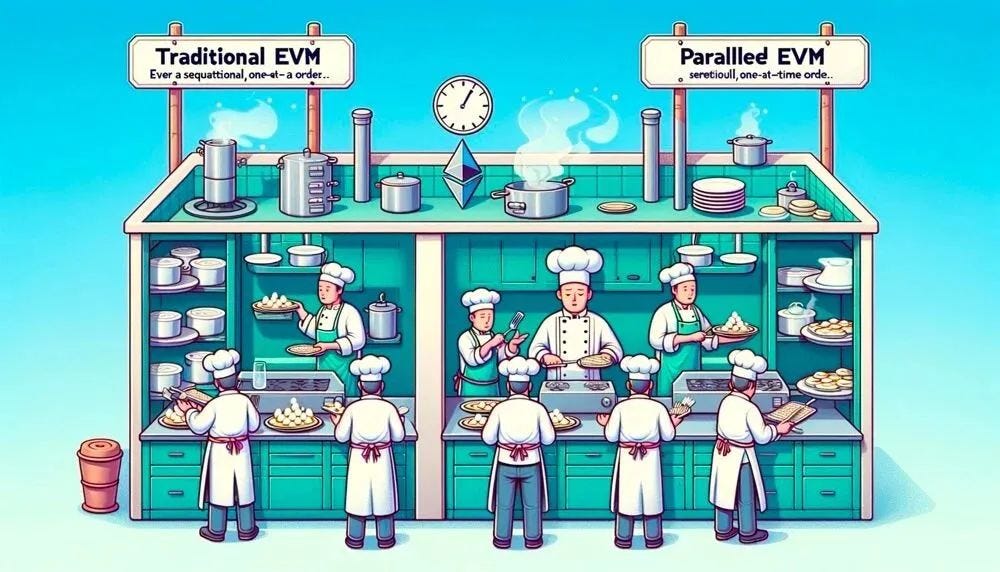
Parallel EVM Narrative: Why Layer2 Is More Advantageous Than Layer1?
TechFlow Selected TechFlow Selected
Parallel EVM Narrative: Why Layer2 Is More Advantageous Than Layer1?
Many L1 and L2 chains can become parallel Rollup chains to Ethereum.
 Navigating Web3 tides with focused insights
Author: Haotian
I've noticed that many people still misunderstand "parallel EVM." To be precise, it should actually be called "parallel Rollup." @SeiNetwork's so-called parallel EVM only introduces a parallel pre-processing capability before transactions are submitted to the EVM execution environment. In essence, it is just another form of Rollup.
Following this logic, many L1+L2 chains could become parallel Rollup chains for Ethereum—as long as they possess parallel transaction processing capabilities. Why? Here’s my brief analysis:
1) "Parallel EVM" is easily misunderstood as meaning the EVM itself can execute smart contracts in parallel. However, the EVM cannot change its state management and transaction consistency mechanisms within its native chain environment. All current implementations labeled as "parallel EVM" are actually based on the concept of parallel Rollups—or more technically speaking—“parallel Mempool.”
Achieving true parallelism at the EVM level would require fundamental changes to Ethereum’s architectural layers, including state management, transaction execution logic, and consensus mechanisms—making it nearly impossible to implement in practice.
2) Sei achieves parallel transaction processing through its dual-turbo consensus mechanism and EVM compatibility. In simple terms, validator nodes locally manage their own Mempools, eliminating delays from a shared public Mempool. Nodes cross-validate via Gossip in a randomized manner, improving efficiency. Additionally, Access DAG (Directed Acyclic Graph) tracks different states across transactions to resolve conflicts, enabling highly efficient parallel processing.
Although Sei claims to be the first parallel EVM chain, the ability to process transactions in parallel is not unique to Sei. Chains like @solana, @SuiNetwork, and @Aptos_Network also possess similar capabilities.
In fact, any L1 or L2 chain with parallel transaction processing capability can be considered a parallel Rollup chain as long as it establishes connectivity with EVM.
For high-performance new-gen L1s, leveraging advanced programming languages like Move or Rust, adopting object-centric account models similar to UTXO, and implementing consensus designs where storage and execution are separable—all make achieving parallel transaction processing relatively straightforward.
However, integrating parallel processing into the "pre-processing" stage of EVM essentially makes these chains another variant of Rollup. This means such innovative L1s are now competing directly with Ethereum’s native layer2 solutions.
When an L1 competes head-to-head with L2s, it becomes a form of downward competition. Can we really say such an L1 is impressive? Personally, I’m skeptical. At best, we can say it has added EVM compatibility. From this perspective, “parallel EVM” isn’t really a novel concept after all.
3) I am more optimistic about the narrative and potential of layer2+ chains with parallel processing capabilities. For layer2 Rollups, the Sequencer only needs to perform fine-grained transaction processing—such as parsing transactions, detecting state conflicts, and leveraging底层 technologies like account abstraction within its pre-processing Mempool—to achieve parallelism. For layer2s, adding parallel processing capability is technically feasible.
The real challenges lie in decentralizing the Sequencer and building a decentralized tokenomics model—an argument I previously made when discussing how layer2s will eventually be redefined.
In other words, once layer2 projects like @MetisDAO successfully solve the decentralization of Sequencers and establish fully decentralized economic models, pursuing narratives like “parallel EVM” will open up far greater possibilities.
After all, layer2s inherently serve Ethereum’s mainnet. Their deeper alignment with Ethereum in areas like data availability (DA) and interoperability gives them stronger foundational advantages compared to other L1s that merely claim EVM compatibility for marketing purposes.
Crucially, Ethereum’s layer2s can even reverse-integrate other L1s by treating them as execution VM layers.
In summary, cutting through the hype, we must recognize that “parallel EVM” essentially equals parallel processing capability + EVM compatibility. Any L1 with parallel processing can achieve this via EVM compatibility. Likewise, existing EVM-compatible layer2s can naturally evolve into superior parallel EVM platforms simply by adding parallel transaction processing.
Personally, I see greater promise in the narrative and outlook for parallel Rollups at the layer2 level. As for L1-level narratives, they might still hold some appeal if framed within the broader context of modular, composable blockchain architectures. But if the ultimate goal is merely turning these new L1s into de facto layer2s for Ethereum, I remain unconvinced.
Join TechFlow official community to stay tuned
Telegram:https://t.me/TechFlowDaily
X (Twitter):https://x.com/TechFlowPost
X (Twitter) EN:https://x.com/BlockFlow_News
 Haotian | CryptoInsight









