









Biteye 2024 Year-End Sector Outlook
TechFlow Selected TechFlow Selected
Biteye 2024 Year-End Sector Outlook
Analysis and Outlook of Seven Key Sectors to Watch in 2024.
 Navigating Web3 tides with focused insights
Authors: @0xdddd111, @lviswang, @FINT1121, @Jesse_meta, @pikpika6, @shouyi16, @0x_Way, core contributors of Biteye
Editor: Crush, core contributor of Biteye
On January 11, BTC ETFs finally received approval from the SEC. Today, 11 BTC ETFs officially began trading on U.S. markets—an historic milestone moment for the crypto industry.
With ETFs bringing BTC into the broader mainstream and the upcoming Bitcoin halving event at the end of March, 2024 is undoubtedly a crucial year for the crypto space.
So what sectors should we be watching in 2024? In this article, we present a collaborative analysis and outlook on seven key sectors in 2024, contributed by members of the Biteye community.
01 Bitcoin Ecosystem
Looking back at 2023, the dominant narrative within the Bitcoin ecosystem was clear. After Domodata introduced the BRC20 standard on March 8, inscriptions quickly flourished on the Bitcoin mainnet. The combination of new asset narratives with Bitcoin's own story propelled ORDI, the first inscription asset, to surpass a $1 billion market cap within the year.
As on-chain activity increased, network congestion and high transaction fees became apparent. During popular minting events, BTC gas fees reached levels unacceptable even for regular users, highlighting Bitcoin’s urgent need for scalability—now a central theme in its future development. So what directions within the Bitcoin ecosystem should we watch moving forward?
1. New Asset Issuance Protocols on Bitcoin
Atomicals is an optimization project targeting Ordinals and BRC20 that solves BRC20's over-reliance on centralized off-chain indexing. It leverages and extends Bitcoin’s UTXO model, treating each satoshi’s UTXO as a specific Atomical token or digital object. $ATOM, the first token under Atomicals, uses PoW-based minting and is considered more decentralized and aligned with Bitcoin purist ideology. Due to its technical advantages, it currently enjoys strong community consensus.
SRC-20 is a token standard built on the Stamps protocol. BTC Stamps were invented by @mikeinspace. The key difference from Ordinals lies in data storage: while Ordinals store image/text information in witness data, Stamps embed data directly into transaction outputs. This makes Stamps permanently existent on the Bitcoin chain, requiring full nodes to synchronize the data.
Bitmap is the first metaverse project in the Bitcoin ecosystem, mapping inputs of transactions within Bitcoin blocks into land parcels (Parcels) to form districts or zones. Bitmap also introduced the BRC-420 protocol—a composite asset standard based on Bitmap that combines multiple inscriptions into complex ones, enabling creation of diverse assets ranging from small characters and pets to elaborate digital items.
Other notable protocols worth monitoring include CBRC, Veda, Rune, and Sat.
2. Bitcoin Infrastructure
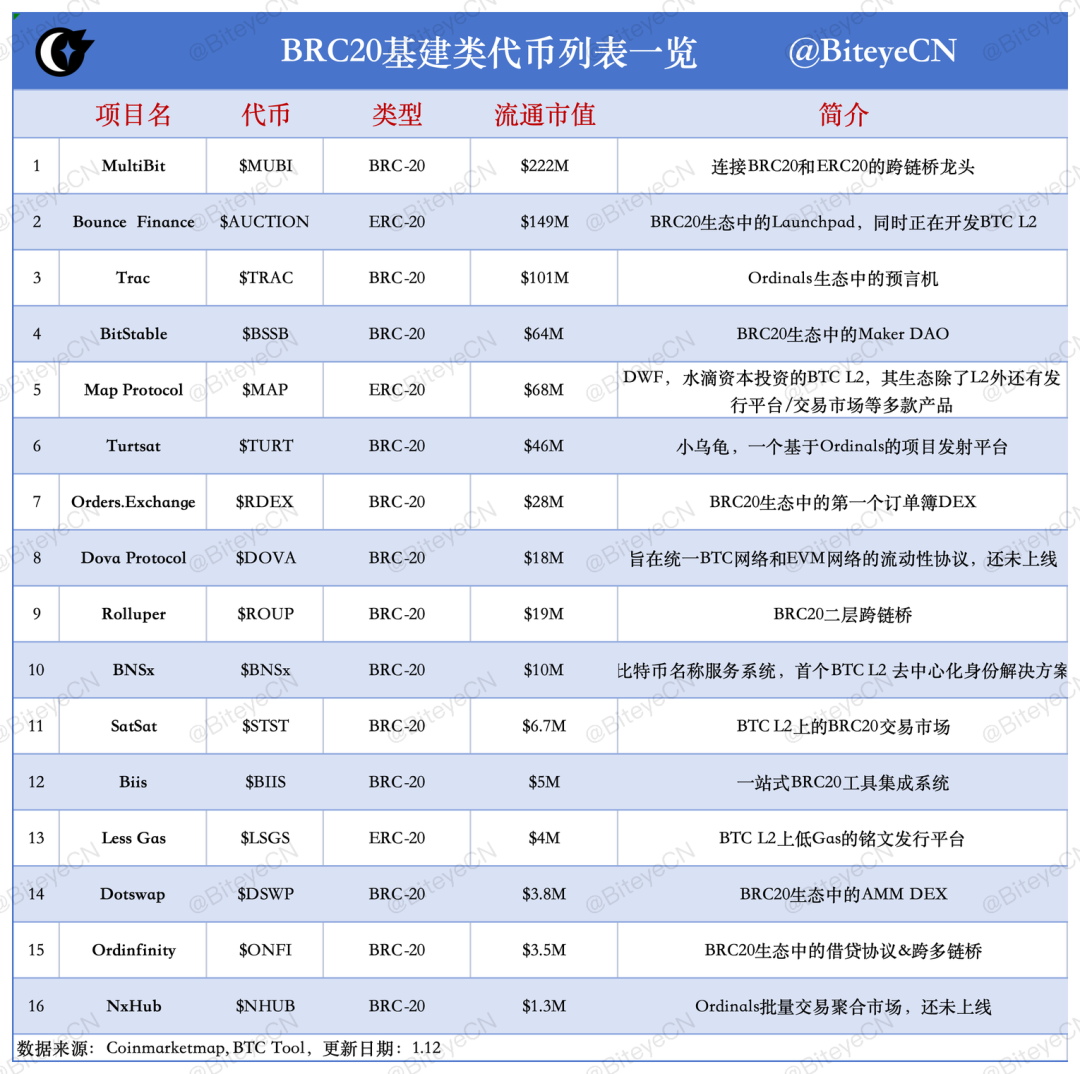
Currently, major Bitcoin infrastructure projects fall into several key categories:
-
Cross-chain bridges
-
IDO platforms
-
DEX exchanges
-
Lending platforms
-
Marketplaces
3. Bitcoin Scaling Solutions
Bitcoin scaling solutions are primarily developing along two paths: Lightning Network and sidechains.
1) Lightning Network
Proposed in 2016 by Joseph Poon and Tadge Dryja, the Lightning Network is one of Bitcoin’s Layer 2 solutions.
Built on payment channels, it enables fast and low-cost transactions through off-chain payments settled eventually on the main chain. Theoretically, the Lightning Network can process up to millions of transactions per second.
The Taproot Assets protocol, introduced by Lightning Labs on October 19, 2023, allows asset issuance on the Lightning Network. Currently, Nostr Assets is the leading platform for issuing and trading Taproot Assets, where tokens $TREAT and $TRICK are mainly used for staking to participate in new launches.
2) Sidechains
Stacks ($STX): Stacks is currently the most mature L2 in the Bitcoin ecosystem, using a Proof of Transfer (PoX) consensus mechanism.
It anchors transactions by bundling them and broadcasting block information from the Stacks chain onto the Bitcoin network, ensuring transaction security.
Stacks provides a complete execution environment—applications that can run on Ethereum or similar chains can also be built on Stacks.
Validators and miners on Stacks can stake $STX and $BTC respectively to mine both $BTC and $STX, helping secure the network.
According to Stacks’ roadmap, the launch of the Nakamoto upgrade and sBTC in Q1 this year will be significant milestones worth close attention.
3) Others
Beyond the above, other noteworthy Bitcoin scaling solutions include RGB protocol, Rootstock ($RIF), BitVM, and BEVM.
02 Modular Blockchains and Data Availability (DA)
1. Modular Blockchains
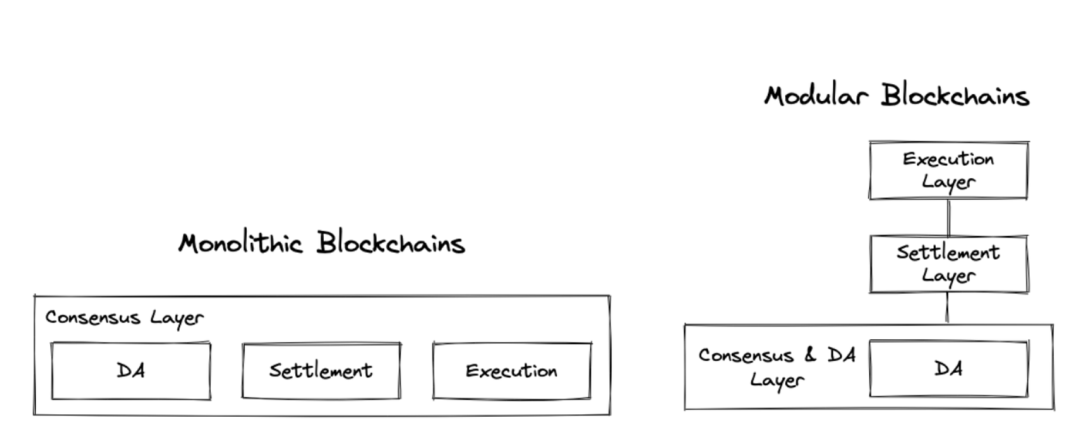
Modular blockchains specialize in specific functions—such as Execution, Consensus, Settlement, or Data Availability (DA)—and rely on other blockchains or services for remaining tasks.
This design enhances security and allows teams to focus energy on developing core features.
By decoupling blockchain components, modular architectures overcome performance bottlenecks of traditional monolithic chains. Each module can use specialized providers, enabling customizable combinations for tailored blockchains.
Key projects in modular blockchains:
-
Celestia ($TIA)
Celestia implements DA off-chain using Reed-Solomon erasure coding and Namespaced Merkle Trees to ensure data availability at lower cost and higher efficiency.
Although Celestia has launched its token, users can still indirectly participate in all modular projects using Celestia via staking. Many recent Cosmos-based projects have included Celestia staking accounts in their airdrop eligibility.
-
Manta
Manta Network is a modular blockchain designed for zero-knowledge (ZK) applications and the first L2 to migrate its DA layer from the Ethereum mainnet to Celestia.
Since Manta switched its DA from Ethereum to Celestia in December last year, its transaction fees have dropped by 99.8%. Manta’s TVL now exceeds $800 million, ranking just behind Optimism and Arbitrum.
-
AltLayer
AltLayer is a decentralized Rollup-as-a-Service protocol with a fully modular stack, allowing end-users to choose rollups based on their needs.
Its Rollup SDK supports Arbitrum Orbit, OP Stack, etc., while DA layers support Eigenlayer, Celestia, and Astria.
AltLayer has already launched Phase 1 testnet missions and OATs on Galaxy. Future testnet activities may add utility to OATs. Additionally, AltLayer previously released Ottie NFTs, which could potentially qualify for future token airdrops.
-
Cevmos
Cevmos is a rollup stack co-developed by Evmos and Celestia, aiming to become the optimal settlement layer for EVM-based rollups on Celestia.
Cevmos is actually an acronym combining Celestia, Evmos, and Cosmos.
2. Data Availability Layers
Data availability (DA) layers are one of the primary directions in modular blockchains. Celestia itself is a modular blockchain dedicated solely to DA.
Data availability refers to public storage of transaction data enabling verifiability. DA layers ensure data correctness, protection, and ease of validation. For current use cases, the most direct benefit is drastically reduced gas fees for both projects and users.
Currently, Ethereum L2s must upload calldata to the Ethereum mainnet—meaning Ethereum handles DA—which incurs enormous costs.
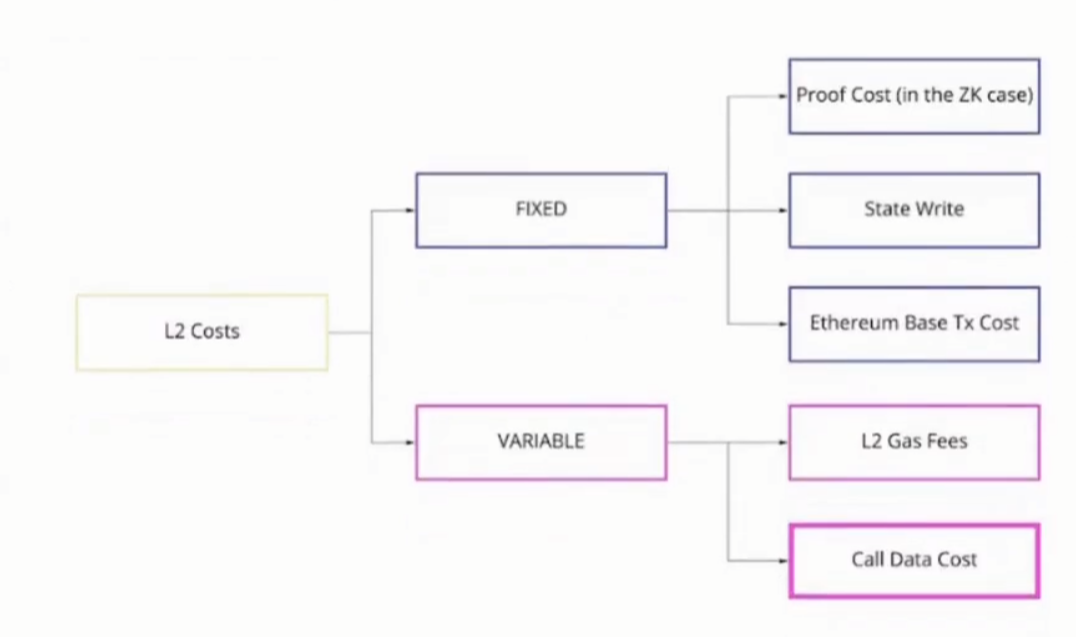
As demonstrated by Manta’s massive fee reduction, the cost-saving advantage alone—combined with current market热度—makes it clear that DA meets real demand from Web3 builders, indicating vast market potential.
However, bigger pie means fiercer competition—the so-called "DA War." Numerous new DA projects are expected to launch soon (listed below are DA service providers, not users):
-
Avail: A modular blockchain led by Polygon team, a major competitor to Celestia. Currently in testnet phase, Avail runs an incentivized “Node Wars” program where participants earn rewards by operating nodes.
-
Fuel: Unlike Celestia, Fuel focuses on the execution layer using SwayLang. Users can obtain Zealy badges for participation.
-
EigenDA: Provided by EigenLayer, offering low-cost, large-scale rollup data availability secured by ETH restaking. Participation can be achieved through EigenLayer.
Meanwhile, established players may promote proprietary DA solutions. Choosing among DA providers will become a critical market博弈 point.
For example, Ethereum’s Danksharding is essentially a DA solution, employing more complex verification techniques than Celestia.
Ethereum founder Vitalik has repeatedly endorsed Ethereum’s native DA technology, stating on social media that L2s using third-party DA aren’t truly part of the Ethereum ecosystem—effectively building a moat around Ethereum’s DA.
Ultimately, DA is a business-to-business play with limited user-facing impact. Thus, a DA project’s soft power—first-mover advantage, connections, influence—may outweigh technical specifics. The DA War in 2024 will be fascinating to watch.
03 DePIN
As predicted in Biteye’s 2023 outlook report, DePIN has become a hot sector—crypto seems to have found a large-scale practical application beyond finance.
DePIN stands for Decentralized Physical Infrastructure Networks—using crypto incentives to bootstrap and sustain decentralized physical infrastructure.
DePIN represents a vital bridge between virtual crypto and the real world, promoting data security and efficient coordination of idle resources—enhancing lives while showcasing crypto’s utility and appeal.
In early stages, DePIN projects use tokens or anticipated airdrops to incentivize user participation and attract capable developers to build cost-effective products.
As more users adopt the product or service, project revenue increases—funds can then be used for treasury management and further marketing, rewarding both suppliers and consumers, attracting more participants and investor capital, creating a thriving ecosystem.
During bull markets, DePIN benefits from strong positive flywheel effects. Recently, Binance and OKX have highlighted DePIN, releasing themed introduction videos.
A joint research report by Messari and Escape Velocity categorizes DePIN into six subsectors: computing, wireless, energy, AI, services, and sensors.
Below are representative projects across subsectors—not investment advice. Readers are encouraged to explore further for socially impactful innovations.
-
Computing
Driven by machine learning and AIGC, data generation is growing exponentially, increasing demand for secure decentralized storage. Filecoin ($FIL) leads the storage sector and ranks among top earners in DePIN.
-
Wireless
Helium ($HNT) is a decentralized wireless network and one of the earliest, most famous DePIN projects—ranked top in DePIN funding with $250 million raised, alongside Filecoin.
Its sub-DAO Helium Mobile ($MOBILE) offers discounted mobile plans and recently emerged as a breakout star due to rapid price appreciation.
-
Energy
Arkreen is a global decentralized renewable energy data network that tokenizes credible, verifiable data from renewable devices, advancing carbon neutrality.
-
Artificial Intelligence
Render Network ($RNDR) is a decentralized GPU rendering network connecting idle GPUs to support film and animation rendering, partnering with companies like Stable Diffusion and Netflix.
-
Services
Braintrust ($BTRST) is the first decentralized talent network, matching elite freelance tech professionals with enterprise needs.
-
Sensors
Hivemapper ($HONEY) is a mapping network where contributors use Hivemapper dashcams to capture street imagery and create updated maps.
There are two main ways investors can engage with DePIN:
-
Become a provider by purchasing equipment to deliver services and recoup costs/profit via token rewards.
-
Buy relevant tokens, as during bull runs, projects often use equipment sales revenue to boost token prices, encouraging further purchases and accelerating network growth.
However, note that DePIN projects tend to have aggressive market-making strategies. Observed token prices often exhibit extreme volatility. Investors might consider swing trading, dollar-cost averaging, or grid trading.
Additionally, users can benefit as consumers by accessing more cost-effective DePIN services.
04 New Public Chains and Ethereum Ecosystem
Public chains form the backbone and largest infrastructure layer of the crypto industry. With ongoing technological advancements, we believe four major trends will define 2024: high-performance parallel EVM chains, Ethereum restaking, the Cancun upgrade, and modular blockchains. (Modular blockchains were covered earlier.)
1. Parallel EVM Chains
Recently, Georgios, CTO of Paradigm, declared 2024 the “Year of Parallel EVM,” with active internal technical exploration underway.
One source of EVM performance bottleneck is sequential transaction processing, causing network congestion, delays, and high gas fees during peak times—the biggest pain point for Ethereum users.
Parallelizing EVM execution could significantly improve throughput and efficiency. Two main approaches exist:
1) Independently designed parallel EVM chains
2) Adding a parallel execution layer as an L2

Notable projects:
-
Sei ($SEI)
Sei is a Layer 1 optimized specifically for trading, using optimistic parallelization. Its upcoming V2 aims to achieve full parallel EVM. Sei also enables interoperability between CosmWasm and EVM smart contracts, offering a more diverse execution environment.
-
Eclipse
Eclipse is a modular rollup platform that brings Solana to Ethereum—using Solana’s parallel VM as the execution layer, Ethereum for settlement, Celestia for DA, and Risk Zero for fraud proofs—to build a parallel EVM chain.
Eclipse is currently on testnet; users can apply via the official website.
-
Lumio
Lumio is an L2 based on OP Rollup, aiming to use Aptos as the execution layer. Move-based Aptos once showed great promise and may shine again in the parallel EVM race.
Lumio is currently in closed testing on Ethereum, gradually opening access to NFT holders and Liquidswap users. Interested users should monitor for testnet opportunities.
2. Ethereum Ecosystem
2023 saw explosive growth in Ethereum L2s, with over a dozen launching mainnets. According to L2Beat, total L2 TVL has reached $19.35 billion. With OP Stack and Polygon CDK lowering the barrier to launch new L2s, total TVL is expected to keep rising in 2024 as more L2s go live.
1) Restaking Narrative
Beyond L2s leveraging Ethereum security, EigenLayer taps into Ethereum validators to simplify launching new chains.
EigenLayer is an Ethereum-based middleware introducing “restaking”—allowing validators to re-stake their ETH or LSD tokens to secure other protocols like oracles, bridges, or chains, gaining Ethereum-level security at lower cost and earning additional yield.
Recently, liquidity from EigenLayer stakes has been converted into new liquid restaking tokens (LRTs), giving rise to the “LRTfi” trend of nested liquidity. Notable projects:
-
Pendle ($PENDLE)
Pendle will soon list ether.fi’s liquid staking token eETH. Users can deposit eETH into Pendle’s LP to earn EigenLayer points, EtherFi points, and multi-layered staking yields.
-
Swell
Swell is an LSDfi protocol where users stake ETH to earn Pearls and staking rewards. Pearls are linked to airdrops. Swell plans to add restaking functionality to swETH, allowing users to receive rswETH—unlocking ETH liquidity while boosting returns.
-
Puffer Finance
Puffer is a liquid staking protocol built on EigenLayer. Using its proprietary Secure-Signer tool and RAV technology, it resolves slashing risks in Ethereum and EigenLayer networks, offering participants low-risk double yields. Mainnet launch planned for 2024.
2) Cancun Upgrade
On the evening of January 4, the 178th Ethereum Core Developers meeting finalized the Dencun upgrade timeline. Testnet activation for the Cancun upgrade begins on January 17.
The core of the Cancun upgrade is EIP-4844, aimed at increasing Ethereum’s transaction capacity.
Before Cancun, L2 transactions were stored in L1 calldata—a costly method with limited space.
After the upgrade, L1 will store L2-submitted data in a new location called “blobs,” which offer cheaper and larger storage.
Note: L2 revenue comes from user gas fees minus fees paid to Ethereum. With the Cancun upgrade, L2s’ costs to Ethereum drop sharply—meaning L2 profitability can increase substantially.
Thus, the Cancun upgrade is fundamentally bullish for all L2s using Ethereum as their data availability layer—including both Optimistic and ZK rollups.
In the coming quarter, assets related to the Cancun upgrade stand to gain solid fundamental tailwinds.
Most directly, OP and ARB are prime beneficiaries. Native protocols within their ecosystems may also see spillover effects—e.g., Velodrome ($VELO), the largest DEX on OP, and GMX ($GMX) on ARB.
Smaller Optimistic rollups like MetisDAO ($METIS) and Boba ($BOBA) also benefit. MetisDAO plans to deploy a decentralized sequencer—offering dual narratives worth watching.
Additionally, since EIP-4844 introduces temporary blob storage—data gets deleted after ~1 month—L2s wanting long-term data retention must use external storage providers. This indirectly boosts demand for decentralized storage—a positive for that sector.
05 GameFi
GameFi currently divides games into two categories:
1. Fully On-Chain Games (FOCG)
2. Non-Fully On-Chain Games (NFT assets + off-chain gameplay)
1. Fully On-Chain Games
Fully on-chain games store not only assets but also game state and logic entirely on-chain. Compared to non-fully on-chain games, they are more decentralized and composable.
However, FOCG remains in early stages with high entry barriers—token or NFT holders may need to wait long periods before seeing returns.
Two main FOCG engines:
Join TechFlow official community to stay tuned Telegram:https://t.me/TechFlowDaily X (Twitter):https://x.com/TechFlowPost X (Twitter) EN:https://x.com/BlockFlow_News
 @BiteyeCN









