








The Legal and Regulatory Logic Behind Bitcoin Spot ETFs
TechFlow Selected TechFlow Selected
The Legal and Regulatory Logic Behind Bitcoin Spot ETFs
Regardless of how the SEC stages its performance, the approval of the BTC ETF is profoundly historic.
 Navigating Web3 tides with focused insights
Author: Will Awang
After a decade-long struggle for BTC ETF approval, the path finally brightened with hope. At 4 a.m. on January 11, 2024, the U.S. Securities and Exchange Commission (SEC) simultaneously approved 11 spot BTC ETFs, including those from Bitwise, Grayscale, Hashdex, BlackRock, Valkyrie, Invesco, Ark, VanEck, WisdomTree, Fidelity, and Franklin.
All of this should be credited to Grayscale's legal victory. On August 29, 2023, a U.S. federal court ruled in favor of Grayscale in its lawsuit challenging the SEC’s rejection of its spot BTC ETF application. This decision accelerated the approval process over the past few months for traditional financial giants like BlackRock and Fidelity applying for BTC ETFs.
This article will examine, from a regulatory and legal perspective, how the SEC’s stance shifted after Grayscale’s win—specifically its proactive identification of market manipulation risks—the logic behind approving BTC ETFs, and the SEC’s continued caution that other crypto assets are securities, warning of ongoing market risks.
1. The Court Ruling Pushed the SEC to Accelerate Approvals
Previously, the SEC refused to approve spot BTC ETFs due to concerns about fraud and market manipulation. All rejected applications were denied under the rationale from securities law stating that “the products were not designed to prevent fraudulent and manipulative acts and practices.”
In 2021, the SEC first allowed futures-based BTC ETFs, arguing that futures products are harder to manipulate because they are priced off the Chicago Mercantile Exchange (CME), which is regulated by the U.S. Commodity Futures Trading Commission (CFTC).
In the case, Grayscale argued that the logic used to approve futures-based BTC ETFs should equally apply to spot BTC ETFs—otherwise, all previously approved futures ETFs should be revoked. The judge agreed, ruling that the SEC’s rejection of Grayscale’s application was arbitrary and capricious, as the SEC failed to justify its inconsistent treatment of similar ETF products. The court found this differential treatment violated administrative law, granted Grayscale’s petition, and vacated the SEC’s denial.
Only after the Grayscale ruling did the SEC fully shift its stance—from passively rejecting applications to actively reviewing them—and stated in its 22-page approval order: This order approves the Proposals on an accelerated basis.
2. What Risks Did the SEC Highlight for BTC ETFs?
ETFs themselves are long-established compliant financial instruments with no legal barriers. BTC is also the only asset that U.S. regulators, particularly the SEC, have explicitly defined as a “non-security.” So where do the risks lie?
In its 22-page approval document, the SEC clarified: The risk lies in the uncontrollable nature of the underlying asset markets—specifically, the potential for manipulation in the BTC spot market.
Although each ETF has surveillance-sharing agreements with regulated exchanges such as CME to monitor BTC futures market risks, BTC spot trading does not occur on CME, so monitoring cannot directly cover the spot market.
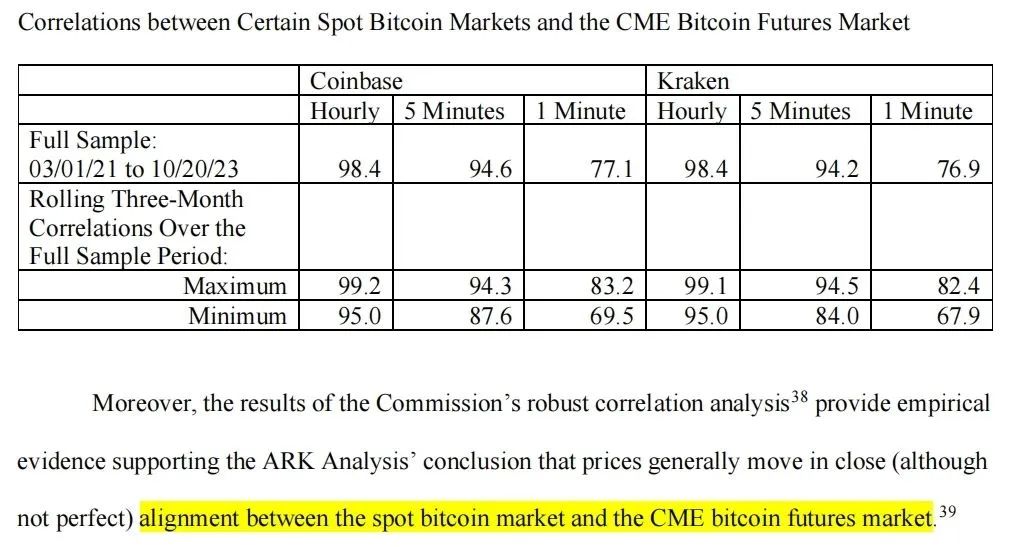
BTC futures on CME are already a compliant product. Therefore, demonstrating a strong correlation between BTC spot prices and CME futures prices is the best approach. To this end, the SEC analyzed price correlations since 2021 between BTC prices on Coinbase and Kraken and CME futures prices, finding a high degree of correlation. This implies that if fraud or manipulation occurs in the spot market, it would likely affect the futures market as well, thereby being detectable by CME’s monitoring systems, allowing regulators to intervene and control risks.
3. Market Manipulation in the BTC Spot Market
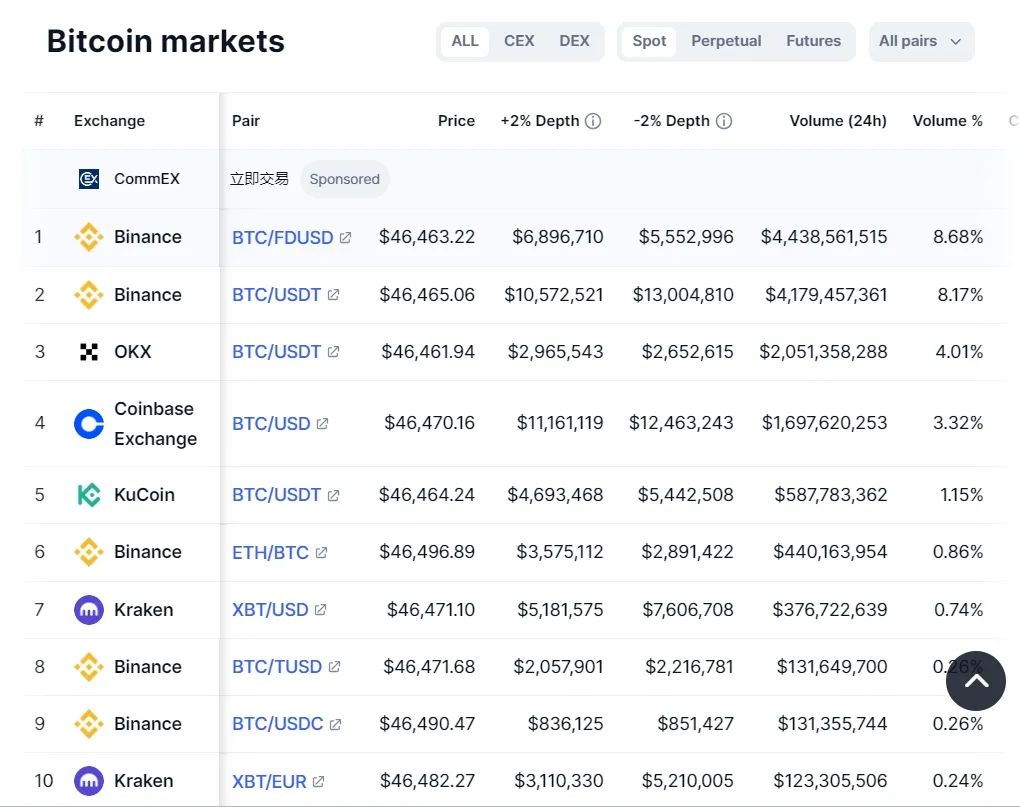
The primary risk of market manipulation in the BTC spot market stems from market makers or participants trading on centralized exchanges (CEXs). If U.S. regulators can extend oversight to these CEXs, they can relatively manage these risks.
To achieve this, U.S. regulators have enforced compliance frameworks on major crypto exchanges like Coinbase and Kraken, while also launching targeted enforcement actions against Binance—the largest exchange by trading volume—and successfully bringing it into the regulatory fold.
4. The Neutral SEC and the Cautious Gary Gensler
Thus, the SEC, acting neutrally, evaluates whether rule changes submitted by national securities exchanges comply with the Securities Exchange Act and its regulations, including whether they are designed to protect investors and the public interest. At 4 a.m. on January 11, 2024, the SEC approved 11 spot BTC ETFs: from Bitwise, Grayscale, Hashdex, BlackRock, Valkyrie, Invesco, Ark, VanEck, WisdomTree, Fidelity, and Franklin.
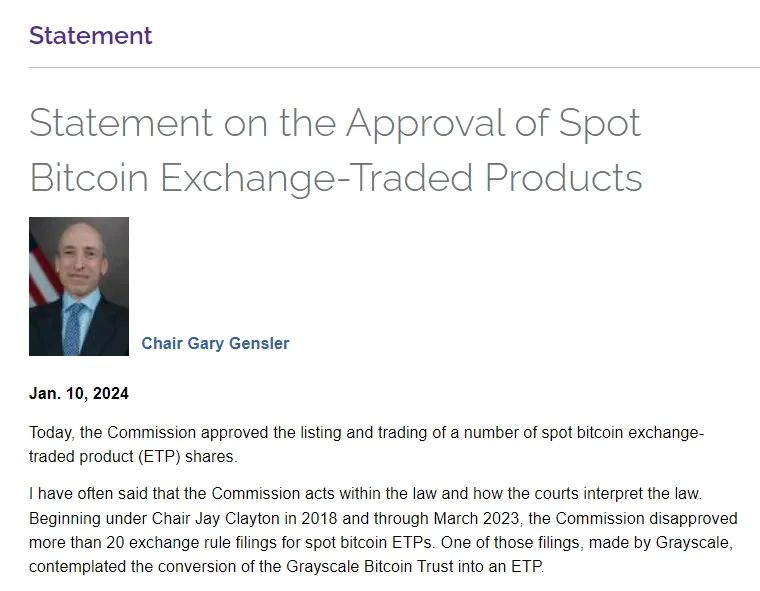
More importantly, the SEC emphasized in its press release:
Today’s approvals are limited to ETFs holding one non-security commodity, bitcoin. They should in no way be viewed as indicating the SEC’s willingness to approve listing standards for any other crypto asset securities. The approvals also do not reflect the SEC’s views on the status of other crypto assets under securities laws or on the current non-compliance of certain crypto market participants with those laws.
As I’ve said before, the vast majority of crypto assets are investment contracts and therefore subject to securities regulation.
While the SEC is neutral, I must note that underlying assets in precious metals ETFs have industrial and commercial uses, whereas BTC is primarily a speculative and volatile asset, often used in numerous illegal activities, including ransomware, money laundering, sanctions evasion, and terrorist financing.
Although the SEC today approved the listing and trading of spot BTC ETFs, we have neither endorsed nor approved bitcoin itself. Investors should remain cautious regarding BTC and crypto-related products.
5. The Pressure Is Now on Coinbase—to Define Crypto Assets
Gary Gensler’s message is clear: BTC is not a security, and market risks are manageable—hence approval. Other crypto assets are securities—that’s a separate issue entirely, unrelated to the BTC ETF approval.
Yet this still returns to the question that Gary Gensler has consistently avoided answering directly: Which crypto assets qualify as securities? This remains both a regulatory challenge concerning the three largest exchanges—Kraken, Coinbase, and Binance—and a political battle requiring responses from the U.S. judicial and legislative branches.

Coinbase has been at the forefront of challenging the SEC and now bears the responsibility. Judge Katherine Polk Failla, who presided over the Uniswap case, directly referred to ETH as a commodity (crypto commodity). Given that she is also overseeing the SEC v. Coinbase case, her response to whether crypto assets constitute securities—“This is not for the courts to decide, but for Congress”—has passed the ultimate question to the U.S. legislature.
However, the congressional legislative process will be lengthy, making the 2024 election year particularly significant.
6. GM BTC ETF
Regardless of how the SEC frames it, the approval of BTC ETFs is historically significant, allowing those of us who embrace crypto-punk ideals or dreams of overnight wealth to participate directly and add vivid color to the unfolding tide of history.
As Wang Chuan put it: “In retrospect, January 10, 2024 may stand alongside August 13, 1971 (when Nixon severed the dollar’s link to gold) and January 18, 1871 (when German unification led Europe and the U.S. into the gold standard system) as pivotal moments in monetary history.”

Join TechFlow official community to stay tuned
Telegram:https://t.me/TechFlowDaily
X (Twitter):https://x.com/TechFlowPost
X (Twitter) EN:https://x.com/BlockFlow_News
 0xWillmfer









