








Bankless on Bitcoin Inscriptions: Exploring NFT Innovation in Bitcoin
TechFlow Selected TechFlow Selected
Bankless on Bitcoin Inscriptions: Exploring NFT Innovation in Bitcoin
The development of Ordinals and their impact on Bitcoin and the crypto economy are both worth paying attention to.
 Navigating Web3 tides with focused insights
Author: Bankless
Translation: Luccy, BlockBeats
Editor's Note:
With the introduction of the Ordinals protocol, the Bitcoin ecosystem has undergone a revolutionary transformation. In this market cycle, Ordinals have not had a smooth journey—from their inception to Bitcoin Core developers threatening to "fix inscriptions," token prices have swung wildly between surges and crashes.
Challenges such as network congestion caused by inscription minting have sparked widespread debate about Bitcoin’s future direction. Bankless reviews the design principles and adoption of Ordinals, highlighting both the opportunities and risks facing the Bitcoin ecosystem when confronting these challenges. It argues that the development of the Ordinals space—and its impact on Bitcoin and the broader crypto economy—will be worth watching in the future. BlockBeats translates the full article below:
The core feature of the Ordinals system is the ability to engrave arbitrary data onto individual satoshis. This is why the term "inscription" has recently become synonymous with "Bitcoin NFTs" or "Ordinals-style NFTs."
This inscription process is completed by including data within Bitcoin transactions. Specifically, the data is placed in the transaction witness—a part of Bitcoin transactions that typically contains signatures and other authorization proofs.
The data inscribed can vary widely—from simple text to images, SVGs, or even HTML. Once a satoshi is inscribed with data and the transaction is mined, the inscription becomes permanent. Its security, immutability, and decentralization are equivalent to any other data on the Bitcoin blockchain. This means that once inscribed, a satoshi will forever carry its data and remain distinguishable from all other satoshis.
Furthermore, thanks to Ordinals theory, we can track the movement and ownership changes of an inscribed satoshi across different transactions and time periods. This enables us to trade, gift, or sell these inscribed satoshis just like any other Bitcoin transaction. However, special care (sat control) must be taken during transactions to ensure the correct transfer of a specific inscribed satoshi, since Bitcoin transactions generally do not distinguish between individual satoshis.
Ordinals On-Chain
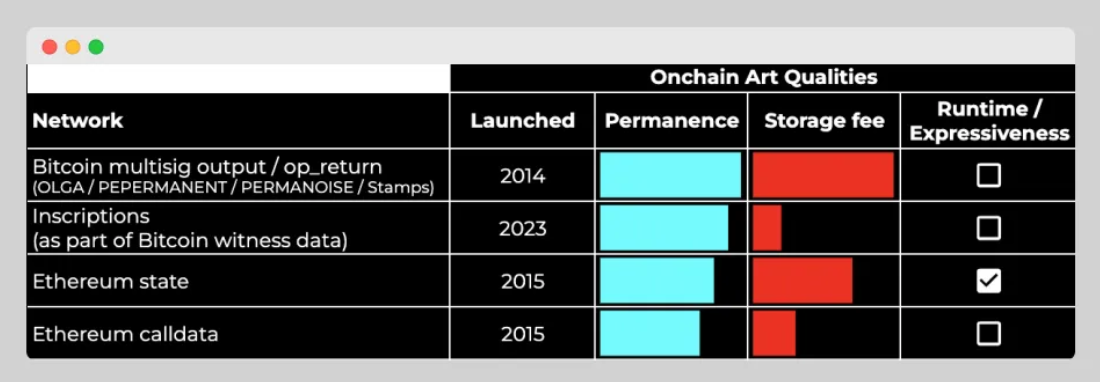
For flexibility and practicality, many Ethereum-based NFTs store their art and metadata off-chain—on networks like IPFS—rather than directly on Ethereum. This is due to Ethereum’s narrow data limits and high on-chain storage costs.
In contrast, every Ordinals mint is fully on-chain on Bitcoin, enabled by how data is stored within transactions, and at a significantly lower cost compared to on-chain Ethereum NFTs. While they lack advanced smart contract functionality, they currently offer the best balance of permanence and cost efficiency in the NFT space.
BRC-20
The Ordinals method has driven popularity in creating 1/1 NFTs and NFT collections on Bitcoin. However, atop Ordinals themselves emerged BRC-20—an experimental and unofficial fungible token standard built via inscriptions.
BRC-20 tokens are not smart contract-based like Ethereum’s ERC-20, nor are they fully fungible. They are created by inscribing fragments of JavaScript Object Notation (JSON) text into Bitcoin NFTs. This JSON contains basic token information such as maximum supply and ticker symbol. For transfers or trades, additional NFTs are inscribed to batch-track balance adjustments—e.g., 100 tokens, 500 tokens, 1,000 tokens, etc.
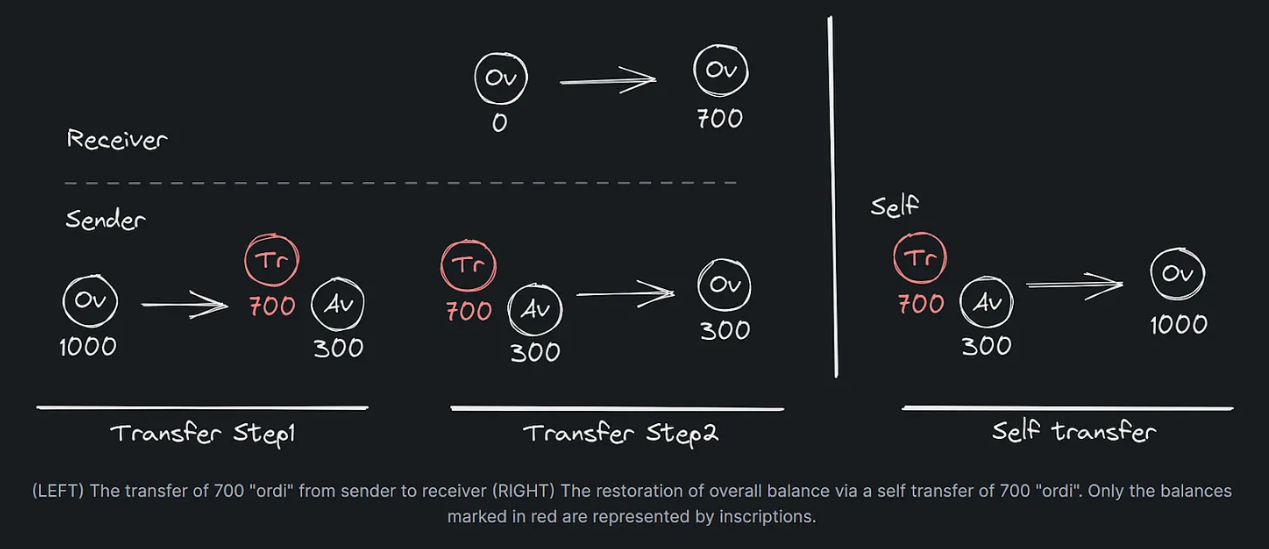
In recent months, BRC-20 tokens have rapidly risen in popularity, with $ORDI becoming the first token in the crypto economy to surpass a $1 billion market cap.
Rare Sats
Rare Sats, ignited by the Ordinals protocol, introduce a new layer of perception to satoshis.
At the heart of understanding Rare Sats is the Rodarmor Rarity Index, named after Casey Rodarmor, the founder of Ordinals. This index categorizes satoshis based on their uniqueness and scarcity. Categories range from the common—which make up most of Bitcoin’s supply—to the mythical, which includes the very first satoshi mined in Bitcoin’s genesis block.
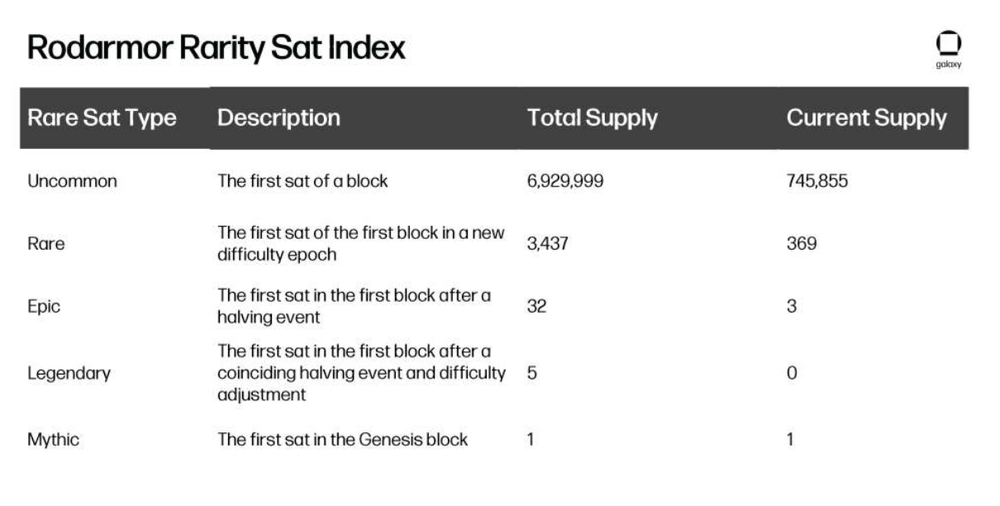
The index also identifies other notable categories such as uncommon, rare, epic, and legendary sats, each with unique characteristics and maximum supplies, often tied to key moments in Bitcoin’s timeline—such as mining difficulty adjustments and halving events.
Beyond these categories, there are other uniquely significant satoshis, such as Pizza Sats, Palindrome Sats, and Block 9 Sats, each commemorating special moments or patterns in Bitcoin’s history. For example, Pizza Sats honor Bitcoin’s first known real-world purchase, while Palindrome Sats feature captivating numerical symmetry.
Growing fascination with Rare Sats has given rise to the practice of "Sat Hunting," transforming ordinary satoshis into sought-after collectibles and creating one of the newest niches within the NFT ecosystem.
Top Ordinals Markets and Wallets
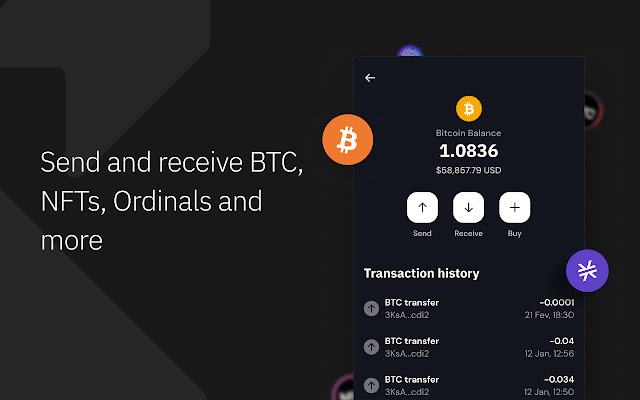
To create and transfer Ordinals and BRC-20 tokens, you need a wallet capable of recognizing and managing inscribed satoshis. Some wallets gaining popularity in this space include:
-
Xverse——"Bitcoin wallet for everyone"
-
Leather——"Enter the Bitcoin economy"
-
OKX——"Your Web3 gateway"
Once you’ve set up your wallet, you can start exploring popular Ordinals markets to see if any NFT listings or BRC-20 tokens catch your eye. Among the largest platforms are OKX’s Ordinals Market, Magic Eden, and Gamma.
Ordinals Adoption
In 2023, following Casey Rodarmor’s introduction of the Ordinals protocol, the Bitcoin community began grappling with a surge in Bitcoin NFT minting—a method that transforms individual satoshis (the smallest denomination of Bitcoin) into non-fungible digital artifacts.
Notably, the Ordinals protocol drew ridicule from some "old guard" Bitcoin purists—a reaction strikingly similar to how these same individuals dismissed Counterparty-based Bitcoin NFTs as spam back in 2014. Their argument remains that Bitcoin should only ever be used for payments.
In contrast, veterans from Counterparty and a new generation of creative experimenters believe the Ordinals approach could revolutionize Bitcoin’s NFT landscape. Most importantly, these new NFTs are boosting transaction fee revenue for Bitcoin miners, offering an alternative path as block rewards gradually decline.
Zooming Out
The introduction of Ordinals has not only diversified Bitcoin’s use cases but also sparked debates about Bitcoin’s fundamental nature. While some traditionalists advocate preserving Bitcoin’s original purpose as a payment system, a growing number view these developments as a natural evolution of the network’s capabilities—opening new avenues for creativity and financial opportunity.
By enabling diverse types of data to be stored on-chain at relatively low cost, the Ordinals protocol has proven to be a legitimate disruptor in the NFT space. It challenges preconceived notions of what’s possible on the Bitcoin blockchain, extending its utility beyond simple monetary transactions.
However, this innovation is not without challenges. The surge in Bitcoin NFTs—especially the popularity of BRC-20 tokens and the practice of "Sat Hunting"—has exacerbated network congestion. This phenomenon has raised concerns about the scalability and efficiency of Bitcoin L1 as it ventures into new territory involving digital asset creation and management.
Looking ahead, ongoing discussions around network congestion, transaction fees, and the role of NFTs in the Bitcoin ecosystem will likely shape the network’s future trajectory. Therefore, the evolution of the Ordinals space—and its impact on Bitcoin and the broader crypto economy—remains highly worth watching.
Join TechFlow official community to stay tuned
Telegram:https://t.me/TechFlowDaily
X (Twitter):https://x.com/TechFlowPost
X (Twitter) EN:https://x.com/BlockFlow_News
 Bankless









