









SEC Blunder Shocks $1.7 Trillion Market
TechFlow Selected TechFlow Selected
SEC Blunder Shocks $1.7 Trillion Market
2024's first major blunder!
 Navigating Web3 tides with focused insights
Author: Qin Jin
The U.S. SEC created the first major blunder of 2024.
In the early hours of January 10, Beijing time, the U.S. Securities and Exchange Commission (SEC) posted on social media platform X stating, "Today the U.S. Securities and Exchange Commission has approved Bitcoin ETFs for listing on all registered national securities exchanges. The approved Bitcoin ETFs will be subject to ongoing supervision and compliance measures to ensure continued investor protection."
The message quickly became headline news across social media. Prominent influencers and major financial media outlets rapidly followed up with reports and reposts, sending shockwaves through the entire $1.7 trillion crypto market.
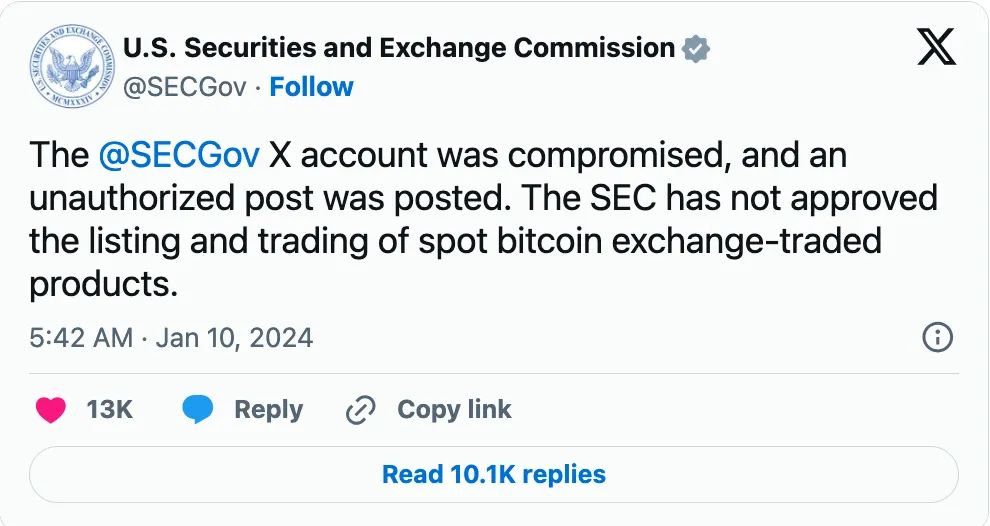
But no one expected that the official announcement from the U.S. SEC was actually false. The SEC later clarified on X that its account had been compromised and an unauthorized post published. The U.S. SEC has not yet approved the listing or trading of spot Bitcoin ETF products.
Following the incident, BTC briefly surged past $48,000 before rapidly falling back to around $44,600, registering a 24-hour drop of 1.81%. According to Coinglass data, total liquidations across the market reached $226 million in the past 24 hours, including $147 million in long positions and $79.53 million in short positions.
After the breach, U.S. Securities and Exchange Commission Chairman Gary Gensler was labeled by cryptocurrency enthusiasts and Wall Street executives as a foolish bureaucrat. Edward Snowden, the well-known national security whistleblower, wrote on social media: "God, Gary, get it together." In a subsequent article, Snowden added: "You have only one job." Snowden, wanted by the U.S. for espionage charges, currently resides in Russia.
According to Fox Business News, aside from regulatory implications, this event is one of the most embarrassing incidents the U.S. SEC has faced in recent years. The SEC had been preparing to announce the approval of spot Bitcoin ETFs on Wednesday—an event symbolizing maturity for the $1.7 trillion cryptocurrency market. Once approved, cryptocurrencies could become accessible to millions of retail investors. ETFs would track Bitcoin’s daily price, allowing small investors to buy and trade ETF shares on major securities exchanges for the first time in history.
Although the SEC claims to be a victim of this chaos, securities lawyers say the circumstances surrounding the fake announcement—and the resulting wild swings in Bitcoin—should prompt an investigation into the commission itself.
Technically, Bitcoin is classified as a commodity and therefore falls directly under the jurisdiction of the Commodity Futures Trading Commission (CFTC). However, securities lawyers note that in recent years the SEC has blurred the boundaries of its responsibilities, especially regarding cryptocurrency enforcement. Many argue that if a Wall Street firm or crypto company suffered a hack of this nature, SEC staff would already have been demanding answers.
Beyond potential market manipulation, the SEC also adopted new rules in July targeting so-called "cybersecurity risk management" for regulated entities. These rules require registrants to disclose material cybersecurity incidents and important information about their cybersecurity risk management strategies and governance.
"They must investigate this matter because the movement in Bitcoin was so significant—it's inevitable," a securities lawyer told Fox Business. "Given the substantial change in Bitcoin’s price, registered broker-dealers must file documents with the commission. Moreover, the SEC itself violated its own cybersecurity rules. I’ve never seen anything like this."
At the time of this scam, investors were eagerly awaiting the SEC’s decision on as many as ten Bitcoin ETF applications, including those from BlackRock, Ark Invest, Grayscale, and WisdomTree.
Fox Business noted that critics of cryptocurrency have long argued the asset class is prone to manipulation and used for illegal activities due to lack of regulation. For example, Dennis Kelleher, a former senior Senate staffer and critic, said that anyone who still believes there are no speculators, predators, fraudsters, and criminals in the Bitcoin market should now be convinced by today's market manipulation and the forged @SECGov "approval" tweet. While facts remain unclear, he added, a $22 billion market swing equals massive illicit gains.
The U.S. SEC’s Response
U.S. Securities and Exchange Commission Chairman Gary Gensler responded to the false message, stating that the SEC's Twitter account was hacked and an unauthorized tweet was posted. The U.S. Securities and Exchange Commission has not approved the listing or trading of spot Bitcoin ETF products.
The U.S. Securities and Exchange Commission (SEC) said it is cooperating with law enforcement to investigate the cyberattack. The agency also stated that an “unknown party” accessed the SEC’s X account, and that unauthorized access has since been terminated. Additionally, the X platform said it is investigating the cause of the SEC account breach.
The error made by the SEC due to the account breach has turned it into a target of ridicule on social media.
U.S. Senator Bill Hagerty responded to Gary Gensler on social media, saying that just as the SEC would hold a public company accountable for a major market-impacting mistake, Congress needs an explanation for what happened. "This is unacceptable," he said.
Adding fuel to the fire, crypto artist Billy Restey inscribed the tweet "Gary Gensler responds to spot ETF approval being false" as an Ordinals NFT archive. He said, "This tweet has now been recorded on the Bitcoin blockchain, and none of us will ever forget it."
The crypto market experienced a false alarm.
Eric Balchunas, senior ETF analyst at Bloomberg who has closely tracked spot Bitcoin ETF developments, posted on X that the SEC is expected to announce approval of a spot Bitcoin ETF between 4:00 PM and 5:00 PM Eastern Time on Wednesday (5:00 AM to 6:00 AM Beijing time Thursday), with product launches expected the following day locally.
Approval Still Expected
Bloomberg ETF analyst Eric Balchunas said that although clues point to the SEC’s official account being hacked, he leans toward believing the false "SEC approved" message originated internally—possibly a "planned tweet drafted by an SEC employee but accidentally scheduled for the wrong date."
He believes it would make perfect sense for such a tweet to be published at this time tomorrow. "To me, the wording sounds exactly like legitimate SEC language—not something a prankster would write. I think we’ll see it," he said.
Standard Chartered analysts recently predicted that if the U.S. SEC approves a spot Bitcoin ETF, inflows could exceed $1 billion within the first three months and surpass $100 billion by year-end. The bank previously forecasted Bitcoin could reach $100,000 by the end of the year.
According to Standard Chartered’s New York precious metals analysts, gold ETPs saw prices rise 4.3 times over seven to eight years following their launch.
Standard Chartered expects Bitcoin’s price trajectory post-ETF approval to follow a similar pattern, though the surge could occur over a much shorter timeframe—one to two years—due to faster development in the Bitcoin ETF market.
Standard Chartered stated that if ETF-related capital inflows materialize as expected, Bitcoin could approach $200,000 by the end of 2025. By the end of 2024, U.S. spot Bitcoin ETFs are projected to hold between 437,000 and 1.32 million newly issued Bitcoins—worth approximately $50 billion to $100 billion.
Join TechFlow official community to stay tuned
Telegram:https://t.me/TechFlowDaily
X (Twitter):https://x.com/TechFlowPost
X (Twitter) EN:https://x.com/BlockFlow_News










