








Bitcoin Spot ETF Approval Countdown: One Day to Go — The U.S. Won't Let Go Easily
TechFlow Selected TechFlow Selected
Bitcoin Spot ETF Approval Countdown: One Day to Go — The U.S. Won't Let Go Easily
The U.S. will not easily relinquish the pricing power originating from Wall Street; ETF approvals will bring a compounding effect to this pricing power.
 Navigating Web3 tides with focused insights
Author: Hedy Bi, OKG Research

One day before the approval of spot Bitcoin ETF applications, SEC Chair Gary Gensler posted a warning on X about the risks associated with digital assets. This statement was interpreted by the market as increasing the likelihood of approval, pushing Bitcoin's price above $47,000 this morning.

Source: Bloomberg
Market enthusiasm is not only high but applicants are also making thorough preparations. ARK Invest (ARK), the asset management firm founded by Catherine Wood, will be the first applicant to receive a final response from the SEC regarding its spot Bitcoin ETF application. At the end of last year, ARK sold all remaining GBTC positions and used half of the approximately $100 million proceeds to purchase BITO ("potentially as a liquidity transition tool to maintain Bitcoin beta") and integrate it into ARKW (ARK Next Generation Internet ETF) or ARKB (Ark 21Shares Bitcoin ETF, ARK’s pending spot Bitcoin ETF). Market participants are poised for action—SEC approval of a spot Bitcoin ETF would mark the end of a decade-long struggle since institutions first began applying in 2013.
Wall Street's bargaining power won't be easily relinquished; ETF approval would amplify U.S. influence
If spot ETFs are approved, mutual funds, hedge funds, and individual investors could participate in the crypto market through traditional stock exchanges just like buying stocks, directly holding Bitcoin and removing compliance barriers. The immediate capital inflow effect is only one aspect; more importantly, the U.S. would strengthen its pricing power in the crypto market and become an industry rule-setter.
As Bitcoin mining hash rate shifts from China to the U.S., American miners now control 40% of global hash rate—the largest share worldwide—meaning the U.S. already holds significant supply-side leverage.

Figure: Global Bitcoin Hash Rate Distribution
Source: worldpopulationreview.com
ETF approval would require institutional holdings and trading data disclosure, enhancing market transparency for regulators and participants. With such information, regulators can better supervise market activities and reduce risks of manipulation and fraud. To illustrate, while blockchain allows easy tracing, tracking, and verification of “each water droplet,” regulating every single transaction individually is extremely difficult for authorities. But if these droplets are collected in glass containers—with regulatory requirements imposed on each "container"—regulators can establish rules and oversight far more effectively.
For the U.S., ETF approval would solidify its role as rule-maker and market leader in the crypto space. Regardless of whether spot Bitcoin ETFs are approved, the U.S. will not easily give up this substantial advantage.
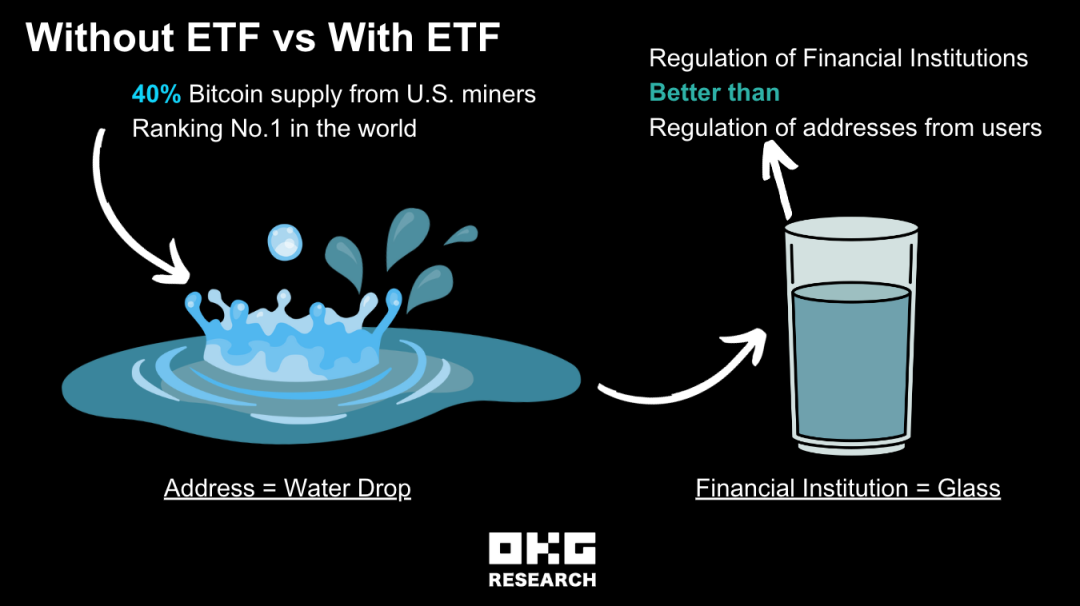
Figure: OKG Research - With ETF Compliance Channel vs. Without ETF Compliance Channel
Moreover, anticipation around spot Bitcoin ETFs has visibly impacted the supply side: mining competition is intensifying. According to OKLink data analysis by OKG Research, hash rate has grown at an average monthly rate of 5.17% over the past three months—significantly higher than the 1.76% average growth rate during the same period last year—indicating much fiercer competition among miners (on the supply side).
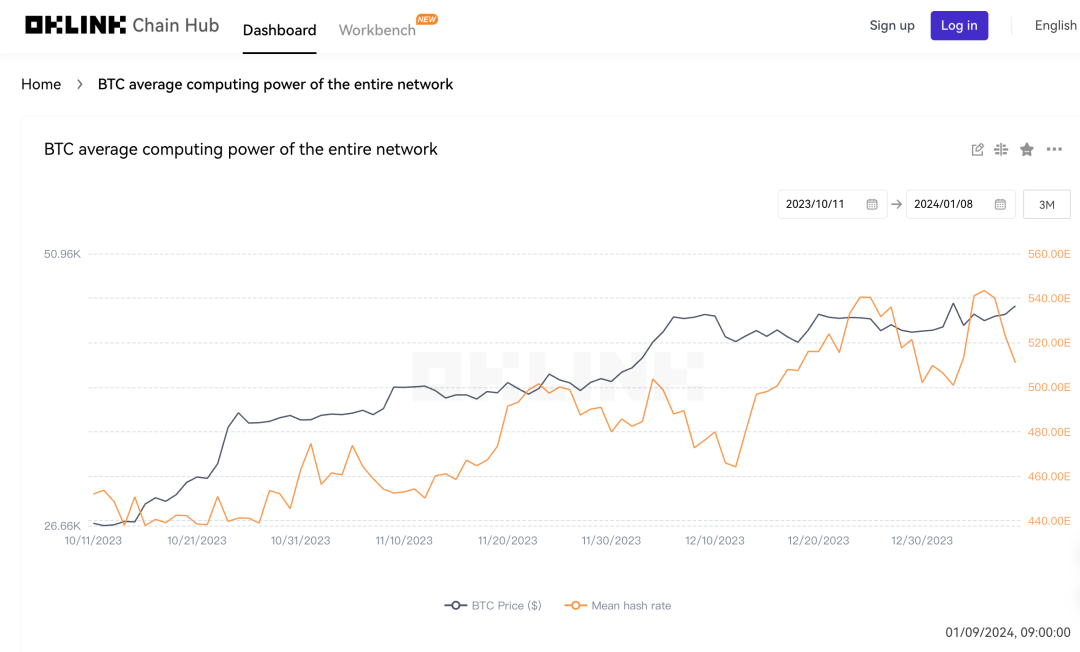
Figure: Bitcoin Hash Rate
Source: OKLink
From an operational cost perspective, OKLink data shows that miner revenue per unit of hash power has declined steadily by 8% over the past three months (Figure 2), while overall monthly revenue increased slightly at an average rate of 1.55%. Despite falling per-unit profitability, miners continue selling Bitcoin to cover operating costs.
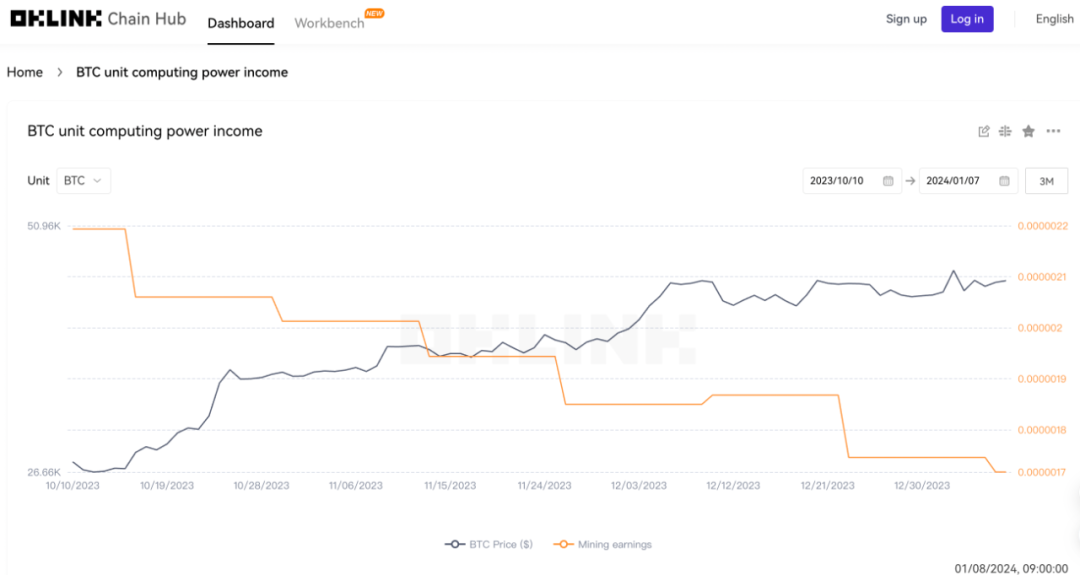
Figure: Bitcoin Miner Revenue per Unit Hash Power
Source: OKLink
New markets preparing to launch, existing participants remain steadfast
Although the ETF news has long been anticipated, OKLink on-chain data reveals differences based on timing and risk appetite: New investors are more willing to bear the opportunity cost of waiting for compliant, convenient access channels, foregoing potential early gains from direct on-chain holdings. In contrast, existing market participants—long-term holders, Bitcoin advocates, and institutions that backed Bitcoin early—continue focusing on its long-term value.
Some early institutional supporters have already participated via alternative routes—for example, ARK sold all remaining GBTC stakes and allocated funds to BITO (Bitcoin Strategy ETF, which invests in Bitcoin futures rather than physical Bitcoin). Grayscale is also seeking to convert GBTC into an ETF. These players tend to focus on Bitcoin’s fundamentals, technological development, and market demand, remaining relatively unaffected by short-term volatility or ETF approval rumors.
According to OKLink on-chain data from OKG Research, these developments haven’t significantly heated up on-chain activity. Over the past three months (October 10 to January 7), the total number of Bitcoin (BTC) addresses grew linearly, with an average monthly increase of 1.16%, matching last year’s growth rate.
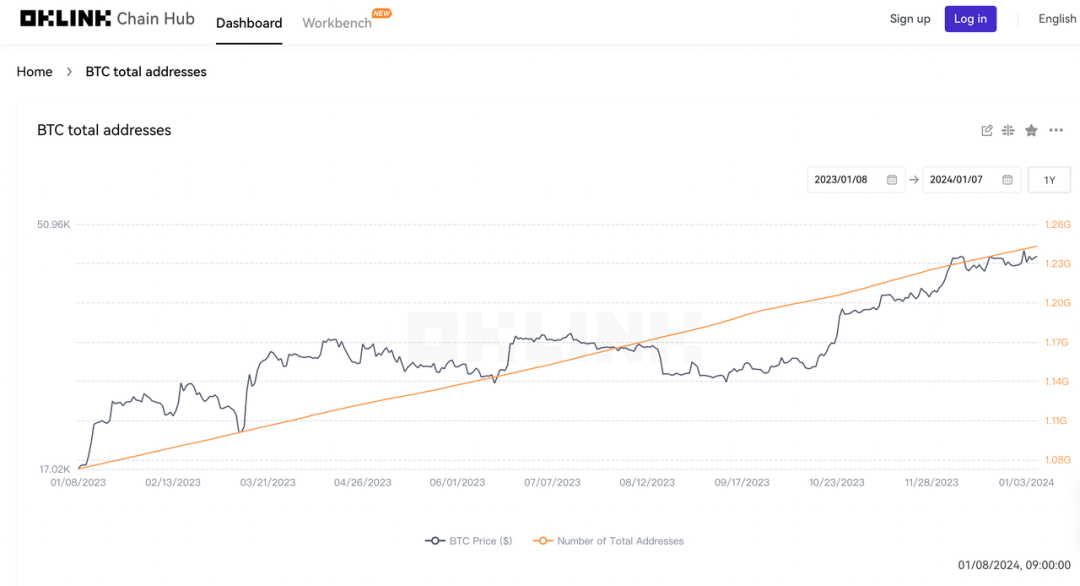
Figure: Total Number of Addresses in the Bitcoin Ecosystem
Source: OKLink
Additionally, observing active address counts reveals peaks did not coincide with Bitcoin ETF-related news, but rather occurred in December 2017 and March 2021.
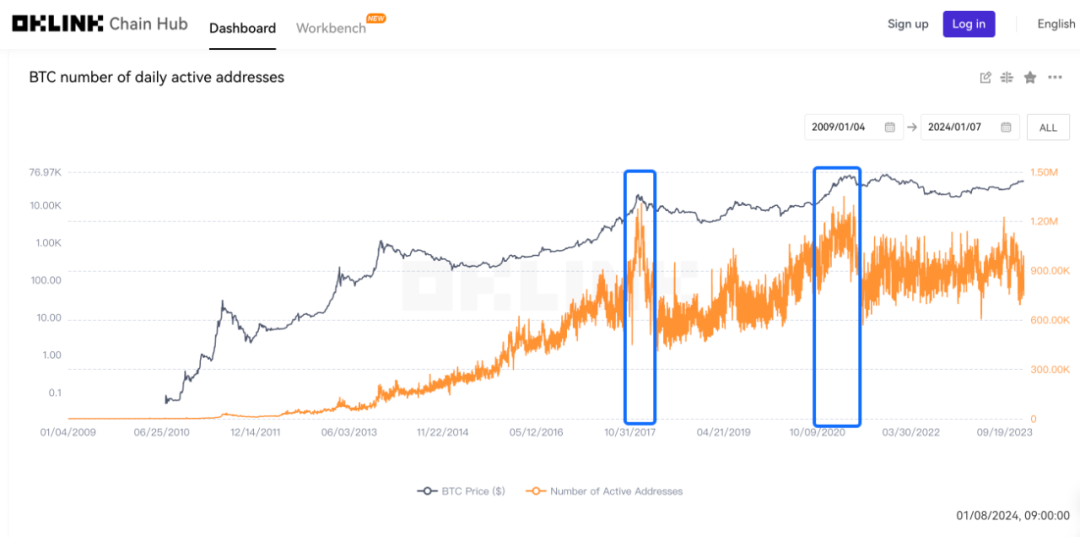
Figure: Daily Active Bitcoin Addresses
Source: OKLink
Blooming prosperity: The era of unregulated growth is gone

“Are you ready to start anew?”
Even if the U.S. does not approve spot Bitcoin ETFs, the market will never return to the “wild west” era. According to CoinGecko, eight markets globally currently allow spot cryptocurrency ETFs, including Canada, Germany, Switzerland, and tax havens like the Cayman Islands and Jersey. Yet none have generated the same level of excitement as the anticipation surrounding U.S. ETF approval—further underscoring the powerful combined impact of打通 both supply and distribution channels controlled by the U.S.
While the U.S. ETF narrative remains uncertain, Hong Kong took decisive steps in 2023. On December 22, 2023, the SFC issued multiple circulars stating it was “ready to accept authorization applications for spot virtual asset ETFs.” Taking Hong Kong as an example, according to KPMG’s 2023 Private Wealth Management Report, private banking and wealth management AUM in Hong Kong reached HK$8.965 trillion by the end of 2022. If just 1% of that capital flows into spot Bitcoin ETFs, approximately $11.6 billion could enter the market.
According to OKG Research, several financial institutions are already planning to launch spot Bitcoin ETFs in the first half of this year. Such massive-scale competition will pressure the SEC not to easily reject well-prepared ETF applications.
Two key differences between Hong Kong and U.S. approaches to spot Bitcoin ETFs deserve attention:
-
In its December 22 circular, Hong Kong’s SFC indicated support for both cash and in-kind creation/redemption models, giving investors greater flexibility. The U.S. SEC mandates a cash-only approach, aiming to reduce market manipulation risks. Cash-based creation/redemption also indirectly controls Authorized Participants (APs) and compresses their risk-free arbitrage profit margins. If APs manipulate prices through operations across primary and secondary markets, market stability could be compromised. Conversely, in-kind redemption allows market makers to receive Bitcoin in exchange for ETF shares, improving tax efficiency. Financial institutions across the Pacific hope for diversified options—according to CBNC, Fidelity and BlackRock have sought approval for both cash and in-kind mechanisms to serve investors who already hold Bitcoin but seek convenience in trading and taxation.
-
Currently, eight Bitcoin ETF applications have been filed in the U.S., intending to list on Nasdaq, Cboe BZX, or NYSE Arca. Cboe BZX accounts for 5 out of 8 applications—the largest share. Unlike U.S. applicants targeting exchanges with prior experience in financial instruments, Hong Kong’s December 22 circular merely states that the SFC and HKMA have outlined conduct requirements for intermediaries distributing ETFs.
Should U.S. spot Bitcoin ETFs be approved and begin trading on one of the three designated platforms, this precedent would motivate HKEX to consider offering trading venues for spot Bitcoin ETFs issued by Hong Kong firms.

Figure: On December 22, SFC released multiple circulars
Source: SFC
Regardless of whether U.S. ETFs are approved tomorrow, time has moved forward—the “Westworld”-like era of crypto is gone forever. In 2024, the crypto market will undoubtedly be “in full bloom.”
Join TechFlow official community to stay tuned
Telegram:https://t.me/TechFlowDaily
X (Twitter):https://x.com/TechFlowPost
X (Twitter) EN:https://x.com/BlockFlow_News
 @OKGResearch









