









In 2024, who will be the savior of the metaverse?
TechFlow Selected TechFlow Selected
In 2024, who will be the savior of the metaverse?
Although the metaverse has cooled down, hardware upgrades will bring it a glimmer of hope.
 Navigating Web3 tides with focused insights
By Mu Mu
When the "first year of the metaverse" began, technology sought to digitize everything within a world built on 0s and 1s, drawing virtual extensions of time and space.
In Neal Stephenson's novels, a virtual city develops along a 100-meter-wide road, with electronic signs spreading across dimly lit blocks. People can enter this highly free and advanced city through VR headsets, purchase virtual land, and build structures.
Yet in 2023, the global influence of the metaverse concept plummeted. Whether looking at Google Trends, Baidu Index, or WeChat Index, searches for keywords like "Metaverse" or "元宇宙" show a cliff-like drop in popularity.
The metaverse truly entered the mainstream in 2021 when Facebook’s parent company rebranded itself as Meta. Capital and internet giants were the first to act—Roblox, a platform focused on game creation, became the first publicly traded “metaverse stock,” while Chinese tech giants such as Tencent, Alibaba, and Baidu all rushed into the space.
Dubbed the "3D Internet," the metaverse was almost equated with the "future world"—but within just two years, it was reduced back to an experimental concept. The vision was too grand; amid a global economic downturn, the metaverse was abandoned by capital and questioned by users before even taking shape. As artificial intelligence emerged as the new tech darling of 2023, the metaverse became capital’s discarded child, and Pico’s fourth-generation update faced an uncertain fate.
The difficulty in realizing the metaverse lies in its overly futuristic vision—it requires nearly every emerging technology: AR/VR (hardware and software), 5G (computing), AI (for virtual beings), blockchain (for economic systems), and more.
Meanwhile, the XR industry—the gateway to the metaverse—has seen no breakthroughs in nearly a decade. This has constrained social and entertainment activities in virtual spaces, rendering virtual humans, NFT virtual goods, and virtual venues ineffective within the metaverse.
Despite this, some true believers continue building. While Meta shut down its Metaverse Spaces for efficiency, it simultaneously released the Meta Quest 3 headset to keep upgrading hardware. Apple is accelerating development of its spatial computing device, Vision Pro, with the first model expected to launch in January 2024. Samsung has restarted its XR hardware plans and is actively preparing new products.
Opening the channel—headset hardware in 2024 will be the faint ray of light piercing through the metaverse desert.
Bubble Bursts, Industry Under Pressure
The most renowned metaverse company is Meta, formerly Facebook's parent firm. It once planned to invest $70 billion over ten years fully into the metaverse. But in 2023, this company that literally renamed itself after the metaverse did not step into its envisioned future.
Last year, Meta shocked the industry with the “largest layoff in history,” cutting 11,000 employees, including projects in Reality Labs, its wearable devices division.
Underlying the layoffs was profitability. Amid the global economic downturn in 2023, Zuckerberg called it the “year of efficiency,” with the company proactively exiting underperforming or non-essential projects.
Meta’s financial report shows that in the first three quarters ending September 30, total revenue reached $94.791 billion, up 12% year-on-year. Meta’s revenue falls into two main parts: the Family of Apps, generating $93.666 billion (up 13% YoY), and Reality Labs, earning $825 million (down 42% YoY).
Meta executives noted that in the first nine months of the year, Reality Labs reduced the company’s overall operating profit by approximately $11.47 billion, and they expect the division’s operating losses to increase significantly in 2024.
With cost-cutting and efficiency now Meta’s top priorities, parts of its metaverse plans have been paused. Back when Meta first entered the metaverse, the sector was white-hot both domestically and internationally.
In 2021, gaming platform Roblox became the first metaverse IPO, with its stock surging 54.4% on its debut day. Within a year, its market cap soared from $4 billion to $45 billion. Japanese social gaming giant GREE announced its entry into the metaverse business. Microsoft unveiled its enterprise metaverse solutions at the Inspire Global Partner Conference.
In China, ByteDance invested heavily to acquire Pico (Xiaoniao Kan Kan), a Chinese VR startup. Alibaba, Baidu, and others also rushed into the metaverse, fearing they’d miss the next big wave.
Today, searching for “metaverse” reveals flatlining interest curves.
 Sharp decline in metaverse search interest (via Google Search)
After Meta pulled back, companies worldwide began retreating from the metaverse race.
Meta initially planned to produce 7 million Quest 3 units in the second half of 2023 but has since revised that to between 2 and 2.5 million. For 2024, Meta expects shipments to drop further to 1 million units.
Two years after being acquired by ByteDance, Pico underwent major contraction, shrinking its team from 2,000 to around 1,000 people. According to IDC data for the first half of 2023, Pico maintained nearly 60% market share in China over the past two years, but in terms of business scale, it contributed little to ByteDance. Earlier this year, Pico cut its annual sales target to 500,000 units—half of last year’s goal.
In 2023, Tencent effectively disbanded its XR team, announcing a shift in hardware strategy, while Xu Chen, head of XR content ecosystem, left the company. Qiyi’s VR subsidiary, Mengxiang Zhanfang, was reported to be in operational crisis, with about 100 current and former employees unpaid, and operations largely halted.
The entire industry is feeling the pressure of the burst metaverse bubble.
Virtual Worlds Turn Into Ghost Towns
Poor hardware sales have left metaverse platforms half-dead.
In 2022, Meta launched Horizon Worlds, marking its first real step toward making the metaverse a reality. However, the internal experience fell far short of the polished preview videos. Three months after launch, monthly active users numbered only 300,000.
Last year, a netizen leaked that Horizon Worlds had only 38 actual users. A YouTuber’s field investigation found the situation not quite that dire—but still far from optimistic. Daily active users likely number around 1,000. When he tallied players across the Top 20 popular virtual worlds, the total came to just 902.
 Horizon Worlds’ avatars were mocked for their simplistic design
Players being “rarer than endangered species” accurately describes today’s metaverse platforms.
Facing this dilemma, Microsoft announced in January 2023 it would shut down its 3D social VR platform AltspaceVR to cut costs. It also canceled several other VR initiatives and laid off 10,000 employees. AltspaceVR officially shut down on March 10, 2023.
Domestic Chinese metaverse platforms have fared no better.
Baidu’s Xi-Rang remains a dull product where users can only wander aimlessly. Recently, Xi-Rang introduced a lightweight mini-program entrance, allowing access via WeChat or Baidu mini-programs without downloading an app, plus one-click sharing. But regardless of updates, the core issue remains: this so-called metaverse platform fails to deliver immersion, reducing users to “running maps” while staring at phone screens.
Beyond Xi-Rang, platforms like Moutai’s Xunfeng and Jay Chou’s music space lack both gameplay and immersive experiences. Virtual spaces confined to phone or computer screens quickly turn into ghost towns after brief moments of hype.
Why are headset-compatible platforms like Horizon Worlds and AltspaceVR failing? One netizen put it bluntly: “Without a headset, you can’t experience anything. But with one, you realize it’s worse than not experiencing it at all.”
The metaverse’s software and hardware are completely disconnected.
Hardware Upgrades on the Horizon
When the concept was hot, capital flooded in, and companies raced to claim their share. But after numerous virtual spaces and games were created, people realized the “key” to entering this virtual world lagged far behind their metaverse dreams.
VR headsets remain bulky, with scarce high-quality content. AR devices may be sleek, but for average users, they’re limited to watching films or playing games on virtual large screens. Not only do AR/VR devices fail to achieve the high realism and interconnectivity promised by the metaverse vision, their price tags—often thousands of dollars—raise concerns about becoming expensive paperweights.
Matthew Ball, dubbed the “father of metaverse commerce,” pointed out that the foundation of the metaverse is interoperability—exchanging data across autonomous systems. While XR technology has made significant progress, many technical bottlenecks remain before achieving highly realistic virtual experiences.
After years of effort since 2021, companies investing in the metaverse have come to realize that hardware is the unavoidable hurdle on this path.
Thus, a turning point has emerged. On this long, costly journey, some companies chose strategic retreats focused on self-preservation—like Pico. Others stepped forward, aiming to disrupt the market—such as Apple with Vision Pro.
Apple CEO Tim Cook describes Vision Pro as a “spatial computer”—a key distinction from VR devices like Quest 3 or Pico. Its revolutionary experience, powered by cameras and sensors, integrates familiar iOS apps directly into the user’s real-time environment. Operations require no controllers—just eye movements and hand gestures.
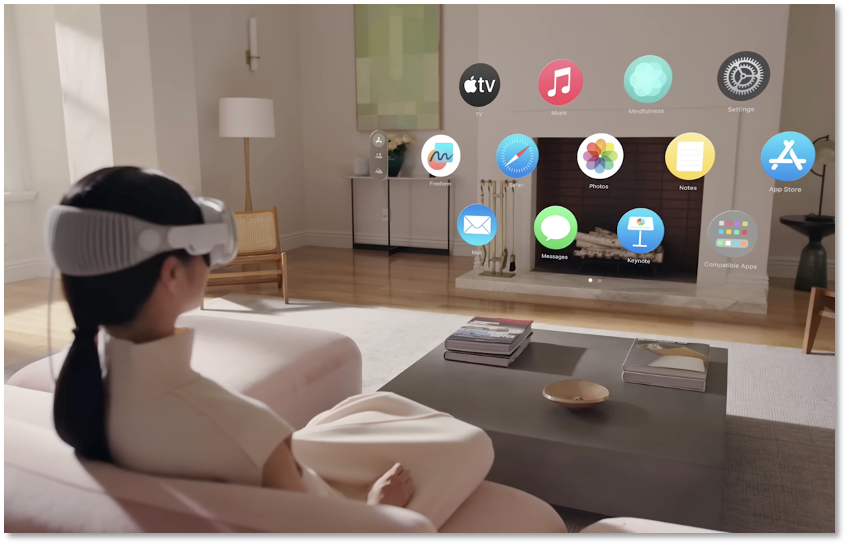 iOS apps float in space with Vision Pro
For example, icons from iPhones or Macs can float in space when wearing Vision Pro, operated via eyes and gestures. Giant virtual movie screens appear before your eyes. Disney parks are brought to life beside you—Mickey Mouse chats with you on the sofa… It integrates gaming, work, and leisure, enabling office tasks and entertainment within virtual space.
Vision Pro is a headset that fundamentally blurs the boundary between virtual and real. Scheduled for initial release in North America this month, it is expected to enter the Chinese market by late 2024 or early 2025. Its second generation is already in development.
This product could redefine the standard for metaverse hardware. Under pressure from Apple’s flagship, Meta and Samsung may also accelerate their own iterations. CICC Research predicts Vision Pro’s user experience could exceed market expectations, driving component innovations—such as silicon-based OLED and IPD interpupillary distance adjustment—and reigniting growth in VR shipments.
In 2024, while the metaverse may be cooling down, upcoming hardware upgrades will bring a glimmer of hope.
Join TechFlow official community to stay tuned
Telegram:https://t.me/TechFlowDaily
X (Twitter):https://x.com/TechFlowPost
X (Twitter) EN:https://x.com/BlockFlow_News










