








Bankless' key crypto themes to watch this year: LRT, DA wars, and parallel EVM
TechFlow Selected TechFlow Selected
Bankless' key crypto themes to watch this year: LRT, DA wars, and parallel EVM
It's time to focus on some key investment themes that are poised to shape the new year.
 Navigating Web3 tides with focused insights
Author: David Hoffman
Translation: Luccy, BlockBeats
Editor's Note: David Hoffman, co-owner of Bankless, outlines six meta-themes to watch during the 2024 bull market, including liquid restaking tokens (LRT), Solana’s development, the gaming ecosystem Immutable and its IMX token, the DA war, Monad—a project dedicated to parallelizing the EVM—and retroactive airdrops. BlockBeats translates the original article as follows:
At the beginning of 2023, our industry faced some of the most pessimistic sentiment ever seen, yet it ended with one of the most optimistic landscapes we’ve witnessed to date.
As we enter the 2024 bull market with renewed energy, it’s time to focus on key investment themes that will shape the new year. Stay ahead by understanding these six narrative meta-themes that will dominate in the coming months!
Restaking and Liquid Restaking Tokens (LRT)
The restaking meta-theme is already gaining massive momentum—even before EigenLayer officially launches. Over $1 billion has already been deposited into EigenLayer contracts, and competition to become a key player in the EigenLayer ecosystem is heating up.
Thus, the liquidity staking token (LST) wars are about to restart—but this time, it will be the LRT war. Liquid restaking tokens will offer all the yield from native ETH staking plus additional returns generated through restaking across networks. Why settle for 5% LST yields when people can earn even more via LRTs?
You might ask—what exactly are LRTs? They’re like LSTs, but their yield includes returns from EigenLayer. EigenLayer supports AVSs (Actively Validated Services)—networks built atop EigenLayer—that generate rewards or fees for those who restake ETH. Restakers may participate in multiple AVSs simultaneously to maximize productivity and boost returns on their staked ETH.
For users like me—who aren’t technically inclined but know others can do better—services that securely and efficiently perform this task will hold significant value. This is where LRTs come in. LRT protocols aggregate user deposits, restake them via EigenLayer, capture all resulting yield, and pass it back to depositors.
This is fantastic. Beyond basic utility, however, I believe one reason the LRT boom will take off in 2024 is because the latest wave of airdrop narratives has already begun. Amid this surge of interest and activity, LRT projects have become "double-dip," two-for-one airdrop hunting opportunities. For example, Swell is currently offering their “Pearls,” which I believe act as placeholder points for a future Swell token, layered on top of EigenLayer points—which themselves may also be placeholders.
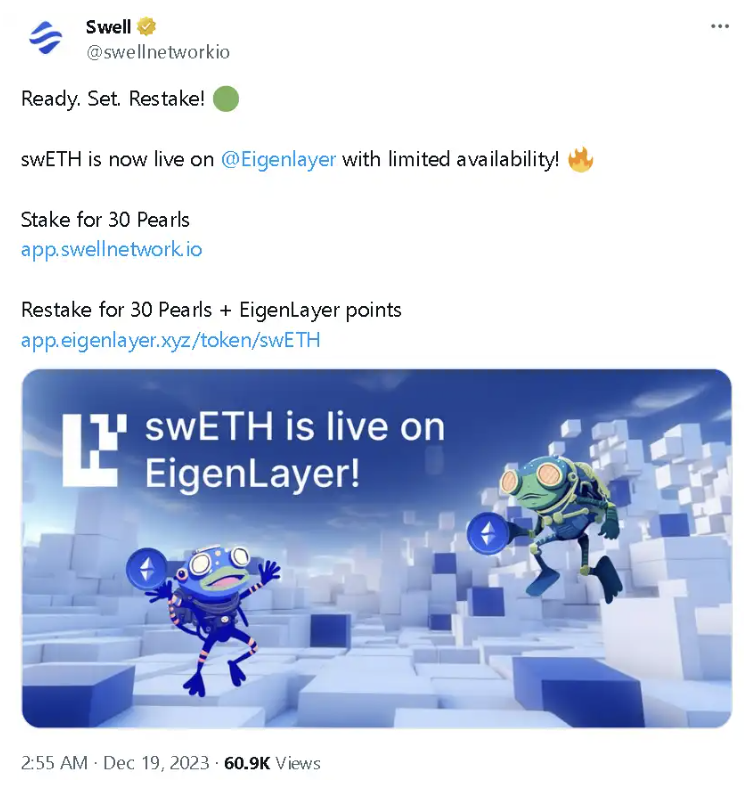
Frankly, I think EigenLayer could become one of the largest airdrops ever. The race to become Ethereum’s dominant LRT token will be just as fierce as the earlier battle for dominance among LSTs.
Admittedly, I’m not familiar with every LRT strategy currently pursued by existing teams. Here, I’ll leave due diligence to you. However, there are two projects I’m closely watching due to my connections—as an angel investor or through Bankless Ventures—these are Puffer and Swell, mentioned earlier.
Notably, Puffer holds a unique advantage through its collaboration with SGX, providing extra slashing protection as an additional defense layer against capital loss. Combined with Puffer’s work with Justin Drake on smooth commitment and Andrew Miller from Flashbots on remote attestation, the project unlocks efficiencies and opportunities others may need to catch up to.
As for Swell, originally an LST project, they pivoted early to liquidity restaking upon seeing signs of opportunity. By the time EigenLayer opened deposits, Swell already had a head start. Today, Swell leads among LRT projects in EigenLayer deposits and ranks second in LST deposits, behind only Lido.
Still, several other projects in this space are worth watching, including Rio Network, EtherFi, Renzo Protocol, and Kelp DAO.
Solana
Has the current meta-narrative become “Bitcoin, Ethereum… and Solana”?
Solana is now generating massive buzz. That tends to happen when a token rises 900% in a single year. It’s drawing back venture capital and attention, while emboldening its community of prior believers.
Undoubtedly, Jito’s launch has recently triggered a version of Ethereum’s 2020 DeFi Summer on Solana. Now, it’s clear the network’s application layer is rising from the ashes of the 2022–2023 bear market.
With Solana’s SOL recently entering the top five crypto assets, everyone is watching whether Solana can fulfill what its biggest supporters believe it can: becoming the most likely home for breakout consumer crypto applications in the upcoming bull run.
Assuming Solana realizes its potential, it will need to attract novel founders building innovative applications—not just shinier versions of what Ethereum already offers. Solana must develop entirely new types of applications uniquely enabled by the network’s properties.
DePIN appears to be an early standout contender here. Still, I believe it’s too early to say if there’s real substance behind it. Regardless, this sector deserves close tracking.
Meanwhile, many tokenless Solana protocols still plan to airdrop tokens in 2024, meaning hype and attention around Solana will persist—at least until those distributions occur. Whether interest can remain high after Solana’s version of DeFi Summer ends remains to be seen.
Internally, Solana’s focus has shifted toward its economy. With some of its toughest technical challenges now behind it, the next low-hanging fruit is its native fee market and overall economic structure. Can Solana fix its economic model? Only time will tell—but its community feels more confident about its chances than ever before.
Gaming
Gaming seems the most reliable category for breakthrough crypto applications in the near future—mainly because we know many highly anticipated games are currently in development, with some launching in 2024.
If a game is fun, people will play it. If game developers know what they’re doing, they’ll thoughtfully introduce crypto elements where appropriate—without making them overwhelming. Gaming itself is a massive industry, and the distribution crypto can achieve through this channel is equally vast.
One of the best aspects of today’s crypto gaming industry is its shift away from explicitly targeting crypto-native players. Many new games are being built for crypto-agnostic audiences.
This shift brings us much closer to tapping into one of the world’s largest populations—there are currently about 3.2 billion gamers globally. If we can build a game that appeals to crypto-agnostic users, it could become crypto’s first true breakout, offering something valuable even to those who don’t care about crypto.
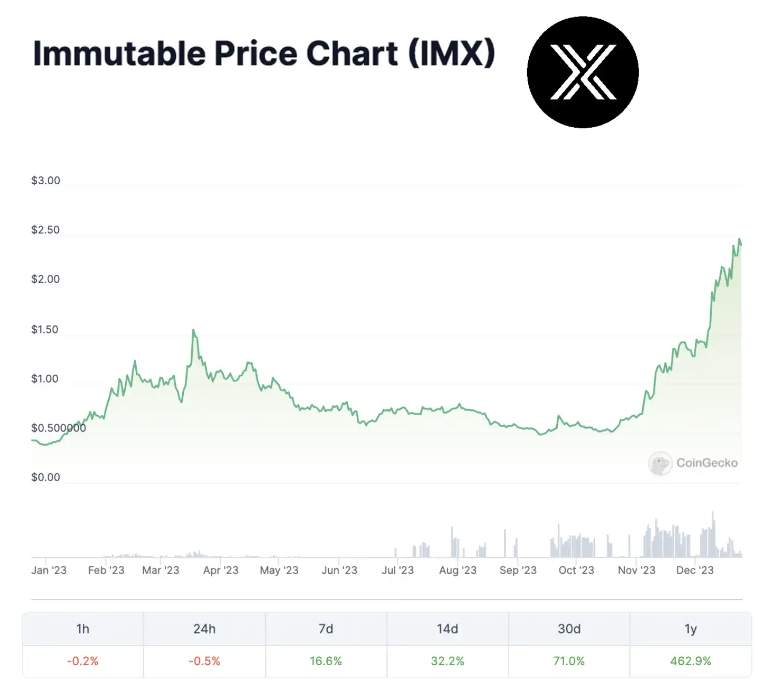
In the meantime, ecosystems like Immutable and its IMX token stand out as exciting examples. Immutable is developing a game-focused zkEVM chain built on Polygon, and it’s currently valued higher than Arbitrum!
The DA War
The data availability (DA) war has already begun—kicked off by the TIA airdrop, which launched at a $20 billion valuation and saw its chart rise further, with FDV climbing to $14 billion.
So why is everyone suddenly obsessed with data availability?
It’s fair to assume DA acts as Web3’s bandwidth layer. Cheap DA layers will transform crypto from slow and expensive to fast, cheap, and abundant—without sacrificing decentralization. In fact, DA is the primary bottleneck preventing chains from scaling in terms of resource costs and throughput. Therefore, whichever DA chain successfully meets these demands can expect long-term, sustainable value flows within the crypto economy.
I’m particularly watching the upcoming EigenDA—the first AVS to go live on EigenLayer—which will serve as the first source of additional yield for the LRT tokens I previously discussed.
EigenDA differs from Celestia in design and possesses unique network properties. Since EigenDA is secured by staked ETH rather than a separate L1, its DA characteristics are closer to Ethereum’s, reducing certain security assumptions and potentially making it an easier choice for rollups that need more DA than Ethereum’s L1 can provide.
Celestia and EigenDA are currently the two main contenders, but others are joining the DA race. NEAR, for instance, has added DA functionality to its chain, benefiting from years of sharding research and offering unique features of its own. I’m sure there are others I haven’t heard of—or are still secret—that will launch in 2024, given how large the prize has become in the DA competition.
Parallel EVM
Solana reignited urgency around building optimized virtual machines for Web3. In a recent episode, I asked Solana co-founder Anatoly Yakovenko, “What’s the most critical component of Solana?” He replied: “SVM’s parallelization.” This unique feature enables Solana to process multiple transactions simultaneously—as long as they don’t touch the same state.
This is a major strength of SVM and a significant weakness of the EVM. Now, the race for parallel VMs is underway on Ethereum L2s and new L1s. For example, the Eclipse project is integrating SVM to build an Ethereum-based rollup (using Celestia for DA), and it’s not alone.
Monad is another project that has been working on parallelizing the EVM for some time. Rebuilding the EVM from single-threaded to multi-threaded execution is no easy feat, but the payoff for success is enormous. Imagine Solana’s scale, speed, and low cost—but with Ethereum’s ecosystem. Monad aims for bytecode equivalence with the EVM, meaning any code written for the EVM environment can be instantly ported to Monad at zero cost.
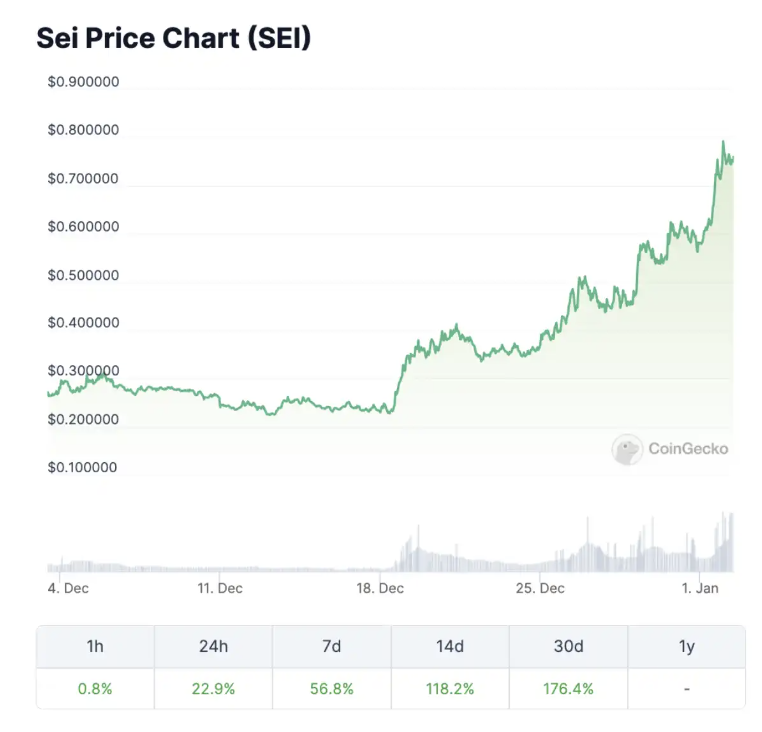
The “Solana speed with Ethereum distribution” strategy isn’t limited to Monad and Eclipse. Sei has also embraced it, as evidenced by their recent announcement of becoming a parallel EVM chain.
Note that when I began writing this article in December, SEI’s price has since exploded—faster than I anticipated—as attention to this narrative accelerated. With Monad not yet launched, SEI became the easiest way to gain exposure to the parallel EVM story, causing its token to appreciate accordingly.
While Monad appears intent on remaining a standalone L1, I predict Monad’s EVM will become a target for Ethereum L2s seeking EVM alternatives. If Monad open-sources its EVM, it could become extremely popular software across Web3. For Monad, pursuing both an ETH L2 and an independent L1 might also be a viable strategy to ensure it captures as much of the competitive landscape as possible.
Back in November, I spoke with Ansgar, who expressed interest in finding a new VM specification to design L2s—one that optimizes execution better than simply copying the L1 EVM onto L2s. Our thinking was: if we can find a better, execution-optimized virtual machine for L2s, we could unite the L2 ecosystem around it as a standard instead of relying on the traditional (and slow) EVM. Such a shift would require coordination, but it could dramatically improve the Ethereum L2 landscape.
Airdrops
My very safe prediction for 2024 is that $2 billion will be airdropped to users. EigenLayer alone could deliver this.
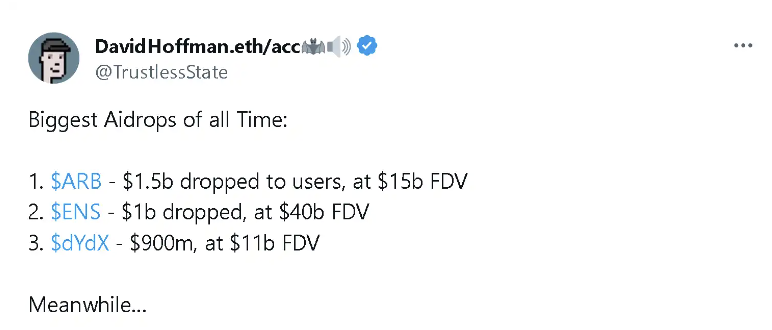
Airdrops weren’t new in 2021, but the retroactive Uniswap airdrop did redefine what airdrops mean and introduced a new paradigm for how apps can leverage them. Fast forward to today, some of the space’s largest projects have spent years fine-tuning their token distribution plans.
Now, it’s time to act. For example, both StarkNet and LayerZero have recently confirmed upcoming tokens, and I expect both to launch in Q1 2024.
These airdrops will pressure others to accelerate their token launches. Once full momentum behind a new airdrop season begins, it’s hard to stop. After all the giants release their tokens and hand billions to users, followers will rush to quickly develop their “apps” and launch their “tokens” to ride the wave.
When that happens, you’ll know we’re nearing the peak of the bubble—and it’s time to start selling, not buying. Be cautious: airdrop farming traps may lure much of your capital in pursuit of maximum yield, precisely when you should be pulling funds out.
For example, Alameda started with zero-risk Bitcoin arbitrage on exchanges, but as the bull market progressed, ultimately leveraged completely illiquid junk tokens. You want to do the opposite. Start by fully utilizing illiquid junk tokens, then, as the bull market advances, exit into dollars, BTC, ETH, and other defensive positions.
Join TechFlow official community to stay tuned
Telegram:https://t.me/TechFlowDaily
X (Twitter):https://x.com/TechFlowPost
X (Twitter) EN:https://x.com/BlockFlow_News
 Bankless









