








Will Web3 technology have its "iPhone moment" in 2024?
TechFlow Selected TechFlow Selected
Will Web3 technology have its "iPhone moment" in 2024?
Today's Web3 market urgently needs more real-world applications and products to break down the barriers between technology and users, enabling true mass adoption.
 Navigating Web3 tides with focused insights
Author: Jason Jiang, OKLink Research Institute
Due to macroeconomic tightening and major institutional collapses, the crypto market has been in a downturn for nearly two years. With macro policies stabilizing and positive news emerging around spot ETFs for crypto assets—combined with the ordinals boom and the approaching halving cycle—interest in digital assets continues to rise.
A new cycle seems to be arriving. But beyond market recovery, what else can we expect in 2024? The OKLink Research Institute aims to return to the essence of Web3 technology, setting aside price movements and regulation, to explore from a technological application perspective the potential "iPhone moment" for Web3 technology in the next cycle.
Tokenization as the Driver of Mass Web3 Adoption
In early 1995, a new café opened at 12 St. Mark’s Place in New York City. Unassuming as it was, the café caused a sensation—not because of its coffee, but because it offered something few had ever heard of: internet access. At that time, the internet remained a niche phenomenon, primarily used by a group of pioneers who believed the “cyberspace” would bring about a new social order. It wasn’t until internet applications began serving real-life needs—transforming cafes, restaurants, libraries, and schools into digital interfaces, and much more—that the internet became the era’s most critical infrastructure.
Today’s Web3 resembles the internet of 1995: exciting yet still niche. As more businesses and governments embrace innovation, the Web3 ecosystem urgently needs practical, real-world applications and products to break down barriers between technology and users, enabling true mass adoption. Among all ongoing innovations, we believe tokenization will drive widespread adoption of Web3 technology and is the most anticipated keyword for 2024.
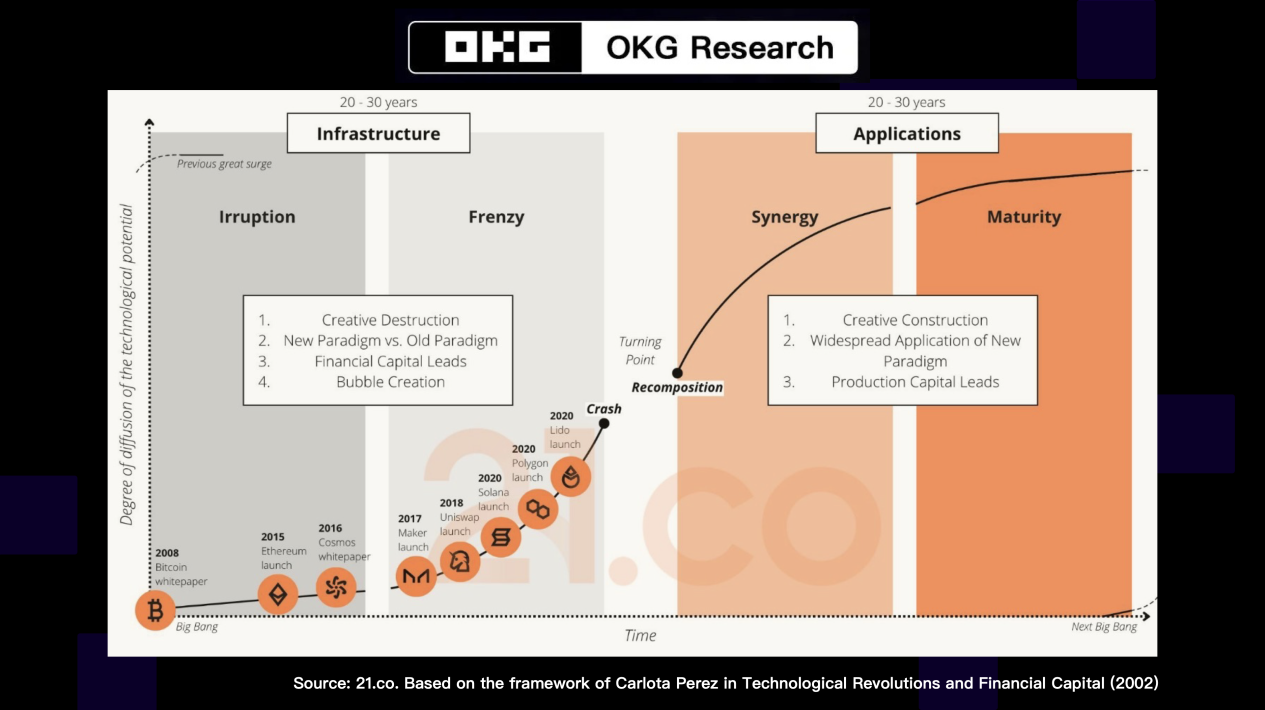
According to the Carlota Perez framework, 21.co believes crypto technology is transitioning from the frenzy phase to the synergy phase.
The core logic of the internet is enhanced connectivity: connecting people, people to things, and things to things. As the next-generation internet, Web3 should follow the same principle. Yet, over the past decade, Web3—and particularly the crypto market—has remained relatively isolated, with narratives confined to on-chain activity. Despite frequent hundred- or thousand-fold gains, these have largely been internal cycles within the crypto ecosystem, lacking genuine connection to the real world. Only now, with renewed focus on tokenization, is the integration between Web3 and the real world experiencing unprecedented growth.
Tokenization brings innovation not only to on-chain systems but also transforms reality itself—changing how various real-world assets are transferred, settled, and stored, such as real estate, art, and financial instruments. Compared to other crypto innovations, tokenization makes blockchain and Web3 more tangible, as its underlying assets are at least perceptible and understandable to users.
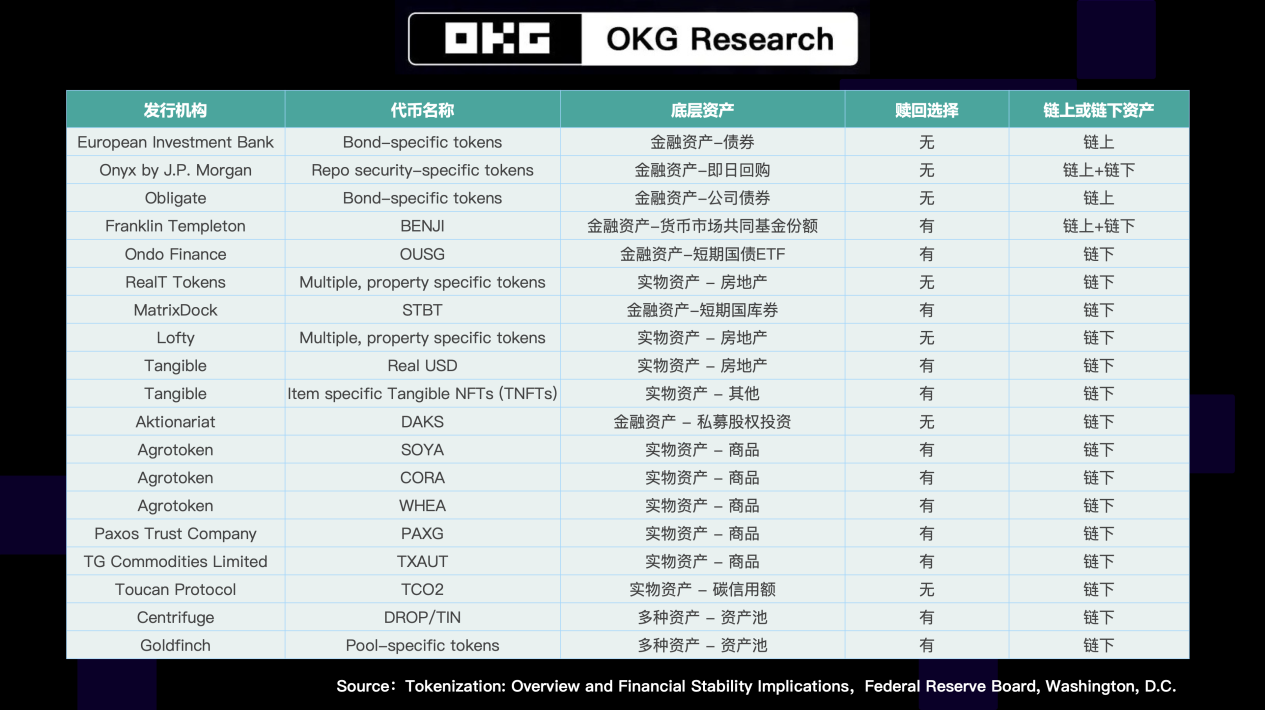
Currently issued tokenized products are mostly backed by off-chain assets.
Another advantage of tokenization is its regulatory friendliness. Crypto assets are hard to regulate because they operate outside the real economy, lacking clear reference points. Tokenization, however, establishes tighter links with the real world and can be seen as an evolved form of asset digitization. By anchoring tokenized products to real-world assets, regulators gain clearer oversight mechanisms. Therefore, compared to other crypto innovations, tokenization is more compliant and easier to accept. Moreover, banks and financial institutions currently involved in tokenization will bring their compliance expertise and experience into this domain.
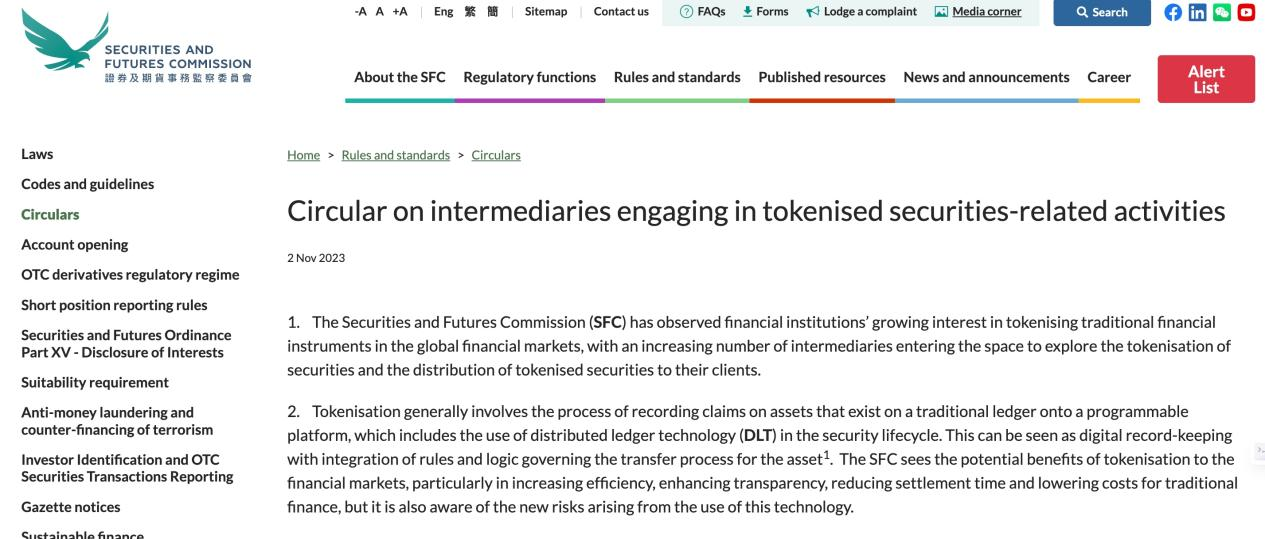
In early November 2023, Hong Kong’s SFC released a circular on tokenized securities.
Blythe Masters, former head of JPMorgan Chase’s commodities trading business, said in a 2015 Bloomberg interview: "You should take this technology as seriously as you would have taken the development of the internet in the early 1990s." That statement is now more relevant than ever—because tokenization is more perceptible to users, valuable to institutions, and friendlier to regulators, it has become a key catalyst accelerating Web3 adoption.
How Is Tokenization in 2024 Different From 2023?
We still have a long way to go before full-scale adoption of tokenization and Web3 technologies. However, change will continue in 2024. Compared to 2023, the OKLink Research Institute believes tokenization will exhibit the following characteristics:
(1) The blockchain and Web3 infrastructure enabling tokenization will become increasingly invisible in the backend, with innovation shifting toward more real-world-facing tokenized product layers. Blockchain technology will also integrate more closely with existing IT systems, accelerating the onboarding of real-world assets and data onto chains.
(2) More countries and regions will not only recognize the potential of tokenization but also accelerate rule-making to accommodate tokenization innovations. Hong Kong, Thailand, and Singapore have already laid foundational groundwork for tokenization practices, and their initiatives will serve as references for others.
(3) While native on-chain tokenization projects may remain more dynamic, traditional financial institutions’ tokenization activities will become significantly more active in 2024. Tokenization offers traditional finance benefits such as improved capital efficiency, reduced operational costs, greater transparency, and better fulfillment of diverse investor needs—though many of these advantages remain theoretical. For more stable innovation, we believe financial institutions will continue a step-by-step strategy in 2024: starting with tokenizing parts of financial processes, gaining partial technological benefits before expanding to end-to-end workflows. Full-scale tokenization remains unrealistic in the short term.
(4) Tokenized deposits and tokenized funds will see even stronger growth in 2024. Tokenized deposits may currently be the closest asset class to mass adoption. Regulatory attitudes in the U.S. are turning positive, with JPMorgan’s tokenized deposit solution receiving approval. We expect more banks to join in 2024. On the fund side, Harvest Fund Management International launched Asia’s first tokenized fund for professional investors this November. According to insiders, more Hong Kong-based funds are exploring tokenization of retail public offerings—potentially positioning Hong Kong as a leader in the tokenized fund market.
(5) Financial institutions will increasingly choose public blockchains for tokenization initiatives. Unlike 2017, when asset tokenization mostly occurred on private or permissioned chains, financial institutions are now actively exploring tokenization of traditional financial tools and products within decentralized frameworks. This reflects both rapid advancements in public chain technology over recent years—now capable of supporting commercial use cases—and growing confidence among traditional institutions in the security and performance of public blockchains. This shift, starkly different from just a few years ago, will continue into 2024.
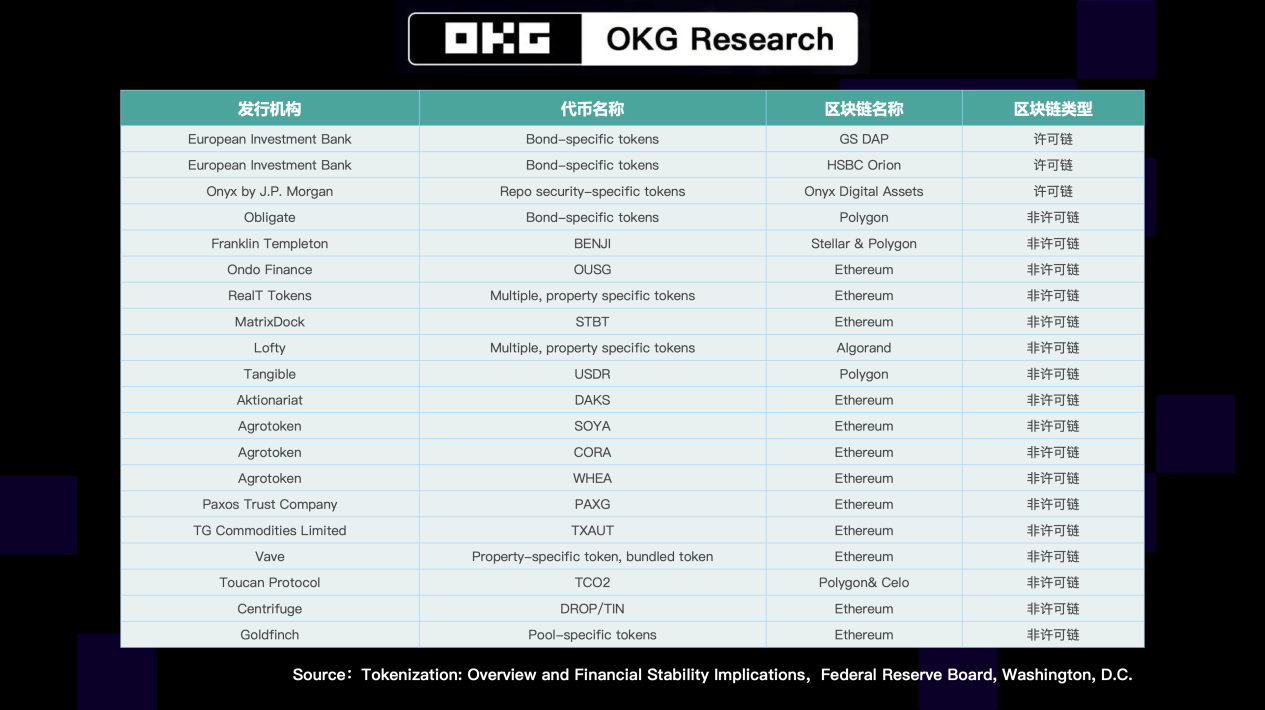
Blockchain choices for issued tokenized products
There are many developments to watch in 2024: Bitcoin halving, Ethereum’s Cancun upgrade, spot crypto ETFs, and more—each potentially pushing the crypto market to new scales and valuations. Yet, we are most excited about tokenization, because it won’t just bring more real-world assets into digital spaces; it will enable Web3 technology to truly enter the real world and deliver value in practical scenarios.
2024 might just be the turning point for tokenization and Web3 technology. We look forward to the arrival of Web3’s “iPhone moment.”
About OKLink Research Institute
OKLink Research Institute is the strategic research arm of OKLink Group, dedicated to helping global commercial, public, and social sectors better understand the evolution of fintech and blockchain economies. Through in-depth analysis and expert content covering technology applications, innovation, tech-society dynamics, and fintech challenges, the institute strives to advance the application and sustainable development of frontier technologies such as blockchain.
Join TechFlow official community to stay tuned
Telegram:https://t.me/TechFlowDaily
X (Twitter):https://x.com/TechFlowPost
X (Twitter) EN:https://x.com/BlockFlow_News
 @OKGResearch









