









Top 10 Bitcoin Influencers of 2023: Is "Him" on Your Radar Too?
TechFlow Selected TechFlow Selected
Top 10 Bitcoin Influencers of 2023: Is "Him" on Your Radar Too?
Does the market direction for 2024 still depend on them?
 Navigating Web3 tides with focused insights
Author: Huo Huo, Baicai Blockchain
The entire cryptocurrency industry experienced significant turbulence in 2023. Early-year turmoil from the Silicon Valley Bank crisis further shook a market already reeling from the FTX collapse, followed by waves of regulatory crackdowns that left industry giants on edge.
Yet, as always, "crisis" and "opportunity" go hand in hand. With Bitcoin's halving approaching, growing expectations for spot Bitcoin ETF approvals, and the rise of the BRC20 narrative sparking inscription frenzies across multiple public chains, these overlapping narratives fueled strong market enthusiasm by year-end. Bitcoin surged past $45,000, delivering an annual gain exceeding 150%, signaling the early stages of a bull market.
Amid this volatile landscape, who are the key figures shaping events? Will they continue to influence the market’s trajectory in 2024?
Stepping Back Gracefully — CZ
On November 23, 2023, CZ announced his resignation as CEO of Binance, stating he would no longer hold executive roles, though retaining majority ownership of the company and transitioning into a behind-the-scenes investor role. The news sent shockwaves throughout the industry.

Why did CZ suddenly resign? The reason lies in Binance and its CEO Zhao Changpeng (CZ) pleading guilty on November 22, 2023, to U.S. federal charges. Binance faced three charges: anti-money laundering violations, operating an unlicensed money transmitting business, and breaching U.S. sanctions. To ensure continued operations, Binance reached a settlement with the SEC, agreeing to pay a staggering $4.368 billion fine, while CZ stepped down.
This legal battle had dragged on for five years—since 2018, when the U.S. Department of Justice began investigating Binance over alleged unlicensed remittance services, money laundering, and sanctions violations. Now, it has finally come to a close.
Looking back at Binance’s journey from an obscure startup in 2017 to today’s industry leader, CZ played an irreplaceable role—essentially building a diversified ecosystem from scratch, spanning spot trading, futures, options, mining pools, cloud services, and public chains. He transformed what was once a single centralized exchange (CEX) into a comprehensive Web3 conglomerate, expanding its products, services, and global brand reach.
Over the past six years under CZ’s leadership, Binance achieved dominance in exchanges, public chains, wallets, and investment. But as Binance grew into a behemoth, CZ may have realized that the greatest challenge was no longer competition—but rather shouldering the responsibility of guiding the crypto industry toward compliance.
Thus, some view CZ’s resignation as “sacrificing oneself to light the path,” clearing the way for future innovators and even paving stones for the potential approval of spot Bitcoin ETFs.
A Heavy Hand — SEC Chair
Since taking office, Gary Gensler, chair of the SEC, has led a stringent regulatory campaign against the crypto sector—especially intensifying in 2023. Notably, he spearheaded the SEC’s lawsuit against Ripple and imposed multi-million dollar fines on platforms like Kraken. These actions triggered widespread fear, uncertainty, and doubt (FUD) across the crypto industry and raised concerns among other top-tier platforms.
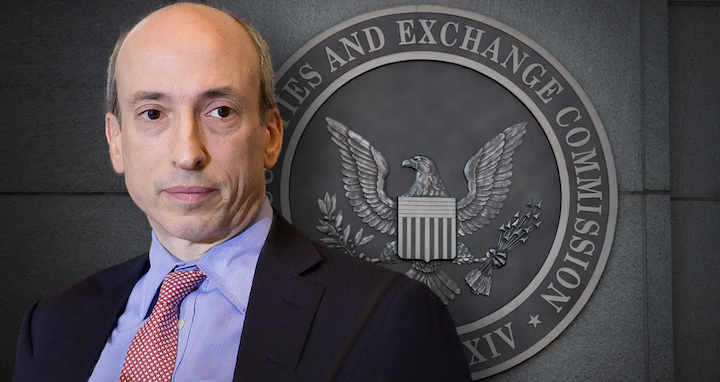
His most high-profile action remains the December 2020 SEC lawsuit against Ripple, the digital payments protocol. Under his leadership, the SEC aggressively targeted staking services on crypto platforms and attempted to classify nearly all tokens as securities.
The recent victory in the case against CZ and Binance marks another milestone for the SEC under Gensler’s leadership. Beyond these two major cases, the SEC has pursued numerous other crypto-related enforcement actions, including:
1) Bittrex and its former CEO were charged with operating an unregistered exchange, broker, and clearing agency.
2) Two individuals involved in the Ormeus Coin fraud scheme were fined over $23 million.
3) Tron founder Justin Sun and his companies were accused of illegally selling unregistered securities, fraud, and market manipulation.
4) Terraform Labs and Do Kwon were charged with orchestrating a multi-billion-dollar securities fraud involving crypto assets.
5) Trade Coin Club was accused of running a $295 million crypto Ponzi scheme.
6) The SEC sued Dragonchain for conducting unregistered crypto asset securities offerings.
7) Eleven individuals behind Forsage were charged with a $300 million fraudulent Ponzi scheme.
8) The U.S. Second Circuit Court ordered Terraform Labs and Do Kwon to comply with SEC subpoenas.
9) The SEC halted Telegram’s TON token distribution, citing unregistered securities offerings.
10) The SEC charged Block.one, which resolved the case by paying a $24 million civil penalty related to the unregistered issuance of EOS tokens.
In short, as the crypto world expands, the regulatory hammer wielded by Gensler’s SEC has been ever-present.
Bear Market Pillar — Vitalik Buterin
Since Ethereum’s creation in 2014, it has now entered its tenth year. Under Vitalik’s leadership, Ethereum has made groundbreaking contributions to the development of crypto—from a platform supporting only digital assets to one capable of hosting diverse decentralized applications, earning the title of “world computer.” If Satoshi Nakamoto is the creator of blockchain, then Vitalik Buterin is arguably the other pivotal leader in the crypto space.
Vitalik laid out Ethereum’s original roadmap: PoW to PoS (Phase 0) → Data Sharding (Phase 1) → Execution Sharding (Phase 2). Over time, this evolved into a rollup-centric roadmap: The Merge, The Surge, The Scourge, The Verge, The Purge, and The Splurge.
Although Ethereum’s overall progress in 2023 appeared relatively quiet, the Shanghai upgrade in April stood out—particularly due to the subsequent surge in staking activity enabled by withdrawals.
Even during the poor market conditions of 2022, Ethereum’s Layer2 solutions saw explosive growth by year-end—a trend that carried through the first half of 2023, especially driven by leaders like Arbitrum. According to L2beat, total value locked (TVL) in Layer2 now stands at $20.1 billion (see chart below), preserving room for builders during this bear market phase.
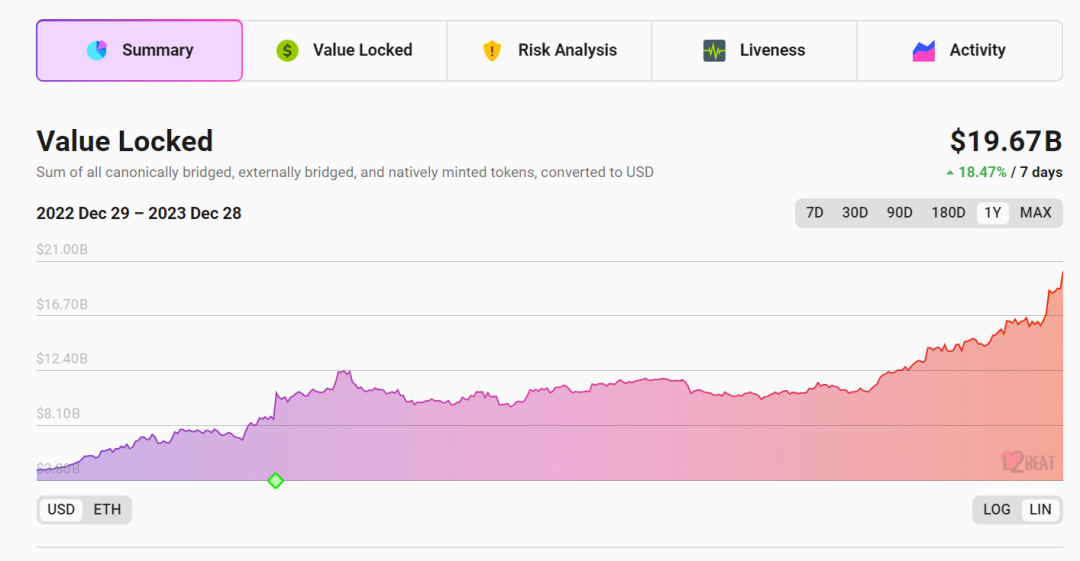
Vitalik strongly favors rollups, particularly integrating them with privacy-preserving zero-knowledge proofs (ZK). While OP-Rollups currently dominate the Layer2 ecosystem, advances in ZK technology suggest ZK Rollups could become the ultimate Layer2 solution.
Another key upcoming milestone is Ethereum’s next major upgrade—the Cancun upgrade. Reports indicate that barring unforeseen issues, testing will officially begin on January 17, 2024. If successful, this will significantly increase Ethereum’s transactions per second and usher in a new era of data storage and retrieval capabilities, further enabling Layer2 development.
Architect of the Inscription Craze — Ordinals Founder
The recent boom in the inscription market exceeded many expectations—and its foundation traces back to Casey Rodarmor, the creator of Ordinals.

Rodarmor has worked in tech since 2010, holding positions at Google and Chaincode Labs, and contributing to core Bitcoin protocol implementations. Last year, he co-hosted BitDevs San Francisco, a grassroots community that meets monthly to discuss technical aspects of Bitcoin—originally founded in New York City and deeply rooted in Bitcoin’s hacker culture.
Earlier this year, Rodarmor’s Ordinal protocol enabled Ordinal NFTs and inscriptions on Bitcoin—the first major attempt since Colored Coins in 2012 and Counterparty in 2014 to bring NFT-like functionality to Bitcoin.
The Ordinal protocol introduced a method for sequentially numbering sats (the smallest unit of Bitcoin, one hundred millionth of a BTC). Once numbered, users can inscribe data onto individual sats to create digital artifacts—Rodarmor’s original vision for NFTs. As of December 27, 2023, cumulative fees for minting Ordinal inscriptions reached 5,028 BTC.
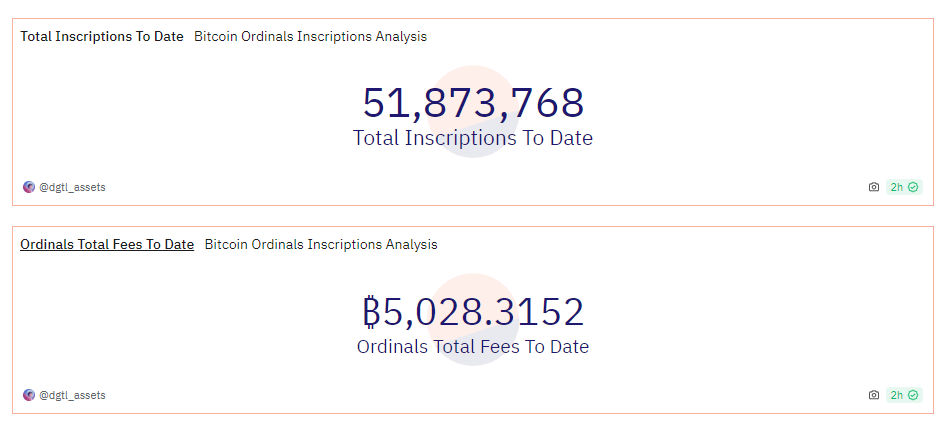
Source: dune.com
Rodarmor said the idea for Ordinals was inspired by Satoshi Nakamoto, Bitcoin’s pseudonymous founder. Satoshi once mentioned something called “atoms” in the original Bitcoin codebase.
Currently working full-time on Ordinals, in September 2023 Rodarmor proposed a new Bitcoin fungible token (FT) protocol design called “Rune”—also known as the Rune Protocol—though it has not yet launched.
Regardless of Rune’s future, Rodarmor’s Ordinals protocol sparked the development of BRC20 tokens, igniting the inscription craze and catalyzing broader growth within the Bitcoin ecosystem.
The Financial Giant Awaiting Approval — BlackRock CEO
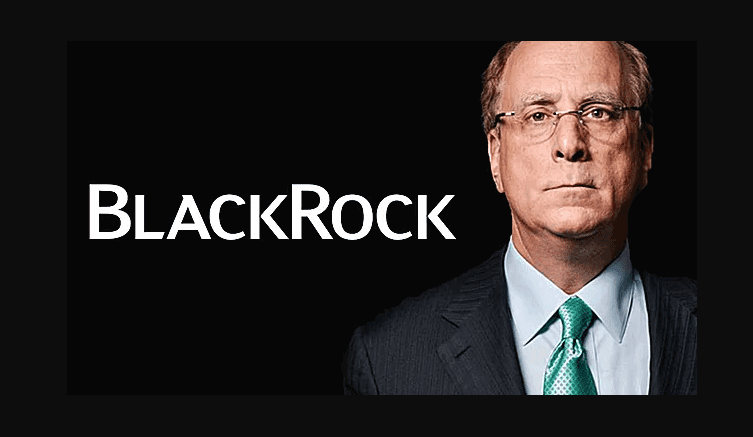
On June 15, 2023, BlackRock filed an application for a spot Bitcoin ETF, sending shockwaves through the crypto industry. The SEC had rejected dozens of similar applications over the past decade. So why did BlackRock’s application generate such excitement?
On one hand, the SEC previously rejected spot Bitcoin ETFs citing concerns about fraud and market manipulation to protect investors—especially after events like the FTX collapse intensified regulatory scrutiny on crypto firms.
But BlackRock, as the world’s largest asset manager, oversees roughly ten times the market cap of the entire crypto industry. If its ETF application is approved, the influx of institutional capital could profoundly impact the crypto market, driving up prices and potentially triggering the next bull run.
On the other hand, BlackRock’s move inspired eight other financial institutions—including Fidelity, Invesco, VanEck, Cathie Wood’s Ark Investment Management, and WisdomTree—to follow suit, submitting their own ETF applications and accelerating momentum for spot Bitcoin ETFs.
BlackRock CEO Larry Fink’s relationship with Bitcoin has evolved over time. As early as 2017, Fink described himself as a “true believer” in crypto but expressed concern over speculative behavior. On July 16, 2018, he stated BlackRock clients showed little interest in crypto, slowing the firm’s investment in the space. By 2019, as market sentiment improved, BlackRock hired Robbie Mitchnick, former marketing head of Ripple, to explore crypto feasibility. In 2020, Fink shifted stance again, acknowledging crypto’s necessity and potential to replace gold. In 2021, he said he was re-evaluating Bitcoin but hadn’t reached conclusions. By 2023, BlackRock submitted its Bitcoin ETF application, and Fink declared that crypto could surpass global currencies.
Lifetime Imprisonment — SBF
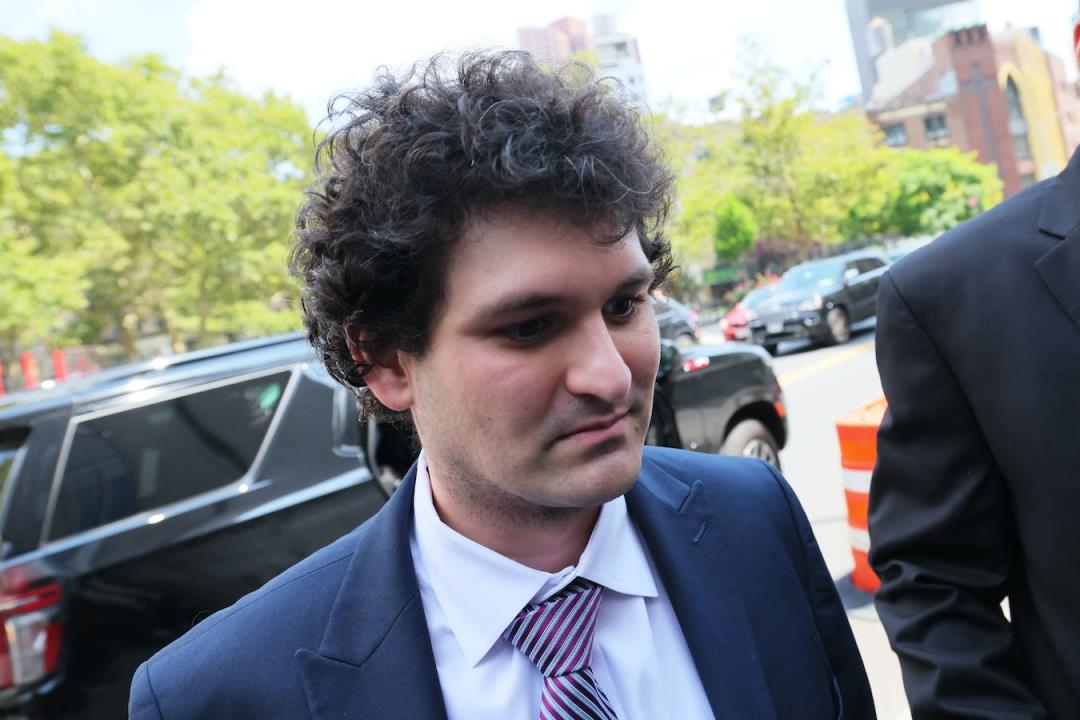
In November 2023, one year after FTX collapsed, its founder SBF was convicted on seven counts, including fraud and money laundering. Prosecutors labeled it “one of the largest financial frauds in U.S. history.”
How did this happen?
SBF, real name Sam Bankman-Fried, was co-founder and former CEO of the now-bankrupt CEX FTX and crypto firm Alameda Research. During the 2020 bull market, FTX rose rapidly to become the world’s third-largest exchange, attracting over a million users and major investment firms, with a peak valuation of $32 billion.
In November 2022, CoinDesk published a financial report exposing potential debt issues between FTX and Alameda Research. This triggered user panic and a massive withdrawal event, leading FTX Group to declare bankruptcy within days and SBF to resign. In 2021, at age 28, SBF ranked among Forbes’ 30 Under 30—but just two years later, his net worth plummeted to $0.
After FTX’s collapse, more than $370 million in assets were stolen, prompting investigations by U.S. prosecutors. FTX brought in former regulators to manage the chaos, but the collapse raised serious questions about oversight. Court filings revealed over $2 billion had been transferred to SBF. FTX sued SBF and other ex-executives for misappropriating $1 billion in corporate funds. The trial featured 20 witnesses, including the former CEO, SBF’s ex-girlfriend, and other executives.
The trial began in early October 2023, lasting a month, with sentencing scheduled for March 28, 2024. If sentenced to the maximum on all counts, SBF could face up to 115 years in prison.
However, on December 30, 2023, the U.S. government dropped six charges against SBF, including campaign finance violations and conspiracy to bribe, meaning he will avoid a second trial.
Meme Guru — Musk
Musk’s most famous crypto connection is undoubtedly his association with Dogecoin, but his involvement dates back earlier—already in 2021, both Tesla and SpaceX purchased large amounts of Bitcoin.
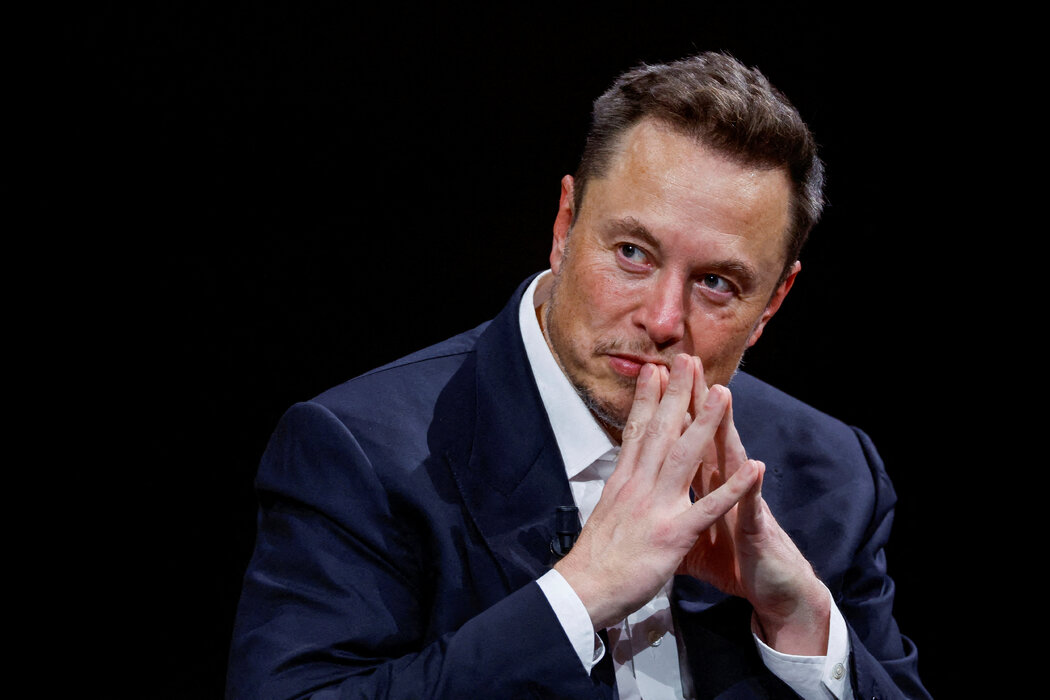
After acquiring Twitter in October 2022, on April 5, 2023, Musk changed Twitter’s logo to a doge meme, causing Dogecoin’s price to spike over 20% instantly. See article: Why Did Elon Musk Change Twitter’s Logo to the Dogecoin Meme?
Then, on July 30, Twitter replaced its iconic blue bird logo with an “X”—an act seen as highly symbolic in the crypto world. In 1999, Musk co-founded X.com, an online financial services and email payment company, which later became PayPal—one of the earliest and most successful online payment processors.
Now, Musk is transforming Twitter into a broader service named X—likely aiming to turn this iconic social media app into a financial platform. Speculation suggests he may integrate Bitcoin, Ethereum, other cryptocurrencies, stablecoins like USDC, and especially Dogecoin—the favorite of billionaires.
Therefore, Musk is poised to bring further transformative changes to the crypto industry.
Pressing Forward Under Pressure — Coinbase CEO
With CZ stepping down from Binance and SBF imprisoned, Brian Armstrong remains one of the most prominent figures still navigating turbulent waters. As co-founder and CEO of Coinbase, Armstrong holds considerable influence in the crypto space.
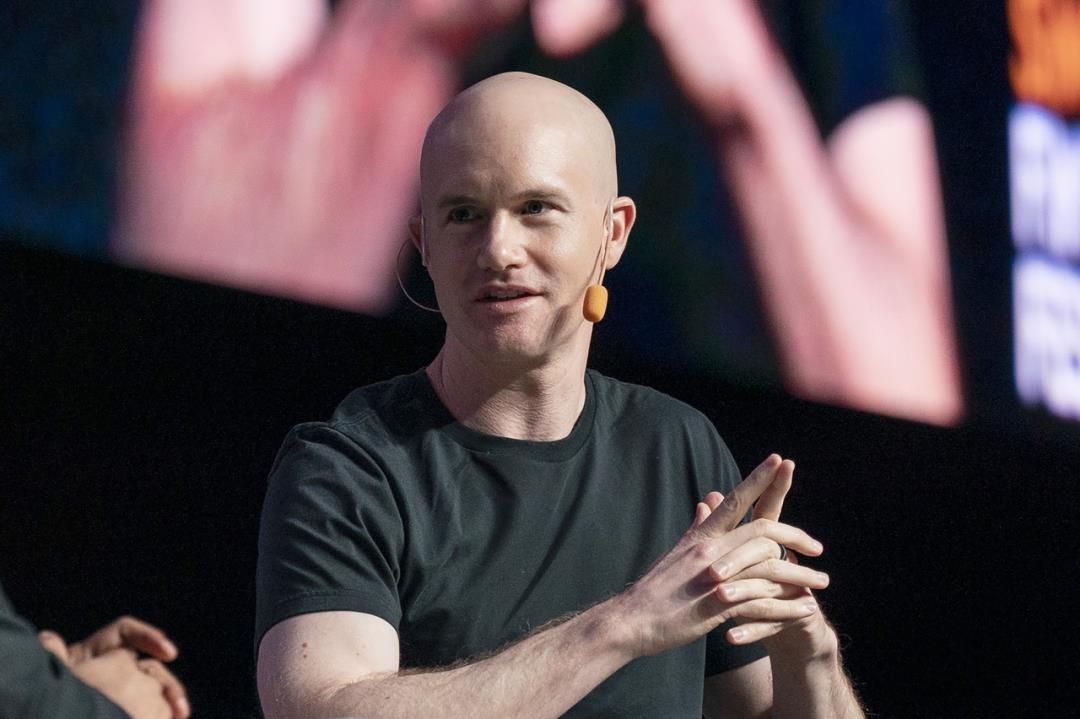
Coinbase launched its own Layer2 blockchain Base and derivatives exchange Blade this year, and plans to offer a Bitcoin ETF in 2024—clear signs of proactive preparation for the next wave of crypto adoption.
Like Binance, Coinbase also faces regulatory challenges, having been accused of illegal trading activities. The SEC’s broad classification of tokens as securities has impacted the entire industry. Yet Armstrong continues pushing forward, likening Coinbase to a local sheriff calling for action against overreaching U.S. agencies. He posted on X: “We can’t always grow as fast as others—the nature of our industry means compliant operations are harder and more costly. The [Binance] news only confirms that doing the hard thing was the right decision.”
As early as January, Coinbase acquired FairX, a derivatives exchange regulated by the U.S. Commodity Futures Trading Commission (CFTC)—a key step toward offering crypto derivatives to U.S. retail and institutional clients. He also founded the advocacy group “Stand With Crypto” to protect the industry from government criticism.
From a macro perspective, Binance’s regulatory setbacks and similar charges against rival Kraken have benefited Coinbase individually—its stock price rose 200% this year, with market cap exceeding $25 billion. However, Coinbase still faces headwinds from broader market weakness. While certain settlements eased major pain points this year, the overall market still needs stronger catalysts.
Currently, the next major catalyst hinges on whether regulators approve a spot Bitcoin ETF. Notably, BlackRock’s proposed Bitcoin ETF is custodied by Coinbase—raising hopes for approval and fueling gains in both Bitcoin and Coinbase shares. The outcome remains to be seen.
AI Game-Changer — OpenAI CEO
Since ChatGPT’s release on November 30, 2022, it became one of the fastest-growing consumer apps in history—reaching 100 million monthly active users within two months. Its parent company OpenAI’s CEO, Sam Altman, quickly rose to prominence.
Beyond ChatGPT’s initial explosion in popularity, last month Altman was temporarily ousted after several researchers sent a letter to the board claiming OpenAI had made a major AI breakthrough that might threaten humanity.
On November 18, 2023, OpenAI announced via its official site that current CEO and so-called “father of ChatGPT” Sam Altman would step down and leave the board. The news shocked the industry. Soon after, many employees threatened to resign in solidarity. Altman then stunned everyone by announcing he would join Microsoft alongside his team. Yet, in another twist, just five days later, Sam Altman returned as OpenAI’s CEO.
Altman stated on X that his decisions over the past few days—including joining Microsoft—were aimed at preserving OpenAI’s team and mission. With a new board in place and support from Microsoft CEO Satya Nadella, Altman expressed eagerness to return to OpenAI while maintaining a strong partnership with Microsoft.
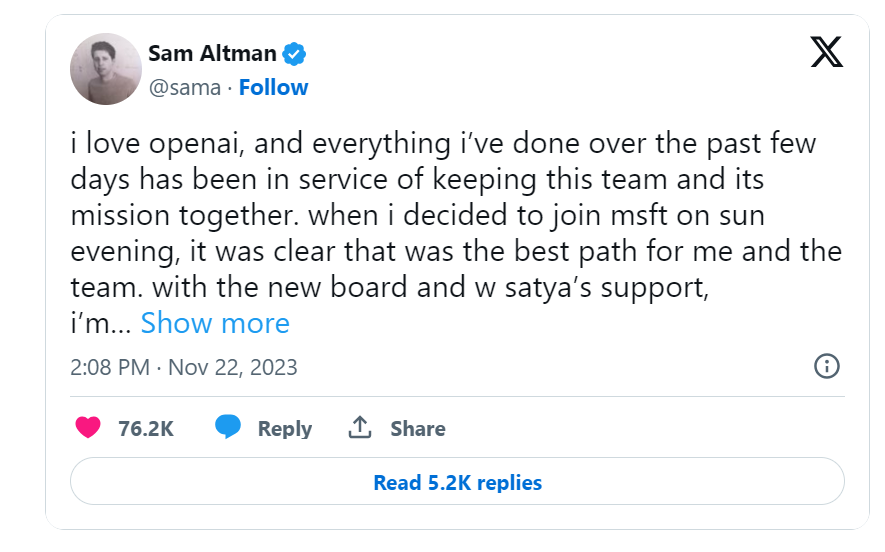
Translation: I love OpenAI. Everything I’ve done in the past few days was to keep this team and its mission intact. When I decided to join Microsoft last Sunday, it clearly seemed the best path forward for me and the team. With a new board and Satya’s support, I...
In July this year, Altman launched Worldcoin and its token—an initiative targeting global digital identity verification and income inequality. Given that much of the world lacks digital identity verification, Worldcoin aims to build the world’s largest, fairest digital identity and currency system to help everyone access global financial services—though it currently faces regulatory hurdles.
As AI becomes one of the most watched trends in crypto for 2024, Sam Altman cannot be overlooked.
Bitcoin Finally Pays Off — El Salvador President
Reports indicate that as of December 4, 2023, El Salvador President Nayib Bukele stated that at current Bitcoin prices, selling their holdings would fully recoup their investment and yield over $3.6 million in profit—an outcome largely driven by President Bukele’s bold policies.
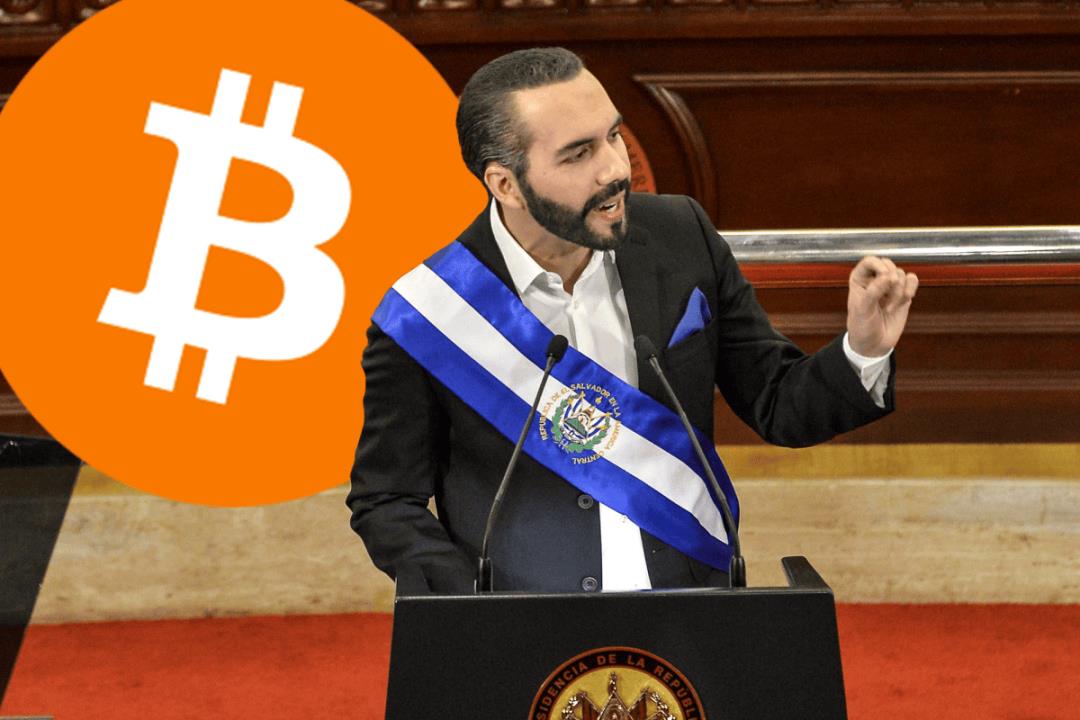
El Salvador, a small Central American nation without its own currency, uses the U.S. dollar. This creates economic friction—workers abroad pay high remittance fees, hindering GDP growth. About 70% of Salvadorans lack bank accounts or credit cards, and frequent government instability poses long-term risks. To stimulate the economy, El Salvador needed to attract new investors.
Besides external factors, Bukele is also a genuine Bitcoin enthusiast. Driven by his vision, on June 9, 2021, El Salvador passed a law with overwhelming support, making Bitcoin legal tender—the first country in the world to do so. This decision drew global attention. Since implementation, El Salvador has actively promoted digital payments and financial inclusion, aiming to provide broader financial access through Bitcoin adoption. It was also reported that the country commits to buying one Bitcoin per day.
This move represents an innovative experiment in financial systems that could influence other nations’ monetary policy choices in the future. Over time, El Salvador’s relationship with Bitcoin will serve as a landmark case study in global digital currency experimentation.
Bonus 1 True Believer — Michael Saylor
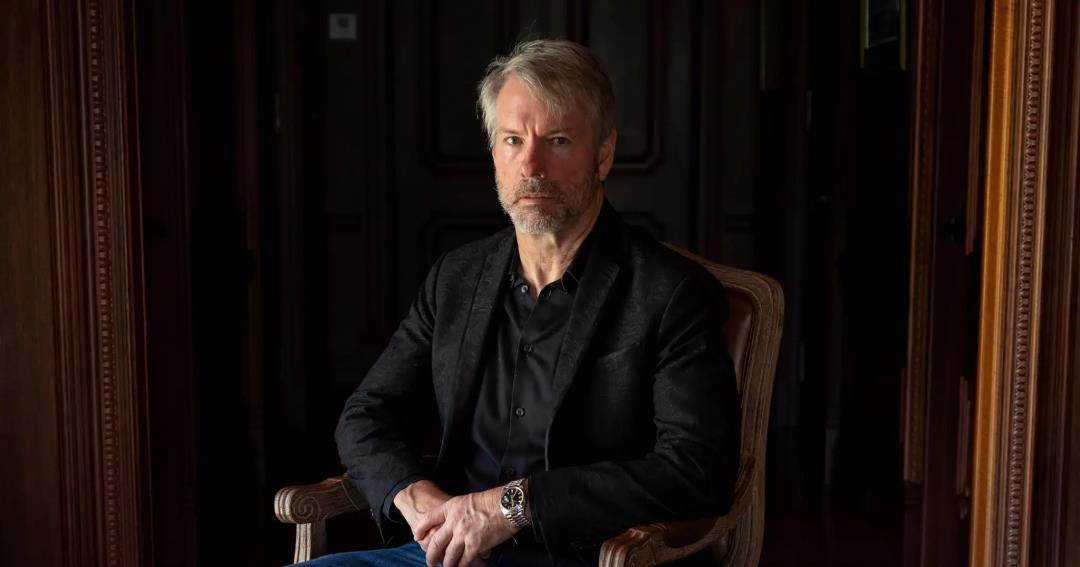
Michael Saylor, CEO of MicroStrategy and a major Bitcoin whale, is a highly influential figure in the crypto space. With an estimated net worth of $3 billion in 2023, his portfolio of over 120,000 Bitcoin has been instrumental in achieving this wealth.
Saylor began investing in Bitcoin in 2020, purchasing large quantities personally and allocating corporate funds to Bitcoin through MicroStrategy. In the following months, he doubled or even tripled down on Bitcoin, borrowing over $2 billion in debt to acquire more volatile crypto assets—solidifying his status as a die-hard Bitcoin advocate.
While 2022 saw the collapse of FTX, Three Arrows Capital, Celsius, and others—making it a grueling year for crypto investors—Saylor remained steadfast, even during Bitcoin’s cyclical lows. On November 13, 2023, at the Australian Cryptocurrency Conference, Saylor shared his outlook for Bitcoin’s future. He emphasized the upcoming 2024 Bitcoin halving, predicting it will mark Bitcoin’s “adolescence” into mainstream asset status, with widespread adoption by major tech firms and banks expected between 2024 and 2028, integrating Bitcoin into their products and services.
Bonus 2 Just Buy Bitcoin — Robert Kiyosaki, Author of Rich Dad Poor Dad
On December 11, financial author Robert Kiyosaki, famed for *Rich Dad Poor Dad*, posted on X warning that the U.S. government is stealing people’s wealth through inflation, but it’s not too late to act. With the banking system bankrupt, he urged people to buy gold, silver, and Bitcoin while they still can. Kiyosaki noted that his previous warnings came true, and his next prediction targets the S&P index, which he believes will severely impact millions of 401k and IRA accounts.
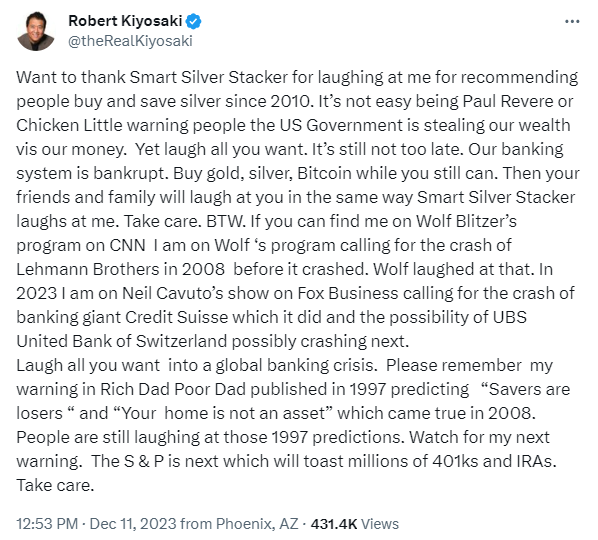
Translation: Want to thank Smart Silver Stacker—for mocking my advice since 2010 to buy and hold silver. Like Paul Revere or Chicken Little, warning that the U.S. government is stealing our wealth through currency devaluation isn’t easy. But laugh all you want—it’s still not too late. Our banking system is bankrupt. While you still can, buy gold, silver, Bitcoin. One day your friends and family will mock you like they mocked me and Smart Silver Stacker. By the way, I predicted Lehman Brothers’ collapse on Wolf’s show—you can find me on CNN’s Wolf Blitzer program. Wolf laughed too.
In 2023, I appeared on Neil Cavuto’s Fox Business show predicting Credit Suisse’s collapse and suggesting UBS might be next. Laugh if you must—the global banking crisis is here. Remember my 1997 warnings in *Rich Dad Poor Dad*: “The saver is a loser” and “Your house is not an asset”—both proved true in 2008. People still mock those 1997 predictions. Watch for my next warning: The S&P will be next, devastating millions of 401k and IRA accounts. Stay safe.
Anyone with even mild interest in personal finance has likely read *Rich Dad Poor Dad*, published in 1997, selling millions of copies and translated into over 50 languages—establishing author Robert Toru Kiyosaki as a financial thought leader. His crypto connection began in 2017, when he started expressing interest in Bitcoin and encouraging people to learn about cryptocurrencies.
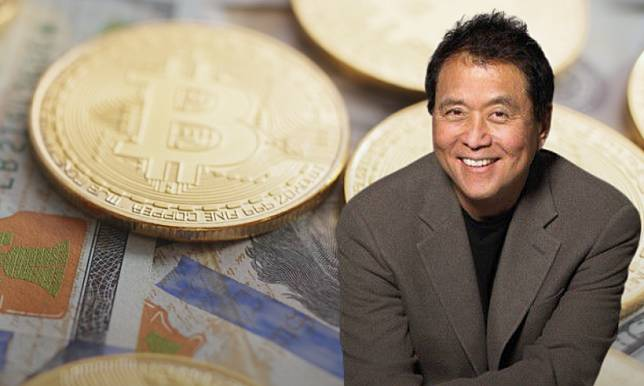
This month’s endorsement isn’t Kiyosaki’s first promotion of Bitcoin. In 2022, he tweeted that Bitcoin behaves more like a commodity—similar to gold, silver, or oil. Moreover, the SEC classifies Bitcoin as a commodity, unlike most other crypto tokens, which are treated as securities.
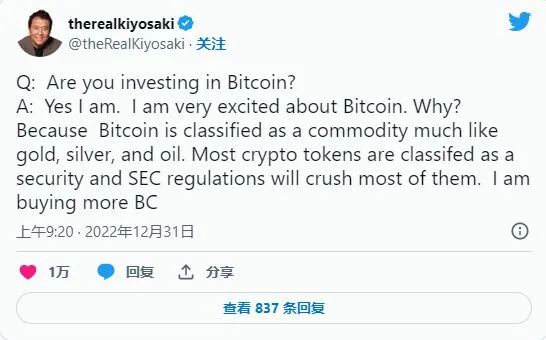
Translation:
Q: Are you investing in Bitcoin? A: Yes, I am. I’m very excited about Bitcoin. Why? Because Bitcoin is classified as a commodity, just like gold, silver, and oil. Most crypto tokens are classified as securities, and SEC regulations will destroy most of them. I’m buying more Bitcoin.
While openly supportive of Bitcoin and other crypto assets, Kiyosaki has not disclosed specific investment amounts.
Conclusion
Though 2023 may have been a low point in the crypto cycle, both speculators and genuine builders have continued advancing the industry in their own ways.
These influential figures have shaped market directions and driven—or paved the way for—the future of cryptocurrencies. Regardless of how the industry evolves, they will remain integral parts of this historic narrative.
Join TechFlow official community to stay tuned
Telegram:https://t.me/TechFlowDaily
X (Twitter):https://x.com/TechFlowPost
X (Twitter) EN:https://x.com/BlockFlow_News
 白话区块链
白话区块链









