









Ethereum "Revenge Achieved": What Are the Hidden Opportunities in the ETH Ecosystem?
TechFlow Selected TechFlow Selected
Ethereum "Revenge Achieved": What Are the Hidden Opportunities in the ETH Ecosystem?
Between one rise and fall, the community cheers, "Ethereum has finally revived."
 Navigating Web3 tides with focused insights
Text by: Kaori
Edited by: Jack
Ethereum has successfully taken its revenge.
This morning, ETH broke through $2,400, reaching $2,414 at the time of writing, with a 24-hour gain of 8.47%. Meanwhile, Solana’s price dropped from its December 26 high of $123 to $104, a decline of 15%.
With one rising and the other falling, the community is cheering, "Ethereum has finally revived." If Ethereum had a script, its rivalry with its archrival Solana would undoubtedly be the most talked-about drama in the crypto space.
Reasons Behind Ethereum's Revival
Currently, the crypto industry is entering a critical phase of transition between bull and bear markets, gradually shifting from euphoria and excitement back to caution.
Further Transition Between Bull and Bear Cycles
According to the market sentiment index on BlockBeats' website, since October, progress on spot Bitcoin ETF news and various protocols and inscriptions within the Bitcoin ecosystem have pulled the crypto market out of the 2023 bear market lows. Subsequently, multiple public chains picked up popular narratives, further boosting market sentiment through inscriptions, memes, and NFTs. The entire crypto space believed a bull market had begun.
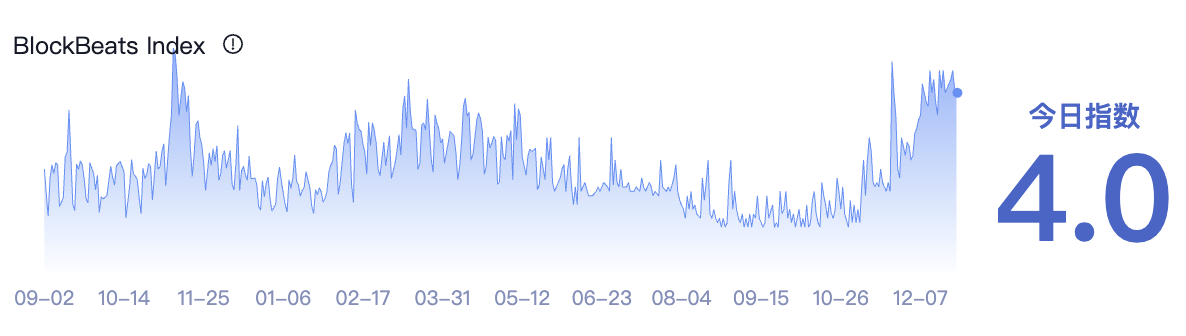
However, during this process, the prices of Bitcoin and Ethereum—the two leading cryptocurrencies—remained range-bound, while new projects within their ecosystems saw exaggerated price surges. For example, the Ethereum inscription ETHS once surged past $16,000, six to seven times the price of ETH at the time, illustrating the market’s frenzy.
Yet, as the inscription market—the so-called catalyst for this bull run—shows signs of exhaustion, it has become clear that the value foundation of inscriptions remains immature. The overall crypto market is still in a transitional phase between bull and bear cycles, experiencing brief myth-making rallies followed by periods of stagnation. Every crypto project with narrative and ecosystem momentum will emerge during this period to assert its presence. Therefore, Ethereum’s price volatility is a normal response within this market phase.
On December 28, Grayscale stated on social media that ETH generated strong returns in 2023 (over 80%), but underperformed compared to BTC and certain other smart contract blockchain tokens. The ratio between ETH and BTC price indices recently hit its lowest level since mid-2021.
In fact, most smart contract platform tokens rose less than Bitcoin this year, with ETH largely consistent with this peer group. The CryptoSector index increased by about 94% in 2023, slightly outpacing ETH’s gains. Grayscale noted, “Although ETH lagged behind Bitcoin and certain other crypto assets in 2023, it still outperformed traditional asset classes. Thus, we view ETH’s rebound as evidence of an expanding cryptocurrency recovery.”
Capital Outflows from Solana’s Ecosystem
Another factor driving Ethereum’s price increase is capital outflows from its main rival, Solana.
Last week, BitMEX founder Arthur Hayes claimed he received divine inspiration during meditation instructing him to sell SOL, a token backed by SBF, and expressed his admiration for Ethereum founder Vitalik. That day, Ethereum briefly spiked in price, but market attention remained focused on Solana’s ecosystem.
During this period, meme coins like BONK, WIF, and SILLY on the Solana chain drove extraordinary returns for DEXs such as Raydium and Jupiter. On December 16, Solana’s DEX trading volume reached approximately $1.475 billion, surpassing Ethereum’s $1.164 billion. Its weekly trading volume hit $6.429 billion, up 52.75%, fueling community belief that Solana might flip Ethereum.
On December 26, according to DefiLlama data, Raydium, a DEX protocol on Solana, generated $161 million in fees over the past seven days—surpassing both Bitcoin ($102 million) and Ethereum ($76.59 million)—ranking first. However, latest data shows Raydium’s 7-day protocol fees have since fallen to fifth place, down 70% from its peak.
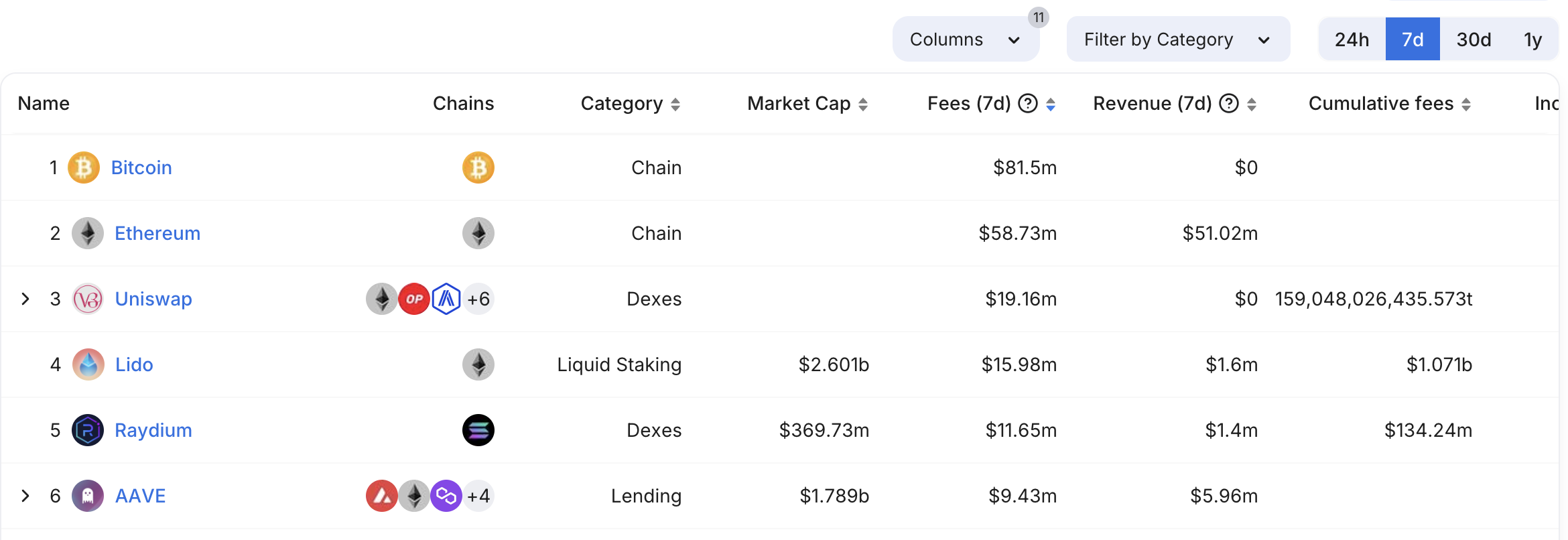
Looking at SOL’s price movements, Solana’s momentum is clearly slowing. Currently, SOL has dropped to fifth place in market cap rankings, with its price falling from a December 26 high of $123 to $103—a 16% decline.
Price performance is always the most sensitive indicator of market conditions. As we remain in an unstable bull-bear transition period, hot money will always flow toward areas with greater wealth opportunities—and Ethereum’s opportunity lies ahead in next year.
Cancun Upgrade and ZK L2 Airdrop Expectations
The upcoming Cancun upgrade is widely seen as a pivotal moment for Ethereum’s resurgence. Following the Shanghai upgrade, the Cancun upgrade will introduce additional enhancements to the ETH blockchain. The highly anticipated EIP-4844 proposal aims to reduce costs and increase speed for Ethereum’s Layer 2 solutions, potentially boosting L2 transaction speeds by 10x—or even 100x—with significantly lower fees.
Many crypto users have long complained about Ethereum’s persistently high gas fees. If the Cancun upgrade successfully lowers transaction costs while leveraging Ethereum’s robust infrastructure, the recent price rise marks the beginning of this expectation being priced in.
This morning, Vitalik Buterin published an article on the Ethereum Research forum proposing three methods to simplify Ethereum’s proof-of-stake design: decentralized staking pools, two-tiered staking, and validator committee mechanisms.
Many believe this was a key driver behind today’s ETH price surge. Additionally, tokens of Ethereum Layer 2 projects also saw broad gains. The total value locked (TVL) in Layer 2 has now reached the $20 billion mark, with a 7-day increase of 23.06%.
Anticipation around potential airdrops from zk-based Layer 2 projects Starknet and zkSync has also brought renewed attention to Ethereum’s ecosystem. On December 1, the Starknet Foundation confirmed screenshots revealing a draft airdrop plan and announced that the snapshot had already been taken. Previously, the “PUA” discourse sparked by Blast made other Ethereum Layer 2 projects realize they must act decisively or risk being left behind. As a result, next year these technically advanced and airdrop-anticipating Layer 2s are expected to align with broader Ethereum market sentiment.
What Are the Potential Opportunities?
Given the promising outlook for Ethereum’s ecosystem next year, what opportunities can we position ourselves for now?
OP Ecosystem
Optimism has led this round of Ethereum ecosystem price recovery. On December 27, OP rose to touch $4, currently trading at $3.84—an all-time high—with a 24-hour gain expanding to 18%.
OP Stack is Optimism’s killer feature—a set of open-source software components enabling anyone to build their own Layer 2 blockchain on Ethereum using optimistic rollups. By moving most computation and storage off-chain while relying on Ethereum for security and finality, Optimism significantly reduces on-chain transaction costs for users.
Previously, over ten projects—including opBNB, Zora, Base, Wordcoin, and DeBank—announced joining the OP Stack ecosystem. The popularity of Base has already been evident through friend.tech, and user-rich projects like Wordcoin and DeBank may attract even more market attention in the future.
Currently, notable OP ecosystem projects include AMM protocol Velodrome Finance and lending protocol Sonne Finance. According to DeFiLlama, Velodrome V2 TVL stands at $150 million and Sonne TVL at $48.87 million, both showing recent increases. CoinGecko data shows Velodrome’s native token VELO is priced at $0.076, up 69.9% over 7 days, ranking 699th by market cap; Sonne’s native token SONNE trades at $0.10, up 60.8% over 7 days, ranking 1,369th.
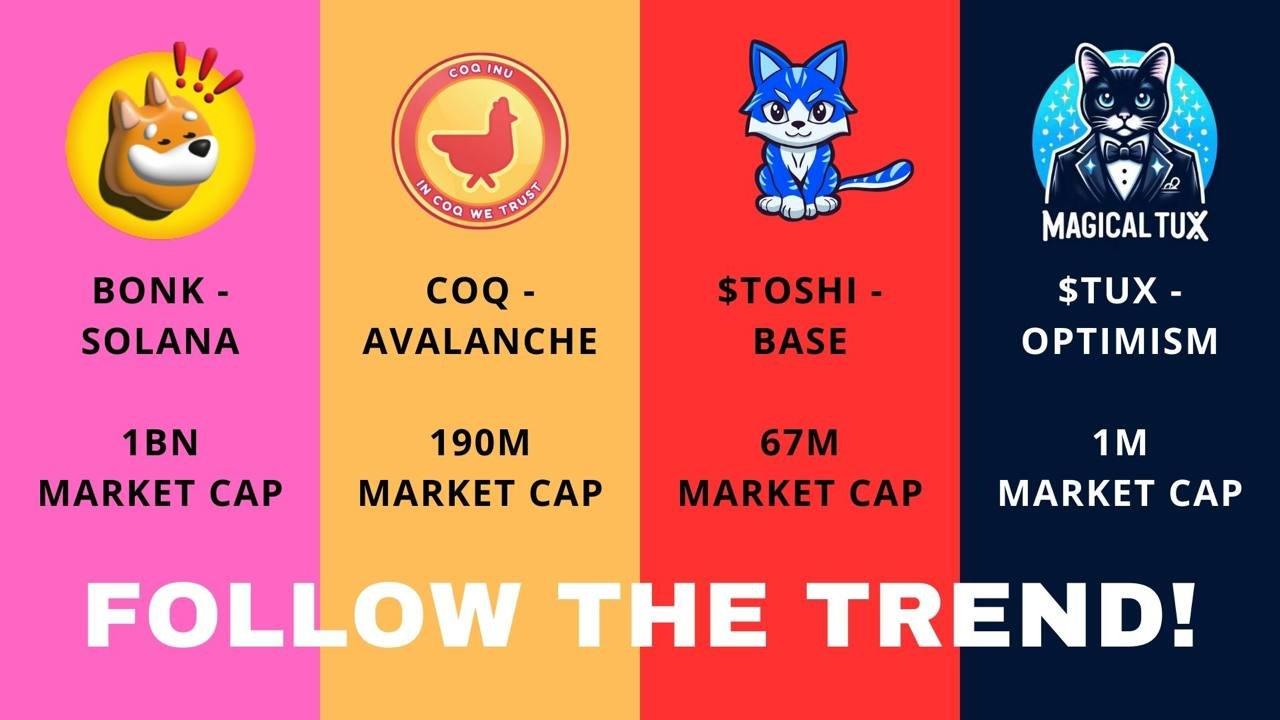
Additionally, meme coins on OP are worth watching. TUX, dubbed the “first optimistic cat,” is the most popular, currently priced at $0.005601 with a 24-hour gain of 204%, according to DEXSCREENER.
ARB Ecosystem
Today, Vitalik posted on Warpcast: “Glad to see that this year, one Rollup has entered Stage One (and several others are very close). This is real decentralization progress. Hoping to see ten Rollups reach Stage One next year, achieving some degree of sequencer decentralization.” From the screenshot Vitalik shared, it’s clear he was referring to Arbitrum.
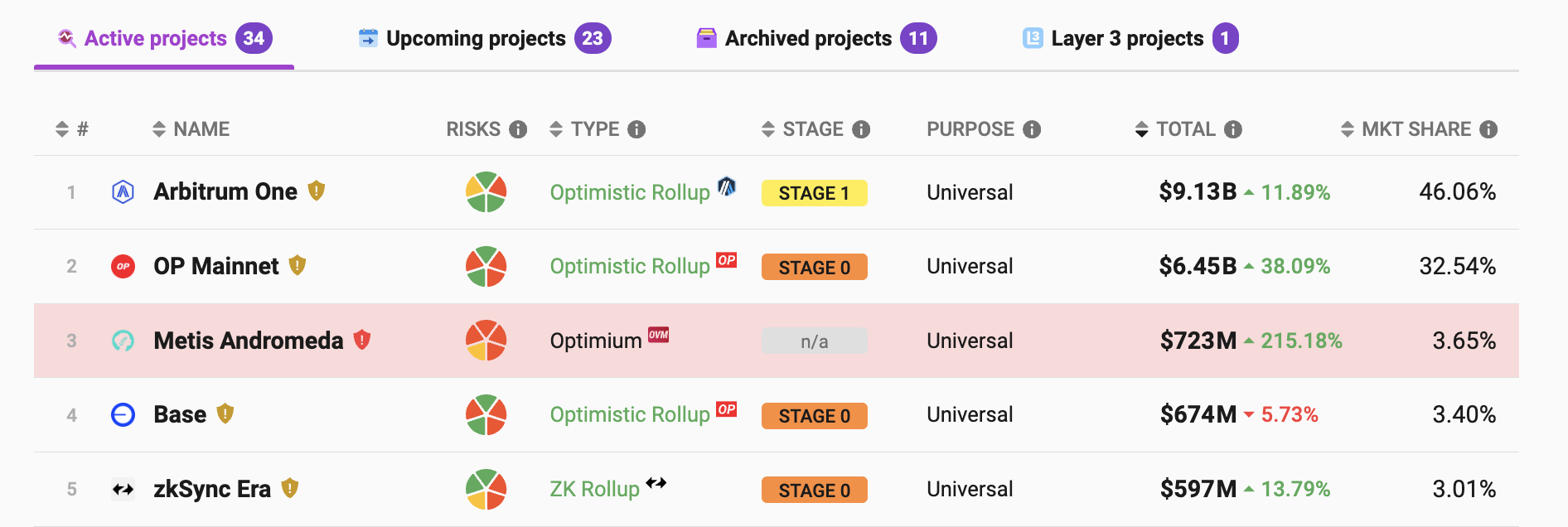
Based on a phased development framework initially proposed by Vitalik on the Ethereum Magicians forum and later summarized by L2beat, a Rollup must meet five criteria to advance from Stage 0 to Stage 1:
-
Deployment of a complete and fully functional proof system;
-
At least five external participants capable of submitting fraud proofs;
-
Users can exit without requiring permission from operators;
-
If a more centralized actor than the Security Council implements an unnecessary upgrade, users have at least seven days to exit;
-
Properly established Security Council.
As the leading Layer 2 solution, Arbitrum being the first project explicitly highlighted by Vitalik at this juncture makes it a particularly noteworthy ecosystem. ARB’s price has responded well to market sentiment—currently at $1.63, with a 24-hour gain of 19.61%.
The Arbitrum ecosystem has long been considered one of the most active Layer 2 environments. Today, crypto KOL Lanhu Notes pointed out that following the Cancun upgrade and significant fee reductions, Arbitrum is poised to evolve into a major hub for Web3 gaming, social applications, and more.
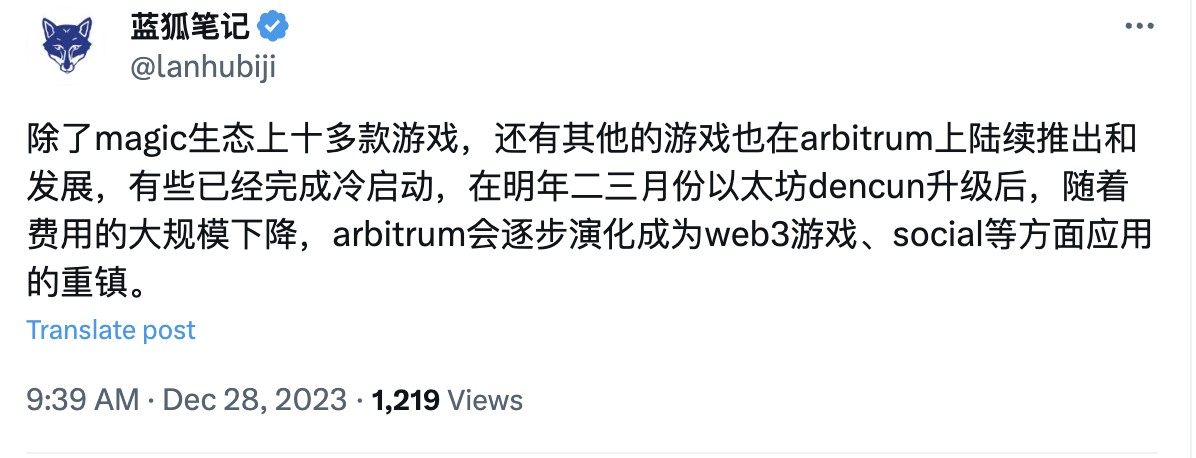
XPET, a social mini-game on Arbitrum, recently swept Twitter comments. The xPET team recently updated its whitepaper, introducing PVE/PVP features and enriching its game ecosystem. Its token XPET has consistently hit new highs, currently at $2.47 with a 24-hour gain of 93%.
Metis Ecosystem
Besides Arbitrum, another Layer 2 drawing attention due to its impressive price and TVL growth is Metis.
On December 18, the MetisDAO Foundation announced the creation of a ~$100 million fund to accelerate ecosystem growth. Named the Metis Ecosystem Development Fund, it will allocate 4.6 million METIS tokens for “sequencer mining, retroactive funding, new project deployments, and other initiatives.” Additionally, according to an official blog post, Metis is expected to become the first Optimistic Rollup with a decentralized sequencer early next year. Distribution from the Metis Ecosystem Development Fund will begin one week after the decentralized sequencer goes live.
Crypto researcher HaoTian believes Metis’ core business logic is simple: given that OP-Rollups have stalled on sequencer decentralization, Metis steps in by offering a viable decentralized sequencer solution—this is its market niche. Therefore, Metis’ performance next year is worth watching.
Recently, the hottest projects in the Metis ecosystem are Hummus and the meme coin VMUM. Hummus is a single-sided AMM built on Metis that allows users to swap stablecoins with minimal loss. Its native token is HUM. Users can stake stablecoins to earn HUM and use staked HUM rewards to boost yields on their staked stablecoins. VMUM is a meme coin launched on December 19, branding itself as the “mother of Vitalik.”
On December 5, Bankless co-founder Ryan Sean Adams wrote on social media: “Some say ETH at $2,200 is hilarious... ETH hasn’t even entered a bull market yet.” He emphasized that Ethereum’s fundamentals remain strong and that its true value has yet to be fully realized.
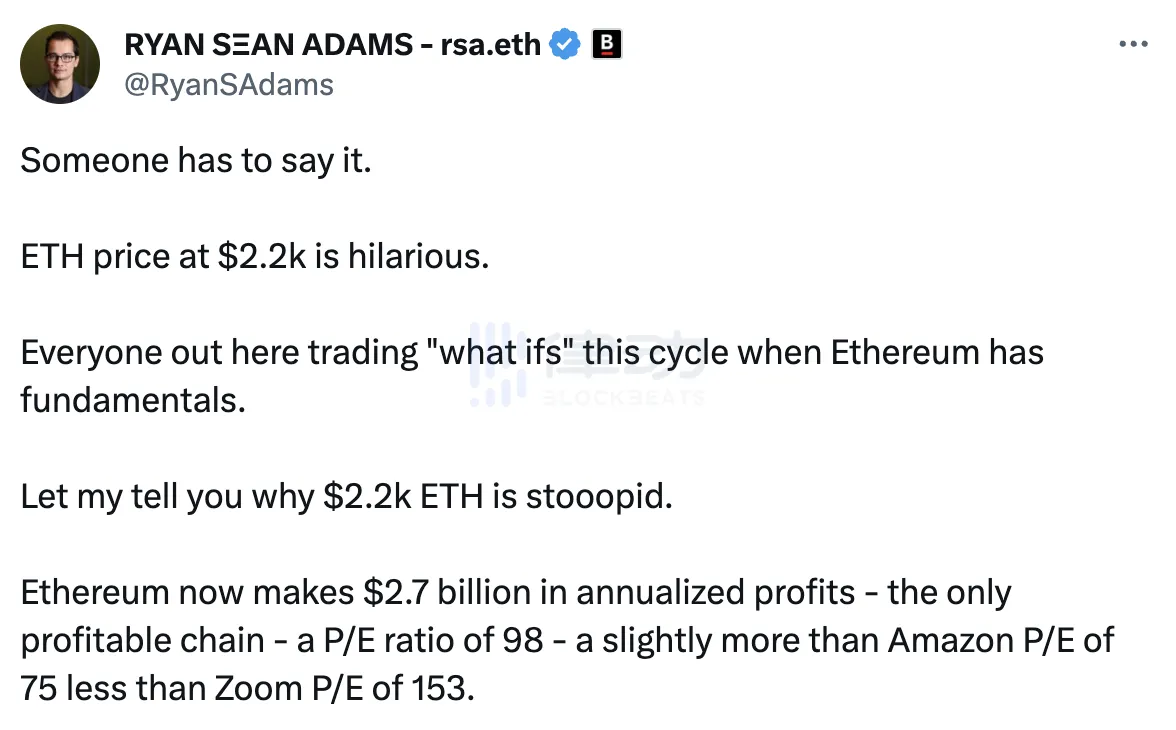
That statement sparked a major debate within the crypto community at the time. Looking back now, perhaps the answers to those debates will become clearer next year. Rather than saying Ethereum has taken revenge, it’s more accurate to say Ethereum hasn’t changed—the market has.
Join TechFlow official community to stay tuned
Telegram:https://t.me/TechFlowDaily
X (Twitter):https://x.com/TechFlowPost
X (Twitter) EN:https://x.com/BlockFlow_News
 BlockBeats









