








Helium's DePIN Past: Bitcoin, Arweave, and STEPN
TechFlow Selected TechFlow Selected
Helium's DePIN Past: Bitcoin, Arweave, and STEPN
As long as the project team isn't living extravagantly, it's not difficult for most projects—especially blockchain-level projects—to survive.
 Navigating Web3 tides with focused insights
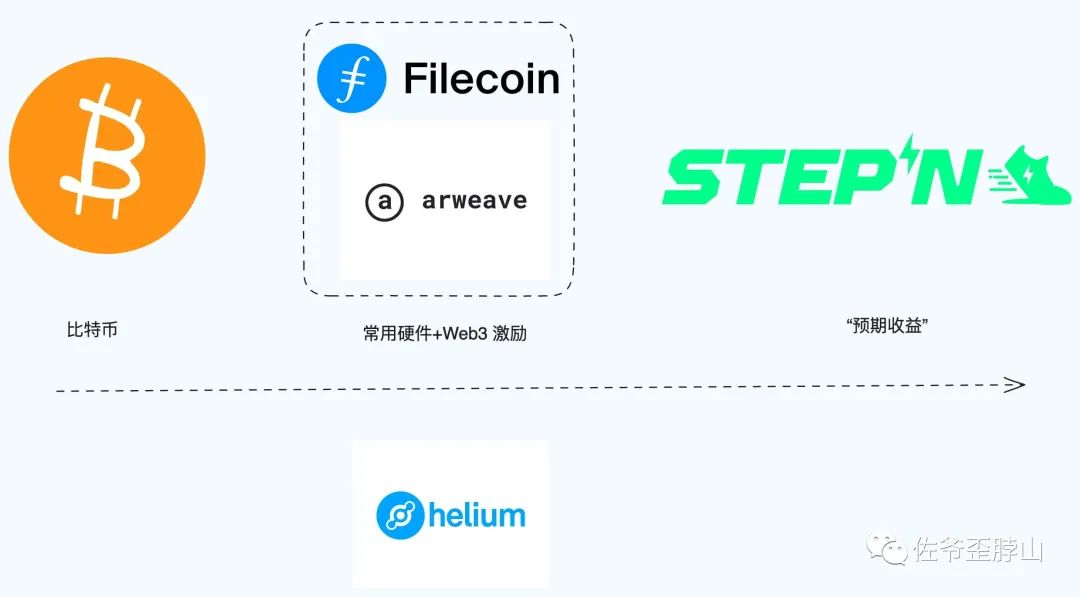
Helium represents the dedicated DePIN narrative, but prior to that, there were at least three significant contributions—alongside specialized hardware—that will constitute the core of the next-generation DePIN narrative.
-
The sanctity of physical hardware: Bitcoin and the PoW mechanism
-
FIL & AR: Commodity hardware + Web3 incentive layer
-
STEPN: Mass-market appeal mechanism + "discounted expected cash flow" monetization model
Messari's Retrospective: Tracing the Origin of the Term "DePIN"
Helium’s resurgence didn’t begin in December, but rather in July when it was listed on Coinbase. Prior to that, DePIN had attracted some market attention, yet Helium had already suffered multiple downturns in token price and repeated complaints from miners, maintaining a persistently heavy Ponzi-like sentiment.
Today, discussing Helium inevitably involves its 5G mobile data plans, which successfully attract users with genuine needs rather than those treating it purely as a financial game. Only with sufficient real users forming a large base of token holders can selling pressure be stabilized. The rumored incident where "Martians" swapped tokens with Sun's group and got rekt is essentially just another variant of dumping and bank runs.
By analogy to the relationship between StepN and various X-to-Earn (X2E) projects, it was the earlier wave of “IoT/ICT/AIoT + blockchain transformation” initiatives that preceded and gave rise to the term DePIN (Decentralized Physical Infrastructure Networks). Helium played a bridging role: if Helium had ultimately failed, DePIN would have struggled to recover; but since Helium has made a strong comeback, subsequent projects need only minor improvements to survive:
-
Micro-innovation: Improving upon the leading project Helium—such as Wi-Fi versus 5G, or satellites versus terrestrial networks;
-
Scene-shifting: Copying Helium’s model but applying it to different domains—for example, VPP (Virtual Power Plant) Starpower and green energy project Arkreen.
After tracing the etymology of the term DePIN, we must now examine actual projects. In DePIN, hardware matters most—not blockchain (software). Therefore, broadly speaking, any project combining hardware with a chain qualifies:
-
2007–2009: Formation of various Bitcoin mining rigs, evolving from personal CPUs to ASICs, cementing their reputation as power-hungry machines;
-
2014: The Filecoin model emerged, gradually attracting participants from Huaqiangbei. Prices rose steadily, becoming less about the original goal of decentralized data storage and increasingly focused on mining for tokens;
-
2017: IoTeX was founded. At the time, it stood out little among numerous public chains—an afterwave of the blockchain transformation craze. Its current relevance is largely coincidental;
-
2021: Helium reached its all-time high (ATH) at $50. While it didn’t match Ethereum’s performance during the same period, the fact that it can now even be compared to Ethereum shows how remarkable this achievement was;
-
Late 2022: Messari officially canonized the concept, formally establishing the term "DePIN."
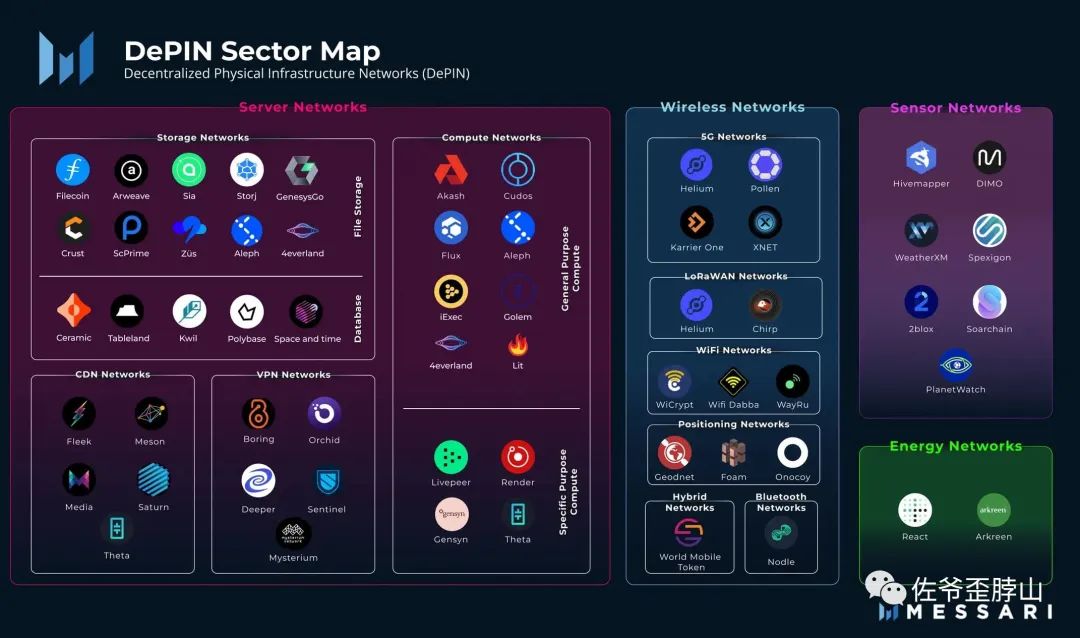
Messari divided DePIN into four major sectors: server networks, wireless networks, sensor networks, and energy networks—essentially combining off-chain data generation with on-chain verification. The focus lies on asset ownership and economies of scale, with relatively low emphasis on anonymity, decentralization, or extreme "fully-on-chain" operation.
Moreover, the classification appears overly broad. For instance, decentralized databases (DDB), while involving hard drives at the infrastructure level, have become highly decoupled from underlying hardware in modern implementations. Their forced inclusion raises serious suspicion of padding the list.
If I were to categorize DePIN, it should meet one of two criteria: first, custom-built dedicated hardware like Helium; second, a dedicated incentive layer that integrates common hardware into a Web3 network—such as Render Network, which pools individual idle GPUs for others to rent.
The Sanctity of Physical Hardware
Bitcoin has long been criticized externally for excessive power consumption. But conversely, this creates a foundational pricing benchmark effect: consumed electricity becomes burned civilization—one kilowatt-hour equals a beam of light illuminating Bitcoin’s value.
When Ethereum transitioned to PoS, debates intensified. Environmental friendliness is not only correct—it's politically correct. Yet PoW (specifically referring to work performed by physical hardware) possesses an advantage PoS cannot replicate: tangible connection to the physical world, and crucially, a *transferable* physical linkage.
While OFAC may not fully control the Ethereum network, it certainly cannot control the Bitcoin network—that’s the key difference. I call this the sanctity of physical hardware. Amid today’s dominance of virtualization technologies, only Bitcoin remains steadfast in upholding this principle.
Arweave & FIL: Long-termism vs. Short-term Speculation
Next comes recognition of the powerful innovation behind FIL and Arweave—leveraging existing physical hardware through a Web3 incentive layer. The frenzy around FIL needs no elaboration; anyone interested should talk to a miner and hear their bitter stories of being repeatedly exploited by FIL.
Arweave’s significance, however, has long gone unrecognized by the market. In my view, AR exemplifies how even marginally successful projects can survive. Despite recent internal conflicts making headlines, AR lags far behind FIL in terms of node count, network scale, and stored data volume. Yet AR continues to persist—precisely because today’s Web3 remains a realm of niche demand fueled by abundant speculative capital, keeping operational costs manageable.
As long as project teams avoid extravagance, survival itself isn't difficult—even for most public-chain-level projects.
The real challenge is breaking into the mainstream. On this front, Helium initially “harvested” a wave of early miners. Today’s spotlight is on Helium 5G, not the original Helium Wi-Fi model. Projects that truly break into Web2 spaces are extremely rare—aside from Bitcoin, perhaps only STEPN fits the bill. STEPN shares similarities with both DePIN and Bitcoin mining hardware: they all rely on “discounted expected cash flows” tied to physical assets—the only difference being whether the asset is a mining rig or a pair of shoes.
But here’s a universal truth: the pricing of DePIN hardware—at $99, $999, or $9,999—is never due to technical sophistication from Shenzhen’s Huaqiangbei. It reflects miners’ expectations of short payback periods or long passive income streams. This isn’t merely similar to STEPN’s model—it’s identical. However, STEPN differs from dedicated DePIN hardware in one critical aspect: fitness isn’t just a Web3 user demand—it’s a global mass market. People will exercise regardless of incentives:
-
STEPN: Targets the fitness market, adding extra incentives atop everyday workouts;
-
Dedicated DePIN: Targets Web3 miners—tokens are only for selling, hardware serves only one function;
-
Commodity hardware + added incentives: Aggressive speculation = FIL; slow and steady = Arweave.
This isn’t about endorsing any particular model, but rather urging clarity: “Before joining as a miner, ask yourself—beyond speculation and mining, what is your actual need?” If you genuinely want to stay fit, getting into STEPN now is still timely. But spending $999 on a Web3 Wi-Fi device? That risk is entirely yours—because no rational person would do that.
Join TechFlow official community to stay tuned
Telegram:https://t.me/TechFlowDaily
X (Twitter):https://x.com/TechFlowPost
X (Twitter) EN:https://x.com/BlockFlow_News
 @zuoyeweb3









