








Coinbase CEO: Cryptocurrency is the future of money
TechFlow Selected TechFlow Selected
Coinbase CEO: Cryptocurrency is the future of money
As the use of cryptocurrency continues to grow, so does its utility.
 Navigating Web3 tides with focused insights
By Brian Armstrong, CEO of Coinbase
Translated by Songxue, Jinse Finance
Cryptocurrency isn't just here to stay—it's the future of money. The industry has moved past the illicit activities that once held it back; compliant growth has arrived. After a major market correction, crypto’s value has risen 90% this year, with trading volume up 60% in the fourth quarter. Globally, 425 million people now participate in the industry, and 83% of G20 nations and major financial centers have established or are developing regulations to create clarity. With this scale and momentum, innovation continues to accelerate. The U.S. Securities and Exchange Commission’s approval of spot Bitcoin ETFs could spark a new wave of growth for crypto as an asset class. But as adoption grows, so does utility—evolving crypto from an asset class into a necessary upgrade for century-old financial systems.
Every day, more consumers who grew up with the internet expect to transfer funds with speeds, reach, and autonomy that traditional financial institutions—or even online payment systems built atop them—simply can’t deliver. They also want low-cost transfers, without powerful intermediaries restricting access and charging high fees and interest rates. Today in the U.S., half or more of key consumer and voter groups are actively seeking alternatives to the current system—including 52% of adults aged 18–40, six in ten Black Americans, and nearly half (47%) of Hispanic Americans. Cryptocurrency is helping build a more open, global system.
-
Over 100,000 merchants and payment channels worldwide now accept cryptocurrency payments, including PayPal and Visa. Drivers include lower fees, faster transactions, and access to new customers.
-
In 2022, global on-chain stablecoin transfers neared $9 trillion—more than the combined volumes of Mastercard, American Express, and Discover. Stablecoins enable currencies like the U.S. dollar to exist digitally. They are faster, cheaper, and more accessible than fiat, while remaining equally stable and secure. For everyday users, they offer the benefits of cash without its drawbacks. In countries with unstable governments or currencies, they provide citizens with safe cross-border transactions.
-
Countries with lower economic freedom—such as Argentina, Brazil, and Nigeria—are among the highest adopters of crypto payments and holders of crypto wealth (and also among the most populous nations in the world).
-
Workers abroad use cryptocurrency for remittances. About one in nine people globally depend on them. Crypto transfers are on average 96% cheaper than other methods and settle in about 10 minutes, compared to up to 10 days elsewhere.
-
Global financial hubs like London, Zurich, Hong Kong, and Singapore are transforming themselves into crypto centers to capture jobs and talent from a more open, globalized system.
Cryptocurrency empowers people with economic freedom—ensuring access to their own funds and fair participation in an economy not constrained by powerful legacy institutions—enabling individuals to build, create, and own their assets. Coinbase’s mission is to increase economic freedom for over a billion people. As crypto’s use cases expand, we’re focused on building the most trusted, compliant products and services, supporting developers, and advocating for fair rules—so the benefits of crypto can be realized in the U.S. and around the world:
Coinbase Wallet is transforming global remittances, enabling anyone to send money anywhere in the world instantly and with zero fees. No charges, no waiting for funds to clear.
Base, a decentralized, open L2 incubated by Coinbase, is laying a new foundation for our vision: payments that settle in one second, cost less than a penny, and empower anyone, anywhere to build incredible on-chain applications.
Our new international exchange, offering spot and perpetual futures trading, is becoming a cornerstone of the global crypto ecosystem—redefining industry standards through our roots in trust, security, and ease of use.
Our “broad and deep” international expansion strategy is accelerating global crypto adoption. We’ve recently secured licenses or expanded in key markets such as Canada, Spain, and Bermuda, and designated Ireland as the location for our EU MiCA entity.
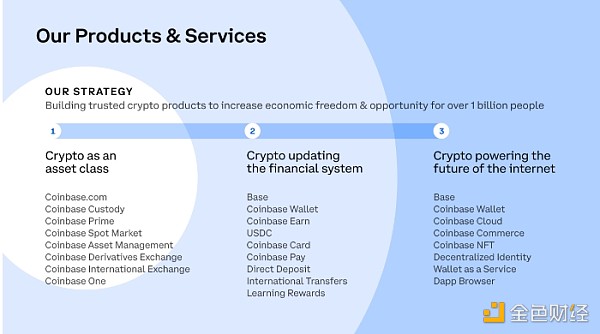
Coinbase is building a stage of clear rules, partnerships, and trusted products and infrastructure to support innovation today and tomorrow—from the ongoing modernization of financial systems to the next chapter of crypto, when one billion people globally use decentralized, crypto-based services for cloud computing, commerce, and beyond. On-chain is the new way to be online.
Coinbase chose to become a publicly traded company in the U.S. because we believe in markets, compliance, and transparency. Our mission is especially vital for the United States at a time when the American Dream and the democratic values it represents are under threat. Both can only thrive where economic freedom exists. We believe the U.S. will ultimately get crypto right. In the meantime, we’ll continue partnering with countries moving forward and embracing the next chapter of crypto, advancing a more open, global financial system. Crypto and Coinbase are just getting started.
Join TechFlow official community to stay tuned
Telegram:https://t.me/TechFlowDaily
X (Twitter):https://x.com/TechFlowPost
X (Twitter) EN:https://x.com/BlockFlow_News










