








Chasing the Hype of Bitcoin and Inscriptions: How These Veteran Projects Are Blooming Anew
TechFlow Selected TechFlow Selected
Chasing the Hype of Bitcoin and Inscriptions: How These Veteran Projects Are Blooming Anew
Inscriptions have successfully expanded to nearly all notable public blockchains, and for non-smart contract chains like Bitcoin, inscriptions are even more significant.
 Navigating Web3 tides with focused insights
Author: Jiang Haibo, PANews
The rise of Bitcoin and the booming inscription ecosystem have formed the dominant narrative in the cryptocurrency world this year. Bitcoin's price increase has been driven by a thriving on-chain ecosystem, expectations of spot ETF approvals, halving anticipation, and anticipated Federal Reserve rate cuts, all significantly accelerated by institutional investor participation—factors that collectively fueled its notable growth this year.
Moreover, the inscription ecosystem, particularly non-fungible tokens (NFTs) and fungible tokens (FTs) represented by Ordinals, has not only injected new vitality and attention into the Bitcoin ecosystem but also spilled over to other public blockchains. Nearly all major public chains have developed their own inscription mechanisms. Existing projects are continuously joining in, revitalizing themselves by leveraging the trend.
Bounce’s Bitcoin Ecosystem Project Auctions and Layer 2
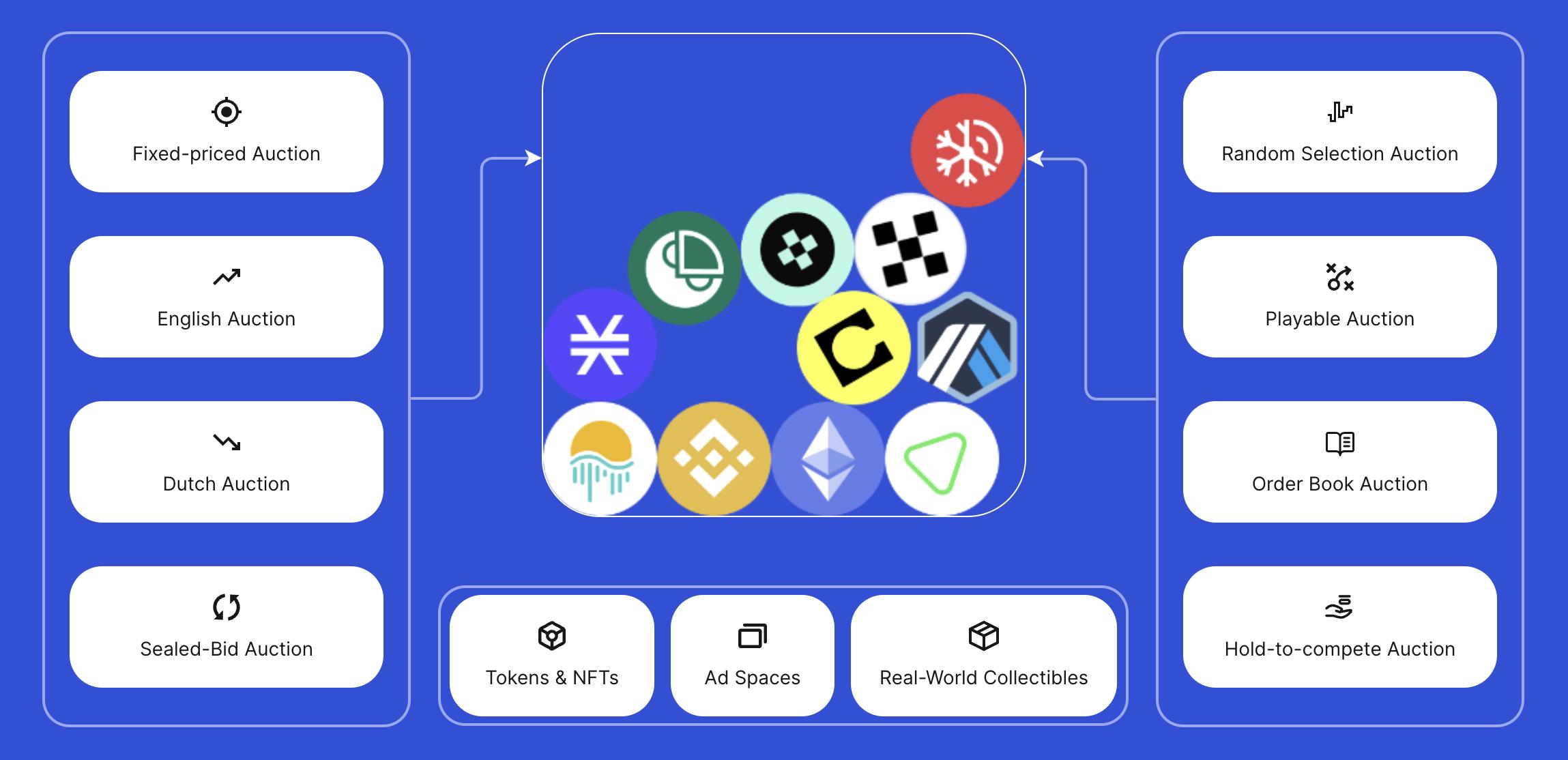
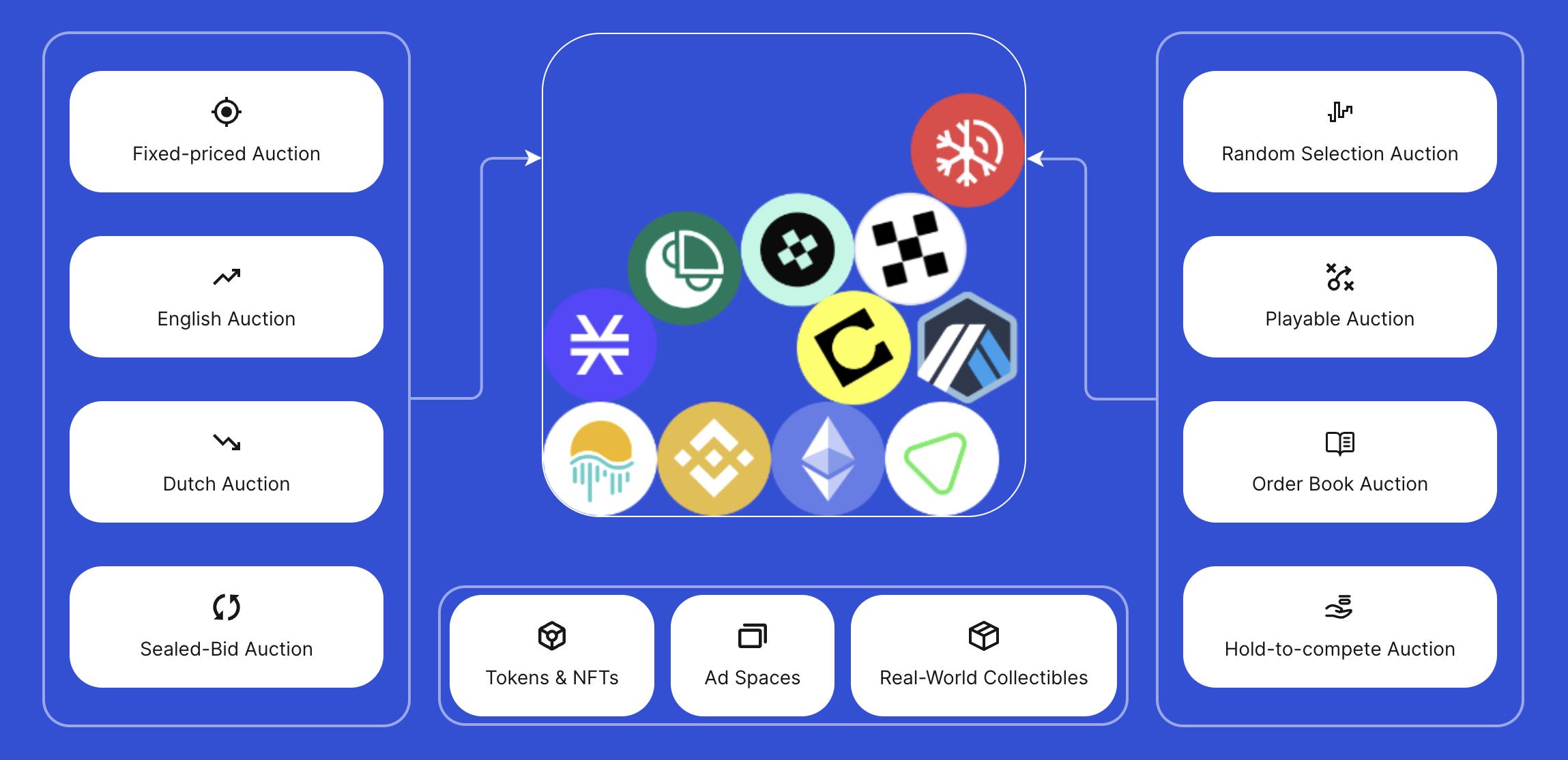
Bounce Finance is an auction-as-a-service (AaaS) protocol providing one-stop token issuance solutions for projects. The platform supports multiple blockchain networks, enabling users to create and participate in various types of auctions, including token and NFT auctions, physical collectibles auctions, advertising space auctions, and more.
Recently, Bounce launched auctions for several Bitcoin ecosystem projects. These projects initially had low valuations, and later auctions allowed earlier project tokens to be used as "shovels"—creating strong performance incentives across the board. Since Bounce’s native token AUCTION also serves as a key shovel in these auctions, its price has risen accordingly.
Taking the recent GoDID auction as an example, GoDID is a decentralized identity (DID) marketplace aggregating services for ENS, Space ID, and Bitcoin Ordinals DID. The BDID token allocates 20% to users who purchase lottery tickets with AUCTION, 40% to AUCTION stakers, 20% to stakers of DAII—the dollar-pegged stablecoin issued by BitStable, the previous Launch project—and 5% to participants in airdrop mining using MUBI, BSSB, AUCTION, or WBTC, where MUBI and BSSB were prior auction projects.
In December, Bounce also announced BounceBit, a blockchain solution designed specifically for the Bitcoin ecosystem—a Bitcoin Layer 2 built on Binance BTCB and AUCTION, scheduled for launch in 2024.
Uniswap Expands to Rootstock
Uniswap is a leading decentralized exchange (DEX). Over time, Uniswap has released multiple versions and expanded across numerous chains.
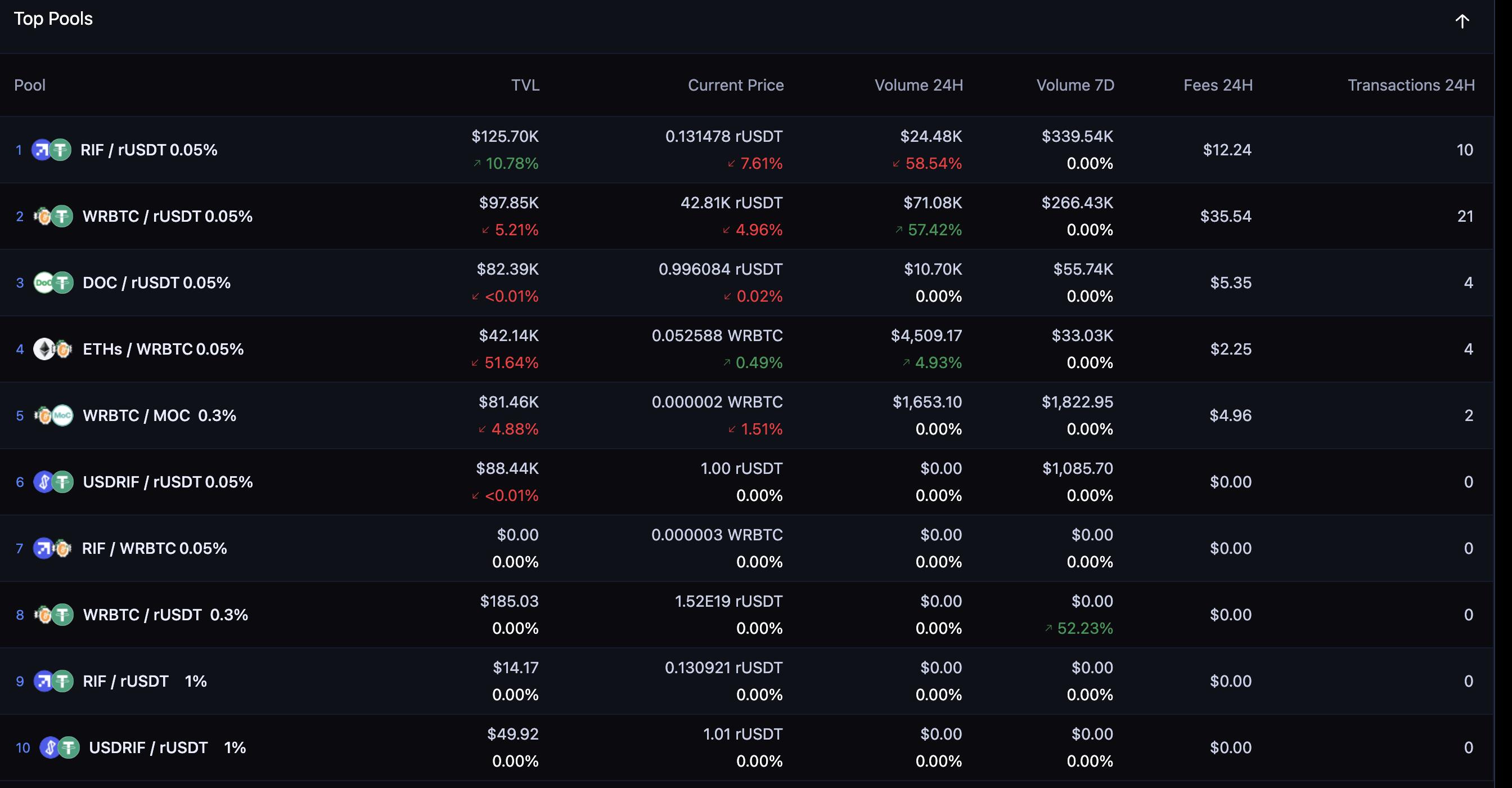
Last week, GFX Labs deployed Uniswap V3 onto Rootstock, a Bitcoin sidechain, via Oku—an action widely seen as Uniswap’s expansion into the Bitcoin ecosystem. GFX Labs received funding from the Uniswap Foundation to build Oku, a trading frontend based on Uniswap V3. Oku features an order book, price charts, transaction history, limit orders, and other functionalities.
Rootstock (RSK) is a sidechain based on the Bitcoin network, compatible with the Ethereum Virtual Machine (EVM), secured through merged mining with Bitcoin, and backed by SBTC, a 1:1 pegged Bitcoin derivative. RSK employs a federation model consisting of trusted entities responsible for managing asset transfers between Bitcoin and RSK, adding an extra security layer to ensure safe cross-network asset movement.
As of December 19, liquidity on Oku stood at $535,000.
NFT Marketplace Magic Eden
Magic Eden is primarily an NFT marketplace focused on the Solana blockchain. It holds significant influence within the Solana ecosystem, offering a user-friendly interface that enables artists, collectors, and NFT enthusiasts to easily buy, sell, and explore NFTs. Key features include low transaction fees, fast transactions, and diverse NFT collections, making it one of the most popular NFT marketplaces in the Solana ecosystem.
In March this year, coinciding with the rise of Ordinals NFTs, Magic Eden announced its expansion into the Bitcoin ecosystem—a crucial step toward its multi-chain vision—further solidifying its position in the multi-chain NFT marketplace landscape.
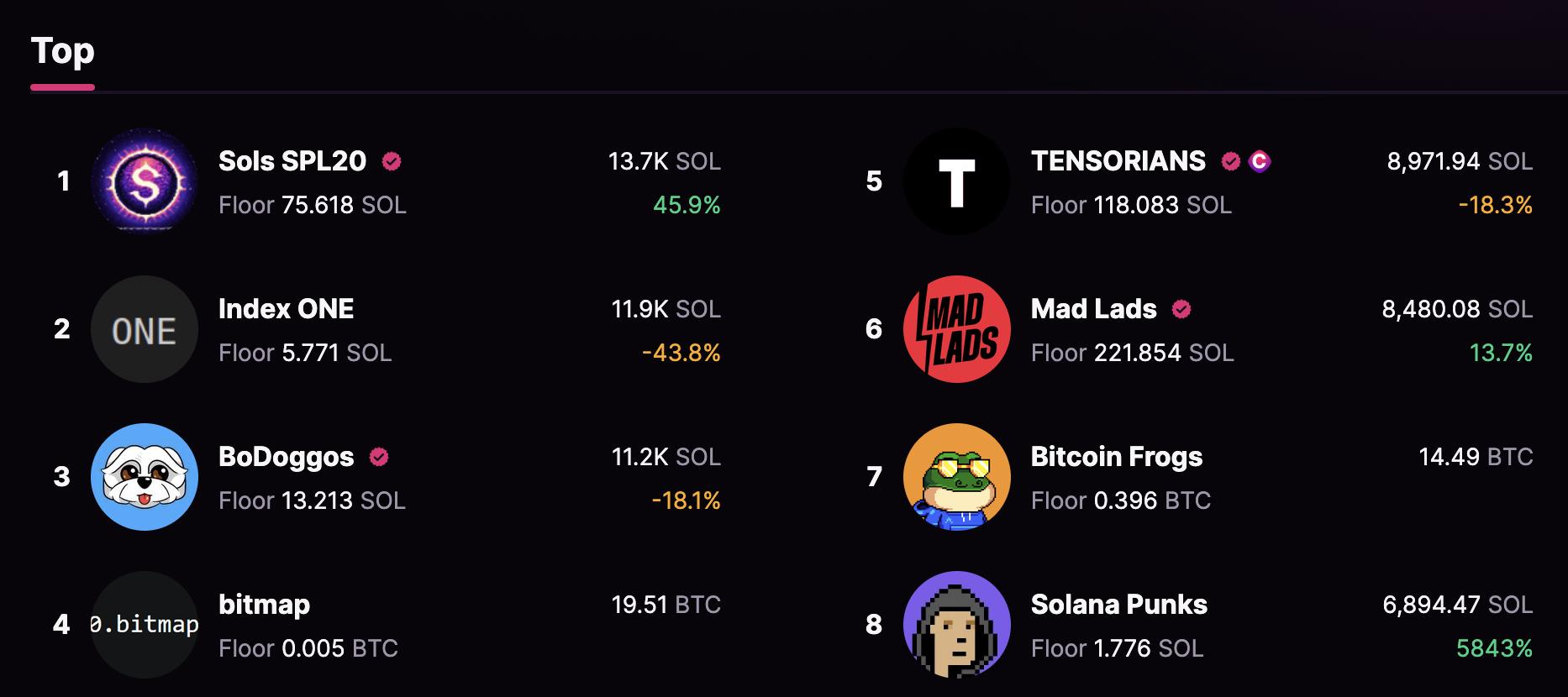
As shown in the figure below, Bitcoin-based NFTs such as bitmap and Bitcoin Frogs now rank among the top in trading volume on Magic Eden.
Nostr: Combining Decentralized Social with Micropayments
Nostr is a decentralized social protocol supported by Twitter co-founder Jack Dorsey. Originating in November 2020, its goal is to build a global, decentralized, censorship-resistant communication network.
In September this year, Nostr upgraded via NIP-57, introducing micropayment functionality called "Zaps," allowing users to send small tips or payments directly through Nostr clients, enabling fast, low-cost payments within the Nostr ecosystem. Zaps are primarily implemented via the Lightning Network, ensuring high efficiency and low costs.
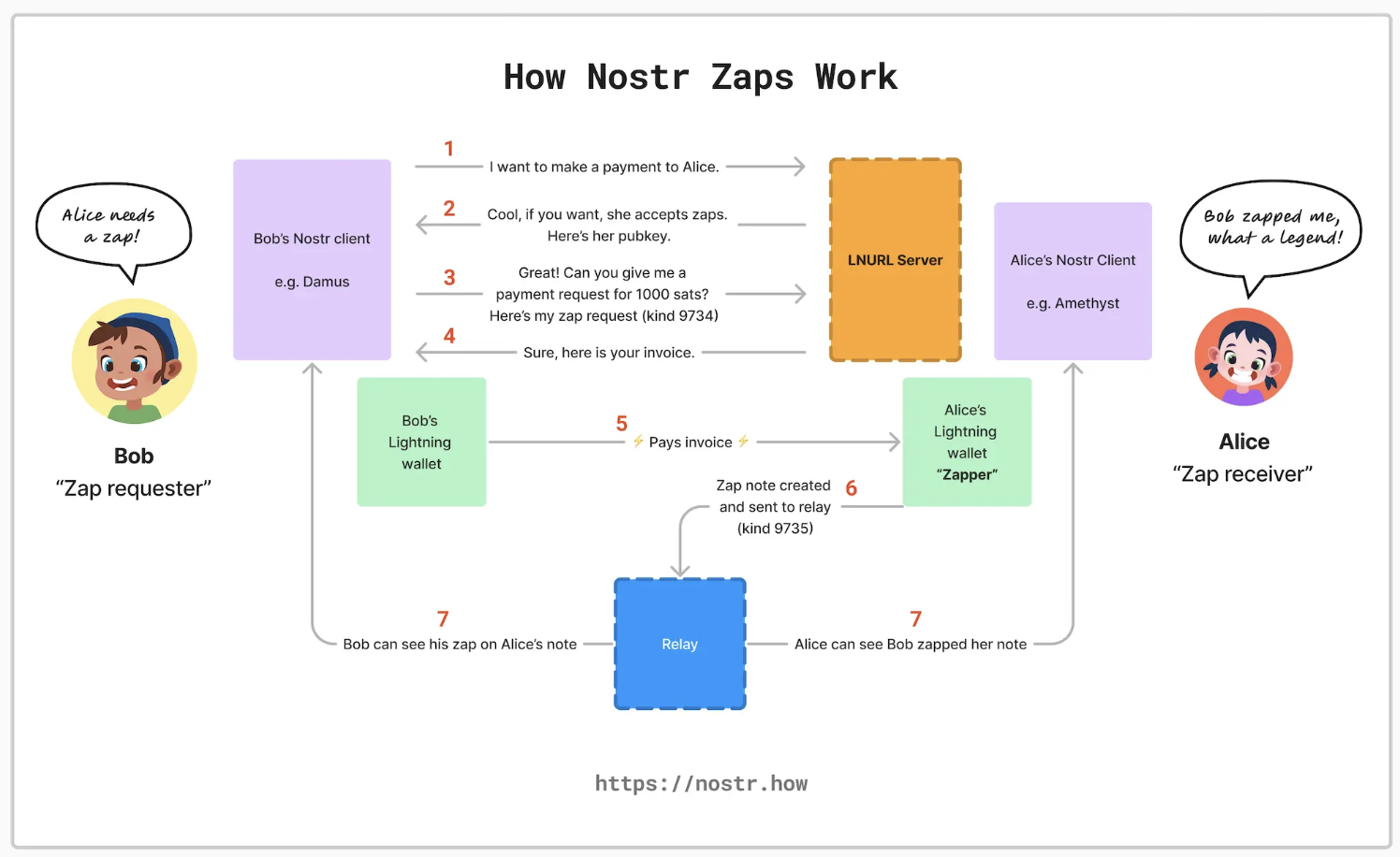
After a user initiates a Zap request from a Nostr client, if the recipient’s Lightning wallet supports Zaps, an LNURL server responds and confirms the recipient’s public key. The client then creates a Zap request containing key payment data, and the LNURL server replies with the required invoice. Once the payer completes the transaction, the funds are sent directly to the recipient’s Lightning wallet.
To date, the number of Zap transactions has exceeded 50,000.
ALEX’s B20 and Oracle
ALEX was originally a DeFi (decentralized finance) platform on Stacks, offering a DEX as its main product, along with a Launchpad, cross-chain bridge, staking, mining, lottery, and other functions. According to DefiLlama data, ALEX’s TVL stands at $38.8 million, accounting for approximately 82.3% of Stacks’ total TVL. Judged solely as a leading DEX on a single public chain, ALEX’s valuation would be constrained, especially given its relatively low liquidity and trading volume.
Following the boom in inscriptions, ALEX developed B20, a decentralized exchange dedicated to trading BRC20 tokens. ALEX also provided new users with STX tokens to cover gas fees within the ecosystem. On B20, these BRC20 tokens can be traded using sUSDT as the base currency—sUSDT being USDT bridged from the BNB Chain to Stacks.
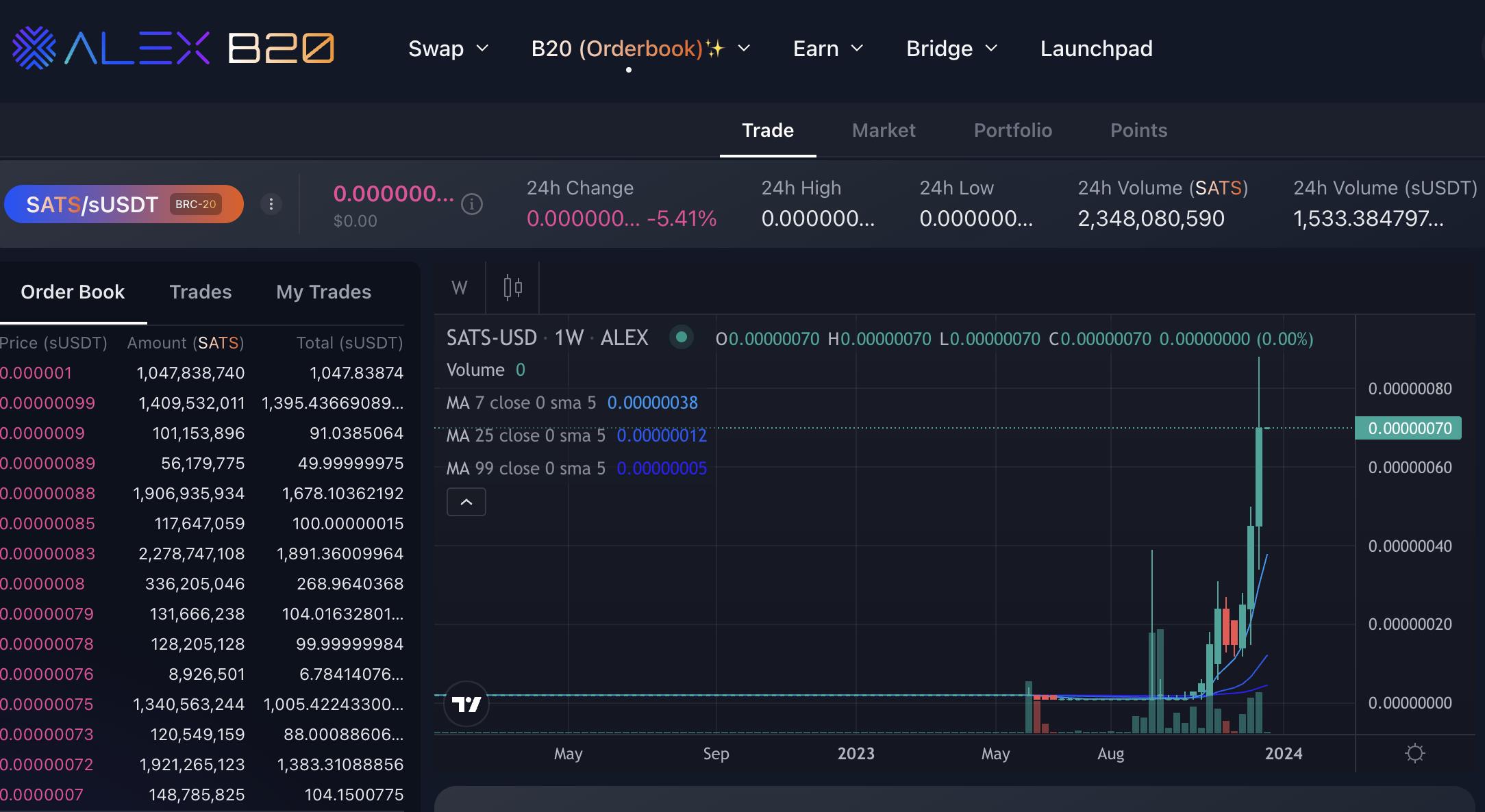
Additionally, ALEX plans to launch the first Bitcoin oracle for BRC20 tokens, developed in collaboration with @domodata, the creator of BRC20 and an ALEX advisor, alongside key off-chain indexers such as BestinSlot, OKX, Hiro, and Unisat. Leveraging Stacks’ programmability and ability to read Bitcoin’s state, ALEX aims to lead decentralized consensus for BRC20 indexing—dubbed the “indexer of indexers.” The Bitcoin oracle will verify every BRC20 event and update global balances in decentralized, on-chain contracts.
Inscription Boom Across Public Chains
Inscriptions, led by Ordinals, have flourished on Bitcoin, with ORDI and SATS both surpassing $1 billion in market capitalization. Projects like Ordinals allow users to attach data—such as text or images—to specific parts of transactions, linking that data to individual satoshis. When such transactions are included in a block, those satoshis carry the attached data. These unique satoshis become distinct digital assets that users can transfer to others, enabling ownership transfer of specific assets.
If inscriptions have introduced a new way of issuing assets on Bitcoin, which previously lacked smart contract support, do inscriptions still hold meaning on other blockchains? Incomplete statistics indicate that over 30 public chains have launched or plan to launch inscriptions, including ETHS on Ethereum, SOLS on Solana, and AVAV on Avalanche. The minting process has even caused temporary outages on networks like Arbitrum, TON, and IOST.
On the evening of December 19, the minting of INJS, the first inscription on Injective, turned into a fiasco. Each INJS mint required users to pay a 0.03 INJ fee to the contract deployer, sparking backlash from inscription enthusiasts. As minting began, Injective’s official Twitter account urged users not to participate, calling the team’s fee-charging practice inappropriate. Subsequently, INJS halted minting and announced future mints would be free—highlighting users’ demand for free launches (Free Launch).
What differentiates inscription transfers on smart contract chains from standard smart contract token transfers? Taking Ethscriptions on Ethereum as an example, Ethscriptions may incur lower transaction fees than traditional smart contract transfers because they reduce costs by utilizing calldata and avoiding conventional smart contract storage and execution. This makes Ethscriptions a more cost-effective method for on-chain operations.
However, bypassing traditional smart contract storage and execution may introduce new security vulnerabilities or unpredictable behaviors, especially when handling complex data structures or logic. Moreover, relying solely on calldata may prevent Ethscriptions from accessing the full range of features and flexibility offered by smart contracts, potentially limiting their practicality in certain applications.
Summary
In the development of the Bitcoin ecosystem, Bounce’s unique auction mechanics have created strong wealth-generation effects and plans to develop a Bitcoin Layer 2; Nostr integrates decentralized social networking with micropayments; ALEX has built a BRC20 trading market and plans to launch the first decentralized Bitcoin oracle; Uniswap and Magic Eden have both extended their core services into the Bitcoin ecosystem.
Inscriptions have successfully spread across nearly all noteworthy public chains. For non-smart-contract chains like Bitcoin, inscriptions are particularly significant. For Ethereum, inscriptions reduce on-chain storage and execution costs compared to traditional smart contracts but may introduce new security risks and lack the functional flexibility of full smart contracts.
Join TechFlow official community to stay tuned
Telegram:https://t.me/TechFlowDaily
X (Twitter):https://x.com/TechFlowPost
X (Twitter) EN:https://x.com/BlockFlow_News
 PANews









