








"Wealth creation myth" fuels FOMO in inscriptions, projects turning "unfair play"
TechFlow Selected TechFlow Selected
"Wealth creation myth" fuels FOMO in inscriptions, projects turning "unfair play"
Compared to farce, what's more terrifying is the trap.
 Navigating Web3 tides with focused insights
By: Weilin
“Minting iotx inscriptions at 1 a.m., minting Tia inscriptions at 2 a.m., minting inj inscriptions at 3 a.m., minting op inscriptions at 4 a.m.…” This widely shared post on social media encapsulates Web3 users’ frenzy for the inscription market.
Since December, the method of minting crypto assets (fungible or non-fungible) using blockchain networks like Bitcoin has exploded in popularity—leaving many Web3 enthusiasts literally “melted” from exhaustion.
The surge largely stems from the price explosions of two tokens, ORDI and SATS, after their listings on centralized crypto exchanges. They are BRC-20 tokens within the Bitcoin inscription ecosystem.
The former surged from a low of $2–3 to as high as $68, achieving a market cap of $1.3 billion. The latter became this year’s hottest “zero-elimination game,” rising from a price with nine decimal places to 0.00000092 USD—erasing two zeros and increasing 100-fold. Their early generation prices on the Bitcoin network were even lower than when they debuted on secondary markets.
The “wealth myth” driven by skyrocketing secondary market prices has become the catalyst pushing Web3 players to obsessively mint inscriptions. Rumors circulated online that a certain whale who invested in ORDI and SATS half a year ago has already cashed out $36 million and achieved “quick financial freedom.”
Such stories always excite speculators and draw massive traffic. Anonymous project teams are quick to respond, launching various inscription tokens for users to “mint.” As a result, blockchains including Bitcoin, Ethereum, Solana, Avalanche, and Injective have all experienced network congestion and soaring transaction fees—clear evidence of market mania.
On the flip side, the current “wealth effect” isn’t as strong as imagined—and carries hidden risks. In the P2P wallet trading zone for BRC-20 inscription tokens, there are far more sell orders than buy orders, indicating weak liquidity in the 1.5-level market. Major exchanges that truly aggregate capital and traffic list few new inscription tokens. The INJS inscription project on the Injective chain collapsed and issued refunds within 12 hours. Fraudulent websites, fake inscriptions, and cases of asset theft have also emerged.
The inscription market is beginning to spawn unethical chaos amid its irrational growth.
The Myth of Wealth Creation
“Profited over $36 million, achieving massive wealth transformation.” This story comes from an analysis post by crypto KOL @riyuexiaochu on X, dated December 13. He observed that an address holding 64 trillion SATS tokens “sold all holdings for profit after SATS launched on Binance, amounting to $36 million, roughly 260 million RMB.”
@riyuexiaochu also found that this address, which had previously aggregated tokens, once held nearly 1 million ORDI tokens, selling them all on Gate.io on May 12. “At a price of $10–12, it was worth tens of millions of dollars. He bought them a few days after April 20, so he likely profited over $5 million.”
This analysis of SATS and ORDI’s on-chain data attracted 144,000 views. Some commenters showcased accounts showing $32.89 million in unrealized SATS gains, adding, “Thanks, I’m quitting now.” Others used their posts to pump another BRC-20 token, DOVI. More still promoted the “number inscription” 3518.
Calls to buy various letter-and-number-named inscription tokens flood X and Binance’s social feed “Plaza,” where multiple versions of inscription “rags-to-riches” tales circulate alongside guides and stories of sleepless nights spent minting.
The price surges of ORDI and SATS fuel these myths and the chase behind them. Dubbed “inscription tokens,” both have unique backstories—but share common traits: they’re built on the Bitcoin blockchain, and their creators are anonymous.
ORDI was launched on March 8, 2023, by X user @domodata, a developer who used the Ordinals protocol—which assigns numbers to the smallest unit of Bitcoin, the satoshi (sat)—to issue an “experimental BRC-20 token ORDI.”
The Ordinals protocol was released on Bitcoin’s mainnet in January 2023 by software engineer Casey Rodarmor. Casey originally intended to bring NFTs to Bitcoin, but @domodata standardized metadata formatting, giving the Ordinals protocol ERC-20-like capabilities—enabling anyone to issue fungible tokens. Crucially, these are tokens issued directly on the Bitcoin network.
Thus, ORDI was born, with a total supply of 21 million tokens—a nod to Bitcoin’s cap. Initially, ORDI traded for just $0.005 within the wallet used to mint it. By May, it began appearing on centralized exchanges, spiking to $17 upon listing—an increase of 3,400 times. Even after falling back to $2–3, it still saw gains of 300–500 times.
Even at this stage, the excitement around ORDI remained confined within the niche “inscribing” community, where many other tokens followed @domodata’s model, created and left for enthusiastic users to mint.
Within a month of ORDI’s launch, over 2,000 BRC-20 tokens emerged—including the later-popular SATS.
Today, UniSat, the Bitcoin inscription wallet, lists over 58,000 types of BRC-20 tokens, with an average of 6,500 new ones monthly. Most are self-created by anonymous individuals. Over 20,000 tokens have completed full minting, yet only 22 have more than 5,000 holder addresses.
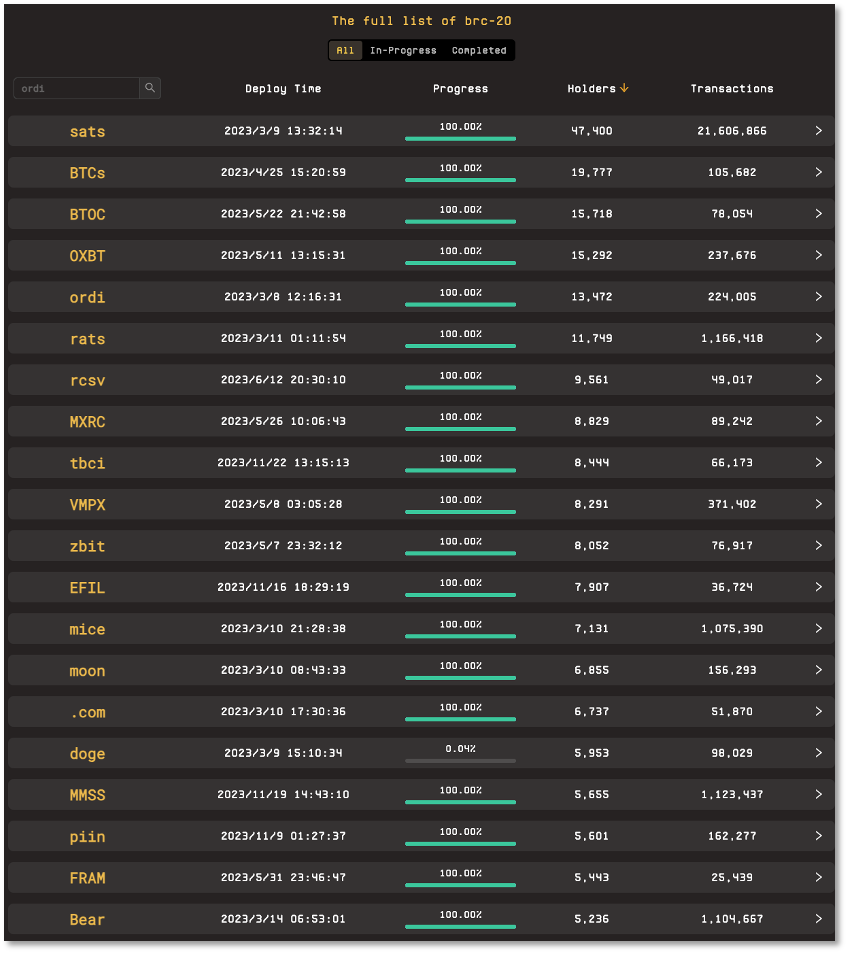
Top 20 BRC-20 Tokens by Holder Count
Minting inscriptions has caused Bitcoin transaction fees to spike. On December 19, Dune Analytics reported that total fees from minting inscriptions via the Ordinals protocol reached 4,282.5 BTC—approximately $176 million.
The reason for the explosion of BRC-20 tokens remains ORDI’s price action. The climax came on November 7, when Binance, the world’s largest crypto exchange, listed ORDI. The token then surged from around $5 to a peak of $69.8—a 1,296% gain in less than a month. From its March launch price, the increase exceeded 1,395,900%, surpassing Bitcoin’s 10-year return of 62,325%.
SATS, launched just one day after ORDI, also gained momentum. Framed as a tribute to Bitcoin’s creator Satoshi Nakamoto, SATS boasts a supply of 21 quadrillion tokens. After entering secondary markets, it turned into another “meme coin zero-elimination game,” jumping from an early high of $0.0000000091 to a peak of $0.00000092—erasing two zeros and multiplying 100-fold within six months.
While seasoned crypto traders debate what inscriptions are actually useful for, those minting them don’t care. BRC-20 tokens have once again created a classic crypto market phenomenon: irrational, rule-defying growth.
During the last bull market, meme coins were similarly mocked—yet produced thousandfold and even ten-thousandfold returns. Now, inscription tokens have become another high-risk, high-reward “casino” for small investors chasing big wins.
Inscriptions That Are Hard to Sell
SATS currently has a market cap of $1.449 billion, exceeding ORDI’s $1.087 billion. Holders of each token now argue on social media over which is the true “market leader.”
Some BRC-20 tokens have been listed on centralized exchanges—RATS, BTCs, and others keep rewriting market caps with their narratives, driving FOMO sentiment and inspiring endless social media posts about late-night minting marathons.
But countless other BRC-20 tokens remain stuck in users’ wallets, waiting for the dream of exchange listing and instant riches. Many more haven’t even reached 100% minting completion, awaiting eager users to “grind” them into existence.
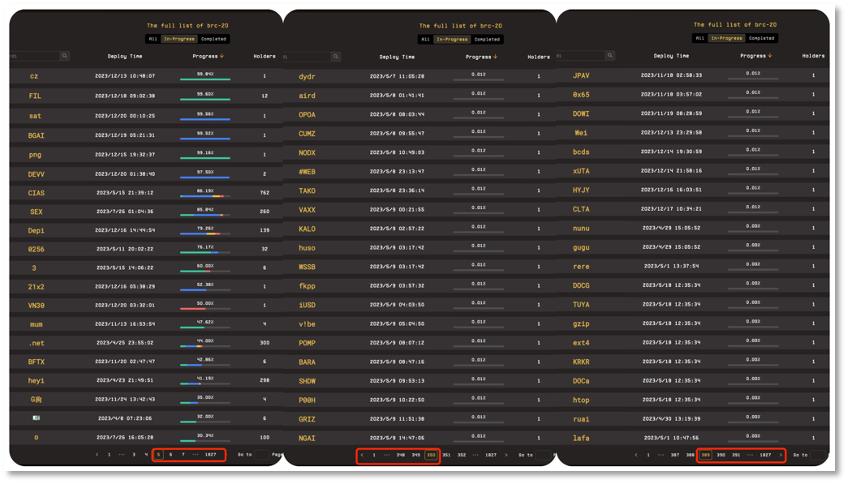
Unisat Web Interface Showing BRC-20 Tokens Awaiting Minting
Meanwhile, wallets catering to inscription minting are multiplying. Beyond UniSat—the earliest and largest Bitcoin inscription wallet—OKX Web3 Wallet, Ordinals Wallet, Hiro Wallet, and Xverse now support storing, sending/receiving, and transferring Bitcoin inscriptions and BRC-20 tokens, with some even enabling direct minting.
Thus, a three-tier market for Bitcoin inscription tokens has formed: - Tier 1: Wallets and minting platforms where users “grind” inscriptions by spending BTC. - Tier 1.5: Peer-to-peer marketplaces where minted inscriptions can be listed. - Tier 2: Centralized exchanges, which already exist.
Anyone can create and mint inscriptions, then list them on 1.5-level P2P markets. But newly minted inscriptions often struggle to find buyers.
Among over 50,000 BRC-20 tokens, OKX Web3 Wallet includes nearly all—both completed and ongoing mints. Yet only about 50 make it onto trading hotlists, and just 38 see over 100 trades in 24 hours.
At 14:16 on December 20, BNSx topped OKX Web3 Wallet’s BRC-20 hotlist with 544 trades in 24 hours and $1.64 million in volume. It has 4,566 holders, a floor price of $1.45, and a daily high of $2.22—a mere 50% gain, far from the hundredfold or thousandfold returns seen elsewhere.
At the bottom, SAT recorded only 9 trades in 24 hours, totaling $269,400. Despite a tiny floor price of $0.000000029, it tripled in value that day. However, with only 43 holders, it remains a niche game.
A crypto trader involved in minting described the value of tokens sitting in wallets as “paper profits.” Having experienced it firsthand, he pointed out a key flaw in the Tier 1–1.5 market: you can list tokens for sale, but there are no guaranteed buyers.
“This differs fundamentally from order books on CEXs. Sellers can’t dump tokens to cash out immediately. When market sentiment is FOMO-driven, everything looks great. But when enthusiasm fades, it’s hard to quickly realize market value,” he emphasized. “Unless you hold top-tier tokens already listed on exchanges, your ability to cash out depends largely on luck.”
Some platforms are trying to solve the liquidity issue. UniSat launched brc20-swap, a decentralized trading app, but supports fewer than 20 BRC-20 assets—far too few to meet seller demand.
Indeed, real wealth effects come only from listing on major centralized exchanges like Binance or OKX—tokens like ORDI and SATS that spread “success stories” across communities. Only centralized exchanges pool sufficient capital and users, harboring dreams of hundredfold or thousandfold returns.
But getting listed isn’t easy.
On CoinGecko, the third-party site tracking exchange-listed assets, fewer than 70 tokens were tagged “Ordinals” or “BRC-20” as of December 20. Only 39 had meaningful trading volume and depth, and just 10 had market caps over $10 million.
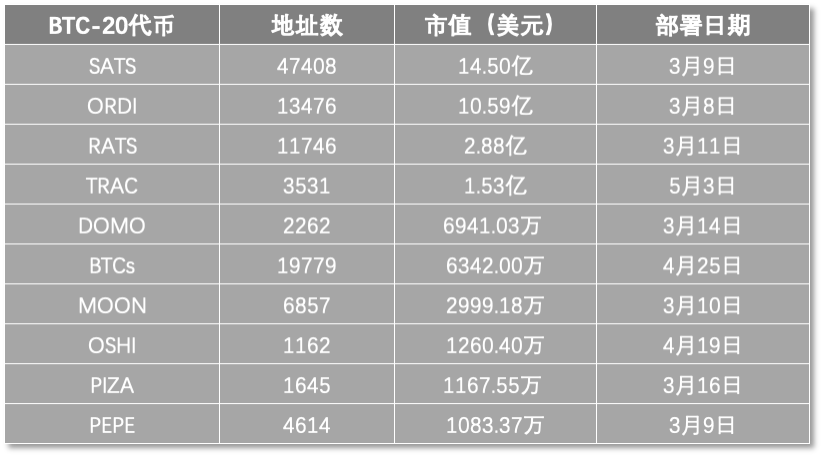
Top 10 BRC-20 Tokens by Market Cap (Data from Unisats and CoinGecko)
This means only 1% of over 50,000 BRC-20 tokens have made it onto centralized exchanges. Yet history shows many delistings end in zero value. For the tens of thousands of others, their fate remains unknown.
Still, more uncertain inscription tokens keep emerging—and other blockchains are rushing in.
Scams and Farces Take Center Stage
Minting inscriptions has caused Bitcoin network congestion, leading to persistently high fees.
Users involved in BRC token minting report that minting a single inscription used to cost $0.25–0.50—so 100 inscriptions cost just 200–400 RMB. Now, “costs easily exceed $5, sometimes reaching over $10 per inscription.”
Spending 3,000 or 5,000 RMB on inscription tokens for a chance at exchange listing? Many feel it’s too risky.
No problem. Ethereum and other EVM-compatible chains, known for low fees and high speed, are stepping into the inscription arena. Various protocols are launching on these Layer 1 and Layer 2 networks, issuing tokens with single-mint costs under $1.
To date, networks including Ethereum (ETH), Solana (SOL), Avalanche (AVAX), Injective (INJ), and Starknet have all introduced integrated inscription protocols supporting issuance, minting, and trading—with new tokens emerging constantly.
Listing on centralized exchanges remains difficult, but decentralized exchanges (DEXs) across chains offer alternative liquidity venues. Yet no equivalent of ORDI or SATS-style rags-to-riches stories has emerged here.
Instead, gas prices across chains have indeed risen due to the surge in inscription-related activity. In the past 24 hours, SOL, AVAX, and INJ have all gained over 20%.
Then came the absurd. The traffic surge from the inscription craze exposed flaws in several chains claiming “seamless transactions.”
On December 5, the TON20 token from Tonado, an inscription protocol on the TON blockchain, launched. A sudden spike in millions of transactions caused prolonged delays in processing—even though validators kept producing blocks, verification couldn’t keep up. Two days later, TON’s on-chain crypto wallet was forced to suspend service.
On December 16, Arbitrum announced that Arbitrum One’s sequencer stopped functioning at 10:29 a.m. ET due to a surge in network traffic caused by inscription protocols. The outage brought the entire network to a halt. The next day, zkSync, another major Layer 2 network, briefly went down due to SYNC inscription minting.
When traffic rushes in blindly, some projects start playing dirty.
For example, CIAS, the first inscription project on modular blockchain Celestia, was suspected by the community of copying COSS’s inscription code. CIAS also suffered an “RPC failure” during minting, forcing it to pause.
The INJS inscription project on Injective imploded just 12 hours after launch. On December 19 afternoon, “abnormal inscription activity” was detected. By evening, Injective’s official team warned users not to participate in INJS minting, citing “lack of transparency—the team collects minting fees and deposits them into unverified wallets.” Ultimately, INJS was canceled, and the team refunded users.
Compared to farces, traps are more dangerous.
As early as May, fake websites mimicking the inscription wallet UniSat appeared. The fraudulent domain added an extra “s” after “unisat” and used SEO optimization on Google, placing the scam site above the legitimate one—tricking users into clicking. Several users reported losing BTC this way.
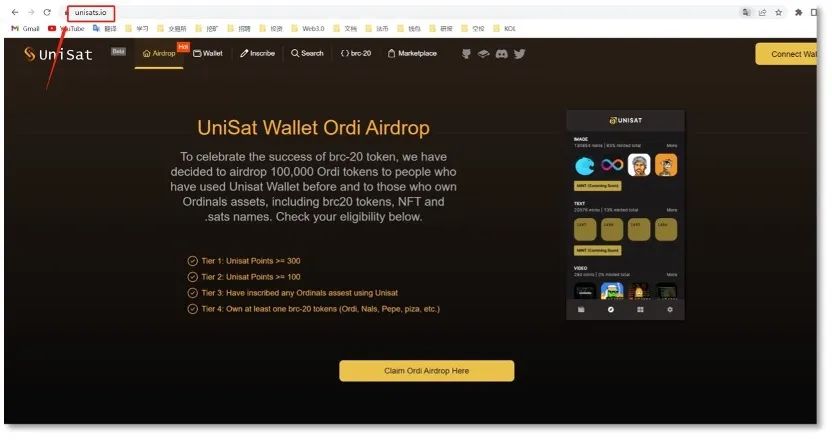
Fake UniSat Wallet Sets Up Phishing Trap
Other scammers exploit the fact that inscription tokens are named with letters, listing fake tokens with identical or confusingly similar names on trading platforms—waiting for careless users to accidentally buy.
Some go further, distributing malicious scripts for minting. Unsuspecting users who copy-paste the code end up having their newly minted tokens stolen—the script owner modifies the code and siphons off the assets, turning users’ efforts into someone else’s profit.
Perhaps many are asking:
If BRC-20 brought the long-missing token issuance capability to Bitcoin—thus showing innovation—what exactly are EVM chains creating? And if EVM chains already support asset issuance, why does the capacity-limited Bitcoin network need to do the same?
But in crypto markets, FOMO leaves no room for “why”—it’s all about profit.
Traders fear missing the jackpot—getting a token listed. Exchanges want traffic fast, hoping to pick hot assets. Miners hope traffic keeps coming so they can earn fees…
Where some win, others lose.
“Lost 50,000 in 3 days…” A veteran crypto player afraid of missing out shared his portfolio in a group chat, complaining. Someone bluntly tagged a token in the screenshot: “So it’s XX coin that rekt you.”
Join TechFlow official community to stay tuned
Telegram:https://t.me/TechFlowDaily
X (Twitter):https://x.com/TechFlowPost
X (Twitter) EN:https://x.com/BlockFlow_News










