Rollup Scaling Reimagined: How Taiko's BBR Is Reshaping Ethereum and L2?
TechFlow Selected TechFlow Selected
Rollup Scaling Reimagined: How Taiko's BBR Is Reshaping Ethereum and L2?
Boosted Based Rollup (BBR) retains the advantages of Base Rollup and adds direct Ethereum scalability.
 Navigating Web3 tides with focused insights
Author: Taiko
Translation: Frank, Foresight News
Editor's Note: On December 13, 2023, Ethereum co-founder Vitalik Buterin participated in the "Multi-proofs for rollups" Twitter Space hosted by Taiko, joining OP Labs researcher proto.eth and Taiko co-founder & CTO Brecht Devos to discuss topics including rollup design and multi-proofs.
The guests specifically mentioned Taiko’s new rollup design proposal “Based Booster Rollup” (BBR), introduced a few months earlier, engaging in an in-depth discussion about its innovative solutions and potential vision. This article provides a comprehensive overview of BBR’s vision, design principles, and technical advantages, translated here for our readers.
A few years ago, Ethereum adopted a rollup-centric roadmap. Since then, the Ethereum community has proposed various rollup designs, all aiming to scale our beloved blockchain in one way or another.
Today, we will detail the new rollup design we introduced several months ago, which we believe comes very close to becoming a native Ethereum scaling solution. We call it the “Based Booster Rollup” (BBR).
Let’s explore together the vision behind the “Based Booster Rollup.”
Based and boosted
“Based rollups” are arguably the most efficient, decentralized, and Ethereum-aligned way to run rollups—by delegating sequencing work to L1, based rollups inherit many advantages from L1 such as decentralization, simplicity, and liveness.
In other words, based rollups represent Ethereum’s path toward native scalability without introducing new risks of centralized or semi-centralized sequencers.
But what if you could further enhance this model by adding plug-and-play native Ethereum L1 DApp scaling capabilities directly into based rollups?
That is exactly what “booster rollups” aim to deliver.
Imagine deploying your DApp just once and having it automatically scale across all L2s—and even extend to additional booster rollups when more block space is needed—all with zero extra configuration.
In short, the entire process requires minimal effort from developers—no redeployment costs, no additional concerns.
Simply put, booster rollups work like adding extra CPU/SSD to your laptop: they make your system more powerful, enabling applications to run faster and scale larger.
For technically inclined readers, here’s a one-sentence technical summary of what booster rollups do: booster rollups shard transaction execution and storage.
If you're interested in how booster rollups work under the hood, check out articles on ethresear.ch by our co-founder and CTO Brecht Devos:
Here’s also an X Thread explaining the thinking behind booster rollups. Now, let’s see why based rollups and booster rollups are the perfect match.
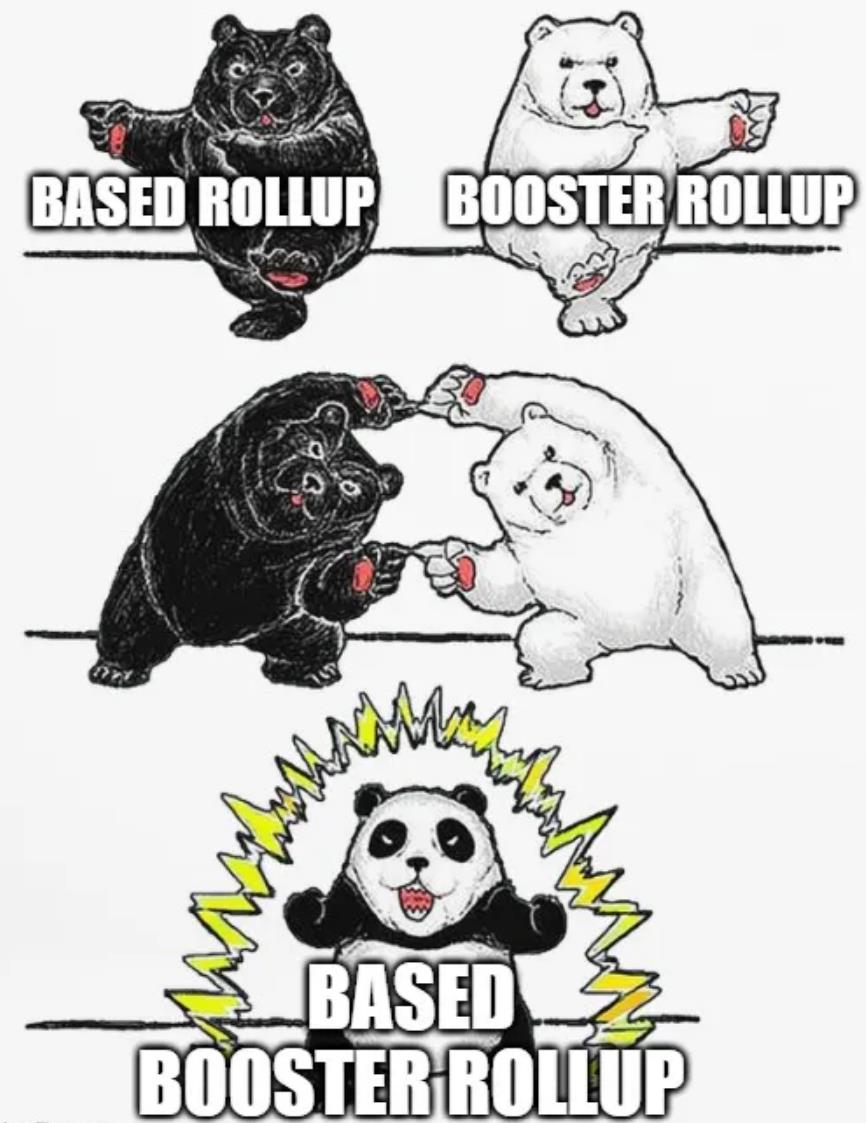
The Vision of “Based Booster Rollup”
Booster rollups are agnostic—any rollup equipped with the necessary enhancements, whether Optimistic or ZK-based, can become a booster rollup.
However, not every rollup needs to be fully boosted; they can still support purely L2-specific features where appropriate.
If your goal is native Ethereum scaling, boosting a based rollup is the smart choice. By allowing L1 validators to propose new blocks for the entire boosted network, Ethereum gains out-of-the-box scalability. This means Boosted Based Rollup (BBR) retains the benefits of base rollups while adding direct Ethereum scalability.
BBR also has the potential to solve the fragmentation issues faced (and created) by current rollups, all while preserving L1 sequencing and its associated benefits. By enabling atomic cross-rollup transactions across all L2s within the boosted network, it delivers all the necessary functionality to realize the original vision of scaling Ethereum “in one place.”
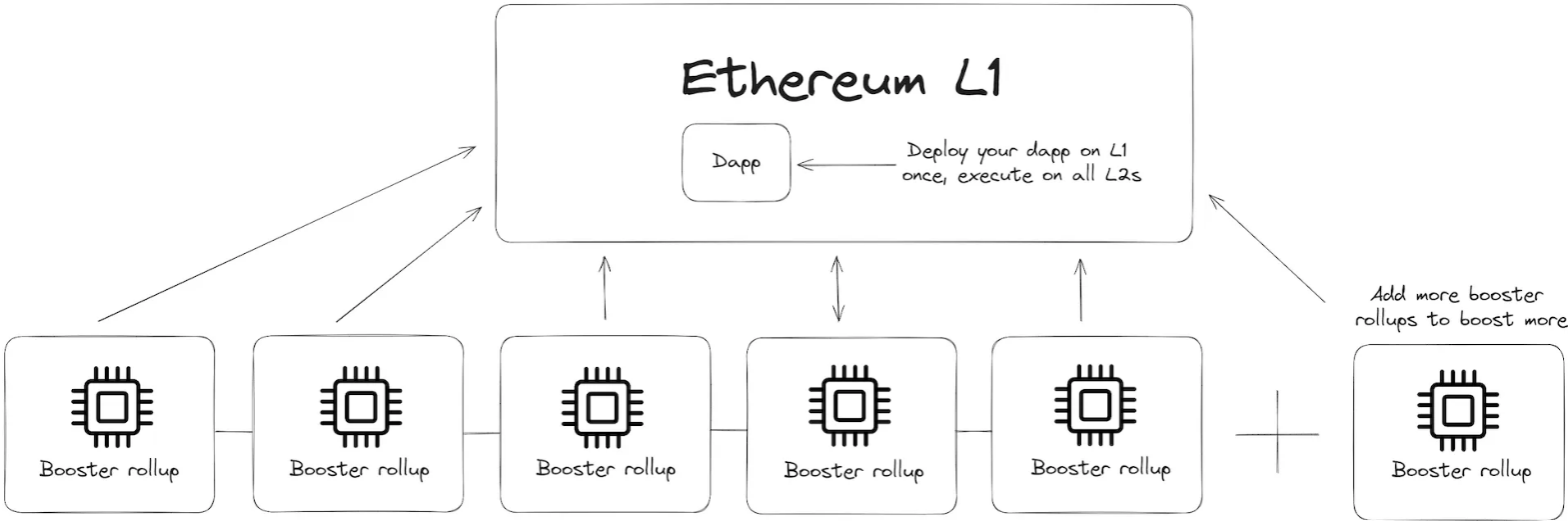
We believe this is a powerful design—one that comes remarkably close to native Ethereum scaling. This is the vision of Boosted Based Rollup (BBR).
What does this mean?
Let’s review the benefits brought by BBR.
For users, BBR means no more worrying about fragmentation or jumping between L2s—their favorite DApps will simply be available across all L2s.
Of course, the BBR design will significantly reduce transaction costs and increase throughput, giving users the scalable and secure Ethereum they deserve.
For developers, BBR allows them to scale their DApps without redeploying across all L2s. Instead, they deploy their DApp once on L1 and that’s it—the DApp automatically scales to all existing and future boosted L2s.

When will it happen?
When can we expect the first BBR to emerge?
Currently, Taiko is working on integrating contestation into the protocol and will test the practical operation of the Based Contestable Rollup (BCR) mechanism (at least partially) on the next testnet.
The BCR design will be implemented on the upcoming mainnet, and we’ll share more details later.
After launching BCR on mainnet (our first major milestone), we plan either to upgrade the protocol to BBR or launch a standalone BBR L2 as our second major milestone.
We believe BBRs have the potential to scale Ethereum to an entirely new level. Teams interested in the BBR design and wishing to collaborate on technical specifications and implementation are welcome to reach out to the Taiko team.
You may also review the first Taiko Improvement Proposal (TIP)—TIP-0001: Support reading and writing to the parent chain—which is a prerequisite for boosted rollups, and join the community discussion.
Taiko will release more detailed information in the coming months.
Join TechFlow official community to stay tuned
Telegram:https://t.me/TechFlowDaily
X (Twitter):https://x.com/TechFlowPost
X (Twitter) EN:https://x.com/BlockFlow_News
 @taikoxyz