








Bitcoin Status Summary and Future Outlook in 2023
TechFlow Selected TechFlow Selected
Bitcoin Status Summary and Future Outlook in 2023
In 2024, Bitcoin may ascend to global asset legitimacy, becoming a cornerstone of innovation and continuously evolving to lead transformations in finance and technology.
 Navigating Web3 tides with focused insights
Author: Thesis
Translation: Baicai Blockchain
When people around the world think of blockchain, Bitcoin comes to mind first. Although the past decade has witnessed countless developments and innovations in decentralized technology—from GameFi to DeFi to NFTs—Bitcoin remains the world’s most prominent digital asset. Therefore, its health, recent developments, and future indicators are crucial.
Looking ahead, the potential approval of the first Bitcoin spot exchange-traded fund (ETF) is expected to unlock massive new investments, suggesting that 2024 could be a pivotal year for the long-term development of the decentralized economy.
Has Bitcoin deliberately disrupted the sequence? Will DeFi exist on top of Bitcoin through protocols such as Taproot Assets and BitVM, or are these merely experimental attempts that have yet to succeed? Will Bitcoin achieve a successful scaling solution? This article provides an in-depth analysis and data interpretation of these questions and the state of Bitcoin in 2023.
2023 was a year of tremendous leaps for Bitcoin. Amid difficult periods for both digital assets and traditional markets, Bitcoin continued to set historic milestones, solidifying its legitimacy as a global asset and network.
Bitcoin is no longer just a niche speculative tool but a foundational building block for various builders and investors to realize their visions. This has driven a wave of innovation, continuously expanding Bitcoin's functionality while aligning with core principles of decentralization and permissionless access.
New technologies like the Lightning Network and novel token standards demonstrate Bitcoin's ongoing evolution, bringing its capabilities closer to those of other popular networks—without relying on the centralized patches and workarounds that underpin many blockchain projects. Bitcoin’s development extends far beyond technological innovation, encompassing advancements in financial services, gaming platforms, and more. In 2024, Bitcoin is poised for even greater progress.
I. Confidence in Bitcoin Strengthened Across the Board in 2023
When assessing Bitcoin's health, price often dominates headlines. However, beneath market fluctuations, on-chain data tells a compelling story: mainstream adoption continues to expand, and long-term holders remain steadfast in their belief in Bitcoin.
1. Broad Participation from Mainstream Investors
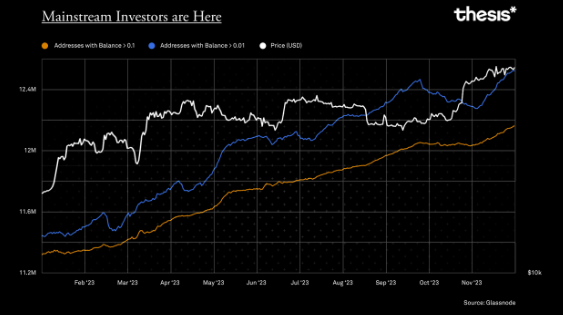
Over the past year, the number of addresses holding balances between 0.01 BTC and 0.1 BTC has steadily increased, indicating growing retail investor interest in Bitcoin. Amid uncertainty in traditional markets, investors are seeking strong alternatives. Bitcoin’s scarcity and monetary policy enhance its appeal as a secure store of value. The increasing participation of retail users lays the groundwork for the next wave of adoption.
2. Long-Term Holders Demonstrate Deep Conviction
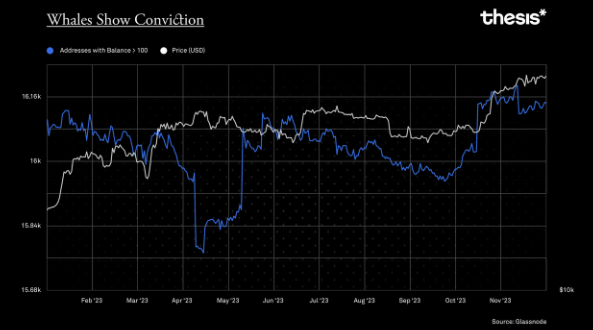
As new investors enter the market, seasoned Bitcoin holders have accumulated more during price volatility, diverging from market trends. While some take profits at higher prices, holder behavior diverging from price movements indicates strong conviction. Continuous accumulation often signals upward price momentum, reflecting holders’ expectations of upcoming changes.
Large holders owning over 100 BTC drive short-term volatility, reflected in address counts. In Q4, they reached annual highs again, signaling renewed institutional investment interest. Data confirms Bitcoin’s enduring appeal and resilience among experienced participants.
3. Decline in Exchange Holdings, Rise in Self-Custody
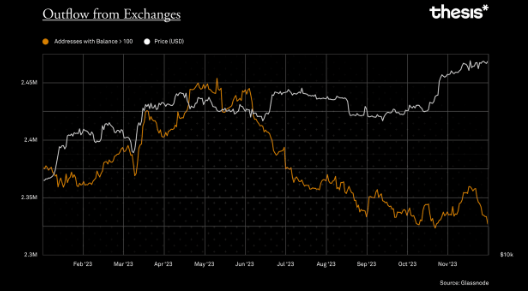
A clear contrast emerges: declining exchange holdings and rising self-custody. Investors increasingly prefer direct control over their assets, independent of broader market movements. This migration compresses exchange liquidity while amplifying Bitcoin’s inelastic supply curve, enhancing its potential upside.
The number of self-custody addresses continues to rise, while exchange holdings decline. This trend, combined with accumulation by long-term holders during price consolidation, reflects enduring confidence in Bitcoin as an investment and store of value. Sustained accumulation often precedes major price increases. Data highlights the importance of holder conviction amid market volatility and underscores the advantage of Bitcoin’s inelastic supply curve. As large institutions absorb Bitcoin supply, selling pressure diminishes even if prices rise. This supply dynamic, coupled with growing mainstream and institutional interest, signals an impending bull market.
The self-custody trend, accumulation by high-conviction holders, and demand from larger investors pave the way for Bitcoin’s next wave of mass adoption. This macro backdrop offers an optimistic outlook for long-term Bitcoin investment. Strong demand persists even during downturns, and selling motivation fades as prices rise. Only high-conviction assets withstand market tests. Self-custody is the purest expression of long-term holding intent.
4. Momentum Building Toward the Next Bull Run
If blockchain signals are reliable, Bitcoin is preparing to launch its next significant growth cycle. Key conditions are in place: expanding mainstream and institutional participation, sustained accumulation by long-term holders, and unwavering self-custody trends. Investor composition and holder behavior suggest accumulating momentum that will propel Bitcoin into its next phase of adoption.
For long-term believers, Bitcoin’s emerging narrative represents an early opportunity. Foundations are strengthening, gradually advancing toward the ideal vision of decentralized money.
II. Bitcoin’s Scalability Challenge
In 2023, scaling Bitcoin to meet growing demand remained a top priority. While innovations like the Lightning Network have enhanced capacity, new Layer-2 protocols emerged this year capable of unlocking further functionality without sacrificing security. These include interoperable sidechains operating alongside Bitcoin.
Bitcoin’s layered architecture improves performance without altering the base layer, much like advanced internet protocols enhance TCP/IP. Examples range from Lightning Network’s fast payments to complex smart contracts on Stacks and RSK. Bitcoin emphasizes stability as a settlement layer while encouraging innovation on upper layers. These layers can support applications requiring full smart contract functionality, high throughput, and privacy—all built atop Bitcoin’s robust foundation.
This modular approach reflects Bitcoin’s philosophy—scaling functionality while minimizing trust. Keeping the base layer simple and maintaining permissionless access makes the network adaptable to diverse needs. Many layered protocols aim to make Bitcoin multifunctional without compromising its decentralized nature.
1. Technical Overview
The core idea behind ZK Rollups is bundling multiple transactions into a single transaction on the Bitcoin blockchain. This process uses zero-knowledge proofs to verify bundled transactions without revealing details. Sovereign and Starkware are leaders in driving zk rollup innovation on Bitcoin.
2. Centralization Concerns and Decentralization Efforts
Current zk rollup implementations raise centralization concerns, primarily due to reliance on centralized sequencers. In many existing systems, a single entity aggregates transactions, generates validity proofs, and submits batched data to the Bitcoin network—requiring significant trust in the sequencer. Over time, hybrid models combining different types of provers may emerge to suit various use cases.
Since this contradicts Bitcoin’s ethos, active efforts are underway to decentralize the sequencer role. The goal is to distribute responsibilities for transaction collection, proof generation, and block submission across multiple entities. Distributing trust better aligns with Bitcoin’s decentralized design.
Several approaches have been proposed:
Threshold schemes can distribute authority among a dynamic group of sequencer nodes based on stake or rotation.
Proof-of-work mechanisms similar to Bitcoin mining could determine which nodes participate in sequencing.
For full decentralization, a future opcode might enable bidirectional transfer of sats and assets between Bitcoin’s base layer and zk rollups. This would require Bitcoin mining nodes to directly parse proofs, significantly enhancing functionality while preserving decentralization.
III. Bitcoin’s Layer-2 Landscape
Beyond zk rollups, other Layer-2 technologies are maturing. Two notable examples are Stacks and Rootstock (RSK).
1. Rootstock (RSK)
Rootstock (RSK) leverages merged mining to achieve security comparable to Bitcoin, despite offering higher throughput than Bitcoin’s base layer.
Merged mining allows Bitcoin miners to simultaneously process and validate both BTC and RSK transactions within the same block. In this model, miners can mine on both the parent chain (e.g., Bitcoin) and child chain (e.g., RSK) concurrently.
The primary advantage of merged mining is enhanced security for the child chain. By leveraging the computational power of a stronger parent chain, smaller chains gain additional protection against double-spending and 51% attacks. This enables RSK to achieve scalability, efficiency, and advanced features impossible on Bitcoin itself, while avoiding less secure consensus models.
However, despite progress, RSK still faces challenges. It struggles to attract sufficient users, and the complexity and novelty of its merged mining mechanism introduce risks.
2. Stacks
Stacks is a Layer-2 smart contract protocol designed specifically for Bitcoin, aiming to bring decentralized applications and smart contract functionality to the Bitcoin ecosystem.
2023 was a year of recovery and enhanced capabilities for Stacks. Despite adoption challenges, overall metrics indicate substantial progress along its roadmap and vision.
Notably, Stacks’ native token STX showed strong recovery in 2023 after a prolonged bear market. STX price rose over 50% in Q1 and surged over 280% for the year—outperforming both Bitcoin and the broader market. This counter-trend performance marked a significant turnaround, solidifying interest even during crypto downturns.
Several key network upgrades were completed this year, including Stacks 2.1, introducing decentralized mining and bridging with Bitcoin. By the end of Q3, Stacks had over 1,100 developers—up 30% from the previous quarter. This efficiency improvement coincided with community growth, with followers increasing by 20%.
Ecosystem appeal grew steadily, albeit from a modest starting point. Assets under management reached all-time highs in both USD and STX, reflecting increased DeFi participation. Non-fungible tokens and gaming projects began gaining attention. BNS-registered names exceeded 300,000 cumulative registrations, showing sustained user interest.
However, not all metrics showed consistent growth. Daily active addresses, contract calls, and transaction volume spiked early in 2023 but later declined. This may indicate instability in user retention beyond speculation. Bottlenecks related to user experience, fees, and network effects may remain barriers to wider adoption.
Stacks made progress in security and scalability, positioning itself for an anticipated inflection point. Public seed nodes launched globally, eliminating centralized risks in query services. Projects began undergoing formal audits, enhancing risk prudence. Although adoption metrics slowed slightly, developments this year achieved cautious progress across multiple fronts. This still-young ecosystem faces bootstrapping challenges, requiring encouragement for user engagement despite incomplete feature maturity.
IV. Lightning Network: Bitcoin’s Scaling Solution Goes Mainstream
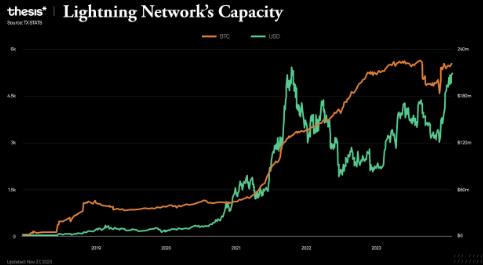
In 2023, payment channels on the Lightning Network (LN) held over 5,400 BTC—worth more than $230 million. Its capacity has grown rapidly from just 1 BTC in August 2018 to today’s robust liquidity pool. This growth is supported by over 70 LN-compatible wallets from leading providers like BlueWallet, Muun, and Phoenix, with adopters ranging from citizens in inflation-hit countries to global enterprises.
But what are Lightning channels? LN micropayment channels establish relationships between two parties, allowing them to continuously adjust balances without broadcasting every transaction to the blockchain. This defers the final settlement of total balances between the two parties to a future point, effectively processing net balances in a single on-chain transaction.
This method enables financial relationships without trusting the counterparty or fearing default. These micropayment channels use real Bitcoin transactions but choose to delay broadcasting them to the blockchain. Thus, both parties can confirm current balances on-chain while actual payments occur off-chain.
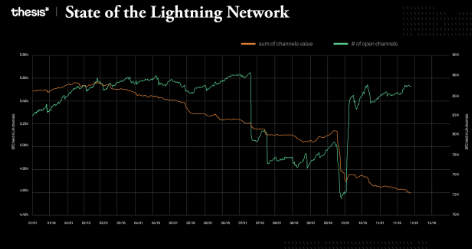
In October 2023, both the number of Lightning channels and total value briefly contracted, possibly due to consolidation events or responses to external market factors. However, both metrics subsequently recovered, demonstrating network resilience. Despite volatility, channel value showed an overall upward trend, indicating expanding network capacity.
1. Enterprise Infrastructure Becomes More Robust
November marked another leap forward with Taproot Assets Protocol v0.2. This toolkit supports issuing assets via LN and Bitcoin, featuring customizable asset burn functions that provide compliance controls for regulated industries.
LN now establishes diversity for enterprises—from tokenized securities to programmable contracts in restricted jurisdictions.
Enhanced RPC calls offer detailed proof-of-transfer monitoring and sophisticated asset lifecycle management.
2. Nostr Integration Unlocks P2P Economy
In September, Nostr’s “NIP-57” upgrade introduced “Zap” notes—representing Lightning invoice receipts—that combine Bitcoin micropayments with social interactions. Content creators receive tips via Zaps; readers fund posts to unlock premium content, filtering out spam. By end-2023, over 50,000 Zap payments were made, showing the Lightning Network’s expanding integration into broader applications.
Demand trends suggest Bitcoin’s decentralized payment channels may continue permeating communication and community-building apps.
3. Retail Giants Drive Adoption
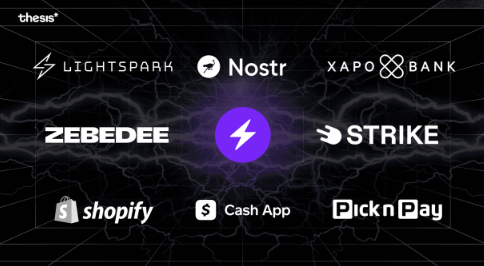
In 2023, major retailers accelerated Lightning Network (LN) penetration into consumer sectors. Stripe’s “Pay with Bitcoin” button opened LN for businesses. Twitter and Zebedee also integrated LN, enabling users to easily tip quality content and conduct fast Bitcoin transactions in games. LN finally delivered on its promise as a scalable layer for global adoption—boosting Bitcoin’s transaction speed and lowering fees. However, broader LN usage still requires deeper integration with payment, e-commerce, and social media platforms to reduce usability barriers.
3. Custody Challenges
Custodial services face regulatory crackdowns, contrasting sharply with breakthroughs in non-custodial wallets. New asset designs and scaling protocols suggest functional enhancements. Despite setbacks in application and infrastructure deployment on Bitcoin, overall progress remains incremental. Miniscript and RGB show promise for extending Bitcoin’s programmability.
4. Cautiously Optimistic Outlook
Looking ahead, despite Lightning Network progress, it still faces growing pains inconsistent with external success. High-fee events caused by network congestion expose persistent scalability limits. Core developer departures highlight technical risks. About 90% of transactions go through custodial wallets, reflecting UX barriers for non-custodial use. While Lightning promises immense potential, it is not yet a mature product.
Temporary volatility should not negate Bitcoin innovation. Lightning has already transformed lives for millions worldwide and appears ready to advance into a new phase through optimizations like Anyons and batch settlements. Bitcoin continuously iterates, turning challenges into progress. History suggests Lightning’s setbacks may become opportunities for advancement.
V. Ordinals: Artifacts Inscribed on Bitcoin
Among Bitcoin’s developments, one standout technological innovation is the emergence of Ordinals. It transforms individual satoshis into unique digital artifacts capable of carrying rich data. An ordinal is the smallest unit of Bitcoin that can record data such as text or images. Once inscribed, each satoshi becomes a unique digital asset.
The Ordinals protocol was first proposed on January 21, 2023, by founder and developer Casey Rodarmor. It leverages the 2021 Taproot upgrade, which enhanced Bitcoin’s functionality by expanding data attachment per transaction to 4MB. This technical advancement utilizes Bitcoin’s existing infrastructure, opening new possibilities for embedding richer data on the blockchain—and clearly differentiating itself from traditional digital assets and NFTs.
In February, Yuga Labs announced the first Bitcoin NFT series based on Ordinal inscriptions.
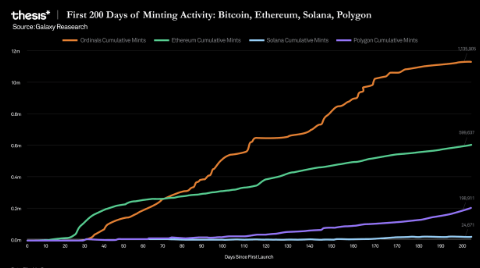
By June, over 11 million ordinals had been inscribed onto Bitcoin, with peak volumes occurring in May. From July to September, inscription volume continued rising, with plain text being the most popular type. Looking ahead to end-2023, projections estimate Ordinal trading volume will reach approximately $725 million.
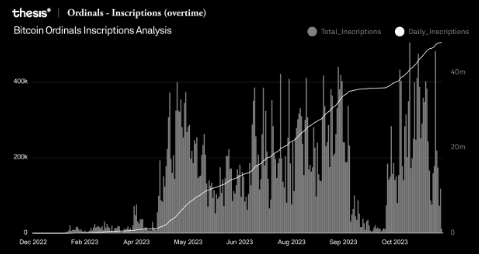
With the rise of Ordinals, NFT sales dropped 8.7% from $4.2 billion in September 2021 to $3.8 billion in October 2023. The introduction of Ordinals caused surges in Bitcoin transaction fees and block size, resulting in a staggering 45.0745 million on-chain inscriptions. On November 12, 2023, Bitcoin recorded a daily historical high of 505,345 Ordinal inscriptions.
1. Technical Deep Dive: Understanding the Ordinals Protocol
Inscription Process
Various services help create ordinals. First, users must set up a Taproot-compatible wallet synced with the Bitcoin core chain and choose the inscription type: single ordinal or collection. Then, users upload data such as images or text for inscription, with file sizes recommended to stay under 35KB.
File size and network congestion affect inscription transaction fees. Finally, specify an unused receiving address to receive the newly created ordinal.
This system enables each satoshi to be uniquely identified by an ordinal number, tracking asset movement. Each satoshi receives a serial number based on mining time, allowing up to 2,100,000,000,000,000 ordinals. The ordinal system assigns rarity based on mining and inscription timing.
Unlike many NFTs, all information related to ordinals is permanently recorded on-chain, not dependent on third-party storage. This feature allows recursive protocols to retrieve data from existing inscriptions to generate new ones.
2. Wallets Supporting Ordinals
Ordinals Wallet: A Bitcoin wallet improving upon previous limitations, supporting various ordinal operations. Features a user-friendly interface, community-funded.
Xverse Wallet: A Bitcoin Web3 wallet supporting interaction and providing Bitcoin ordinal services within Gamma. Ordinals appear in user NFT collections within about 30 minutes.
Hiro Wallet: Supports secure Bitcoin storage, transfer, and rapid creation of ordinal NFTs. Compatible with platforms like Gamma and OrdinalsBot, enabling browser-based inscription.
MetaMask: Manages Bitcoin Taproot keys, verifies ordinal addresses, provides keystores. Supports hardware wallets, explores ordinals via Generative Marketplace.
OKX Wallet: Integrates Taproot upgrade, supports viewing and transferring ordinals, features cross-chain operations and BRC20-S standard.
3. Significant Growth in Bitcoin Ordinals Market Trading Volume
Various Bitcoin Ordinals markets—including OKX, Uniswap, Magic Eden, and Gamma—showed significant trading volume growth.
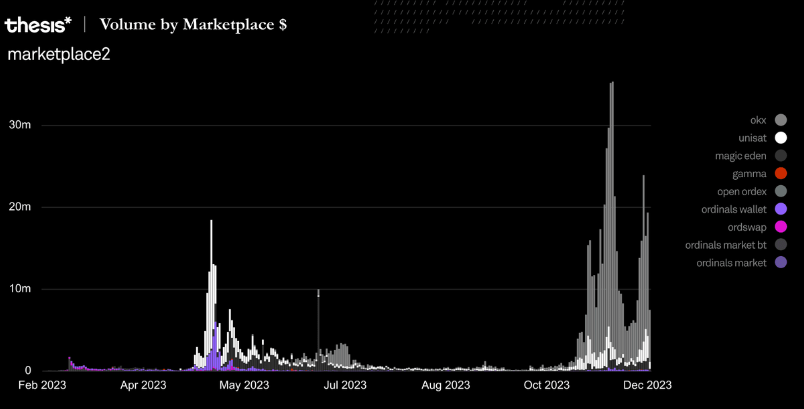
Total trading volume: Dune Analytics data shows total transaction volume on Bitcoin Ordinals markets reached $794,330,265.
Total transactions: 1,173,402 transactions occurred on these markets in 2023.
Unique users: Cumulative number of unique users interacting with these platforms reached 253,379.
Individual high-value trades: On markets like OKX and Ordinals Wallet, some high-value trades exceeded $1 million.
4. Technical Foundation: SegWit Taproot
The 2017 Segregated Witness (SegWit) upgrade laid the foundation for Ordinals by introducing witness data, reducing block space used per transaction and enhancing network processing capacity. The 2021 Taproot upgrade further improved this capability by introducing new scripting features and removing size limits on transaction witness data, enabling storage of up to 4MB of data on Bitcoin.
5. Advantages of the Ordinals Protocol:
Attracts new users: Introducing NFT-like assets draws new users interested in digital assets and NFT trading to Bitcoin.
Market demand: Increased inscription transactions indicate market interest and demand for this new form of block space utilization.
Increases miner fee revenue: The Ordinals Protocol brings additional fee income to miners, supporting Bitcoin’s security model.
Drives adoption of Layer-2 solutions: Increased transaction fees and block space usage may accelerate adoption and development of Layer-2 solutions like the Lightning Network, aiding Bitcoin network scaling.
Accelerates Taproot adoption: The rollout of Ordinals speeds up adoption of the Taproot upgrade, offering more compact transactions and enhanced privacy.
6. Disadvantages of the Ordinals Protocol:
Increased block space cost: Including additional non-financial data in blocks raises fees and puts pressure on node operation, potentially leading to centralization of full nodes.
Speculation and market distortion: May divert capital toward trading Ordinals assets rather than holding Bitcoin as value storage, potentially affecting Bitcoin’s perception as an investment.
Impact on Satoshi fungibility: By creating non-fungible properties, Ordinals may challenge Bitcoin’s use case as ultrasonic money, potentially affecting Bitcoin’s fungibility.
Additional tracking and privacy concerns: Data associated with Ordinals may make on-chain behavior easier to track, raising privacy issues.
Risk of data pruning: Bitcoin nodes may prune inscription data, raising concerns about permanence of digital assets—potentially a vulnerability in Bitcoin’s decentralization.
7. Concerns Regarding Ordinals
The Ordinals protocol has sparked controversy over indexing digital assets on the Bitcoin chain. Managing these numbers is challenging, leading to some incorrectly numbered inscriptions (“cursed ordinals”), adding system complexity. Errors may arise from minting multiple inscriptions in one transaction or assigning multiple numbers to the same satoshi. Proposed solutions include renumbering existing ordinals, though this could impact prior data. Some worry such changes may harm collectible values. Others support renumbering to fix issues, proposing mitigations like snapshots preserving affected ordinals or allowing users to re-inscribe.
8. Recursive Ordinals
Recursive ordinals represent a significant advancement aimed at solving connectivity issues in the protocol.
By leveraging how ordinal data is stored, recursive ordinals enable complex on-chain software operations, bypassing the 4MB limit of standard ordinals.
Recursive ordinals allow more interconnected on-chain data sources, greatly improving storage efficiency and reducing transaction costs.
The protocol enables developers to host applications, video games, and large files directly on the Bitcoin network, opening possibilities for building more advanced applications and smart contracts.
Recursive ordinals are a critical step toward more complex DeFi architectures, aligning with efforts to integrate Ethereum Virtual Machine and Solidity into the Bitcoin network.
Although recursive ordinals have sparked debate—some concerned they’re maintained by relatively centralized developer groups, conflicting with Bitcoin’s ethos—others welcome the advancement for its potential to reduce storage redundancy and transaction costs.
9. Use Cases for Ordinals:
Collectibles: Taproot Wizards, ORD Rocks, and Bitcoin Punks are among the best-known collections, with upcoming generative art collection TwelveFold expected to gain popularity.
Markets: OpenOrdex is a highly interesting marketplace—fully open-source and strictly using decentralized tools for transactions. It employs partially signed Bitcoin transactions (PSBT) to enable trustless listing and purchasing of inscriptions.
Browsers: OpenOrdex, Gamma, and Ordinals.com are research tools analyzing ordinal/inscription activity. These browsers also provide data on transaction IDs, addresses, output values, weights, satoshi numbers, and positions.
Inscription services: Minting ordinals is complex, so inscription services emerged to help collectors create collectibles. Providers like OrdinalsBot, OrdSwap, Gamma, Bitcoin Bandits, and Luxor Mining handle various steps of ordinal creation.
Wallets: Current Bitcoin wallets lack satoshi selection functionality, necessary for sending ordinals to other addresses. However, wallets like Sparrow, Electrum, and Xverse—with UTXO selection—are widely used for ordinal collecting.
Data and discovery: OrdinalHub and Ordinal Directory are platforms helping collectors discover trending and new collections and analyze floor price data.
VI. Taproot Assets: Making Bitcoin a Multi-Asset Network
In mid-October, Lightning Labs announced the Alpha version of "Taproot Assets," a meta-protocol enabling issuance and management of arbitrary assets on the Bitcoin blockchain. With Taproot Assets, users can create fungible and non-fungible tokens, storing asset metadata within existing UTXOs. This provides foundational tools for building a multi-asset network on Bitcoin.
Taproot Assets integrates tightly with the Lightning Network, enabling cheap and fast transactions using these arbitrary assets. This initiative is seen as ushering in a new era for Bitcoin, where various global currencies become Taproot Assets and enable instant forex transactions over Lightning. But what impact will this have on Bitcoin? Supporters and skeptics differ sharply, raising concerns such as whether fee spikes similar to Ordinals and BRC-20 will occur, and whether regulatory scrutiny on Lightning Network will increase as different assets enter the Bitcoin network.
1. Core Mechanism of the Taproot Assets Protocol (TAP)
Taproot Assets is a protocol built upon the data storage method enabled by the Taproot network upgrade, similar to BRC-20. But unlike BRC-20 and other fungible token protocols, Taproot Assets uses a "Universe" to track token ownership information. Creating Taproot Assets involves a complex process using special Merkle trees (MS-SMT) and Taptweaks to construct asset information. This includes the outpoint for minting assets, an asset label chosen by the minter (e.g., hash of a brand name), and metadata linked to the asset such as URLs, images, or documents. All this information is stored in a 32-bit asset ID, while the UTXO serves as the unique identifier for the newly created asset.
Handling Taproot Assets:
Once created, Taproot Assets can be transferred on the Bitcoin blockchain or directly through Lightning Network channels. Compared to other fungible tokens, Taproot Assets enable multiple asset operations (minting, sending, receiving) within a single on-chain transaction, improving on-chain efficiency and reducing congestion and fees. In contrast, BRC-20 triggered noticeable congestion on the Bitcoin network and drove up fees (peaking at $30 during the Ordinals craze).
One of the most compelling applications of Taproot Assets is its compatibility with the Lightning Network (LN). Although assets are issued on the Bitcoin blockchain, bridging with LN enables lower-cost, faster transactions, enhancing asset utility. In the future, direct deployment on Lightning channels will also be possible.
Using Taproot Assets on LN is very simple—no need to select payment methods when routing channels. Bitcoin can provide liquidity for different assets, incentivizing routing node operators to help route Taproot Assets to earn more routing fees paid in satoshis.
Here’s an example scenario: L-USD (Lightning Network USD, a Taproot Assets stablecoin) can be paid with BTC and ultimately settled in L-USD, thanks to edge liquidity—LN nodes willing to exchange value with BTC—allowing you to pay any LN invoice with Taproot Assets, or receive any asset by issuing a standard Lightning invoice.
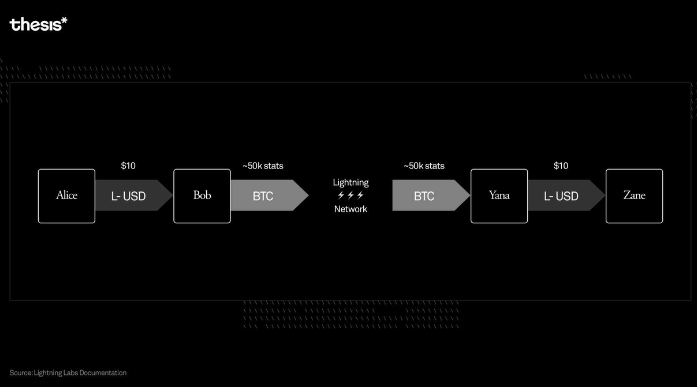
Note that intermediary transactions do not directly transfer the stablecoin itself—no selection needed—as long as BTC liquidity is available, the transaction can be routed. Invoices ultimately settled in Taproot Assets can be paid with BTC or any other asset, and anyone holding Taproot Assets can pay any Lightning invoice.
2. Token Custody and Ownership
As mentioned above, custody and ownership of Taproot Assets differ from other fungible tokens on Bitcoin.
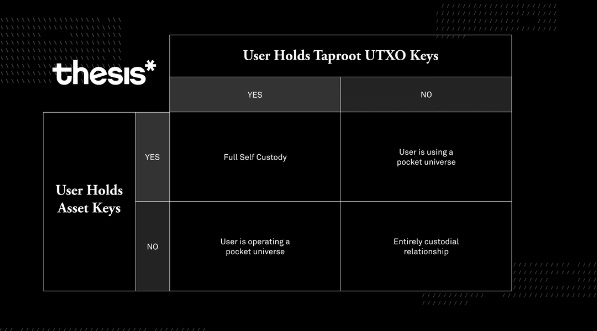
A Taproot Assets Universe is a repository for assets and their proofs—essentially a full node for a specific asset, providing historical data for verification. The Universe will contain all relevant information about the token, such as issuance, recent transfers, quantities, etc., but this information is only publicly accessible at the discretion of the "Universe operator." Therefore, compared to blockchain explorers, Taproot Universes are more private.
A Pocket Universe is a collective way to store Taproot Assets using TAP (Taproot Assets Protocol) without giving up asset ownership. A Pocket Universe controls the Taproot key of a UTXO but does not control the keys to the (possibly multiple) Taproot Assets held within that UTXO. Asset holders can use Pocket Universes to efficiently batch their transactions.
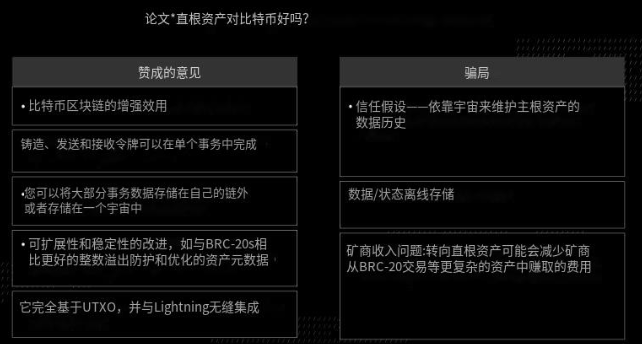
3. Pros and Cons of Taproot Assets
Overall, we can examine the potential benefits Taproot Assets may bring to Bitcoin and understand some advantages and disadvantages of this upgrade.
Data Statistics
Currently, there is little transaction and value data for Taproot Assets on Bitcoin. Although nearly 65,000 unique assets have been minted on the network, the protocol is still in its initial implementation phase, making these mostly experimental.
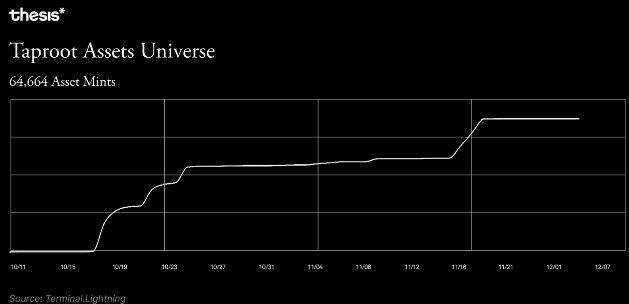
Given the explosive growth we’ve seen with BRC-20 tokens this year, it will be interesting to see whether Taproot Assets can find similar demand. Once direct deployment to Lightning channels is supported, we expect to see more activity and usage of TAP.
Taproot Assets and consumer-facing Bitcoin applications drive practical usage and adoption of Bitcoin, integrating it into the global financial system.
VII. Overview of the BRC-20 Standard
The BRC-20 standard enables enhanced token creation and management on the Bitcoin network. Through Ordinals technology, this protocol allows tokens containing JSON data to seamlessly transfer and interact on the Bitcoin network. This standard provides developers with a framework to create various tokens on Bitcoin, opening broad possibilities for programmable assets.
1. BRC-20 Trends and Market Performance:
The initial ORDI token was quickly minted, reaching a market cap of $1.4 billion, but then saw a significant decline—from $990 million to $379 million, a 62% drop. This token accounted for over 80% of BRC-20 market volume, and its price volatility directly impacted the market caps of other BRC-20 tokens.
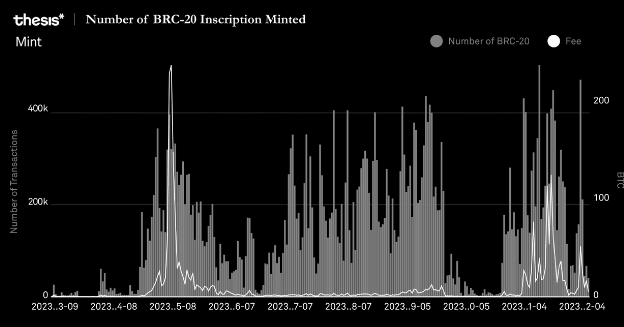
Despite varying valuations of BRC-20 tokens, the overall ecosystem shows resilience. Activity remained relatively stable between May and July 2023, then rebounded from late September to late October 2023. Notably, in November 2023, BRC-20 tokens set a new record by minting over 492,000 tokens.
Key Findings:
Blockchain technology innovation: Through the Taproot upgrade, the Ordinals protocol embeds rich data on the Bitcoin blockchain, enabling Bitcoin to support more types of assets.
Enhanced market potential: The Ordinals protocol attracts new users and market demand, driving digital asset creation and interest in Bitcoin-based digital collectibles and artworks, increasing demand for block space.
Emergence of recursive ordinals: The introduction of recursive ordinals marks a major advancement, enabling complex software operations and overcoming the 4MB limit of standard ordinals, expanding interconnected data sources, improving storage efficiency, and reducing transaction costs.
Potential for DeFi architecture: Recursive ordinals open new possibilities for complex DeFi architectures on Bitcoin, going beyond simple file linking to allow decentralized platforms requiring complex logic and algorithms.
Future Outlook and Impact:
Ordinals and recursive ordinals will continue influencing the Bitcoin ecosystem. The potential to directly host large files like applications or video games on-chain will bring innovative applications. As developers explore integrating complex structures on Bitcoin, certain dynamics within the ecosystem may shift.
But this evolution is not without challenges. Controversies around numbering architecture and centralized concerns regarding maintenance and protocol setup highlight the delicate balance between innovation and adherence to decentralization principles.
The impact of Ordinals on transaction fees, block space utilization, and Bitcoin’s overall scalability remains debated. As the Ordinals market matures and more platforms emerge, we may gain clearer insight into how these digital artifacts fit into the Bitcoin ecosystem and interconnected Web3 platforms.
Although the full potential and long-term impact of Ordinals and recursive ordinals are not yet fully realized, they represent an important stage in Bitcoin’s development. As the ecosystem evolves, we can expect further advancements that continue leveraging the unique capabilities of ordinals, potentially reshaping the landscape of blockchain technology and digital assets.
2. Bitcoin Shopping and Services
Bitrefill: Allows users to purchase gift cards, mobile top-ups, and everyday goods with Bitcoin. Expanded into the U.S. in 2023 and launched Pay Bill service, enabling users to pay various bills with Bitcoin and other cryptocurrencies.
OpenBazaar: A decentralized marketplace where users can buy and sell goods and services directly with Bitcoin. Announced relaunch in 2023 and plans to release OpenBazaar 3.0.
River Financial: A financial service specializing in Bitcoin buying, selling, and investment management, receiving significant funding support. Offers comprehensive services including a Bitcoin trading platform, secure storage, private client services, and Bitcoin mining services.
Swan Bitcoin: Focuses on Bitcoin savings plans, allowing users to automatically purchase Bitcoin regularly.
Strike: A financial app enabling global money transfers, with optional conversion to Bitcoin.
Zebedee: Provides a Bitcoin gaming platform where players earn Bitcoin through gameplay. Launched instant fund-sending in 2023 and introduced the "No Big Deal" (NBD) nonprofit to advance open-source Bitcoin development.
Above are key insights into Bitcoin shopping and services.
3. Privacy and Security First
Wasabi Wallet and Samourai Wallet are Bitcoin wallet applications emphasizing privacy and security. They enhance Bitcoin’s privacy and user security by offering anonymized transactions and robust privacy features. These wallets continuously update and improve to meet user needs, delivering better performance and functionality.
Beyond these wallets, other applications and services promote Bitcoin’s global adoption by integrating it into daily life, finance, and gaming. However, these applications also face challenges related to scalability, regulatory environments, and user adoption. Overall, Bitcoin has made significant progress, but there are still hurdles to overcome on the path to broader global adoption.
VIII. Fold: Bitcoin Rewards and User Adoption Case Study
Fold’s growth and user appeal indicate rising interest in Bitcoin rewards and highlight the development of the Bitcoin economy. Over 250,000 people are on the waitlist for Fold, with 20,000 early users participating in the Fold Card program, demonstrating consumer acceptance of new Bitcoin-reward financial products.
High transaction volumes and cumulative earnings of 65 billion satoshis underscore Fold’s success in financial transactions and Bitcoin investment. This success demonstrates the growing popularity of Bitcoin in everyday financial activities.
Fold’s popularity signals a trend of consumer acceptance of Bitcoin in daily transactions—not limited to experienced crypto users but extending to broader demographics. This suggests Bitcoin may become part of a more widespread financial system.
Fold’s success reflects broader Bitcoin adoption trends, showing how innovative platforms leverage cryptocurrency features to deliver new solutions and drive wider integration of digital currencies into daily life.
IX. Cross-Chain Bitcoin: Bringing Bitcoin to Other Networks
Yield-bearing assets have gained significant attention in the cryptocurrency space in recent years, especially within DeFi. Users can earn returns such as fee distributions by staking assets, becoming a mainstream trend. However, many participants remain cautious toward projects offering no yield. Although yield designs may be unsustainable and require relinquishing asset control, some projects attempt to introduce yield to the Bitcoin network in secure and ethical ways.
Babylon creates a way for Bitcoin to secure various proof-of-stake chains without bridging Bitcoin to other chains, providing safeguards. Through remote staking, staked Bitcoin is locked in a contract on the Bitcoin chain. When violations occur on other chains, similar to shared security solutions on Ethereum or Cosmos, these stakes are slashed.
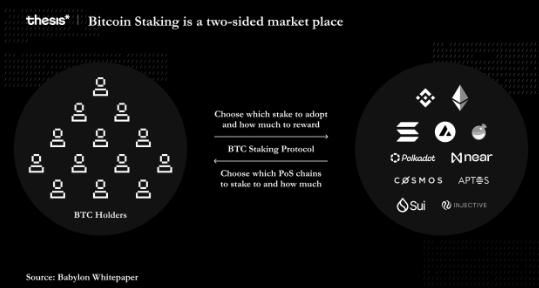
Since Bitcoin lacks smart contract functionality, Babylon achieves remote staking through advanced cryptography, consensus protocol innovations, and optimized use of Bitcoin’s scripting language. Key features of Babylon include:
Bitcoin timestamps help synchronize proof-of-stake chains with the Bitcoin network and enable fast unlocking of staked Bitcoin.
Extractable One-Time Signatures (EOTS) allow slashing of staked Bitcoin in cases of malicious stakers.
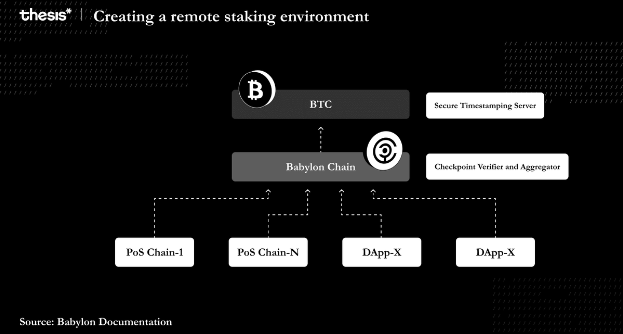
Native staking on Bitcoin to protect other proof-of-stake chains offers multiple benefits. First, this function operates completely independently of the Bitcoin network, eliminating bridge-related risks and increasing demand for Bitcoin, helping boost miner fees. Second, it opens new avenues for earning yield on Bitcoin, enhancing Bitcoin’s viability as an asset and store of value. Finally, extending Bitcoin’s security to other proof-of-stake chains strengthens their economic security—a significant value proposition for both Babylon and native Bitcoin staking.
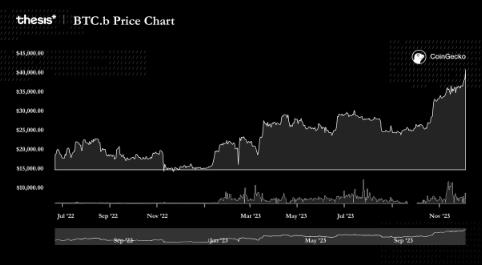
Bitcoin wrapping is becoming increasingly popular for transferring Bitcoin wealth across different ecosystems. Some currently popular wrapped options include Avalanche’s BTC.b. BTC.b is an ERC-20 token in the Avalanche ecosystem, designed specifically for the Avalanche C-Chain. Its bridge uses a highly secure method to wrap Bitcoin into the Avalanche ecosystem, allowing users to trade and swap wrapped Bitcoin on the Avalanche C-Chain. As of December 4, 2023, BTC.b had a market cap of approximately $152.4 million, with trading activity across multiple decentralized exchanges.
1. wBTC
wBTC is an ERC-20 token on the Ethereum blockchain representing Bitcoin. It links wBTC to underlying BTC one-to-one through a bridging process. Users must deposit Bitcoin into a designated custodian to create wBTC. Although these custodians are typically regulated and follow industry best practices, wBTC is not fully decentralized due to its reliance on centralized intermediaries.
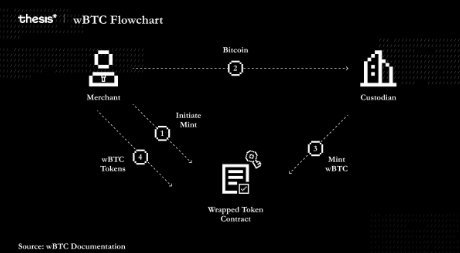
wBTC is created through collaboration between custodians and authorized entities and merchants. After Bitcoin is deposited, wBTC tokens are issued at a 1:1 ratio. Users can redeem wBTC back to Bitcoin—merchants burn
Join TechFlow official community to stay tuned
Telegram:https://t.me/TechFlowDaily
X (Twitter):https://x.com/TechFlowPost
X (Twitter) EN:https://x.com/BlockFlow_News
 @thesis_co









