Emerging Dynamics in the Bitcoin ETF Landscape
TechFlow Selected TechFlow Selected
Emerging Dynamics in the Bitcoin ETF Landscape
Because funds in spot ETFs are redeemable, closer alignment with the underlying BTC assets may lead to more accurate tracking, thereby reducing the higher volatility associated with futures ETFs.
 Navigating Web3 tides with focused insights
Author: Pedro M. Negron
Translation: Shan Oba, Golden Finance
The cryptocurrency industry has long been abuzz with speculation over the potential approval of a spot Bitcoin ETF. Such an ETF would offer direct exposure to the asset and provide access through traditional financial channels. Growing interest from both traditional finance and the crypto ecosystem has captured the attention of major players in traditional finance, who are now seeking to seize this opportunity. The approval process for applications has been lengthy and tedious. Companies originating from the cryptocurrency space, such as Grayscale, have been pioneers in this field, yet their applications remain pending.
With final deadlines approaching for other product applications, speculation and interest surrounding the topic are rapidly intensifying.
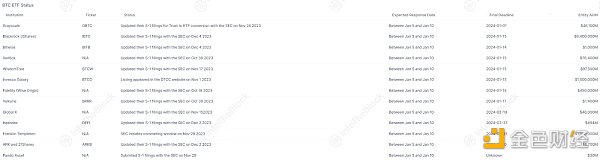
Before making a final decision to approve or reject an application, the U.S. Securities and Exchange Commission (SEC) has the authority to delay its ruling up to three times. Ark Invest will be the first company to reach its final deadline on January 10, 2024. The simultaneous listing of nine Ethereum futures ETFs on October 2, Monday, suggests that the SEC might consider adopting a similar approach when evaluating whether to approve spot Bitcoin ETFs. Rather than approving each application individually before their respective deadlines—which could imply favoritism toward specific entities—the SEC may opt for broader, simultaneous approvals.
In early 2022, the bear market caused GBTC to trade at a discount relative to the value of the Bitcoin it held. By the end of 2022, after the collapse of Genesis under Grayscale’s parent company Digital Currency Group, the discount on GBTC widened dramatically, reaching a record high near 50%.
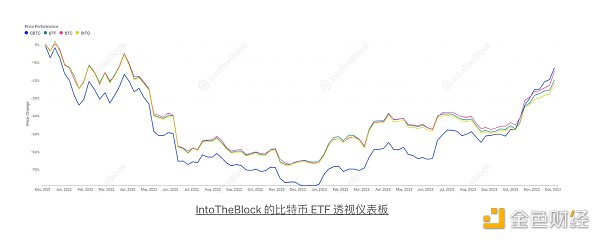
However, in the summer of 2023, BlackRock's application for a Bitcoin ETF—backed by its impressive track record of having 575 out of 576 ETF applications approved and managing nearly $10 trillion in assets—reignited optimism that an ETF approval was finally possible. This led to a narrowing of GBTC’s discount. Shortly afterward, Grayscale achieved a significant legal victory against the SEC over its denial of converting GBTC into an ETF. This win further confirmed the shifting dynamics within the sector.
As a result of these developments, Grayscale’s GBTC has become a barometer reflecting market sentiment regarding the likelihood of ETF approval. This is evident in GBTC’s 320% price surge during 2023, which outpaced Bitcoin’s 165% gain over the same period. These rising price movements and the divergence between GBTC and BTC became particularly apparent in the correlation between the two assets amid differing volatility levels.
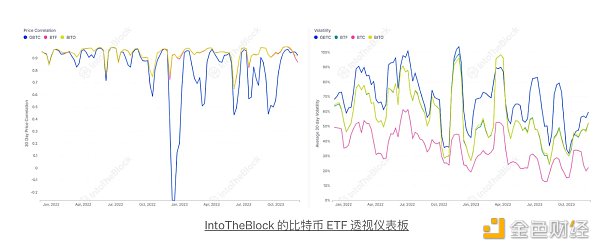
At the point of maximum divergence between GBTC and Bitcoin prices, the correlation between the two assets dropped to -0.27. Such a low correlation indicates that during this particular period, GBTC traded almost inversely to Bitcoin’s price movements. Over the past two years, GBTC’s volatility peaked at 103%, significantly surpassing Bitcoin’s maximum volatility of 61%.
Additionally, it is worth noting the trend analysis of already-approved Bitcoin futures ETFs, BTF and BITO. Over the past two years, the 30-day volatility of both ETFs has consistently remained higher than that of the underlying asset BTC they aim to track. The heightened volatility in these futures ETFs can be attributed to their structural mechanics—specifically, the monthly rolling of futures contracts. Typically, when new futures contracts are issued, they carry a premium, but this premium gradually erodes as the contract approaches expiration. During the rebalancing process—from one month’s contract to the next—futures ETFs often buy Bitcoin at a premium, leading to poorer performance and increased volatility.
This dynamic is one reason why a potential spot ETF could emerge as a superior product. Because funds in a spot ETF are redeemable, tighter alignment with the underlying BTC asset may lead to more accurate tracking and reduce the elevated volatility associated with futures ETFs.
While the idea of a spot Bitcoin ETF has been discussed for years, understanding its deeper implications is crucial. Unlike Bitcoin futures ETFs, which were approved at the end of 2021 and involve derivative contracts, spot ETFs would entail the direct purchase of actual Bitcoin. A spot ETF would pave the way for traditional market participants to invest directly in Bitcoin. Although the path to approval for a spot Bitcoin ETF remains uncertain, recent events indicate that the landscape between traditional finance and the cryptocurrency market is shifting—and increasingly converging. These developments underscore the evolving nature of cryptocurrencies as a significant asset class and growing recognition of their legitimacy.
Join TechFlow official community to stay tuned
Telegram:https://t.me/TechFlowDaily
X (Twitter):https://x.com/TechFlowPost
X (Twitter) EN:https://x.com/BlockFlow_News