








Interpreting the Render Network Upgrade: Why Migrate to Solana?
TechFlow Selected TechFlow Selected
Interpreting the Render Network Upgrade: Why Migrate to Solana?
The core upgrades include migrating from Polygon to the Solana ecosystem, upgrading from the old token to the new RENDER token, and introducing the Burn and Mint Equilibrium tokenomics model.
 Navigating Web3 tides with focused insights
Authors: Feng & Carol, DFG
On November 2, Render Network officially announced the successful completion of its upgrade to Solana, marking the formal migration of this leading decentralized rendering platform from the Polygon ecosystem to the Solana ecosystem. This transition involves the implementation of multiple Render Network Proposals (RNP) approved by the community over the past year and a half, including not only the Layer 1 ecosystem migration but also the issuance of a new token (RENDER) and the deployment of a new Burn and Mint Equilibrium (BME) tokenomics model—each having profound implications for the entire Render ecosystem and all stakeholders of RNDR (soon to be upgraded and renamed as the SPL token RENDER).
Recent secondary market data further reflect the community's positive response to Render’s latest developments. According to Coingecko, the price of RNDR surged above $4 recently, reaching a new high in nearly 21 months.
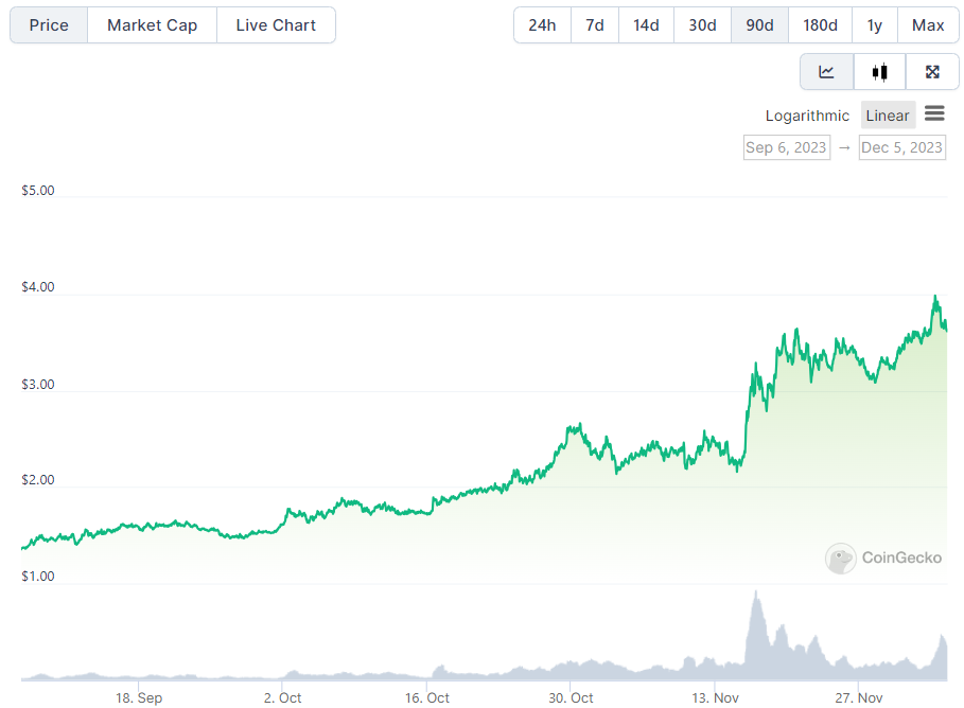
RNDR (ERC-20) Price Trend Over the Past Three Months / Source: Coingecko
What Are the Core Components of the Upgrade?
Render is undergoing a series of major technical upgrades, with each proposal interdependent and mutually reinforcing. The core upgrades include migrating from Polygon to the Solana ecosystem, upgrading from the old token to the new RENDER token, introducing the Burn and Mint Equilibrium (BME) tokenomics model, and implementing a redesigned token incentive and ecosystem resource redistribution mechanism centered around the BME model.
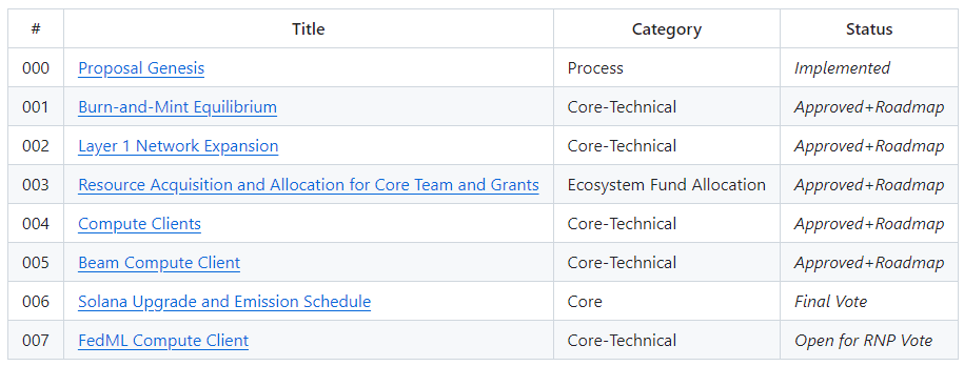
Relevant RNP Proposals Involved in the Render Upgrade / Source: Render GitHub
Introduction of the BME Model
The innovation in tokenomics lies at the heart of this upgrade series. As early as June 2022, the Render community proposed RNP-001, advocating for the adoption of the Burn and Mint Equilibrium (BME) tokenomics model—a framework already successfully implemented by Helium Network (HNT).
Render Network is preparing to switch to a BME model with a net emission cap. By adopting this new token model, long-term supply-demand equilibrium—or even deflation—for RENDER can be achieved. According to the roadmap outlined in RNP-001, the new model is expected to be deployed in the coming weeks, launching an emission program on Solana.
RNP-006, which has just passed final voting, details part of the BME emission and distribution plan, specifying how emissions will be allocated among different network participants, including node operators, compute client partners, artists, and liquidity providers.
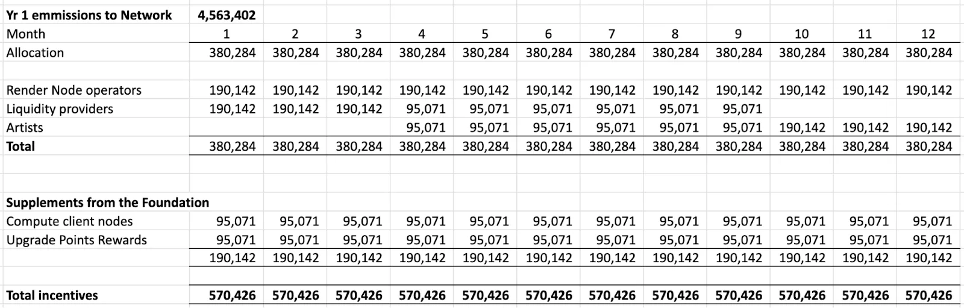
First-Year Emission and Incentive Distribution Details Under the BME Model / Source: Render
Joining the Solana Ecosystem
To better implement the BME proposal and meet evolving network demands, the Render community made the significant decision (RNP-002) to migrate from Polygon to Solana. In a community sentiment survey on selecting a new L1, nearly 55% of members supported Solana due to its faster speed, lower costs, and superior ability to support Render Network’s expansive vision.
A key change associated with the Solana blockchain upgrade is the replacement of "RNDR" with "RENDER." RNDR is an ERC-20 token, while RENDER is a new token built on the Solana blockchain. All work on the Render Network (3D and AI) will be paid in $RENDER, and users can transfer and upgrade their current RNDR (ERC-20) tokens to RENDER (SPL).
Another transformation involves introducing a new Solana-compatible voting system. Community members who upgrade to the RENDER SPL token will participate in network governance via Nation.io, a voting system similar to Snapshot. During the upgrade period, both Nation voting on RNP and Snapshot voting will remain open, with votes aggregated across both platforms.

Community Survey Results on L1 Selection / Source: RNP-002
Ecosystem Resource Redistribution
The new BME economic model establishes a balanced emission schedule designed to ensure flexible emissions that proportionally reward the network’s four main stakeholder groups—node operators, artists, liquidity providers, and compute clients—based on their contributed value.
Creators will receive a percentage of the RENDER spent during an epoch as token rewards. This reward percentage could initially reach up to 100% of the RENDER spent and may gradually decrease over time. Node operators will be rewarded for executing tasks or delivering value; the Render Foundation has announced the distribution of 1.14 million RENDER tokens to incentivize new node operators to participate in AI computing tasks. Liquidity providers will earn periodic rewards for contributing staked tokens to liquidity pools on partner exchanges. Early adopters migrating from RNDR (ETH) to RENDER (ETH) will also receive incentives. Additionally, given the network’s growth objectives, the reward allocation between specific stakeholders—or newly emerging ones—will remain adjustable to ensure contributors are adequately compensated. Overall, the implementation of the new model will provide incentives for all ecosystem participants.
What Impact Will Render’s Solana Upgrade Have on the Ecosystem?
Flexible and Sustainable Tokenomics Model
With the introduction of the BME model, the RENDER token will gain stronger value backing and effectively enter a deflationary mechanism. Compared to the previous payment token model, the BME model offers two primary advantages:
-
RENDER will be treated as a commodity asset, better aligning with the network’s long-term goal of establishing a tokenized computing standard.
-
When network utilization reaches a certain threshold, RENDER will enter a de facto deflationary state, significantly increasing the token’s value.
Specifically, under the new model, miners will earn more income when rendering demand is low. However, when the total cost of rendering tasks exceeds the total amount of RENDER rewards released, miners will earn less than under the previous model (burned tokens > newly minted tokens), pushing the RENDER token into deflation.
Looking back at Render Network’s operations, rendering workload has grown approximately 20–30% over the past three months. According to a report by Insight Partners, the revenue of the visualization and 3D rendering software market is projected to reach $11.83 billion by 2030, growing at a compound annual growth rate of 20.3% from 2022 to 2030. In the coming years, broader adoption by multiple compute clients is expected to stimulate user and traffic growth, potentially scaling to match the size of today’s rendering market. Surging business demand will trigger the RENDER token burn mechanism and accelerate its deflation.
Faster and More Scalable Network
Render is already a mature project processing millions of rendered frames annually, with increasingly demanding requirements on the underlying L1 network. Migrating from Polygon to Solana will greatly enhance the infrastructure foundation for Render’s business expansion in several key aspects:
In terms of transaction performance, the most direct metric is TPS. Ethereum Mainnet handles about 14 TPS, while Polygon Mainnet averages around 130 TPS. In contrast, Solana’s average TPS over the past month is more than 30 times higher than Polygon’s, reaching approximately 4,000 TPS. Distributed rendering services require real-time networking, high hardware demands for rendering, interactive information exchange mechanisms, and on-chain synchronization of node states to maintain decentralization—necessitating an L1 capable of handling large-scale, high-load operations while supporting both on-chain and off-chain liquidity.
Regarding transaction costs, Solana offers significantly higher throughput and lower fees compared to Polygon. Based on Render team estimates, running the same number of frames on Solana would reduce rendering costs (i.e., transaction fees) by over a thousandfold compared to Polygon. Given the massive network traffic required for on-chain state synchronization in the Render network, transaction cost is a critical consideration.
Overall, compared to Polygon, Solana is faster, cheaper, and better equipped to handle Render Network’s ambitious vision. Render aims to deliver real-time, rendered, interactive holographic streaming—requiring dynamic on-chain state updates. To achieve this, the network must support high-performance code execution both on-chain and on GPUs. Rust provides greater speed and flexibility than Solidity, ultimately enabling the same codebase to be used for both GPU rendering tasks and smart contracts.
A Rising Star in DePIN, AI, and Digital Rights Management
Render is one of the benchmark projects in the Web3 DePIN (Decentralized Physical Infrastructure Networks) sector, providing hardware infrastructure for rendering, AI, and related fields, and is often regarded as the “NVIDIA of Web3.” Market cap data from Coingecko show that Render currently ranks second in the DePIN space, behind only Filecoin and ahead of established projects such as Arweave and Helium. Against the backdrop of the current AI application boom, Render stands out as one of the few projects consistently innovating and realizing AI narratives. Digital Rights Management (DRM) is another cutting-edge domain where Render focuses, enabling fast, low-cost royalty flows among multiple parties—an essential feature for monetizing next-generation streaming applications. Moreover, by migrating to Solana, Render can bring complex 3D assets, IP, and AI-generated works’ DRM and royalties fully on-chain, allowing contributors to training datasets to receive compensation.
Currently, whether in terms of commercial use cases or economic models, Render demonstrates clearer growth potential and room for imagination compared to Filecoin. It is well-positioned to catch up with Filecoin and emerge as a leader across multiple sectors including DePIN, AI, and DRM.
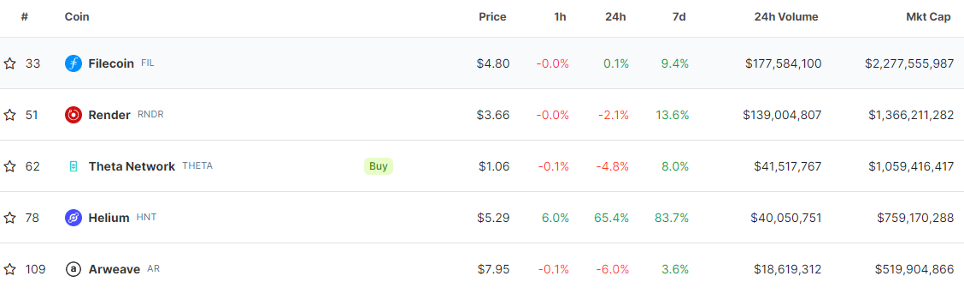
Render Currently Ranks Second in the DePIN Sector After Filecoin / Source: Coingecko
Outlook: From Explosive Growth to the Future
Since April of this year, Render’s business has entered a phase of rapid growth. In April alone, the number of rendering jobs reached a record high of 179,500—an exponential tenfold increase compared to earlier months. Since then, the monthly average has remained above 120,000 jobs and continues to climb, reflecting the explosive growth of Render’s rendering business. Key drivers include:
-
Its parent company OTOY (a leading U.S. cloud rendering firm) has a strategic partnership with Apple, whose official promotional videos have prominently featured the Render Network logo. Octane X supports Macs and iPads equipped with M1, M2, and the latest M3 high-performance chips, paving the way for Render to potentially become an integrated rendering component within Apple’s software suite.
-
Render recently established a collaboration with Stable Diffusion, enabling it to render 3D images and videos generated through large language models.
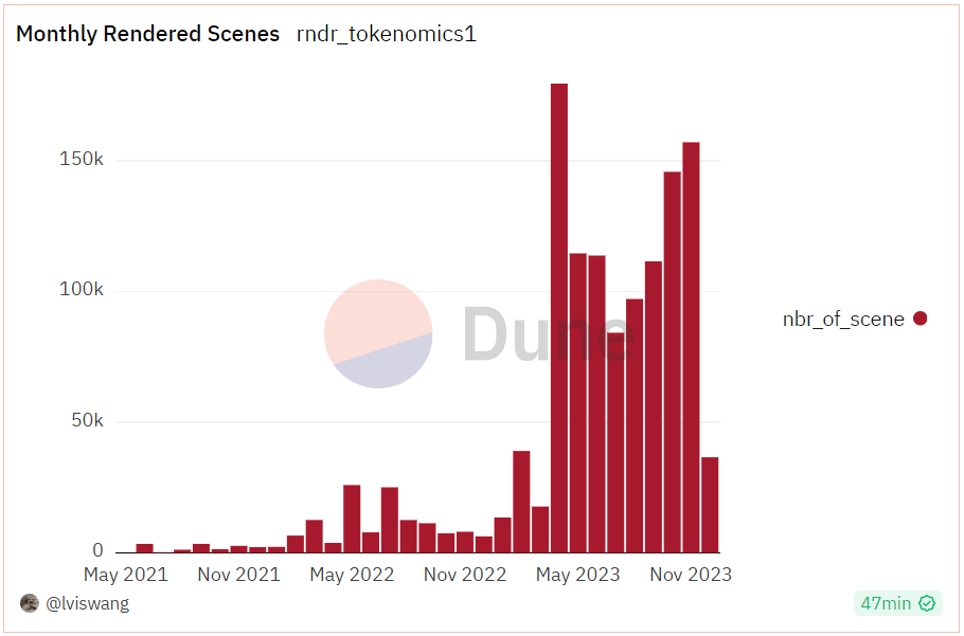
Monthly Rendering Jobs Show Explosive Growth / Source: Dune
Leveraging its parent company OTOY’s powerful rendering technology, Render secured an early leadership position in decentralized rendering. Yet, it has continuously pursued product and technological innovation. This tokenomics overhaul and migration to Solana are pivotal steps toward delivering enhanced cloud rendering services.
Beyond these changes, Render is pursuing further innovations. For example, the latest RNP-007 proposal plans to integrate the FEDML cloud platform, aiming to channel AI community demand into Render’s compute network. FEDML’s GPU marketplace will incorporate Render, enabling AI developers seamless access to Render’s powerful distributed GPU resources. In addition to FedML, Render is actively onboarding other compute clients such as Beam, io.net, and additional cloud platforms. Furthermore, at the recent Solana Breakpoint 2023 conference, Render announced support for multiple new renderers, including Maxon’s Redshift, Physical, and Standard renderers.
These effective initiatives ensure strong narrative continuity for Render moving forward. With AI commercialization just beginning and related fields like AR and VR poised for growth, demand for distributed GPU compute networks like Render is set to remain high. DFG is an early investor in Render Network and remains highly confident in the project’s product and technical progress. We believe Render Network is fully prepared to lead a large-scale decentralized rendering revolution.
Join TechFlow official community to stay tuned
Telegram:https://t.me/TechFlowDaily
X (Twitter):https://x.com/TechFlowPost
X (Twitter) EN:https://x.com/BlockFlow_News








