









Which U.S. listed companies could emerge as winners amid the crypto boom?
TechFlow Selected TechFlow Selected
Which U.S. listed companies could emerge as winners amid the crypto boom?
All innovation cycles begin with speculation. Speculation often leads reality, and fundamentals take time to catch up.
 Navigating Web3 tides with focused insights
Author | RockFlow
Key Takeaways
① Coinbase has carved out a unique niche within the complex world of crypto. Its long-term trajectory will largely depend on two questions: "Can it dominate U.S. crypto infrastructure?" and "Will the crypto economy become a meaningful part of the real economy?"
② As one of the largest publicly traded corporate holders of Bitcoin, MicroStrategy benefits from a stable core SaaS business that limits downside risk, while its strategy of continuously purchasing BTC with low-cost capital offers substantial upside potential.
③ Marathon, as a leading Bitcoin mining company, operates fundamentally on energy arbitrage. Operational differentiation, hardware upgrades, and energy efficiency strategies will be key competitive advantages enabling miners to outperform Bitcoin’s returns and survive across market cycles.
Every innovation cycle begins with speculation. Speculation often precedes reality, while fundamentals take time to catch up.
This was true for the internet over the past few decades. Despite suffering through the dot-com bust in the late 1990s, it eventually gave rise to some of the world’s largest and most profitable companies.
The crypto market may face similar challenges. It would be dishonest to claim that the sector’s rapid expansion over the past decade was driven purely by fundamentals rather than speculation. The critical question now is: if the market moves beyond the post-bubble phase, what real value will remain? And which companies will emerge as industry leaders?
From today's vantage point, the RockFlow research team highlights which U.S.-listed companies have the potential to survive as long-term participants in the crypto space and evolve into true giants.
1. COIN: A Key Player in Infrastructure and Institutional Adoption
Coinbase has established a distinctive niche within the intricate world of cryptocurrency. Founded in 2012 as an early Bitcoin-focused platform incubated by Y Combinator, over a decade later, Coinbase has evolved into a leading exchange for buying and selling digital assets, consistently prioritizing regulatory compliance.
In recent years, Coinbase has diversified beyond just being an exchange, expanding into broader blockchain technology—ranging from wallet infrastructure and staking services to Layer-2 scaling solutions. The launch of Base, its L2 rollup, is a prime example.
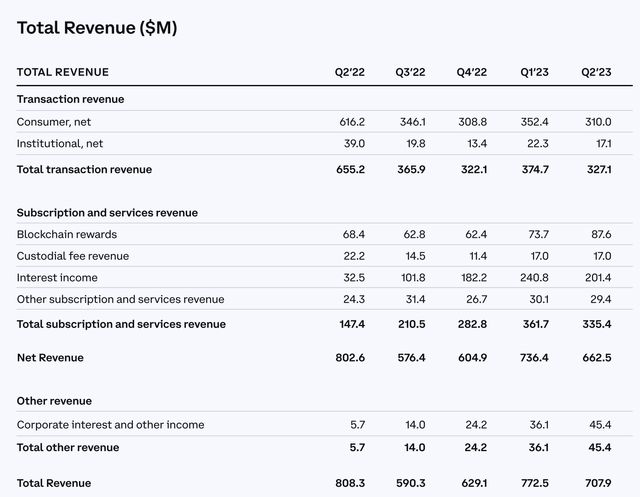
At the same time, its revenue streams are becoming significantly more diverse: transaction fees from retail users have declined (mainly due to sharp drops in BTC and ETH prices over recent quarters), while other sources of income are surging. Interest income, for instance, jumped from $32.5 million in Q2 2022 to $201.4 million in Q2 2023. Below is a chart showing Coinbase’s key financial metrics over the past five quarters:
In this volatile and nascent industry, Coinbase is building a reputation for trustworthiness—a result of unwavering commitment, transparent operations, and a user-centric approach. This trust extends beyond its trading platform to its diversified product suite—from multi-functional financial products like savings and rewards, to the Coinbase debit card, and further into Web3. Coinbase’s ecosystem strategy is gradually unfolding.
Objectively speaking, the future valuation of Coinbase hinges on answers to four key questions:
First, can Coinbase dominate the U.S. crypto market infrastructure?
Second, is Coinbase more than just an exchange?
Third, will the "crypto economy" become a significant component of the real economy?
Fourth, will Bitcoin and Ethereum prices continue to rise?
These four questions encompass nearly all of Coinbase’s narrative.
Can Coinbase dominate U.S. crypto infrastructure? Currently, Binance and others still lead in trading volume and scale. However, a crucial differentiator in crypto is trust—users need confidence in asset security and exchange compliance. Binance faces major hurdles operating in the U.S., entangled in ongoing disputes with regulators like the SEC. In contrast, Coinbase is under strict supervision by the CFTC, SEC, and financial regulators in the UK and Europe. Given this, Coinbase is likely to remain the preferred choice for both individual and institutional investors seeking secure exposure to Bitcoin.
Second, Coinbase is not merely an exchange. In traditional U.S. finance, institutions typically specialize in specific roles: Robinhood, TD Ameritrade, and Schwab focus on retail brokerage; State Street and BNY Mellon handle asset custody; PayPal, Visa, and Mastercard dominate payments; NYSE and Nasdaq operate stock exchanges.
The current crypto financial system is different. Coinbase already operates retail brokerage, custodial solutions, exchange services, and is a leading player in crypto payments. Calling it “the crypto equivalent of NYSE + Robinhood + State Street + PayPal” wouldn’t be an exaggeration.
Third, will the "crypto economy" become a meaningful part of the real economy? There is significant disagreement on this. Mature real-economy markets—like agriculture, oil, and gas—thrive because entire industries profit by selling essential goods to consumers. The oil market isn’t just about speculating on oil prices—it supports real businesses across the energy supply chain. The corn market isn’t just speculation—farmers and large institutions trade and hedge risks to deliver stable food prices. So, how many real commercial participants exist in crypto today?
Currently, very few people use Bitcoin as a payment method, and mainstream cryptocurrencies are far from viable for everyday transactions. Wider adoption and circulation likely depend on final U.S. approval of a Bitcoin spot ETF, which could expand crypto’s effective “commercial use,” such as enabling individuals and institutions to hold Bitcoin directly. The crypto economy may persist as a speculative vehicle and emerging asset class, but achieving broad commercial viability remains highly challenging.
Fourth, will Bitcoin and Ethereum prices keep rising? Coinbase earns fees based on the value of assets traded or held on its platform, and it also holds a large amount of Bitcoin on its own balance sheet. Therefore, rising cryptocurrency prices directly boost its market value. Historically, persistent inflation and continuous fiscal and monetary stimulus have strengthened the consensus around gold and Bitcoin as primary safe-haven assets.
Although the crypto industry faces challenges, this also means remaining players stand to benefit more. Coinbase is one of the few exchanges capable of genuinely attracting institutional investors. In the long run, it may outperform even the cryptocurrencies themselves.
2. MSTR: A Better Bet Than BTC Itself
The U.S. SEC’s prolonged delays in making formal decisions on multiple Bitcoin spot ETF proposals have disappointed many investors. However, for those familiar with MicroStrategy and Bitcoin investors, this only enhances MSTR’s appeal—as it remains the most accessible way to gain Bitcoin exposure via a U.S. stock account.
MSTR is among the world’s largest publicly traded corporate holders of Bitcoin, thanks to its strategic decision in August 2020—to continuously purchase Bitcoin using excess cash, debt, and equity financing.
According to its Q2 2023 earnings report, as of July 31, MSTR held 152,800 bitcoins at a total cost of $4.53 billion, averaging $29,672 per bitcoin. Of these, 15,731 were pledged as collateral for its 2028 secured notes, leaving 137,069 bitcoins (about 90%) unencumbered.
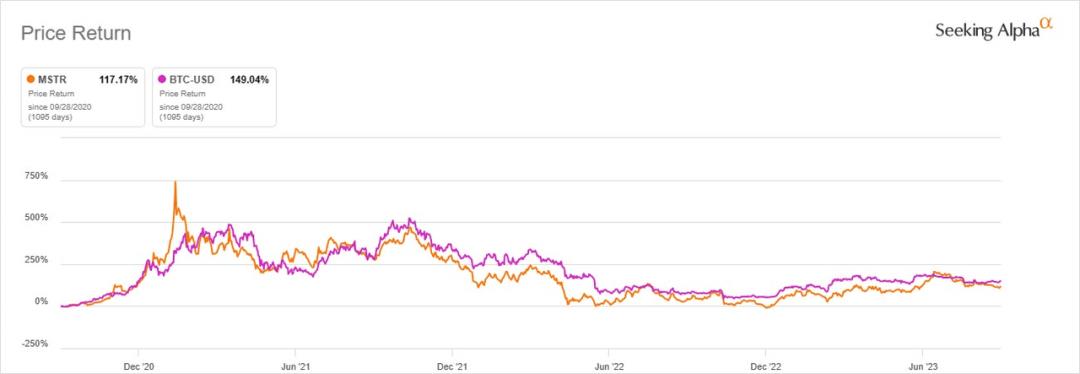
Since launching its buy-and-hold Bitcoin strategy three years ago, MSTR’s stock price has shown a strong correlation with Bitcoin’s price. As shown in the chart below:
For investors betting on Bitcoin price appreciation, MSTR is not the only option. Stocks like Marathon Digital and Riot Platforms—Bitcoin miners—and exchanges like Coinbase also move in tandem with Bitcoin. However, unlike these, MSTR has a solid underlying core business, giving it a distinct advantage.
Stable Core Business Limits Downside Risk
MSTR is also a SaaS company, providing enterprise analytics software and services for decades. It serves a solid customer base including Hilton and Sony, generating predictable annual revenue—$499 million in 2022, $511 million in 2021, $481 million in 2020, and $486 million in 2019. Analysts project $501 million in revenue for 2023.
MSTR is migrating its enterprise software clients to the cloud, shifting revenue from product licensing to recurring subscriptions. So far, the subscription model has proven successful, with high renewal rates—93% in Q2 2023, maintaining above 90% for six consecutive quarters.
To stay aligned with tech trends, MSTR’s core analytics platform is exploring integration with AI. The company is deepening its partnership with Microsoft, integrating its analytics tools with Azure OpenAI and Microsoft 365. MSTR is also pursuing innovation through MicroStrategy Lightning, aiming to leverage the Bitcoin network for new e-commerce use cases and cybersecurity applications.
While these initiatives are unlikely to drive explosive revenue growth, they signal healthy development in MSTR’s core business—meaning it can reliably generate sufficient cash flow to cover operational costs, thereby limiting downside risk to its stock price.
From a valuation perspective, MSTR’s current share price appears reasonable compared to other software firms. But the difference lies in the fact that MSTR is not a typical software company—it also holds over 137,000 unpledged bitcoins. This gives its stock greater potential to outperform even major tech and SaaS peers.
Advantage in Accessing Low-Cost Capital
Another key reason investors favor MSTR is its ability to raise capital under attractive terms. The company currently has $2.2 billion in outstanding debt and convertible notes, with a weighted average interest rate of about 1.6%. Compared to a 2.1% average rate at the end of 2022, this reduces annual interest expenses by over $15 million.
Using low-cost debt to continuously acquire BTC is a smart strategy. As the crypto market improves in the coming quarters—potentially catalyzed by SEC approval of a Bitcoin spot ETF, the April 2024 halving, and possible rate cuts amid declining inflation—Bitcoin’s capital appreciation is expected to exceed debt and interest costs.
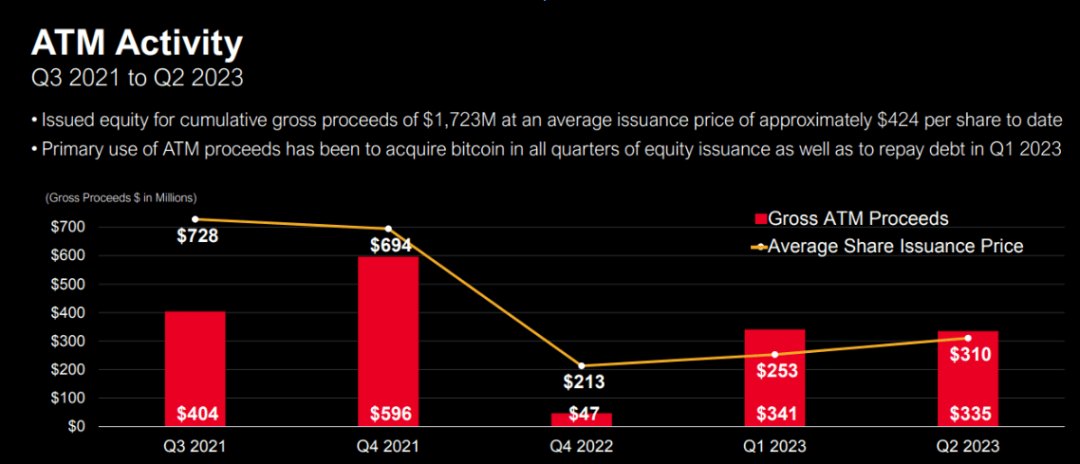
Equity issuance is another funding tool for MSTR. Since Q3 2021, it has raised $1.7 billion through its ATM program, issuing shares at an average price of around $424 per share. The proceeds have primarily been used to buy more Bitcoin.
A unique aspect of MSTR’s ATM program is that, compared to other Bitcoin players like MARA and RIOT who frequently issue new shares, its share count growth has been minimal.
MSTR’s total shares outstanding increased from 11.3 million in 2021 to 14.1 million in the latest quarter. In contrast, MARA’s shares rose from 102.7 million to 174.2 million, and RIOT’s from 117.3 million to 185.3 million over the same period.
Slower share growth means MSTR retains greater capacity to issue additional shares for future fundraising. Additionally, on September 24, MSTR sold 403,362 shares for net proceeds of $147.3 million, which were used to purchase Bitcoin.
Risk Factors
It’s important to note two potential risks for MSTR. First, any future decision to sell part or all of its Bitcoin holdings could trigger an overly negative investor reaction. Thus, the company must continue taking on debt and issuing shares to sustain its Bitcoin strategy. However, there’s no guarantee it can keep raising capital on favorable terms, especially if Bitcoin prices remain flat—or worse, decline sharply. Recall that during the 2022 crypto bear market, many leveraged crypto firms went bankrupt.
The second risk involves valuation. While investors can use P/E ratios to assess its software business, GAAP accounting rules require MSTR to record quarterly impairment charges whenever the fair value of its Bitcoin holdings declines. This results in frequent impairment losses on its financial statements. Given Bitcoin’s extreme short-term volatility (e.g., $24 million in impairments in Q2 2023 vs. $918 million in Q2 2022), company valuation becomes even more complex.
3. MARA: Is Mining a Good Business?
Marathon is a Bitcoin mining company offering investors indirect exposure to Bitcoin. Miner stocks generally show a strong positive correlation with Bitcoin prices, and mining stocks often act as leveraged plays on crypto.
Historically, when Bitcoin rises, miner stocks tend to rise even more, as investor sentiment turns euphoric, expecting a multiplier effect. Conversely, when Bitcoin falls, miners suffer disproportionately.
Mining is fundamentally an arbitrage business. Rather than focusing on Bitcoin’s technical details, miners need operational expertise—learning how to run energy arbitrage efficiently. Top-tier mining companies get excited about innovations like new cooling methods, novel architectures, upgraded transformers, or advanced energy arbitrage strategies.
Arbitrage is crucial—it’s one of the key differentiators allowing miners to outperform competitors. Leading miners need top-tier equipment, the lowest production costs, and, more importantly, leadership that understands energy arbitrage—especially a skilled CFO.
Sometimes, they shut down machines because they can earn more through energy recycling programs. An experienced CFO is vital for guiding a mining company through cyclical bear markets and "crypto winters."
Marathon’s Q2 2023 earnings report, released on August 8, revealed its current state: revenue grew 228.5% year-on-year, but net loss widened to $21.3 million (up nearly 200% from $7.2 million in Q1). This reflects high Bitcoin production costs, suboptimal market prices, and heavy operating expenses like energy.
Despite missing expectations, MARA’s performance shows significant year-over-year improvement. Bitcoin production surged 314% year-on-year, averaging 32 BTC per day, though lower average BTC prices (down 14%) weighed on revenue.
The output increase stemmed from a 54% rise in computing power during Q2, reaching 17.7 EH/s—a record high. After Q2, operational hash rate continued climbing, hitting ~19 EH/s in July.
The path to profitability is harder for miners than for exchanges or asset managers. Beyond common regulatory hurdles in crypto, since Bitcoin is their primary revenue source, price volatility severely impacts miners’ profits and cash flow.
Additionally, the next Bitcoin halving is expected around April 2024. With block rewards cut in half, miner revenues may shrink. The halving also increases mining difficulty, forcing miners to upgrade to more powerful hardware. Stronger hardware leads to higher energy consumption and operational costs—challenges miners cannot easily avoid.
Therefore, compared to exchanges and asset management firms, mining represents a riskier crypto investment.
4. Final Thoughts
The crypto industry itself has gone through multiple hype cycles, each fueled by speculation around new technological triggers. These cycles have brought greater attention, users, and capital to the ecosystem, building upon previous progress to expand the possibilities of crypto technology.
Today, the industry may have reached a stage where enough puzzle pieces exist—capable of being reassembled in various ways to meet broader needs and real-world use cases—potentially ushering in a new era.
Throughout this process, even if you’re not directly involved in crypto, you can still support the companies you believe in through investment. Below are the leading crypto companies and crypto strategy ETFs selected by the RockFlow research team from the current U.S. stock market:
Join TechFlow official community to stay tuned
Telegram:https://t.me/TechFlowDaily
X (Twitter):https://x.com/TechFlowPost
X (Twitter) EN:https://x.com/BlockFlow_News










