








Shedding personal labels, the new Binance is once again moving forward "lightweight"
TechFlow Selected TechFlow Selected
Shedding personal labels, the new Binance is once again moving forward "lightweight"
Binance remains as usual, its position as the "top exchange" unshaken.
 Navigating Web3 tides with focused insights
Author: Gou, Foresight News
Unlike the collapse of FTX, two weeks have passed since Changpeng Zhao stepped down from Binance, yet apart from significant discussions during the first day or two, there hasn't been much subsequent turbulence. After Zhao's resignation as CEO and Richard Teng's succession, Binance continues moving forward as usual, no different than before.
No misappropriation of user funds, no market manipulation—yet after months of intense negotiations, Binance ultimately chose to plead guilty and accept penalties. You could view this as a reluctant sacrifice in crypto’s battle with regulators, or as the price paid for its early, unregulated growth. But as CZ himself put it, all of this was “the best possible arrangement.”
The New CEO Champions Stability
"Delivering value to customers" and "financial freedom" were the two key phrases emphasized by new CEO Richard Teng in his first public letter. Alongside his bold declaration that "we are stronger than ever," Teng presents a stark contrast to Zhao’s traditionally relaxed tone—his initial impression is one of humility and restraint.
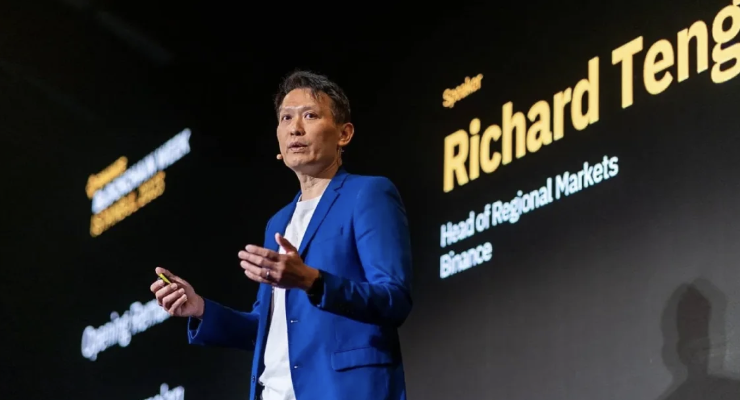
Richard Teng, Binance’s new CEO
Rumors about Richard Teng succeeding as Binance’s CEO first surfaced in a Bloomberg report on June 5, citing sources familiar with the matter who claimed Teng would take over if Zhao left due to regulatory pressures. Although Binance personnel quickly clarified to Foresight News that “this news was mere speculation by a media outlet,” it now appears those reports were well-founded.
This CEO successor—unexpected yet logical—is 52 years old and previously held key positions at the Monetary Authority of Singapore, Singapore Exchange, and Abu Dhabi Global Market.
Teng joined Binance in May 2021 as CEO of Binance Singapore. By December 2021, he was promoted to lead Middle East and North Africa operations, then a year later took charge of Europe as well (becoming head of EMEA). In April this year, he was further entrusted with overseeing Asia, making him responsible for APAC, EMEA regions. Just a month later, Teng assumed leadership over nearly all Binance operations except Binance.US.
While we haven’t yet seen concrete results from Teng’s tenure, his swift ability to stabilize internal morale and market confidence, along with his clear roadmap for Binance’s future, suggests Zhao made no mistake in choosing him.
As early as mid-year during an interview, Teng praised Binance’s recent compliance efforts and reaffirmed that compliance will remain a top priority going forward.
Teng’s background reflects deep expertise in finance and regulatory compliance. While Binance has paid a price for past compliance shortcomings, under a leader with extensive experience in these areas, it can now move forward more boldly. The penalties may mark the end of “Binance 1.0,” but they’ve also torn down a crumbling wall blocking the path to “Binance 2.0.” Beyond the rubble lies a highway leading toward the sunrise.
The Ultimate Stress Test
Beyond the new CEO’s calm leadership, many observers now see something else through this event: Binance has matured into an organization no longer dependent on any single individual.
Much like major internet companies valued at tens or hundreds of billions, whose founders have become symbolic figures, Binance today continues steadily along its established trajectory even without active involvement from its original leader. Unlike many smaller Web3 projects that collapse when their founders depart, Binance resembles Bitcoin after Satoshi Nakamoto disappeared—far from fading away, it has grown stronger.
On the market share front, despite being impacted in recent years by events such as the FTX collapse, lawsuits from the U.S. Securities and Exchange Commission (SEC), Commodity Futures Trading Commission (CFTC), and investigations by the U.S. Department of Justice, Binance still maintains around 50% market share in both trading volume and reserve assets—its position as the leading exchange remains unshaken.
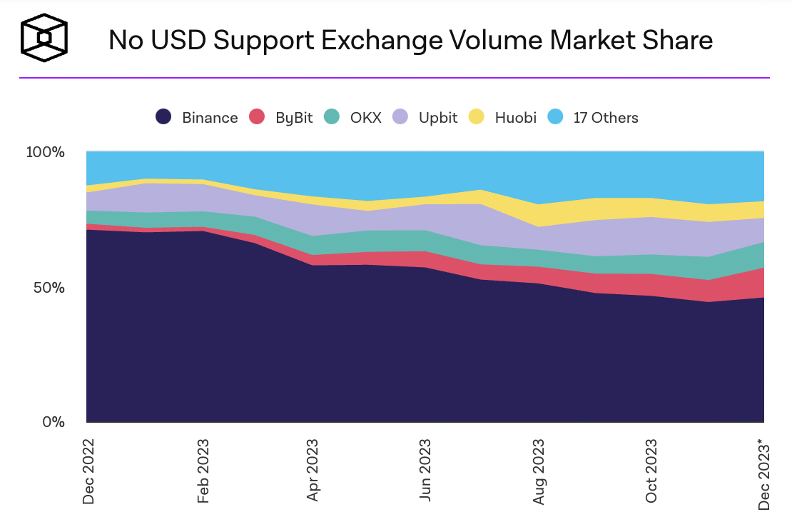
Market share by trading volume among exchanges not supporting USD trading, The Block
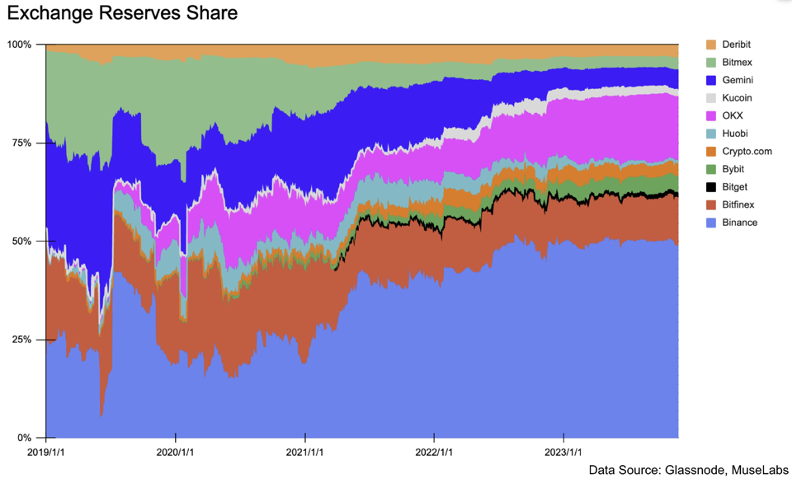
Proportion of exchange reserve assets, sourced from X user Jinze (Golden Ze)Twitter
According to DefiLlama, on November 22, negative news triggered over $3 billion in outflows from Binance, causing its reserves to drop from nearly $70 billion to approximately $66.6 billion. However, the figure has since rebounded to around $68.6 billion. Excluding the impact of rising token prices, newly inflowing and returning funds have already offset at least half of the losses. Nansen data also shows that just one week after withdrawals surged due to Zhao’s departure and the massive fine, capital outflows ceased entirely—and on Ethereum, there was even a net inflow of nearly $90 million.
Compared to the waves of FUD that followed FTX’s collapse and multiple U.S. regulatory lawsuits, this time the market stood largely united behind Binance. While many users withdrew funds as a precautionary measure, this time we know—they will come back.
Moreover, perhaps because Binance had long prepared for the settlement terms, or because the entire Web3 community has grown more resilient since the trials of 2022, we’ve seen almost no significant negative fallout from this incident. In a sense, Binance has earned broad market recognition—external pressures can no longer easily erode trust and confidence in it.
Next Stop: Binance 2.0
“Binance’s settlement with the U.S. government is positive for the crypto industry and exchanges, significantly reducing potential systemic risks associated with exchange operations,” stated JPMorgan in a report. From another perspective, the Department of Justice’s actions serve as a public message: as long as operations are compliant, cryptocurrency exchanges can function within the United States.
Earlier this month, Binance announced the launch of Binance Web3 Wallet, officially entering the Web3 wallet space. Looking back, Binance has expanded into nearly every corner of the Web3 ecosystem: exchanges, cloud services, PoW mining pools, staking, finance, payments, Binance Labs for investment and incubation, and Binance Research for education, market analysis, and outreach. If we include BNB Chain, Binance now touches virtually every sector.
When Tim Cook succeeded Steve Jobs at Apple, many believed Apple had lost its soul without the “Godfather of i.” Yet Apple continued to drive innovation across the industry. Though nothing matched the awe of the original iPhone’s debut, Apple never fell from grace—instead, it surged ahead, with its stock climbing from $1 trillion to $2 trillion and eventually $3 trillion, creating miracle after miracle.
Similarly, managing Binance’s vast and complex operations requires more than a single individual—it demands mature management and innovation systems. Therefore, whether or not CZ remains, Binance’s existing and new ventures are unlikely to be significantly affected.
Binance’s resilience through adversity delivers a powerful boost to the entire industry, demonstrating that regulation isn’t arbitrary—if requirements are met, the market doors remain open. Now, under Richard Teng’s leadership, Binance 2.0 has officially begun. This new CEO is expected to strengthen Binance’s compliance foundation while continuing to advance industry development and financial freedom.
Join TechFlow official community to stay tuned
Telegram:https://t.me/TechFlowDaily
X (Twitter):https://x.com/TechFlowPost
X (Twitter) EN:https://x.com/BlockFlow_News
 Foresight News









