









Coinbase Former CTO Balaji AMA Transcript: Network States Will Reshape Global Politics, Most Excited About Research in Longevity
TechFlow Selected TechFlow Selected
Coinbase Former CTO Balaji AMA Transcript: Network States Will Reshape Global Politics, Most Excited About Research in Longevity
Cryptocurrencies have achieved decentralization on a global scale, and this trend has been accelerating since 2021.
 Navigating Web3 tides with focused insights
Written by: TechFlow
Balaji is an American entrepreneur, investor, and highly creative philosopher and thinker. He was co-founder of Earn.com (later acquired by Coinbase) and Counsyl, former CTO of Coinbase, a partner at a16z, and author of "The Network State".
Yesterday, he participated in a community AMA, discussing extensively and deeply on multiple topics related to politics, economics, and technology. TechFlow has selected some of his responses, including those on network states, decentralization, longevity/immortality, and current developments in bioscience.
Moreover, among the questioners were several heavyweight figures—such as the following six questions posed by Vitalik:
-
It seems that since 2021, momentum around “finding alternatives to San Francisco” has weakened, with AI and "return-to-office" mandates driving re-centralization. In this context, what new thoughts do you have about breaking these network effects and achieving more tangible geographic freedom?
Balaji: I believe we are still moving toward at least three technological poles (which I call NYT, CCP, BTC), and one decentralized center that skillfully combines them.
Why? Because: (a) cryptocurrency has already achieved global decentralization, and this trend has accelerated since 2021; and (b) AI execution inherently encourages decentralization (since people may ask questions from different angles).
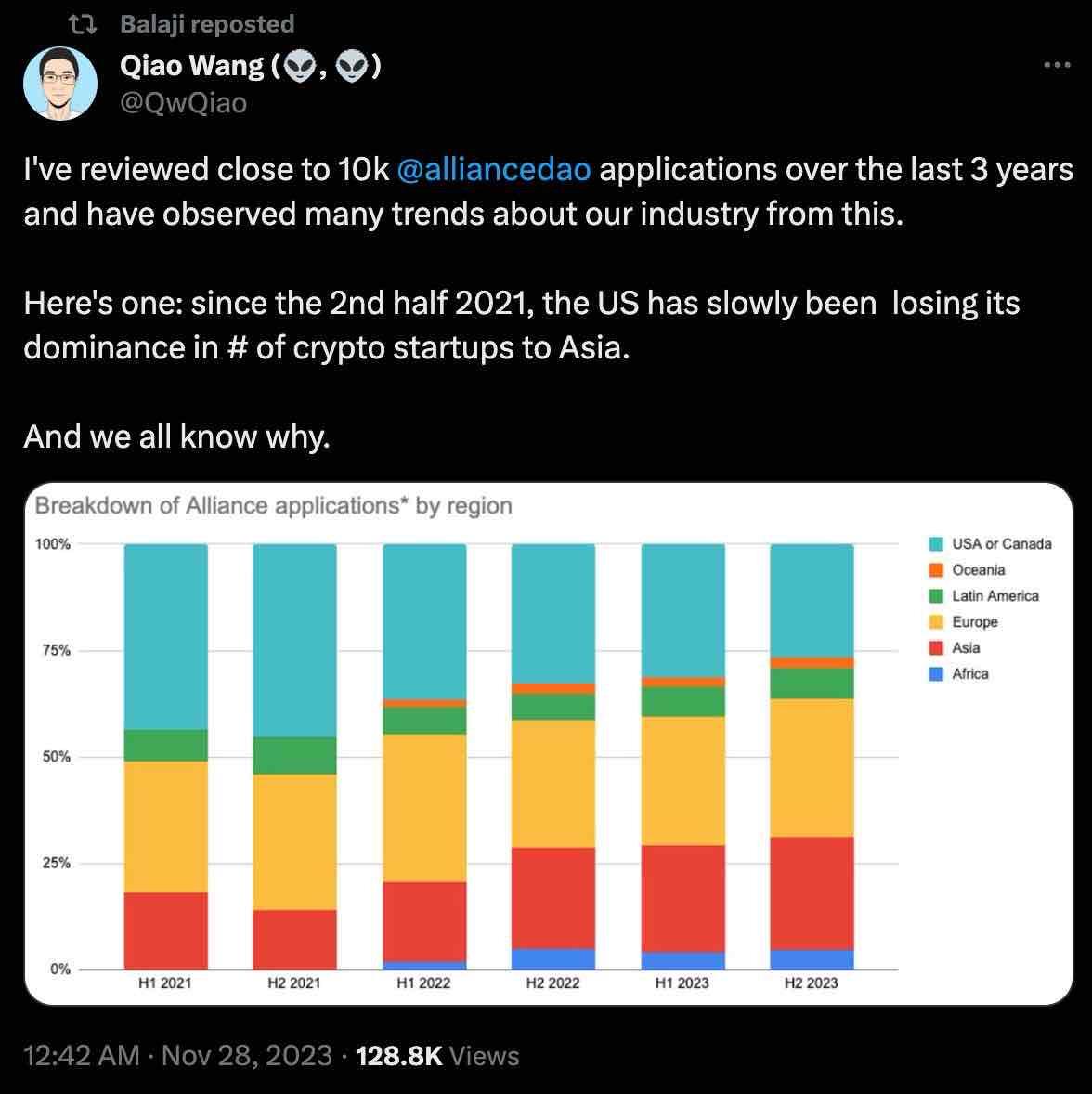
(c) I think there’s still more volatility ahead regarding U.S. regulation and economy. For example, banning autonomous vehicles in San Francisco/California shows they will resist adoption of more new technologies. We’ll see whether a small group of tech workers in this most tech-centric city can use AI to disrupt many blue-collar jobs and earn billions...
Basically, my view is: San Francisco matters, but isn’t absolutely essential. Yes, we could reclaim cities via a “Gray Tribe” strategy. But equally possible is being swallowed by stronger blue (tech) political forces opposed to AI-driven disruption. (Gray = "decentralized center")
-
What's the best example you've seen of blockchain-as-a-ledger?
Balaji: I think wijuwiju.eth's interface.social offers an excellent Twitter-like interface built on the Ethereum blockchain. This is exactly what we want—an intuitive user interface displaying cryptographically provable events.
-
Where do you most disagree with the views of the 'Indian middle-class elite'? Or where do you most disagree with the views of 'Silicon Valley middle-class tech venture investors'?
Balaji: The 'Indian middle-class elite' haven't yet realized that tech professionals in India already enjoy a better standard of living than their Western counterparts. That's why seemingly trivial debates about Bangalore vs. San Francisco spread widely on Twitter. See this tweet.
An even more interesting answer might involve the role of the Indian diaspora. The diaspora represents the Indian nation, the Indian network—but not the Indian state. My thinking differs here, but I think it's starting to gain acceptance; see this article.
-
What is the greatest value-add (or should be the value-add) that a network state can—or should—offer its host country?
Balaji: The obvious value-add is economic—providing locals with more capital than they currently have. I think this is necessary, but not sufficient. You also want many locals to become “dual citizens,” such as Bitcoin Americans or Ethereum Japanese.
-
What do you think are the most reasonable and realistic forms of autonomy/legal concessions that a network state should seek from host governments—at least in the short term?
Balaji: The minimal level of autonomy required to live the life you want. Through socially agreed-upon norms within a group, you can accomplish a lot.
-
Which types of people did you not expect to be interested in the idea of network states?
Balaji: I’ve been surprised by how quickly people across many different regions of the world grasp the concept—even without translation. Two examples:
There are also others I didn’t anticipate would be attracted—people who don’t prioritize the same things I do, but genuinely want to build communities together. For instance, among those eager to change the status quo, supporters of network states tend to come more from progressive left-wing circles rather than center-left ones.
The following questions are drawn from other parts of Balaji’s AMA session.
-
What does “home” mean to you? Which cities or places feel most like home, and why?
Balaji: “Home” is the phone’s home screen.
Just kidding. Seriously, I enjoy a stable physical environment, but I don’t particularly care where it is. I just want a place where I can drink coffee, walk in the sun, and think quietly. It doesn’t need to be luxurious.
-
Should network states be formed as DAOs (Decentralized Autonomous Organizations)? If so, which platform should be used (e.g., Ethereum, Bitcoin, or others)?
Balaji: From a technical perspective, the platform doesn’t matter—the community is what’s crucial. Can you attract 10 paying members and keep them consistently engaged? It sounds both easy and hard.
-
Have you read Vitalik’s new post “d/acc”? (TL;DR: his take on techno-optimism.) If so, how compatible is it with the Gray / Network State movement?
Balaji: It’s a good post. I might write something soon with more evolutionary/biological angles, because I think that may be our best precedent for thinking about silicon-based intelligence evolution.
-
What are your thoughts on the comment that governance in network states may be more susceptible to social media influence than more traditional existing governance models?
Balaji: My answer: Think about Trump.
More broadly, all governance is influenced by social media. Just as traditional finance is becoming as volatile as decentralized finance.
The only solution is to face it head-on. We need to build institutions that are primarily internet-native, capable of handling the internet’s inherent instability.
-
What is the strongest argument against Bitcoin that you’ve encountered (i.e., one you find compelling)?
Balaji: Apple, Google, and Microsoft pose a systemic risk to the entire crypto ecosystem—including Bitcoin—because they could implant backdoor private keys through software updates. See this tweet.
-
When do you expect the first nation resembling a network state to emerge?
Balaji: It took 13 years from whitepaper to El Salvador recognizing Bitcoin. So let’s wait and see…
-
How do you view online organizations owning distributed property?
Balaji: In the foreseeable future, it will be “just” a multinational corporation. There are many known entities that own global real estate—from Hilton and Starbucks to construction and tech companies. It depends on what you’re trying to do.
-
Are network states composable? Will we see networks of network states (cities, nations, alliances)?
Balaji: Yes, network states are composable. I discuss this in my book. Briefly, imagine Starbucks acquiring some or all Peet’s Coffee locations and rebranding them so your Starbucks card works. That’s what happens when two networks partially or fully merge.
-
What are your thoughts on Poland?
Balaji: Eastern Europe could become the new Western Europe. If the U.S. abandons Ukraine to fend for itself, Poland will need to resolve its relationship with Russia. Aside from that, Poland has many attractive qualities in its positioning.
-
What recent advances in biomedical science excite you the most?
Balaji: I’m most excited about research into longevity. See:
-
Which industries, ideas, or internet subcultures are currently undervalued but you believe will rise significantly in status over the next 5 to 8 years?
Balaji: Bro science (fitness and nutrition). It will become the foundation for self-experimentation, leading us toward longevity and Human 2.0.
-
Many discussions focus on creating ever-smaller tribes, with relatively little attention to increasing global cooperation. How do we balance the need for larger bonds and narratives in civilization-building with innovation occurring mostly in small groups with fast iteration cycles?
Balaji: I see a centralized East and a decentralized West. In the East, large-scale entities persist, while in the West, small-scale entities continue growing—even in regions previously stabilized by the West.
-
What was your early life like, between ages 5–16? And what do you think contributed most to shaping who you are today?
Balaji: K–12 felt like prison to me. But ultimately gave me foundational knowledge in physics and self-learning ability—back when the internet wasn’t really accessible.
How would I describe myself? I'm not really a computer person—I’ve always been a math person.
-
When governments notice people aligning more with their network states than with physical nations, does this lay the groundwork for conflict? If so, how should network states respond? Should they become political parties?
Balaji: Yes, this could lay the groundwork for conflict. When people identify more strongly with network states than physical nations, it may trigger struggles over power and control.
I think political movements are an intermediate stage between online communities and full network states. Whether to become a party in a specific country remains to be seen—but it’s certainly an option.
-
Based on what you know now, how far is humanity from achieving “immortality”?
Balaji: Much closer than we think. Impressive results have already been achieved in animals like mice.
-
What’s your next short-term goal?
Balaji: Finishing the final version of *The Network State*—including paperback, hardcover, audiobook, translations, and open-sourcing the code repository.
Join TechFlow official community to stay tuned
Telegram:https://t.me/TechFlowDaily
X (Twitter):https://x.com/TechFlowPost
X (Twitter) EN:https://x.com/BlockFlow_News
 深潮TechFlow









