









Arthur Hayes: The treatment of CZ and Binance is absurd
TechFlow Selected TechFlow Selected
Arthur Hayes: The treatment of CZ and Binance is absurd
If you hold cryptocurrency, make sure to store it in a wallet where you control the private keys. Otherwise, you own nothing and will forever remain a slave.
 Navigating Web3 tides with focused insights
Author: Arthur Hayes
Translation: GaryMa, Wu Shuo Blockchain
*Note: This article is a selected translation based on the Chinese version; some details or information may have been omitted.
Changpeng Zhao (CZ), former CEO of Binance, is a "sinner"—but not for the reasons you might think, such as recent legal actions. In Satoshi Nakamoto’s eyes, CZ and all of us are sinners because we profit from centralization. Centralization is the tool of the devil. Humanity—and possibly artificial intelligence in the future—will cooperate through decentralized structures without coercion to achieve shared goals. States enforce centralization by threatening violence to compel collaboration.
In just six years, from 2017 to now, CZ and the Binance team have grown from nothing into the world's largest centralized cryptocurrency exchange. Binance isn't only the biggest crypto trading platform—it likely ranks among the top ten globally in average daily trading volume, across both traditional and alternative markets.
Just a few years ago, CZ was an obscure Canadian of Chinese descent. His surname doesn’t carry the same weight as Rothschild, Rockefeller, or other powerful lineages. Yet within less than a decade, he rose to become one of the richest people on Earth, building his fortune on enabling millions worldwide to trade cryptocurrencies. For some, Binance represents a path toward financial freedom. For others, it offers an efficient way to speculate on new political, economic, and technological systems.
The problem for the financial and political establishment is that the intermediaries facilitating this industrial revolution aren't run by members of their own class. The intermediaries and owners of crypto assets are ordinary people themselves. Never before have individuals been able to own a piece of the industrial revolution in under ten minutes via desktop and mobile trading apps. Fundamentally, those who control centralized exchanges use tools of the state, corporations, and legal structures to disintermediate institutions meant to run global finance and politics under the U.S. system. CZ has paid a heavy price for this.
How high was the cost? CZ and Binance paid the largest corporate fine in U.S. history: $4.3 billion!
This seems odd. Bad girl U.S. Treasury Secretary Yellen stands up to denounce all of CZ and Binance’s crimes. Did Lloyd Blankfein, former CEO of Goldman Sachs, receive similar treatment during his tenure when GS helped former Malaysian Prime Minister Najib Razak and financier Jho Low steal over $10 billion, burdening a developing nation with more expensive international debt? No—Lloyd retired with his stock options intact, and GS faced no criminal liability. Have any CEOs of too-big-to-fail banks faced criminal prosecution for triggering the worst global financial crisis since the Great Depression of the 1930s? No—they got free passes because prosecuting them would threaten the banking system. Did HSBC executives ever personally reposition cash deposit points so Mexican drug cartels could launder money more efficiently from profits earned selling drugs to the American public?
Then why must a company less than ten years old face such extreme punishment? Did Binance commit more crimes than any bank in U.S. history, some of which have existed for centuries? Clearly, the treatment of CZ and Binance is absurd, highlighting only the arbitrary nature of state punishment.
I’m no Dostoevsky, and this isn’t a philosophical treatise on crime and punishment—but this absurdity tells us something about what we believe. It tells me that cryptocurrency is one of the most important political, financial, and technological developments in the history of civilized humanity. We’re trying to build a parallel financial, political, and economic system based on voluntary participation rather than violent coercion. It’s so transformative that one person can become one of the richest in the world in under a decade, and his company can become more essential than centuries-old elite financial institutions. For the first time ever, we—the people—can own the foundation of a new digital human society with just a swipe on a smartphone. If after seeing the immense pressure the state has placed on CZ and Binance you still don’t want to join the Bitcoin and broader cryptocurrency movement, I don’t know what else you’re waiting for.
If you hold cryptocurrency, ensure it's stored in a wallet where you control the private keys. Otherwise, you own nothing and will remain a slave forever.
That said, let’s get to the real focus of this piece: China and the United States are friends again. The result of this renewed friendship will be the activation of China’s printing press. Let’s see how this eastern giant is about to fuel the emerging crypto bull market.
The Time Has Come
What has changed is the renewed alignment between the U.S. and China. Even if this closer relationship lasts only a few years, it gives China cover to act as the world expects—just as they did between 2008 and 2015—by printing heavily.
Let me first illustrate through a few charts why now is the perfect time to inject RMB credit into the global system.
The RMB Will Strengthen
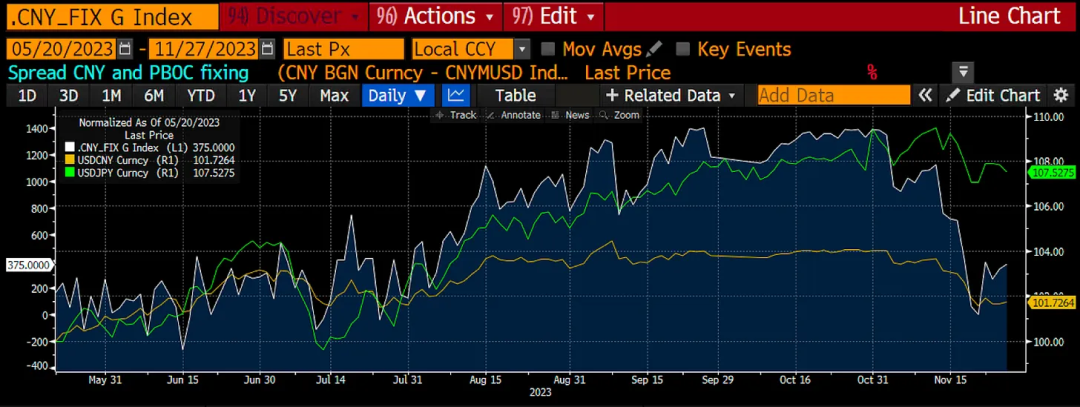
The blue shaded area shows a chart of the People's Bank of China’s (PBOC) official yuan-to-dollar rate versus its fair market value. The higher the value, the greater the yuan's depreciation against the dollar. As shown, the yuan (yellow) has been under downward pressure due to the yen’s (green) depreciation, yet the PBOC has kept it stronger than it should be. This is costly, as it means the PBOC is selling precious dollar assets to maintain an artificially strong yuan.
Now that bad girl Yellen is pursuing a weak-dollar policy, the PBOC no longer needs to spend valuable dollars supporting the yuan. The yen is strengthening and realigning with the firm yuan. Japan is China’s biggest export competitor. If the yen depreciates, the yuan must also weaken so Chinese exporters retain global competitiveness. Now the yuan is at fair value—and as the dollar continues to weaken, the yuan will actually strengthen. This gives China enormous room to significantly expand onshore RMB credit without causing currency depreciation or placing huge strain on the PBOC to keep the yuan artificially strong.
China Is in Deflation
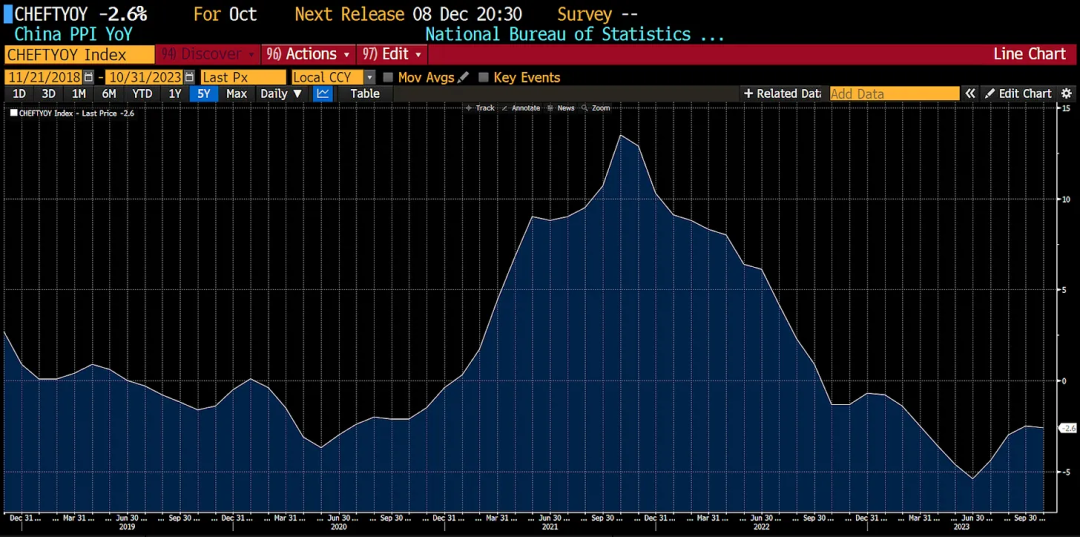
China’s economy is built on infrastructure investment and manufacturing, not consumer spending—a supply-side or supply-driven economic structure. Therefore, the most relevant inflation metric is Producer Price Index (PPI), not Consumer Price Index (CPI). PPI is falling, indicating weakness in the economy’s supply side.
The PBOC has significant room to ease by increasing credit growth, as PPI remains in deflationary territory.
As I’ve explained above, China has ample space to greatly expand credit. With PPI in deflation, credit expansion won’t trigger worsening inflation. Nor will it cause currency depreciation leading to capital flight, given the U.S. is pursuing a weak-dollar policy and the yen is strengthening.
But How Do We Crypto Traders Profit—Even If All This Happens Rapidly?
Michael Pettis, former Bear Stearns bond trader and current professor at Peking University, argues that China exhausted its capacity to absorb debt productively in the early 21st century. Since then, all newly added debt has been invested in projects yielding returns below the cost of debt. The result is that despite trillions of yuan allocated to various projects, society has grown poorer, as future economic growth is unlikely to match interest costs and principal repayments.
As real interest rates fall, state-owned enterprises (SOEs) producing goods could theoretically expand output. Sure, more Chinese gadgets will flood U.S. and European markets. But much of the new credit will flow into financial speculation, because the world doesn’t need more physical goods. As Pettis argues, China cannot profitably absorb more debt, so it gets pushed into financial markets instead.
Capital—meaning digital fiat credit—is globally interchangeable. If China is printing yuan, that money will enter global markets and support prices of various risk assets. If hundreds of billions in yuan flow out of China, SOEs and households will speculate in global financial markets simply because there are insufficient productive domestic uses for capital.
There are micro and macro pathways for capital from China to flow into Bitcoin.
Micro
Hong Kong is China’s gateway to global capital markets. SOEs and wealthy Chinese make international payments through Hong Kong banks. Today, Hong Kong hosts several fully licensed crypto exchanges and brokers that allow Bitcoin purchases.
Any affluent coastal Chinese person knows about Bitcoin and its potential as a store of value. They’ve watched this currency evolve from infancy to maturity and have actively participated in its success. Given a legal way to move cash from mainland to Hong Kong, Bitcoin would be among the key risk assets purchased.
Macro
Since the late 2010s, Chinese authorities have tried to shift China from a supply-driven to a demand-driven economy. At a basic level, they pursued this by making onshore credit more expensive, shifting activity from capital-intensive heavy industry toward consumer goods and services. As a result, many companies—especially property developers—turned to offshore borrowing in U.S. dollars. Demand for dollars and repayment of dollar loans pushed up the dollar’s value and made global credit more expensive. Now, as China’s banking system provides abundant RMB credit, demand for dollar funding and liquidity will ease.
Given the U.S. dollar is the world’s dominant funding currency, lower credit costs will drive up all fixed-supply assets like Bitcoin and gold, priced in dollars. The beauty of this macro bullish thesis is that it doesn’t require Chinese firms or wealthy individuals to buy any Bitcoin directly. The global interchangeability of fiat credit ensures marginal dollar liquidity will flow into hard currencies like Bitcoin.
2024 and Beyond
Nothing forces perspective shifts like an election year. A politician’s primary goal is always re-election. The Democrats will do whatever it takes—they’ve already shown they’re willing—to maintain power, even arresting former President Trump. Thus, we can expect the friendly Biden administration to sweep minor U.S.-China misunderstandings under the rug. Therefore, I will continue moving funds from Treasuries into cryptocurrencies, because I want to get in before data clearly shows China’s printing press is running.
Join TechFlow official community to stay tuned
Telegram:https://t.me/TechFlowDaily
X (Twitter):https://x.com/TechFlowPost
X (Twitter) EN:https://x.com/BlockFlow_News
 Arthur Hayes









