








Long Read: Understanding Binance in the CZ Era and Its Path Forward After the Shake-up
TechFlow Selected TechFlow Selected
Long Read: Understanding Binance in the CZ Era and Its Path Forward After the Shake-up
This article will break down Binance's key milestones in its entrepreneurial journey from the perspective of the development patterns of the crypto industry.
 Navigating Web3 tides with focused insights
Author: Ginger Lao Qin @ASuperGinger
Preface
The decision to write this article was made in early 2023, over a month after the FTX collapse. Intrigued by how CZ could bring down FTX through just a few tweets, I began tracing Binance's development path. It took nearly three months to clarify Binance’s business evolution and strategic priorities, but due to missing key information, the article remained unpublished.
Then came Binance’s latest news: “Binance to Pay $4.3B to Settle U.S. Criminal Case; Changpeng ‘CZ’ Zhao Resigns as CEO and Pleads Guilty in Seattle.” (Coindesk, Nov 22, 2023)
The long-pending regulatory sword over Binance has finally fallen. The era of CZ-led Binance is now concluded, and the missing pieces of this narrative are now complete—allowing this article to finally be released.
Introduction
Binance has become an enterprise that inspires both admiration and awe within the crypto industry.
In just over six years, under CZ’s leadership, this company has risen to become the undisputed superstar team in crypto history—through global expansion, riding market cycles, making swift and decisive decisions, and maintaining high yet pragmatic vision.
As of December 2022, Binance had 120 million users worldwide and captured over 70% of the entire cryptocurrency trading market share.
Throughout 2022, the blockchain industry faced repeated collapses, pushing market uncertainty about asset security to its peak. Binance founder CZ’s role in accelerating the FTX crisis catalyzed another market crash, plunging the industry into a deep bear market. Before many individuals and institutions could recover from losing half their assets overnight, the dominoes of FTX-affiliated blockchain companies collapsed at lightning speed—and the aftershocks have not yet ended.
It’s hard not to agree that today, there are virtually no institutions capable of challenging Binance. A popular joke quietly circulating in the industry proves its dominance: “There are only two types of exchanges—one is Binance, the other is non-Binance.” Many market participants may feel a vague unease: why does a centralized entity dominate such a decentralized space? Is this a delicate balance?
Yet today, Binance is far more than just an exchange.
Looking back at Binance’s journey in recent years, nearly every major decision appears timely and effective. Riding the bull markets of 2017 and subsequent cycles, we can clearly sense Binance’s turbulent growth and expanding power.
This article focuses on梳理 Binance’s business moves and development trajectory since inception, deeply dissecting critical milestones in its entrepreneurial journey from the perspective of the broader crypto industry’s evolutionary patterns. Alternative perspectives are welcome for discussion.
Binance’s Risky Debut and Struggles for Stability
CZ excels at trading. Before founding Binance, he was already a seasoned player in the trading world. From Tokyo Stock Exchange to Fusion, from OK to Binance—trading has defined his career for over a decade.
If going all-in on blockchain in 2014 and his time at OK helped him grasp the mechanics of decentralized finance, then creating Binance was his practical application of mastering the game rules. In this volatile new industry, there’s nothing more adventurous than personally building a vast and complex commercial empire.
July 2, 2017: Initial Coin Offering (ICO) successfully raised $15 million.
August 30, 2017: Server migration out of China
September 4, 2017: The People's Bank of China officially banned ICOs
September 2017: Affected by the "9/4 ban," Binance compensated users across four ongoing ICO projects with nearly $6 million in losses
September 2017: Just 50 days after launch, Binance already served users from over 180 countries.
January 10, 2018: Binance surpassed 5 million registered users, daily trading volume exceeded $1 billion, becoming the world’s largest digital currency exchange
Binance’s debut wasn’t smooth sailing—it was extremely perilous. ICOs greatly excited CZ because they eliminated issues like excessive equity dilution by institutional investors, unfair allocations, and too much interference from backers. This crowdfunding-like model was highly popular in the crypto market at the time, with mostly individual investors holding fragmented stakes. Driven by community faith, it gathered people who shared common beliefs, often backing projects based on founders’ backgrounds and visions—effectively voting them into existence.
Turning Point One: Token Price Collapse
ICOs shifted fundraising from institutional to community-driven models. Binance’s first round raised $15 million worth of Bitcoin and Ethereum. A month later, when Binance officially launched BNB, the token immediately crashed. Distrust grew within the community—mainly because BNB’s public sale price was lower than the ICO price, making early contributors feel shortchanged. At that time, Binance’s exchange product hadn’t even launched, so users couldn’t verify whether Binance would deliver on its whitepaper promises or judge what kind of product the former OK co-founder and CTO—who had left under bitter circumstances—could actually build.
Ten days later, the Binance exchange went live—but even that couldn’t dispel mounting skepticism. In the blockchain world, ten days feels like ten months, allowing extreme shifts. CZ even used personal funds to buy BNB, but the impact was minimal. BNB dropped from its ICO price of $0.15 to a low of $0.0997 in August.
Turning Point Two: He Yi Joins
Realistically, Binance urgently needed a morale boost. After enduring immense pressure for several weeks, good news arrived: Binance announced He Yi’s joining. Previously, as a senior media figure, she played a crucial role in helping OK break into mainstream awareness and capture significant traffic in mainland China. Early Chinese blockchain users held her in high regard. Her arrival was a lifeline for Binance. Based on user trust in He Yi, BNB prices gradually stabilized.
However, Binance’s early-stage crisis wasn’t fully resolved. In August 2017—just two months after completing its ICO—rumors of the upcoming "9/4 ban" reached Binance’s Shanghai office. For safety reasons, CZ relocated the entire team to Japan, completely leaving China. At the time, Japan was the first country globally to recognize cryptocurrencies as financial assets, offering a moderately regulated environment ideal for nurturing decentralized finance.
Turning Point Three: ICO Restrictions
In September 2017, Binance—having debuted via ICO—was using the same method to help multiple new projects launch. The “9/4 ban” hit hard: the People's Bank of China officially prohibited ICOs, causing these new projects to plummet sharply. To protect its reputation, Binance decided to reimburse users for all $6 million in losses—an act that solidified Binance’s brand just as it was beginning to form.
Turning Point Four: Leaving Japan
In January 2018, $530 million worth of cryptocurrency was stolen from Coincheck—the largest digital theft at the time. Shortly afterward, Japan’s Financial Services Agency issued eight “rectification orders,” inspecting 32 crypto exchanges. Many were fined, ordered to reform, or shut down entirely.
Binance, having just established itself in Japan, received warnings from Japanese authorities regarding compliance and fund security following a phishing attack. With Japan’s ambiguous stance, unclear business conditions, and overly strict regulations, Binance abandoned plans to make Japan a hub for global operations. Instead, it accepted Malta’s open invitation, marking the beginning of Binance’s global compliance journey.
Turning Point Five: Crisis Resolved
With a trusted partner onboard boosting confidence, brand credibility restored, token price recovering, and operations now based in a regulatorily welcoming country, Binance crossed its first major startup hurdle. Solving market confidence issues, combined with strong cash flow, the bullish market at the end of 2017, freedom from geographical policy constraints, solid market reputation, and explosive user and trading volume growth gave Binance the confidence to expand aggressively.
As the legendary “raging bull market”—still fondly remembered by industry insiders—slowly unfolded, by January 2018, the secondary market peaked. Binance leveraged this momentum to complete its first overtaking maneuver in just six months: surpassing 5 million registered users, daily trading volume exceeding $10 billion, securing the top seat among digital asset exchanges.
Building Business Moats
To replicate Malta’s “olive branch”-style global compliance entry, Binance needed a more complete industrial chain—one that could generate economic revenue for host governments, create local jobs, and bridge distrust between the blockchain sector and traditional industries.
In martial arts, speed defeats all. Binance expanded rapidly. At its core, trading is monetizing traffic. To increase monetization efficiency, you add investment leverage. Binance only needed to do three things to quickly close its basic business loop: gain more traffic through branding, enrich transaction scenarios, and simultaneously enhance brand strength while improving traffic monetization efficiency.
We can categorize Binance’s current business structure into a triangular framework. No matter which line you follow, everything ultimately serves trading. Like selling water, traffic is everything. While expanding in parallel, Binance never lingers—its core goal remains acquiring traffic to serve trading itself.
Traffic Expansion Businesses: Listings, BSC ecosystem projects, external media, communities, wallets, live streaming, Feed, digital identity (BABT), market data platforms, Binance Academy;
Trading Scenario Businesses: CEX, DEX, NFT platforms (IGO gaming), Launchpad, derivatives trading (futures, options, margin), cloud services, Binance Savings, earn programs, staking (mining pools, SIP,质押), financial services (exchange & payments, gift cards), institutional services (asset management, lending, brokerage, OTC, API), stablecoins (BUSD);
Branding Businesses: Binance Labs incubator, BSC Ecosystem Fund, Binance Research;
Expanding Traffic Pools and Enriching Trading Scenarios
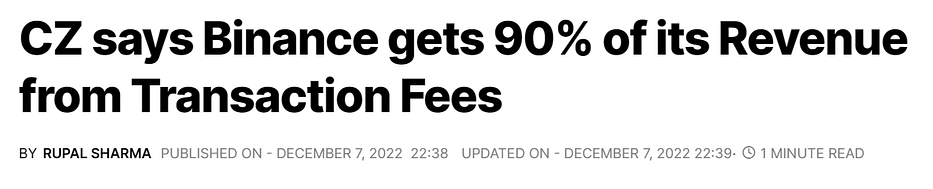
In a December 2022 video interview with TechCrunch, CZ stated that 90% of Binance’s revenue comes from trading fees. According to Bloomberg analysis, Binance earned approximately $20 billion in total revenue in 2022.
Where Does Traffic Come From?
First and foremost is asset appeal. By raising listing thresholds, Binance attracts high-traffic, trending assets. Projects listed on Binance typically expect at least 20x growth potential, generating massive instant traffic in spot trading.
Second, wallet and data platform deployments. These are widely recognized as traffic hubs in the blockchain market. Wallets help accumulate users with varying transaction values, while data platforms reach crypto enthusiasts.
Third, beyond adding popular spot assets and leveraging existing platform features, Binance also created alternative channels for assets not selected for listing—such as integrating payment products with project partners, enabling BNB-based asset swaps within embedded payment channels. This allows many assets to earn trading fees via BNB without requiring full exchange listings.
Additionally, KOLs are highly valued by Binance due to their massive reach. Generous policies and benefits for KOLs—including trading rebates, special perks, and attention from CZ himself—encourage them to promote Binance across their social platforms. Beyond early PR efforts, Binance now hosts only KOL gatherings during major conferences or industry events.
KOLs, content, wallets, and data platforms collectively lower barriers to understanding and using crypto products. Long-term, if Binance positions itself correctly at the user entry point, it becomes the global gateway to the crypto market.
Interestingly, Binance added live streaming and Feed functions within its app, addressing AMA and Twitter promotion demands. This move resembles Ant Forest emerging within Alipay—boosting user engagement and stickiness while serving as an internal traffic circulation channel.
The Academy and Research Institute handle foundational and advanced user education, converting even the least active users through content.
Where Does Traffic Go?
Binance successively captured spot trading, new token Launchpad, and derivatives trading, locking in mainstream traders. Simultaneously, it progressively launched compliant crypto and fiat exchanges globally, updated its product to over 40 languages, capturing transaction traffic worldwide.
With the rise of DeFi Lego, Binance didn’t miss out—promptly launching Dex, stablecoins, and lending services, complemented by financial offerings like exchange, payments, and wealth management, gradually penetrating deeper and more traditional transaction scenarios.
For large capital flows, Binance provides institutional solutions—offering block trading, asset management, lending, brokerage, OTC, and API services—facilitating market makers and institutional entries/exits, expanding trading into low-frequency, high-value scenarios.
Binance also didn’t miss NFT and GameFi trends, pioneering NFT trading sections within CEX, introducing blind box trading and IGOs, attracting active Web3 users and further expanding into the hot “everything-as-NFT” sector.
Binance’s trading map now spans over a dozen fields and more than thirty transaction scenarios—maximizing absorption of diverse user demands from various domains.
Capital Moves Stack Buffs, Amplifying FOMO
Traffic + Scenarios + Brand = Binance’s stable expansion framework. The best way to acquire traffic starts with projects: plant a seed, water it, let it bloom, harvest the fruit. In this financial game, using capital to strengthen branding acts as a multiplier for all business lines.
Reach broad markets via traffic assets/KOLs/brand → Global hackathons → Project integration onto BSC → MVP acceleration funds → Binance Labs investment/incubation → Import Binance ecosystem resources → LaunchPad (IEO)/NFT market (IGO) → Secondary circulation on CEX/Dex → Real-world crypto use cases
No matter where a project (team/developer) enters this pipeline, it gets stamped with the Binance label—granting access to the high-speed train of Binance’s brand power. Once this entire business logic is connected, Binance transforms into a mature “dream factory,” maximizing monetization from projects while unleashing capital’s full potential.
Binance Labs was formed shortly after Binance’s product launch. Investment and acquisitions have run through every stage of Binance’s growth. Comparing Launchpad data reveals clear insights into Binance’s market timing and investment strategy.
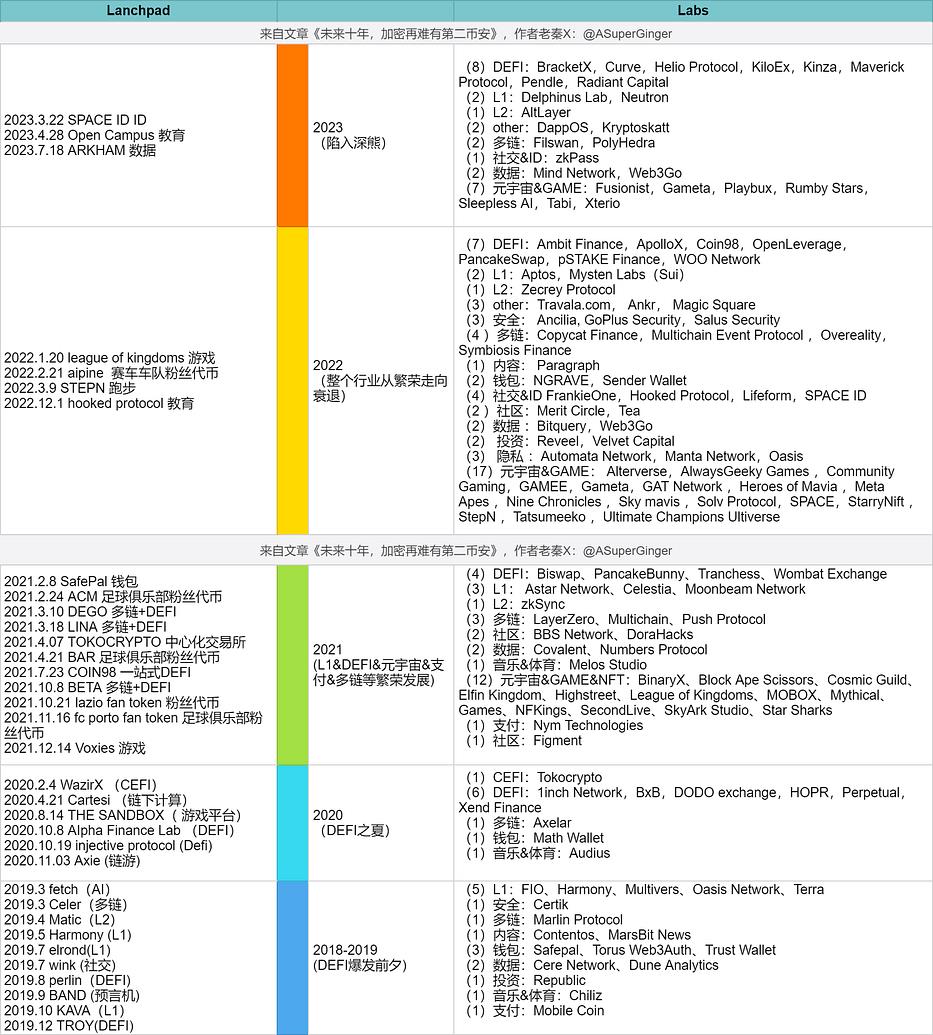
(All above data is publicly available; undisclosed investments excluded)
Judging solely from Binance’s past acquisition cases—from controversial purchases like CoinMarketCap, derivatives platform JEX, to Indian exchange WazirX—each step contributed to building a comprehensive crypto landscape. At the time, no single dominant player existed among top global exchanges. Each acquisition and newly opened traffic gateway gave Binance a strategic edge in global positioning, with each cycle’s breakout trends closely tied to investment directions and promotional campaigns.
Overall, Binance Labs primarily follows two strategies: one focused on strategic positioning within the industry ecosystem with high traffic potential; the other on expanding Binance’s own ecosystem with short-term traffic effects and cross-flow capabilities.
Industry Ecosystem Positioning
Binance Labs invests across numerous sectors and concepts, never limiting itself to familiar areas.
-
2018–2019
Binance Launchpad & Binance Labs accurately captured the L1 wave, launching well-known public chains like Harmony, KAVA, Terra, and Oasis Network—most of which thrived between 2020 and 2021.
-
DeFi Summer in 2020
Binance Labs invested in prominent DeFi projects like 1inch Network and DODO. Meanwhile, Binance Launchpad experimented with then-niche GameFi赛道, listing Axie and Sandbox—laying groundwork for the future Metaverse and GameFi boom.
-
Peak investment phase: 2021–2022
Numerous traffic-heavy projects in NFT and GameFi. However, apart from a few like StepN, none matched the 2019-level success. Possible reasons include massive Western capital inflows from firms like a16z, Paradigm, and Coinbase, gaining significant influence.
Expanding Binance’s Ecosystem
Binance Labs has heavily invested in platform-type projects—including crypto infrastructure, compliant exchanges in various countries, financial platforms, investment platforms, quant platforms—extending its market reach and demonstrating strength.
-
Around 2018
Its investments in infrastructure—like wallets Safepal and Trust Wallet—are deeply integrated with Binance.
-
2020–2021
With solid asset holdings and liquidity foundations, derivatives became battlegrounds for exchanges. Binance internally tested futures products while acquiring JEX, successfully entering the derivatives market. That year also saw deals like WazirX and Tokocrypto, expanding Binance’s footprint in India and Indonesia.
-
2022
Binance Labs invested in WOO Network, which provides liquidity via dark pool mechanisms (WOO Network leverages market maker Kronos Research and API integrations to internalize order flows from other exchanges, helping Binance manage liquidity effectively).
-
2023
Binance Labs-backed Open Campus, Hooked Protocol, CyberConnect pushed main projects onto BSC Chain, deepening integration with Binance’s ecosystem—sparking community speculation about利益 exchanges. Binance顺势 launched a low-barrier Web3 wallet integrated with 1inch, theoretically bridging Binance exchange users with DeFi users.
Binance Labs' extensive GameFi investments significantly boosted traffic and diversified Binance’s asset portfolio.
Thus, Binance’s ecosystem expansion proceeds horizontally and vertically: one axis strengthens Binance’s exchange advantages, broadening its capabilities and solidifying its crypto footprint; the other promotes potentially trending concepts—anticipating future markets, generating heat, establishing trends, delivering alpha returns, and feeding back into the entire ecosystem.
Over six years, Binance Labs’ investments differ from native crypto VCs due to Binance’s inherent platform nature. Rather than focusing purely on secondary market ROI, Binance prioritizes claiming strategic positions and generating traffic—making money first, then talking ideals. Admittedly, this seemingly “short-sighted” focus during expansion phases is a strategic choice.
Timing the Cycle: The Wheel of Fate Spins Rapidly
Combining blockchain industry cycles with Binance’s annual announcements and media reports, we’ve compiled Binance’s yearly progress timeline. We find that starting from trading and expanding into investment, infrastructure, ecosystem, branding, and philanthropy, Binance almost perfectly timed every suitable opportunity in the crypto cycle—steadily raising its moat year after year through deliberate business architecture.
2017–2018
Crypto Market Keywords: ICO, Stablecoins, Public Chains & DApps
-
The 2017 bull market was driven by ICO frenzy, spawning over 2,000 new projects globally; policies began tightening mid-2018.
-
Stablecoins, serving as value anchors, were booming.
-
Top 30 market cap cryptos saw highest growth in public chains, peaking in H2 2017.
-
DApps followed public chain hype but became hacker ATMs due to security flaws.
-
80% of Bitcoin and Ethereum hashpower was concentrated in China. Policy-driven hashpower migration in September 2018, combined with massive capital trapped in bubble projects, led to Ethereum forks and ETH price drops—dragging ETH-funded projects into death spirals, crashing the market to rock bottom.
Binance Keywords: Trading Traffic, BNB, Core Infrastructure
-
Binance offered only spot and futures. To grow users, it implemented two simple yet effective policies: new coin promotions and establishing BNB’s value.
-
Through zero fees, prize giveaways, rebates, project token rewards, trading competitions, ambassador programs, etc., Binance captured active crypto users. BNB began linking to exchange fee discounts, profit sharing, distribution rights, voting on listings, and participation in platform governance.
-
Foundational businesses launched—Labs, Binance Chain, Launchpad, DEX, Charity, Academy, Research, Trust Wallet (acquired), Uganda—played pivotal roles in later traffic acquisition and brand value creation.
2019
Crypto Market Keywords: Institutional Entry, DeFi Year Zero
-
IEO, led by Binance, drove first-half momentum, but Ethereum-based ICO bubbles continued bursting; Bitcoin’s “halo effect” dominated up to 70% market share.
-
Native crypto VCs suffered mass collapses; over half of the top ten active crypto funds were based in the US.
-
Traditional institutions like Grayscale and Fidelity attracted over $20 billion in risk capital.
-
Huobi Global, OKEx, Binance, Coinbase, and BitMEX occupied top spots.
-
Spot market liquidity dried up; blockchain applications shifted toward DeFi. Financial services (settlement/clearing, cross-border payments, insurance, securities) matured. DeFi’s three pillars (stablecoins, lending, DEXs) gradually scaled amid regulatory battles.
Binance Keywords: IEO, Derivatives, BSC, Compliance
-
After minimal activity post-2017 launch, Launchpad relaunched in 2019 with BTT, reigniting market momentum.
-
Only 33 tokens listed in 2019. Due to weak spot liquidity, Binance introduced futures trading and expanded into lending, futures, and wealth management to boost user deposit/withdrawal frequency.
-
Binance Chain and Binance DEX launched. DEX listed 121 trading pairs; 165 BEP2 tokens issued on Binance Chain.
-
BNB expanded to 180+ global use cases.
-
Binance incubator nurtured 21 blockchain projects, directly investing in 14.
-
Launched compliant stablecoin BUSD in September—a USD-pegged coin developed with Paxos and approved by NYDFS.
-
Established five global fiat platforms covering 170+ countries, supporting 300+ payment methods.
2020
Crypto Market Keywords: Bitcoin Value Recovery, Ethereum as King of Chains, Polkadot/NFT Rise
-
Total crypto market cap rose ~400% YoY in 2020. Institutions like Grayscale Trust increased Bitcoin holdings. Bitcoin reached up to 69% market dominance.
-
DeFi protocol TVL was 23x higher than 2019. DEXs, lending, stablecoins, aggregators fueled the “Crypto Lego” party.
-
Layer 2 scaling solutions emerged; Eth2 Beacon Chain launched. DeFi prosperity turned Ethereum into an app chain.
-
Polkadot, NEAR, Cosmos, Solana, Avalanche, BSC, OKExChain entered DeFi.
-
Starting September, NFT sales volume surged—mainly in gaming, virtual worlds, and crypto art collectibles. OpenSea led among exchanges.
Binance Keywords: DeFi, Smart Chain (BSC), Integrated Services
-
Binance’s total trading volume exceeded $3 trillion; listed 184 coins.
-
BSC deployment accelerated; $100 million seed fund launched. BNB evolved from a centralized exchange token to support decentralized services. BNB market cap reached $5.3 billion, with 27 new applications/platforms adopting BNB.
-
Futures, options, and spot margin trading volume exceeded $1.7 trillion. Fiat order volume surpassed $31.9 billion. P2P order volume exceeded $6 billion. OTC commodities trading volume reached $700 million.
-
BUSD ranked fourth in global stablecoin market. Trust Wallet surpassed 5 million users. Binance Pool ranked third globally in network hashpower.
-
Binance Launchpad conducted six token sales, raising $14.72 million. New coin mining program Launchpool provided 22 liquidity pools for eight projects, achieving $900 million in TVL.
2021
Crypto Market Keywords: Mining Migration, Meme Coins, NFTs, Regulatory Tightening, Institutional Shake-Up
-
Total crypto market cap briefly hit $3 trillion. Booming primary market; mainstream capital entering.
-
Bitcoin peaked at $64,000/unit. China’s harsh crackdown on Bitcoin mining caused BTC price to drop 50%. The mining industry experienced unprecedented migration.
-
Top meme coins entered crypto Top 10. NBA Top Shot, Beeple, CryptoPunks, BAYC-class blue-chip NFTs flooded the market.
-
NFT market and infrastructure exploded. New public chain ecosystems rose. GameFi and DeFi continued evolving. Leaders emerged in Metaverse, DAO, and other sectors.
-
U.S. SEC approved Bitcoin futures ETF. Bitcoin became legal tender in El Salvador. Coinbase and other compliant crypto firms went public. NFTs kept breaking into traditional fields. Chinese institutions gradually lost dominance in crypto.
Binance Keywords: BSC, NFT, Investment
-
DeFi summer presented Binance the opportunity to push BSC adoption. Active Ethereum projects gradually joined BSC.
-
Within a year of mainnet launch, BSC’s daily transactions once outnumbered Ethereum by nearly 7x.
-
Official NFT marketplace launched. Over 2.5 million NFTs minted on Binance in 2021—including over 1 million blind boxes spanning art, sports, entertainment, fashion, virtual land, plus over 1 million gaming NFTs from 60+ partnered games.
-
After Steam delisted blockchain games, Binance launched IGO, achieving $188 million in total trading volume.
-
Binance Labs invested in Layer 1, DeFi, payments, multi-chain sectors—with Metaverse, GameFi, and NFTs as primary targets.
2022
Crypto Market Keywords: Fed Rate Hikes, Hacker Attacks, Ethereum Upgrade, New Public Chains, Hong Kong Opening
-
January: StepN peaked in market cap before collapsing into a death spiral.
-
Largest-ever hacking incidents: Ronin Bridge, Horizon Bridge, Nomad Bridge—all lost $3.8 billion combined.
-
Luna and Terra collapse triggered liquidity crises for multiple lending institutions. Three Arrows Capital liquidated. Celsius, Genesis severely impacted.
-
FTX collapse caused severe liquidity crises for platforms like Grayscale, DCG, Amber Group.
-
Ethereum transitioned from PoW to PoS. New public chains like Aleo and Aptos became market narratives.
-
Binance launched soulbound tokens. Web2 giants like Starbucks and Nike explored Web3. Hong Kong announced embrace of virtual assets.
Binance Keywords: GameFi, RWA, Investment
-
NFT segment became more community-focused, diving into GameFi, supporting IGO. Minted and listed 2.6 million NFTs, forming top-tier collaborations with celebrities in sports, music, and entertainment.
-
Beyond continued livestreaming activity, Binance launched Feed in 2022—providing a platform for over
Join TechFlow official community to stay tuned
Telegram:https://t.me/TechFlowDaily
X (Twitter):https://x.com/TechFlowPost
X (Twitter) EN:https://x.com/BlockFlow_News
 @ASuperGinger









