









What’s Behind the High Revenue of RUNE and CACAO, Now in the Spotlight?
TechFlow Selected TechFlow Selected
What’s Behind the High Revenue of RUNE and CACAO, Now in the Spotlight?
Mostly from fees paid by customers, partially from the appreciation of RUNE and CACAO.
 Navigating Web3 tides with focused insights
Author: Joel Valenzuela
Translation: TechFlow
"Where does the yield come from?"
Bitcoin maximalists often pose this question to DeFi, especially when confronted with the crazy high yields on THORChain and Maya Protocol.
There is indeed an answer to this question—let's examine where the yield originates.

Generally speaking, yield comes from organic sources. Otherwise, you are the yield.
I previously discussed potential yield sources in depth in this article, but here I'll focus specifically on THORChain and Maya, as they've recently gained significant attention.
Let’s start with Maya, as it’s actually simpler.
Maya’s yield comes 100% from transaction fees. People pay to swap assets, and liquidity providers receive 80% of those fees. $MAYA holders get 10%, and another 10% goes to the impermanent loss fund (to protect LPs against negative volatility).
THORChain, like most crypto projects, has token emissions (inflation).
According to last week’s statistics, slightly over 40% of revenue came from transaction fees. The remainder consists of block rewards from newly issued tokens—for now. Both nodes and LPs receive these fees and newly minted tokens.
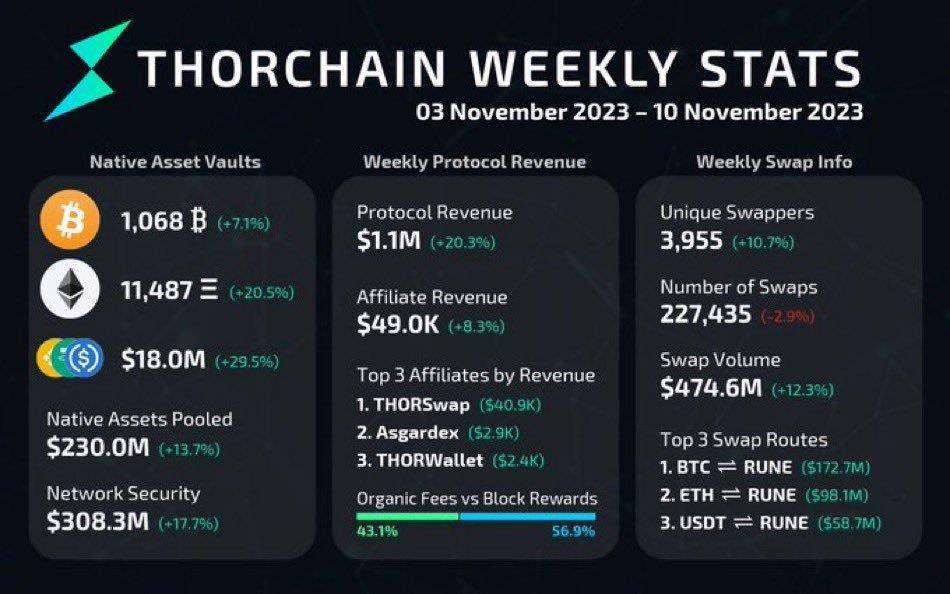
More specifically, in both networks, when a transaction occurs, the transaction fee (or in THORChain’s case, transaction fee + issuance) flows into the pool. The value within the pool increases. Assets remain balanced at a 50/50 ratio between external tokens (like BTC) and native tokens (RUNE/CACAO).
But why are the yields so high?
Two reasons: fee income and token appreciation.
Most of it comes from fees paid by users. Part also comes from the appreciation of RUNE and CACAO.
If you have 50% BTC and 50% RUNE, and RUNE surges in price, your liquidity position earns a substantial annualized return.
The currently high yields still stem largely from Savers, which allows you to earn yield on assets without exposure to RUNE.
This means you only capture upside gains, while liquidity providers take on volatility risk—and the extra rewards.
To reiterate: Yield comes from fees paid by satisfied customers. If you provide liquidity, you earn yield—but if RUNE’s price crashes, you might lose money. However, if you opt for Savers, you won’t lose money. You only gain.
Before Bitcoin purists come knocking, remember that the same “where does the yield come from?” question can be asked of Bitcoin itself.
Bitcoin holders profit only when others buy Bitcoin and push the price up—just like RUNE’s price appreciation, except RUNE has stronger utility. Alternatively, you can earn yield by running a Lightning Network routing node, though the yields there are quite low.
“But wasn’t THORChain hacked?!”
Yes. But that was before mainnet launch. It has since proven highly stable and secure—though nothing is ever 100% immune.
Bitcoin too has had critical vulnerabilities, inflation bugs—you name it. Given enough time, Bitcoin became extremely robust. THORChain will too. It’s still young, and so far, its performance has been impressive.
Join TechFlow official community to stay tuned
Telegram:https://t.me/TechFlowDaily
X (Twitter):https://x.com/TechFlowPost
X (Twitter) EN:https://x.com/BlockFlow_News
 @TheDesertLynx







