








Nomos: The Evolutionary Code from Metaverse to Autonomous Worlds
TechFlow Selected TechFlow Selected
Nomos: The Evolutionary Code from Metaverse to Autonomous Worlds
When Nomos breaks, we tell stories to mend it. When Nomos shatters beyond repair, we tell new stories.
 Navigating Web3 tides with focused insights
Author: Jingyi
With the resurgence of the Lootverse ecosystem, the concept of Autonomous Worlds (AW) is increasingly entering the public eye, especially with the support of MUD. On one hand, skeptics may dismiss it as just another rebranding of the metaverse; on the other hand, we observe a remarkably strong drive and vitality within native AW communities, while many others remain观望. This article explores the cultural roots of AW from the perspective of human societal development and explains why we believe AW represents an inevitable evolutionary direction for the metaverse.
The Metaverse: Still at the Frontier?
Back in 2021, the metaverse captured the imagination of the entire world.
At that time, trapped in a physical world ravaged by the pandemic, the metaverse promised salvation through enhanced virtual reality technologies and hardware—offering a breath of fresh air and transporting us into a bright, futuristic digital realm. McKinsey estimated its value could reach $5 trillion by 2030. Facebook even rebranded itself as Meta and changed its stock ticker from FB to META. In his founder’s letter on October 28, 2021, CEO Mark Zuckerberg defined the metaverse as:
“An embodied internet where you’re not just viewing content—you’re in it. We call this the metaverse, and it will touch every product we build.”
He isolated “presence” as the defining feature of the metaverse. Within it, people would connect with each other through their digital avatars. He envisioned a future where physical things—televisions, offices, games—would be replaced by holograms. Humans would no longer be constrained by physical space. With pride, he declared:
“From now on, our company will focus on being metaverse-first, not Facebook-first.”
Fast forward two years, however, and the development of the metaverse appears to have stalled, along with investor interest and capital flows.
As the COVID-19 pandemic receded, people returned to real life—dining out, commuting back to bustling offices, sweating on sports fields, traveling for client meetings, and enduring rush-hour traffic. The memory of lockdowns gradually faded. While Zoom meetings persist, Wall Street bankers still prefer lunch meetings over interacting with virtual avatars on screens.
So, are humans destined to remain bound by physical existence? Social media suggests otherwise.
Most young people register on Facebook, Twitter, and Instagram, spending vast amounts of time and attention online—making friends, live streaming, watching videos, even forming social relationships. While Decentraland has only about 38 daily active users, platforms like Roblox, Minecraft, and Fortnite are teeming with youth and vibrant communities.
Then why not the metaverse?
Because only culture can reinforce collective behavior. Consensus forms the foundation of culture, and beyond spatial infrastructure, holography, and digital avatars, the metaverse requires much more to generate such consensus.
Nomos, Narrative, and Community
Sociologists have long studied the complexities of how humans build communities.
Communities are social constructs, contrasting with the forces and order found in nature. Natural phenomena like fire, wind, and thunderstorms reveal a reality governed by inherent laws and patterns. In contrast, human communities represent a different kind of social reality—one that must be meaningfully structured.
Social reality must be meaningful—it must organize and interpret our experiences to structure relationships and interactions within the community. This process is called "Nomos," a cognitive and organizational framework for social reality. Through Nomos, people establish social norms, cultural values, and interpersonal bonds, shaping the structure and behavior of communities.
The concept of Nomos was introduced by sociologist Peter Berger, best known for his groundbreaking 1960s work in the sociology of religion, *The Sacred Canopy*:
“If the thesis that the socially constructed world is first of all an ordering of experience now seems more intelligible, it should be easier to understand the idea that a meaningful order is imposed upon the discrete experiences and meanings of the individual—that is, a Nomos. To say that society is a human enterprise that creates a world is practically equivalent to saying that it is an ordering or Nomos-making activity.”
To build a world is to create a Nomos. Spatial infrastructure, avatars, and beautiful visuals alone are insufficient to form a Nomos. The metaverse is merely a space—it does not constitute a world. The problem isn’t lack of desire to interact, but the absence of underlying order and rules—without a social anchor, without Nomos, people won’t stay.
In the dawn of human history, ancient peoples constructed their Nomos based on their understanding of nature—the cosmos. In other words, Nomos was derived from cosmic order, perceived as a legitimate part of natural order within society.
Nomos and cosmos appear complementary. Ancient societies were seen as microcosms reflecting the universe, embodying intrinsic meaning. Though this micro-macro pattern typified primitive and ancient societies, it has transformed across major civilizations.
It's no surprise that Nomos in ancient civilizations often had religious character. From Egypt and Mesopotamia to China, priestly cultures dominated. Even in modern times, when religion is no longer central to human activity, Nomos retains religious aspects.
They repeatedly restore continuity between the present moment and social traditions, situating individual experiences and group identities within a historical context larger than themselves—real or imagined.
People go to war for them, and place their lives within rivers of prayer, blessing, and incantation.
Thus, to build a world where people interact, space alone is not enough—time is essential. This time is not merely natural cosmic time, but social time: the community’s history and traditions—our calendars, festivals, customs. Without these temporal elements, social life becomes meaningless, even if physically present, because mere existence cannot confer meaning.
The secret to creating social time lies in narrative. In his seminal essay “Nomos and Narrative,” the late Harvard Law scholar Robert Cover observed:
“The codes that relate our normative system to our social constructions of reality and to our visions of what the world might be are narrative.”
Thus, it’s no coincidence that ancient religions are built on narratives. They are stories connecting mythic imagination with human conduct, generating divine timelines that provide foundational myths and origin stories. Ancient histories, when traced to their origins, always evolve into myth.
Without narrative, there is no complete Nomos. This is the key distinction: the metaverse is an eternal space, while Autonomous Worlds are worlds fully embedded with narrative and Nomos.
Robert Cover further elaborated on the educational and sustaining functions of Nomos. Education arises from the community’s foundational narratives (or myths), such as Moses receiving divine law. As communities grow and change, Nomos faces pressure and challenges. For example, the Israelites were defeated when their temple was destroyed by foreign powers like Babylon and Rome. These events shook the Nomos, requiring new narratives to sustain it.
As human history unfolded, modern science eventually supplanted religion—not due to philosophical doubts about gods, but because it revealed religious texts like the Bible were not divine. These were not infallible words inscribed by God or gods on stone, but human stories. We entered modernity—a technological civilization, and also an age of massification.
Massification means the liberation of certain social and cultural domains from religious and totemic domination.
Religion no longer dominates human activity. At no point in human history have relations between deities and humans been so minimal. Modernity triumphed, yet the West’s Nomos suffered a spiritual crisis.
We are the hollow men
We are the stuffed men
Leaning together
Headpiece filled with straw. Alas!
Our dried voices, when
We whisper together
Are quiet and meaningless
As wind in dry grass
Or rats’ feet over broken glass
In our dry cellar
— T.S. Eliot, “The Hollow Men”
This sentiment is echoed in Edvard Munch’s famous painting *The Scream*. Ironically, the scream remains forever silent—because it exists on canvas.
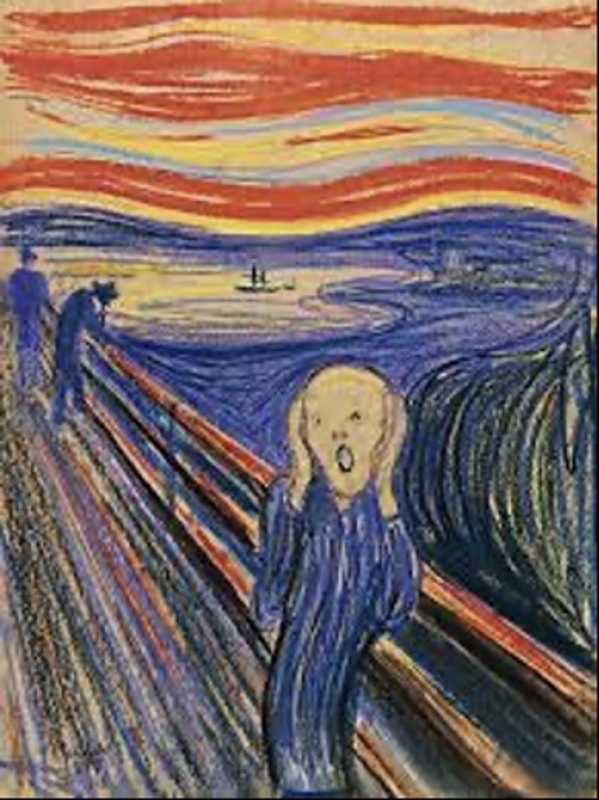
Were we always hollow, or did we become hollow? When Nomos fractures, we tell stories to repair it. When Nomos breaks beyond repair, we tell new stories.
Autonomous Worlds: Reshaping Narrative
Modern society cannot exist without popular culture. From pop music to Hollywood films, popular culture continuously experiments with new forms of comfort akin to religion, testing new Nomoi. Events like the 1969 Woodstock Festival and the annual Oscars echo the special rituals of ancient and medieval carnivals. The fame of Hollywood celebrities and rock stars parallels the gods of Greek mythology—modern “deities” that fascinate and alienate audiences alike, while media outlets greedily feed the public endless stories tailored to consumer tastes.
Our earliest myths were products of collaborative creation. Even works attributed to a single author typically drew from earlier or contemporary oral traditions. *The Epic of Gilgamesh*, *The Iliad*, *The Odyssey*, *Beowulf*, and *The Nibelungenlied* all share this characteristic. In a sense, the singular author was less a sole artist in the modern sense and more a single compiler of stories. Who can say Homer didn’t use earlier tales in his epics?
This is even more evident with religious texts. The Bible and Vedic scriptures were almost certainly written by multiple authors over long periods. The earliest “original” ring legend was *The Nibelungenlied*, a Middle High German poem composed around 1200 AD. German composer Richard Wagner drew from an old Norse variant of the same myth, reworking it into the operatic masterpiece *Der Ring des Nibelungen*. The plot centers on a magical ring that controls the world. The composition took 26 years, from 1848 to 1874. Decades later, a British author retold another ring legend, heavily borrowing from Old English poetry in the Exeter Book to forge a new mythology. He told stories of heroes, hobbits, elves, and the magic ring that ruled them. His name was J.R.R. Tolkien.
It’s no accident that the most popular online and on-chain games share deep thematic roots in our traditions. The emergence of decentralized technology has broken down technical barriers, effectively lowering the cost of sustaining mythologies. When deployed in Web3 environments, Autonomous Worlds are born.
As discussed earlier, “collaborative storytelling” is the origin of myth and represents a more natural state of narrative evolution. Before recorded history, narrators remained hidden behind stories, which grew and evolved at immeasurable speeds with each telling. In this dynamic historical recreation, fixed plotlines eventually formed tribal story systems. This was a permissionless primordial world—everyone could participate, and stories could merge freely.
Timshel described Loot in a tweet as a “massively multiplayer worldbuilding experiment”—a form of collective narrative experimentation. A key element in collective storytelling is the “narrative device.”
Creating an NFT largely involves crafting a “narrative device.” Some have said Loot is like a “perfect writing prompt,” offering a minimalist starting point with its eight categories and five eras. Most convey a tone of “secular yet carefree.” In contrast, text-based NFTs offer even less explicit statement, leaving more room for interpretation. When building narrative devices, rich media isn't necessarily more effective—it may convey stronger messages, but not necessarily be more inspiring. Just as the concept of oral “formulas” revolutionized Homeric studies (Milman Parry), Lootverse may develop its own unique narrative “formulas” as structural supports for future storytelling.
This could have been a fascinating modern (retro) epic, but from the start, the script didn’t follow the original plan. Before resolving internal narrative issues, the real-world Lootverse was fully launched into speculative markets. In the market, story elements first became targets of speculation, then components of scenes within the story world. The “core story” gained corresponding asset value.
At its core, Autonomous Worlds carry an open content layer, building their own narratives and Nomos. Their content autonomy allows them to function normally even after all developers depart. Game companies no longer control virtual items, characters, progress, players’ digital assets, or—most importantly—the foundational narrative of the game. Games possess complex internal logic and governance rules, making them closer to fully constructed Nomoi than traditional entertainment forms like films or pop music. Games often encompass a complete mythology, spawning countless stories, much like the *Star Wars* universe.
Decentralized technology has overcome obstacles in tracking stories, tracing myths, and modifying rules. Thus, it enables not only collaborative creation in narrative but also in maintaining Nomos. Stakeholders can retell stories or create new ones. They can expand existing myths or invent entirely new Nomoi. They no longer need to overcome traditional technical, legal, financial, and commercial barriers to build their own myths. Technology pushes cultural opportunity to its limits.
The greater the interactivity, the deeper player engagement, the more memorable the story becomes, and the more significant it grows. In interactivity, games surpass IP-style NFTs, which in turn surpass pure textual descriptions. Bibliotheca DAO initially viewed fully on-chain games as “games that never end”—evident in the naming of “Eternum,” where games without “wipe” possibilities carry profound narrative seriousness. Entire game development is open to community co-creation. Web3MQ, as an application chain and L3 infrastructure provider, has also built the communication module within the Eternum world. In such a community with a new Nomos, developers do more than fulfill tool-building roles—they design products grounded in cultural and community understanding.
“Moving Castles” deeply explores the relationship between content creators and consumers, and the roles of authors and community stakeholders. They are conducting innovative experiments using participatory streaming formats, aiming to create a “perpetually open text.” Unlike previous “clear, finished information,” this text is open to everyone—anyone can interpret it, add to it, remove from it, and build new narratives atop the old.
We can understand the game’s content layer as an Autonomous World: a perpetually open game is not really a game, but a perpetually open text. Imagine an online document titled “Contemporary History,” evolving from highly restricted editing rights (grand history) to full open access, transcribing itself into films in real time—where everyone is an actor. We can view the term “fully on-chain game” as a descriptor for this future scenario, one that achieves the highest possible consensus.
Developments in the Web3 space have transformed cultural creation and sharing. AW and decentralized technology are changing how we build and maintain Nomos. They offer greater space for collaborative creation and lower the threshold for sustaining myth. Yet they also bring new challenges—how to address threats and abuse, and how to ensure inclusive and equitable cultural opportunities.
In the Web3 era, we may witness vibrant communities and more collaborative creation—beyond a fragile, uncertain physical world, a new cultural form is growing.
Join TechFlow official community to stay tuned
Telegram:https://t.me/TechFlowDaily
X (Twitter):https://x.com/TechFlowPost
X (Twitter) EN:https://x.com/BlockFlow_News
 @SulaXyz









